Anja Dodevska

Laser tattoo removal aftercare instructions template
Download your free laser tattoo removal aftercare instructions template A ready-...

29
Last Updated: Sep 4, 2026
Free PDF 3 pages, print-ready Clinician-reviewed
The Enlighten laser is Cutera's picosecond and nanosecond system for tattoo removal, benign pigmented lesions and acne scars. Before the first session, every patient needs a signed consent form that records the risks, the alternatives and their screening answers.
This free Enlighten laser consent form covers those on three printable pages. It pairs a full risk disclaimer with yes/no questions on pregnancy, infection, allergies and medications, plus space for history and goals. The guide also covers what the form leaves to you: matching skin type to wavelength, aftercare sheets and session records.
A three-page Enlighten laser consent and screening form. It holds the full risk disclaimer, consent and photography statements, eight yes/no screening questions, history boxes and signature lines.
Start from scratch, or upload this PDF or any form you already use, and Pabau's AI Form rebuilds it with tick boxes, text fields and a signature. Attach it to the treatment once, and every patient gets it on time.
AI Form rebuilds the consent, history and aftercare forms you already use. You review each one, then publish.
Patients complete forms on their phone before they arrive, so the front desk stops retyping paper.
Every signed form is versioned and attached to the treatment record, ready when you need it.
Set how long a consent stays valid. Returning patients skip forms they have already signed.
Supports HIPAA and GDPR compliance AES-256 encryption 4.8 on G2 4.7 on Capterra Trusted by 4,000+ practices worldwide

Enlighten III is Cutera’s picosecond and nanosecond laser, firing at 532, 670 and 1064 nm with two pulse durations.
The free download is a three-page consent and screening form, not an aftercare sheet or a treatment record.
Each wavelength is cleared for its own Fitzpatrick range, so screen skin type against the wavelength you plan to use.
Record wavelength, pulse duration, spot size and fluence at every session instead of copying the last entry.
Pabau keeps the signed form, screening answers and session settings on one patient record.
An Enlighten laser consent form shows that the patient understood the treatment, its risks and its alternatives before the first session. Enlighten III is a picosecond and nanosecond system cleared for tattoo removal, benign pigmented lesions and acne scars, as Cutera’s enlighten product page sets out.
Our free download covers the consent and screening part of that paperwork. The form has to name the treatment area, the planned sessions and the risks that come with each indication.
It holds the full disclaimer, eight yes/no screening questions and five free-text boxes, then closes with patient and practitioner signatures. A complete consent record for Enlighten carries these details:
The download leaves the Fitzpatrick type and the aftercare acknowledgment to your own records, so add both if your protocol wants them on the form. Keep the risk section specific, too. Wording such as “minor side effects” undersells what patients can experience, and it weakens the document if a complaint is raised later.
If you treat tattoos on more than one device, our laser tattoo removal consent template is written for tattoo work in general.
Screening happens before the consent is signed, not after. Work through the checklist below, decide whether treatment can go ahead, and record each answer in the patient file.
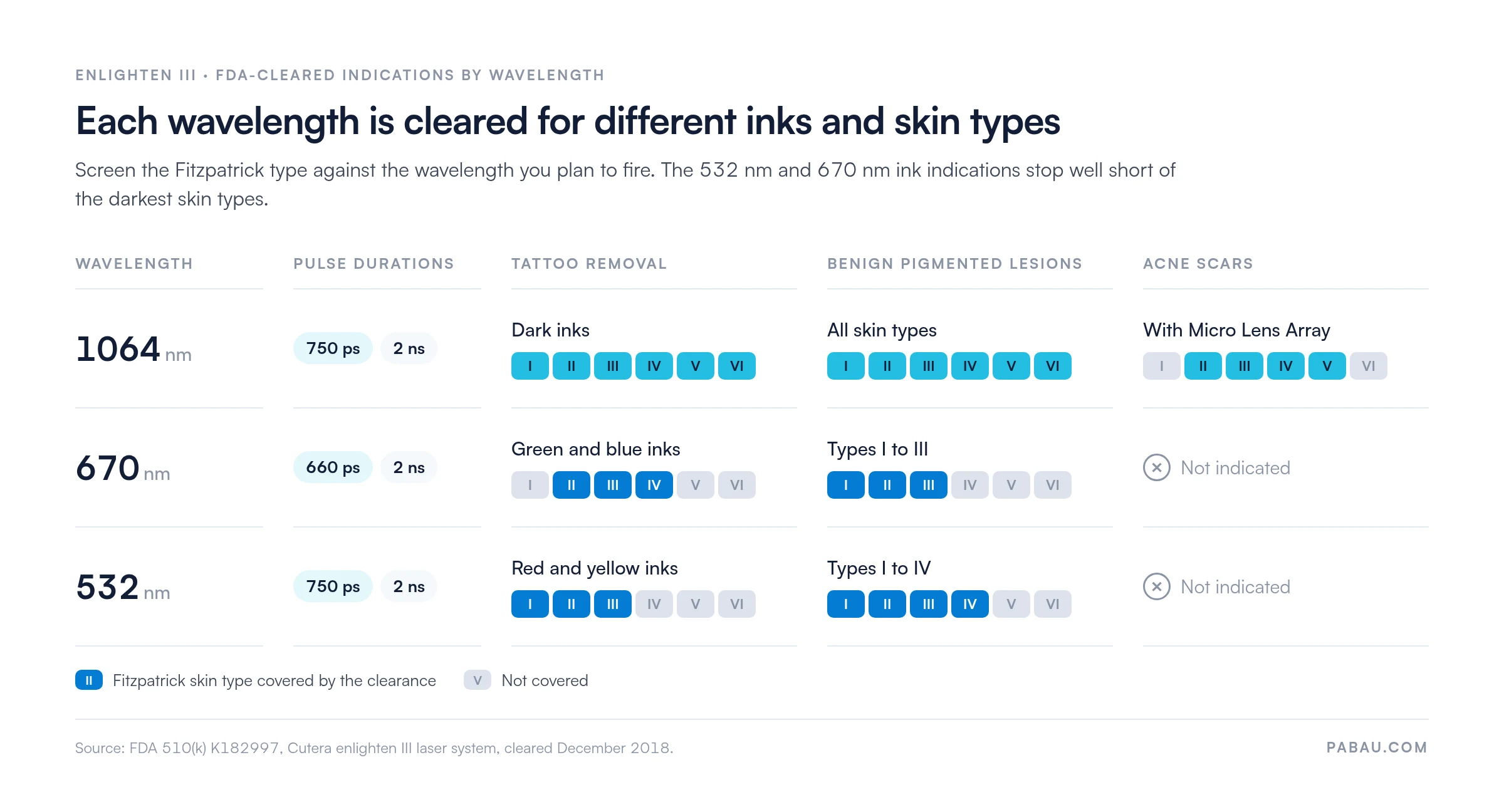
That last check is narrower than most consent templates suggest. Under Cutera’s FDA 510(k) clearance, 1064 nm covers dark inks and pigmented lesions in all six Fitzpatrick types.
The 532 nm wavelength is cleared for red and yellow inks in types I to III only. The 670 nm wavelength covers green and blue inks in types II to IV. The chart below sets out the full clearance by wavelength.
Skin-type limits and setting restrictions are also set out in Cutera’s product documentation. Check the current version before you finalize the protocol, because a template cannot replace the manufacturer’s guidance.
Relative contraindications are not automatic exclusions. When you choose to treat anyway, record the clinical reasoning alongside the decision.
The download does not include an aftercare sheet, so write one in plain language with a timeline. Patients most often misread what is normal after treatment. Give them one clear route for questions, so they do not rely on search results.
Sending the sheet at the end of the appointment works best. Automated aftercare reminders deliver the same version to every patient, whoever is on shift. For tattoo patients, our laser tattoo removal aftercare template is a ready starting point.
A treatment record shows what was done, at which settings, and how the skin responded. It is usually the first document you check when a patient returns with a concern.
Record the device settings from each visit rather than copying the previous entry, because settings change with the target and the skin’s response. According to Cutera’s specifications, Enlighten III offers three wavelengths and two pulse durations: 2 ns and 660 or 750 ps. Record both the wavelength and the pulse duration for every pass.
Set a standard record template before the first session, then review it at each visit so no field gets skipped under time pressure. A short checklist at the start of each appointment stops fluence and spot size from going unrecorded.
Pabau, the practice platform we build, stores these entries through its medical records management tools. The treatment history is then searchable at the next visit.
The download is a single consent and screening form: a disclaimer, consent confirmations, medical screening questions and free-text boxes. Read it against your own protocol, then check the field labels and wording against your practice policy before you roll it out to the team.
Consistency matters most when several practitioners treat the same patient. An entry written from memory a week later is the one an inspector or a complaints panel will question.
The FDA clears medical devices for specific indications. Cutera’s clearance for enlighten III covers tattoo removal and benign pigmented lesions, plus acne scars when the Micro Lens Array attachment is used. Check the current labeling before you describe the device to patients, because the cleared scope is narrower than some marketing claims.
In the UK, the MHRA oversees medical devices. The CQC regulates registered services in England, while Healthcare Improvement Scotland inspects Scottish practices, so confirm which body applies to your location.
Paper consent forms tend to live in one folder, screening answers in another and session settings in a notebook by the laser. When a patient returns with a pigment change, someone has to pull all three together by hand.
Pabau’s laser clinic software attaches the consent form and screening questions to the booking, so patients complete them before they arrive. The signed form, the answers and each session’s settings then sit on one patient record. Practices offering a wider aesthetic menu get the same setup through our medical spa software.

Pabau links consent forms, contraindication screening and treatment records to each patient, so your team works from one record.

The download handles the signatures and the screening questions. The decisions that protect the patient sit around it. Match the Fitzpatrick type to the wavelength, write an aftercare sheet with a timeline, and log settings at every pass.
Put those three habits in place before the first Enlighten patient, not after the first complaint. A consent form signed without them records agreement, but it does not show that the treatment suited the skin. Book a demo to see how Pabau keeps consent, screening and session settings on one patient record.

Running resurfacing alongside Enlighten? CO2 laser aftercare instructions covers recovery steps after ablative treatment.
Offering hair removal too? Laser hair removal informed consent is a ready consent form for that service.
Choosing software for a laser practice? Best software for laser hair removal studios compares the platforms laser practices use for booking and records.
The Enlighten laser is a Cutera system that delivers both picosecond and nanosecond pulses, used for tattoo removal and skin treatments. Its FDA clearance covers tattoo removal, benign pigmented lesions and acne scars, so check the current labeling before describing it to patients.
Enlighten is Cutera’s laser family, and Enlighten III is its model with three wavelengths: 532 nm, 670 nm and 1064 nm. It offers dual pulse durations, 2 ns and 660 or 750 ps, according to Cutera’s product specifications. Confirm the model your practice owns before you finalize settings in your protocol.
Aftercare usually includes wound care, sun protection and avoiding picking at scabs, with a clear route for questions. The exact timeline depends on the treatment settings and your practitioner’s protocol.
Yes, a signed consent form should be completed before treatment, covering risks, contraindications and aftercare. Templates are a starting point, so adapt them to your local regulatory and medico-legal requirements.