Exilis patient treatment record: Free PDF for RF sessions
An Exilis patient treatment record is the session log for BTL’s radiofrequ...

1
Last Updated: Oct 23, 2026

Excel V is a dual-wavelength laser from Cutera that treats vascular and pigmented lesions with little downtime.
The 532 nm KTP wavelength targets hemoglobin and melanin in superficial lesions such as rosacea and lentigines.
The 1064 nm Nd:YAG wavelength reaches deeper vessels and carries less risk on Fitzpatrick IV to VI skin.
Record the wavelength you chose and the reason for it, because that one field guides every follow-up session.
Pabau, practice management software for aesthetic practices, keeps each session’s record beside the patient’s photos and package balance.
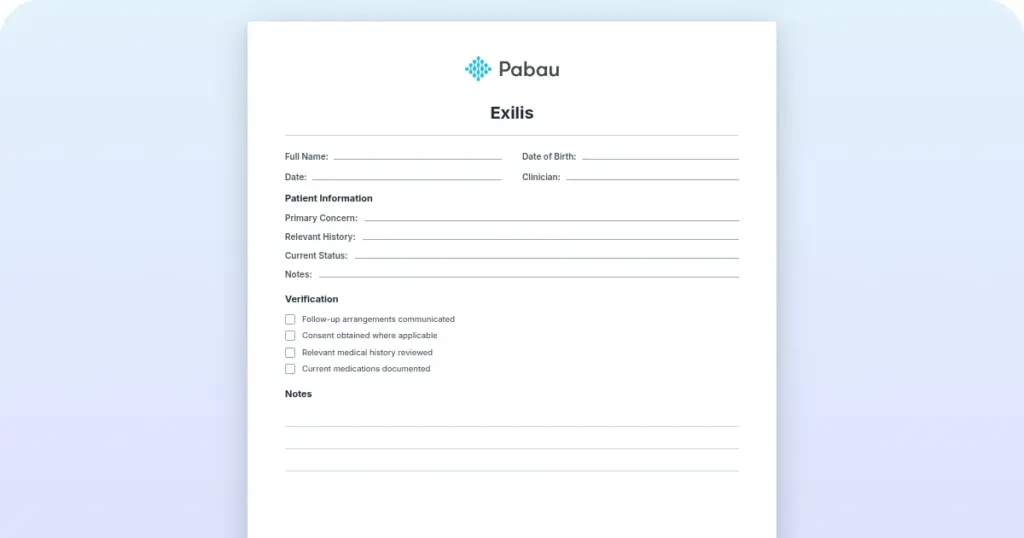
The form covers patient and skin-type details, wavelength and fluence fields, pre-care checks, contraindication screening, and consent declarations. It closes with an outcome log and a printable aftercare sheet for the patient.
Download templateThe Excel V is a dual-wavelength vascular and pigmentation laser made by Cutera. It pairs a 532 nm KTP beam with a 1064 nm Nd:YAG beam in one platform. That combination covers port wine stains, rosacea, age spots and spider veins. It also means every session involves a choice the record has to capture.
A laser record does more work than a routine treatment note. It carries the informed consent trail, the parameters you used, and the response you observed. Miss one of those and the next practitioner is guessing. So is your insurer if a complication is ever disputed.
A generic treatment form has one field for the device. A dual-wavelength platform needs more than that. The template below asks for the wavelength, the fluence, the spot size and the clinical reason you picked them. Practices running several devices usually keep that detail in laser clinic software, where it stays searchable across sessions.
The wavelength choice is the foundation of every Excel V protocol. It follows from the depth of the lesion and the patient’s skin type.
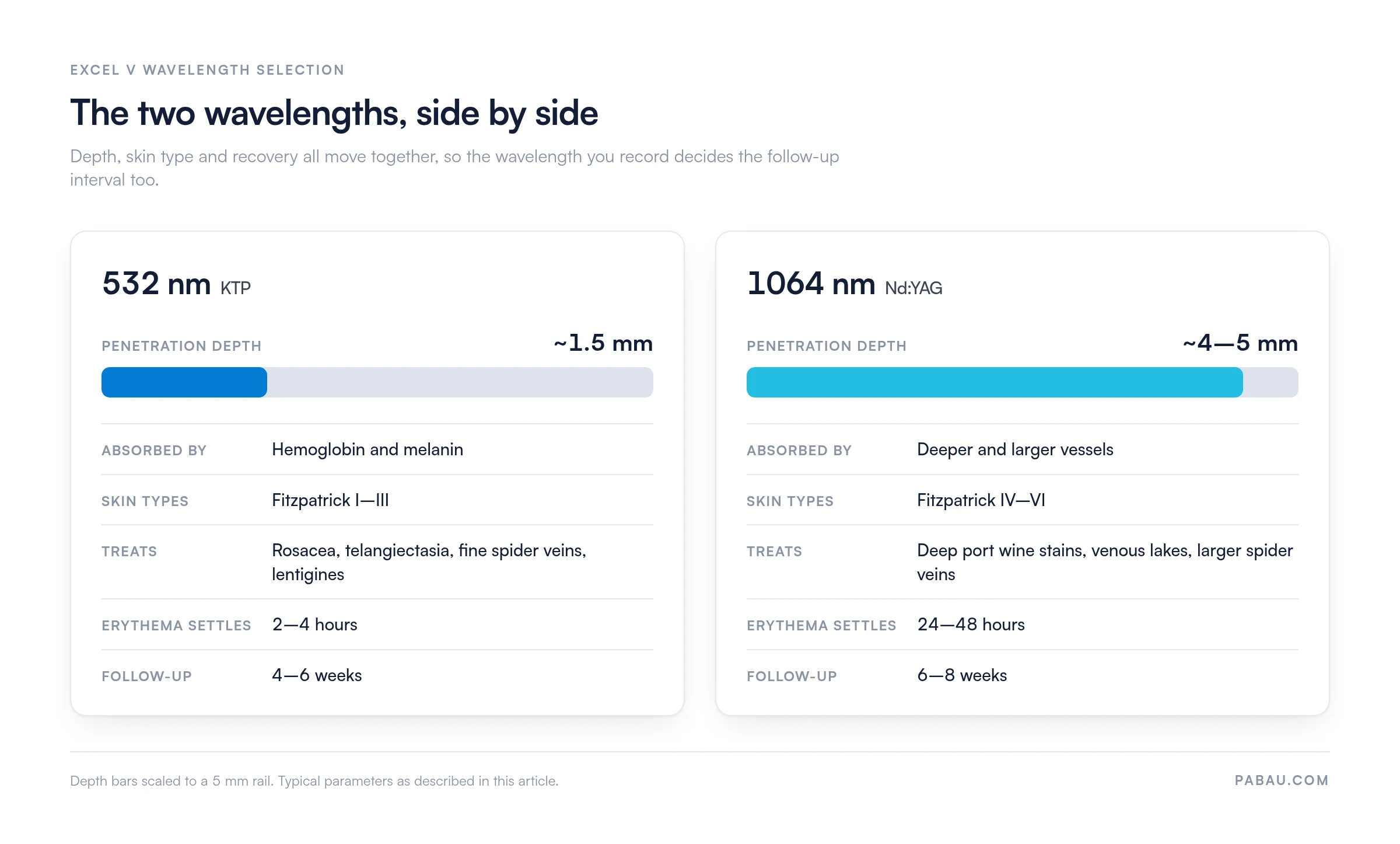
Your record has to prompt for the wavelength and the reason behind it. That matters if a patient questions the outcome, or if a complication appears weeks later. A line reading “532 nm for rosacea, Fitzpatrick II, fluence 10 J/cm²” tells the next practitioner exactly what to repeat.
The form follows five steps, completed during and immediately after the session.
The two wavelengths cover a wide span of vascular and pigmented concerns. Use the table when you record the indication and pick the protocol.
Not every patient is a candidate. The record needs a screening checklist that runs before the laser is switched on. Digital intake forms can collect that history at booking and flag the risks on the treatment record.
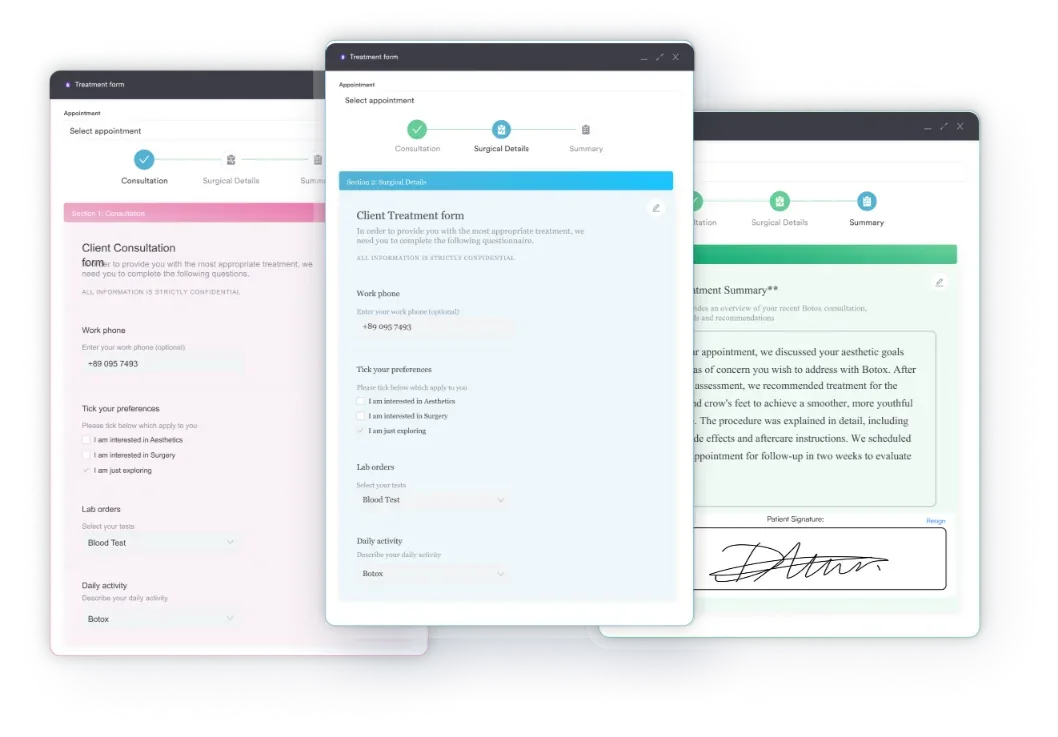
Low downtime is one of the Excel V’s selling points, and accurate expectations are what keep it that way. The record should include a printed aftercare sheet the patient takes home. The template above has one built in.
532 nm, superficial vascular and pigmented lesions: Mild to moderate erythema appears immediately and usually settles within 2 to 4 hours. Patients return to normal activities the same day. Daily SPF 30 or higher is mandatory. Minor bruising is possible but uncommon. Book the follow-up for 4 to 6 weeks.
1064 nm, deeper lesions: Erythema is more pronounced and edema is common, typically settling within 24 to 48 hours. Crusting or temporary hyperpigmentation can appear in darker skin and resolves over 2 to 4 weeks. Patients avoid hot water, saunas and strenuous exercise for 48 hours. Book the follow-up for 6 to 8 weeks.
Write the expected timeline into the record and have the patient initial the aftercare sheet. That signature is what you rely on if a complication is reported weeks later.
Rosacea, port wine stains and significant poikiloderma need 3 to 10 sessions, spaced 4 to 8 weeks apart. The record has to track the package, the sessions left, and the outcome at each visit. Paper notes lose that thread, which is where med spa software starts to matter.
A digital platform links each session to the one before it. It prompts the follow-up booking and keeps the before-and-after photos beside the parameters you used.
Close each session with a line like this one. “Session 1 of 4 complete, follow-up booked for six weeks. 85% blanching on the spider veins. Repeat 532 nm at the same parameters if healing is complete.” That reads as continuity to whoever opens the file next, and it stops a patient being over-treated or dropped mid-protocol.
The record you keep is clinical documentation. The patient needs something shorter they can follow at home. The download above holds both, so you print the aftercare sheet and hand it over at the end of the session. These are the points worth emphasizing.
Plenty of laser practices split this work across three places. The consent sits in a folder, the parameters live in a paper chart, and the photos stay on somebody’s phone. Pulling one patient’s history together then means a physical search.
Practice management software like Pabau keeps them in one file. Pabau’s client records system stores the intake form, the signed consent, the treatment record, the photos and the aftercare sheet against the same patient. So you open one screen before a session instead of three.
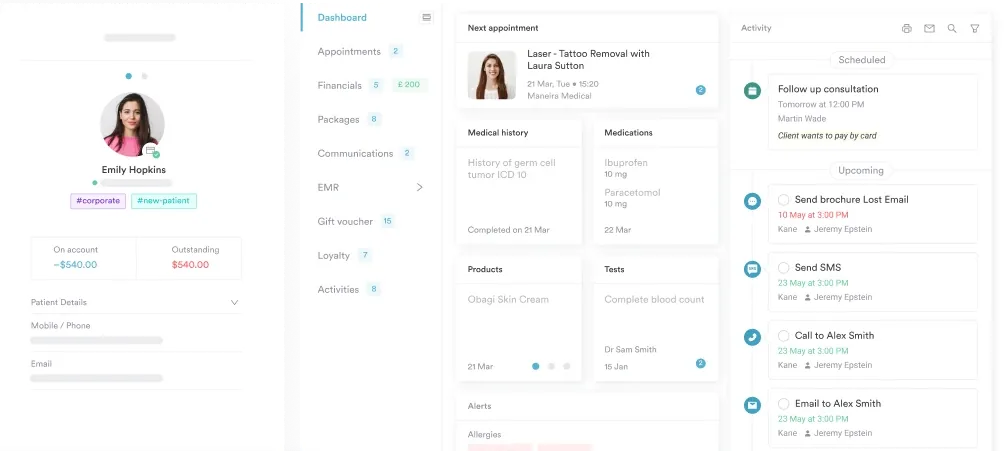
The outcome is a shorter documentation step and a record that holds up under scrutiny. Your team stops rebuilding a patient’s laser history out of three separate sources.

Pabau’s digital forms, treatment records and photo management hold the whole Excel V protocol against one patient file. Your team spends less time on documentation and more on the treatment.

The Excel V asks the same question at every session. Which wavelength, at what fluence, and on what reasoning? Answer it in the record and the rest of the protocol follows from there.
The trade-off is a minute at the chairside. A structured form takes longer to fill in than a free-text note. It pays that minute back the moment a patient returns in six weeks, or a complication has to be explained.
Download the template, use it on the next three sessions, and see whether the follow-ups get easier. If they do, the next step is keeping the same fields somewhere your whole team can reach. Book a demo to see how Pabau holds Excel V records, consent and photos in one patient file.

Also running a ClearSilk? ClearSilk treatment record template documents the 1064 nm settings and aftercare for Cutera’s other Nd:YAG platform.
Documenting a multi-application laser platform? Harmony XL Pro treatment record template carries the same parameter and consent fields for a multi-wavelength system.
Need to pin down skin type before you treat? Full skin assessment template records Fitzpatrick typing and lesion mapping ahead of a laser session.
Building out a whole dermatology record set? Dermatology EMR software shows how consent, charting and clinical photos fit together across a skin practice.
You need the patient name, the date, the Fitzpatrick skin type and the condition treated. Add the wavelength or wavelengths used, the fluence and parameters, the anatomical areas, the immediate response and the aftercare plan. That set protects you on liability and gives the next practitioner continuity. The downloadable template above lays it out as a standardized form.
Keep them for the length of the patient relationship plus 7 to 10 years, depending on your jurisdiction and malpractice exposure. Digital records in a HIPAA-compliant system are easier to hold that long than paper, because backups and archiving happen without anyone remembering to do them.
It can be used on Fitzpatrick IV to VI skin, but it carries a higher risk of post-inflammatory hyperpigmentation. Epidermal melanin absorbs that wavelength, so many practitioners prefer 1064 nm on darker skin. Record the wavelength you chose and the consent discussion behind it.
Isotretinoin is a relative contraindication rather than an absolute bar. Most practitioners wait six months after the final dose, because of the risk of scarring and delayed wound healing. Record the medication history at intake, then either defer the session or document your reasoning and consent before treating.
Write the sequence and the reasoning behind it. A record might read “1064 nm 12 J/cm² for a deep port wine stain, then 532 nm 10 J/cm² for residual superficial erythema”. Add the interval between passes, which is usually 5 to 10 minutes, and the total treatment time. That gives the next session a starting point.