Laser tattoo removal aftercare instructions template
Download your free laser tattoo removal aftercare instructions template A ready-...

26
Last Updated: Sep 4, 2026

ResurFX is a non-ablative 1565nm fractional laser that builds collagen without removing the epidermis.
Most patients need 3-5 sessions spaced 4-6 weeks apart, and redness usually lasts 2-5 days.
Fitzpatrick IV-VI patients need lower energy settings, patch testing, and consent that names hyperpigmentation risk.
Melasma is heat-sensitive, so low-fluence settings and adjunct therapy come before any resurfacing pass.
The free bundle below covers consultation, consent, pre-treatment assessment, and day-by-day aftercare.
Four ready-to-use forms: a consultation record, an informed consent sheet, a pre-treatment assessment, and day-by-day aftercare instructions. The consent sheet covers downtime and hyperpigmentation risk, and the assessment covers Fitzpatrick type and medications.
Download templateResurFX is Lumenis’s non-ablative fractional laser, delivered through the M22 platform. This guide covers how the wavelength works, which concerns respond, who should be treated cautiously, and what recovery looks like day by day.
The paperwork matters as much as the settings. A course runs three to five sessions across several months. The consent language, the energy log, and the aftercare sheet have to match every time.
ResurFX is a fractional non-ablative laser made by Lumenis and built into the M22 multi-application platform. It fires micro-columns of 1565nm energy into the dermis to stimulate collagen remodeling, leaving the epidermis intact.
That intact epidermis is the whole point. Because the skin barrier is never removed, downtime is measured in days rather than weeks, unlike ablative fractional resurfacing. Water in the dermis absorbs the 1565nm wavelength and converts it to heat. That heat triggers a wound-healing cascade, which lays down new collagen over the following weeks.
Collagen-related concerns respond best: atrophic acne scars, fine lines, rough texture, and stretch marks. Results still vary with baseline severity, skin type, and how closely the patient follows aftercare.
Improvement arrives in stages. Patients typically report 30-50% improvement after three sessions, and the result keeps building for 3-6 months after the last treatment as collagen matures.
Every session follows the same five steps. Standardizing the flow protects patient comfort and gives your team one place to record what happened.
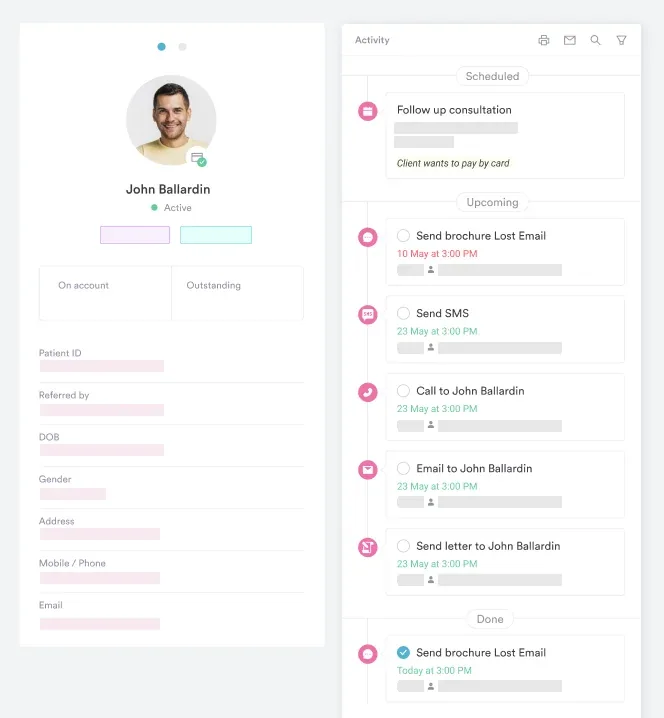
Session spacing matters as much as the settings. Four to six weeks lets collagen remodeling progress, and it gives your team time to review the last session’s outcome before choosing the next fluence.
Recovery is shorter than ablative resurfacing, but the first week is visible. Redness peaks on day two or three rather than on the day of treatment, which is the part patients rarely expect.
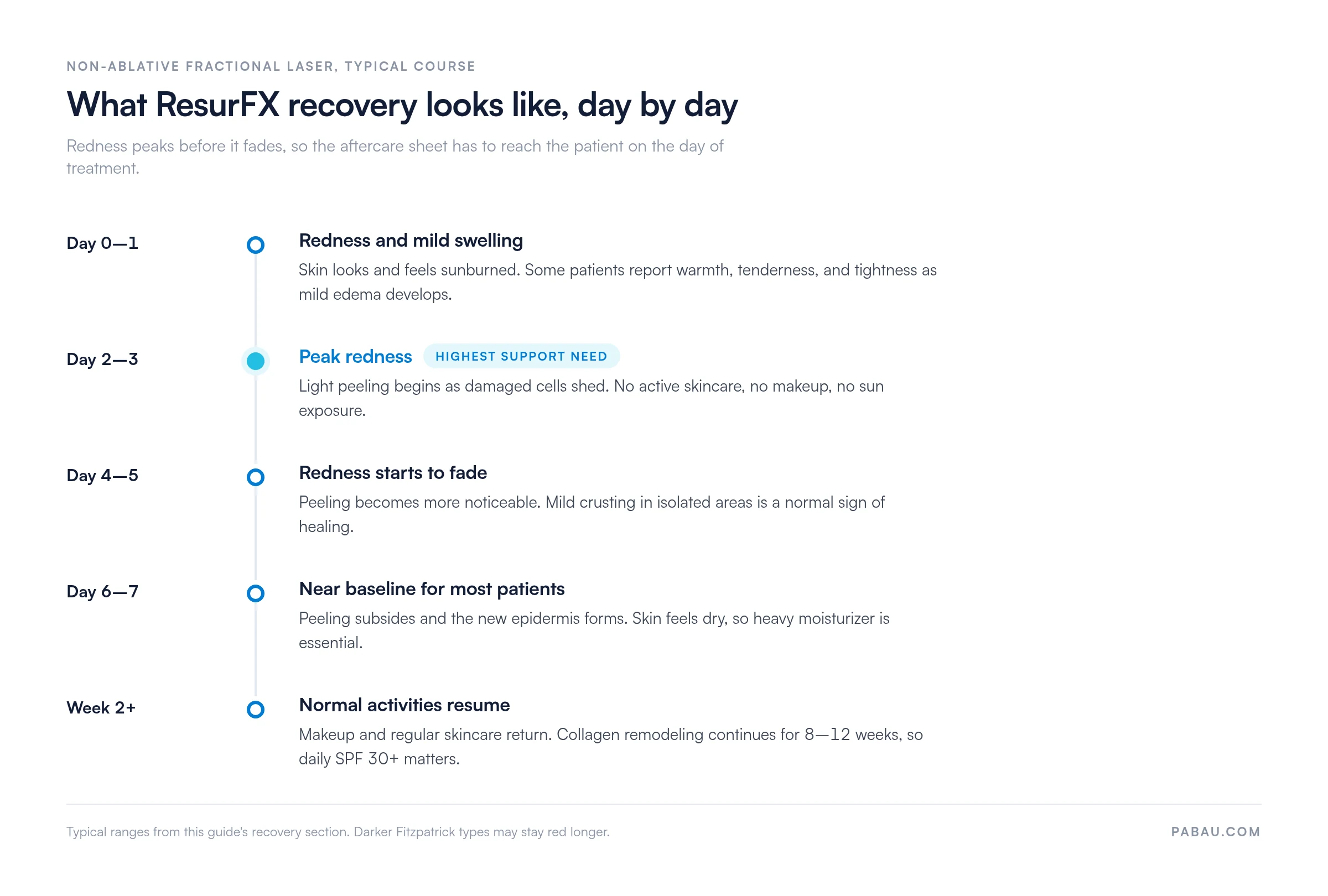
One caveat worth stating at consultation: recovery tracks with Fitzpatrick type, treatment intensity, and individual healing. Darker skin types may stay red longer or develop temporary hyperpigmentation, and the consent form has to say so.
Almost every skin type can be treated, but the protocol changes with the type. Use this framework at consultation to sort straightforward cases from the ones that need a modified approach.
Consumer guides cover the treatment. What decides whether a course runs smoothly is the practice’s own paperwork. That means consent, pre-treatment assessment, photography, and aftercare that reads the same at session one and session five.
Your consent form has to cover the mechanism, the expected redness duration, the honest downtime, and the 3-6 month results curve.
It also has to name contraindications and hyperpigmentation risk, with the Fitzpatrick caveats spelled out. Standardized intake sits behind it, and laser clinic software is what keeps the same questionnaire in front of every patient.
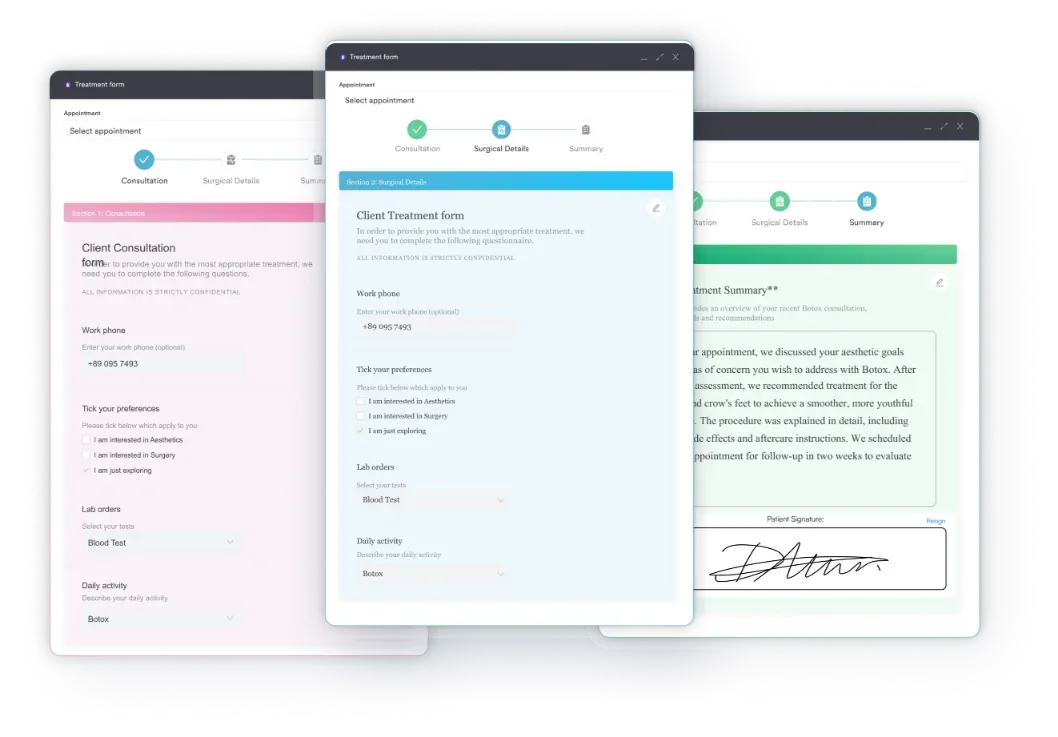
Digital forms remove most of the retyping. Consent, session settings, and photos belong on one client record rather than a shared drive, which is what connected med spa software does. Separately, pre- and post-care automation sends the aftercare sheet and the follow-up survey on schedule.
If your practice also runs an ablative device, the paperwork is not interchangeable. Our CO2 laser aftercare template covers the longer healing window and the wound care that comes with it.
Pricing varies widely by geography, practice setting, provider experience, and treatment area. RealSelf’s community-reported figures run from roughly $275 to $1,999 per session, averaging around $906. That spread is too wide to quote as a headline price. Treat any published range as indicative and price each plan at consultation.
Most practices sell a course rather than a single session, since three to five treatments is the usual commitment. A three-session package at a modest discount makes the course easier to finish and the revenue easier to forecast.
Record the recommended session count and the review date in the treatment plan, then let the reminders follow that plan rather than a diary note.
ResurFX, through the Lumenis M22 platform, is FDA-cleared for skin rejuvenation. Cleared and approved are not the same thing. Clearance comes through the 510(k) pathway, while approval covers a specific therapeutic indication. Marketing copy should never present a cleared indication as a therapeutic claim.
In the UK, the Medicines and Healthcare products Regulatory Agency regulates medical devices, and CE marking or UK Medical Device Regulation compliance is required.
Check the current Lumenis product documentation for cleared indications and contraindications before you launch the treatment. Your own legal and medical advisers should sign off the consent and advertising language for your jurisdiction.
In most laser rooms the paperwork ends up in three places. The consent PDF lives on a shared drive, and the energy settings go in a paper log. The aftercare email leaves from whichever inbox is open. By session three, nobody can say which fluence produced the best result.
Practice management software like Pabau puts those three in one client record. The patient signs consent on an iPad at check-in, and the session note carries the area and the energy settings. The aftercare sheet goes out automatically the same evening. Baseline and three-month photos attach to the same record.
Pabau Scribe, our AI scribe, drafts the session note from the consultation, so tolerance and settings get recorded while the detail is fresh. Every subscription includes every feature, so a single-room practice documents a course the same way a five-location group does.
The outcome is a trail you can defend. When a patient asks why their result differs from the photo they saw, you can show the settings, the dates, and the aftercare they received.

Pabau holds consent, energy settings, photos, and aftercare on one client record, and sends the follow-up automatically. Your team documents a five-session course without retyping anything.

ResurFX earns a place on a treatment menu because the downtime fits around a working week. The trade-off is patience. Results arrive over months, so the consultation has to sell a course of three to five sessions rather than a single appointment.
Two decisions carry most of the risk: the energy settings you choose for Fitzpatrick IV-VI skin, and whether melasma belongs in the plan at all. Both are consent conversations before they are laser settings, and both should be written down.
The bundle at the top of this page covers the forms. Book a demo to see how Pabau logs the settings, sends the aftercare, and keeps three months of photos on one patient record.

Need consent language that holds up for laser work? The laser hair removal informed consent template shows how to word risk and expectation clauses.
Documenting a second fractional device? The Pixel laser documentation template records the handpiece and wavelength alongside the session settings.
Running CO2 resurfacing as well? The CoolPeel laser template covers consent and aftercare for the ablative end of your menu.
Comparing non-ablative options for the same patient? The ClearSilk consent form and clinical guide sets out where that protocol differs.
ResurFX is a non-ablative fractional laser that uses a 1565nm wavelength to stimulate dermal collagen. The epidermis stays intact, so downtime is short. It treats acne scars, wrinkles, texture, and stretch marks.
Most patients need 3-5 sessions spaced 4-6 weeks apart. Improvement shows after the first session, and the result peaks 3-6 months after the last one as new collagen matures.
Redness typically lasts 2-5 days, with light peeling on days two and three. Most patients return to normal activities within a week. Darker Fitzpatrick types often stay red longer.
Active herpes simplex, isotretinoin use within 6-12 months, severe photosensitivity, and some immunocompromised states all rule the treatment out. Fitzpatrick IV-VI patients need careful assessment for hyperpigmentation risk.
Yes, with caution. Fitzpatrick IV-VI skin carries a higher risk of post-inflammatory hyperpigmentation and prolonged redness. Lower the energy settings, patch test 2-4 weeks ahead, and name the risk in the consent form.
Only with care. Melasma is heat-sensitive, and a non-ablative fractional laser can worsen the pigment. Use low-fluence settings alongside adjunct therapy, and consider pigment-directed treatment first.
RealSelf’s community-reported figures run from about $275 to $1,999 per session, averaging near $906. Most practices sell discounted three-session or five-session packages rather than single treatments.