CPT Code 62284: Injection procedure for myelography
CPT Code 62284: official descriptor and procedure overview The American Medical ...

Last Updated: Oct 19, 2026
J7303 is the HCPCS Level II code for contraceptive supply, hormone containing vaginal ring, each. CMS terminated it with effect from 30 September 2021, so it is no longer valid for claims after that date.
Use J7295 for a monthly vaginal ring such as NuvaRing or one of its generics. Use J7294 for Annovera, the reusable yearly vaginal system. A claim submitted under J7303 for a current date of service will reject as an invalid code.
The split follows the product rather than the device class, so the code now depends on what you dispensed. Each replacement carries its own descriptor, its own NDC, and its own unit rule. J7303 keeps one legitimate use. It stays correct for claims and appeals dated on or before September 30, 2021.
Let Pabau's smart automation suggest the right codes, reduce claim denials, and keep your practice compliant—effortlessly.
Automate repetitive tasks and focus on what matters most—your patients.
Reduce coding errors and ensure compliance with the latest regulations.
Clean claims, fewer denials, and faster reimbursements.
Powerful insights and reporting to help your practice thrive.
HIPAA compliant SOC 2 certified GDPR-compliant Trusted by 4,000+ clinics worldwide

HCPCS code J7303 was discontinued by CMS with a last effective date of September 30, 2021.
J7295 replaced it for monthly vaginal rings, covering NuvaRing and its generic equivalents.
J7294 replaced it for Annovera, the segesterone acetate and ethinyl estradiol yearly vaginal system.
Both replacement codes are billed one unit per item supplied, with the NDC reported on Medicaid claims.
Medicaid and ACA-compliant commercial plans remain the main payers. Medicare Part B covers neither code.
J7303 is still the correct code for appeals and corrected claims dated on or before September 30, 2021.
CMS discontinued J7303 outright rather than revising it. Its former descriptor read contraceptive supply, hormone containing vaginal ring, each, and it covered every hormonal ring under one non-specific code. CMS published the decision in its 2021 HCPCS application summary for drugs and biologicals, under request 21.001.
That decision did three things at once. It established J7294 for the yearly vaginal system, established J7295 for the monthly ring, and discontinued J7303. All three changes took effect with the October 2021 quarterly HCPCS update, so September 30, 2021 is the last date of service J7303 covers.
Some third-party coding lookups still display J7303 without a deletion flag, which is where the confusion comes from. The authority is the CMS HCPCS Level II file, and the change is documented in the CMS quarterly HCPCS update record. Treat any reference site that shows J7303 as currently billable as out of date.
The replacement codes are drug-specific rather than device-class-specific. Each descriptor names the hormones and the release rate per 24 hours, so the code you pick is decided by the product dispensed. Both are billed per unit, one unit per ring or system supplied. The diagram below traces that choice from the date of service down to the product.
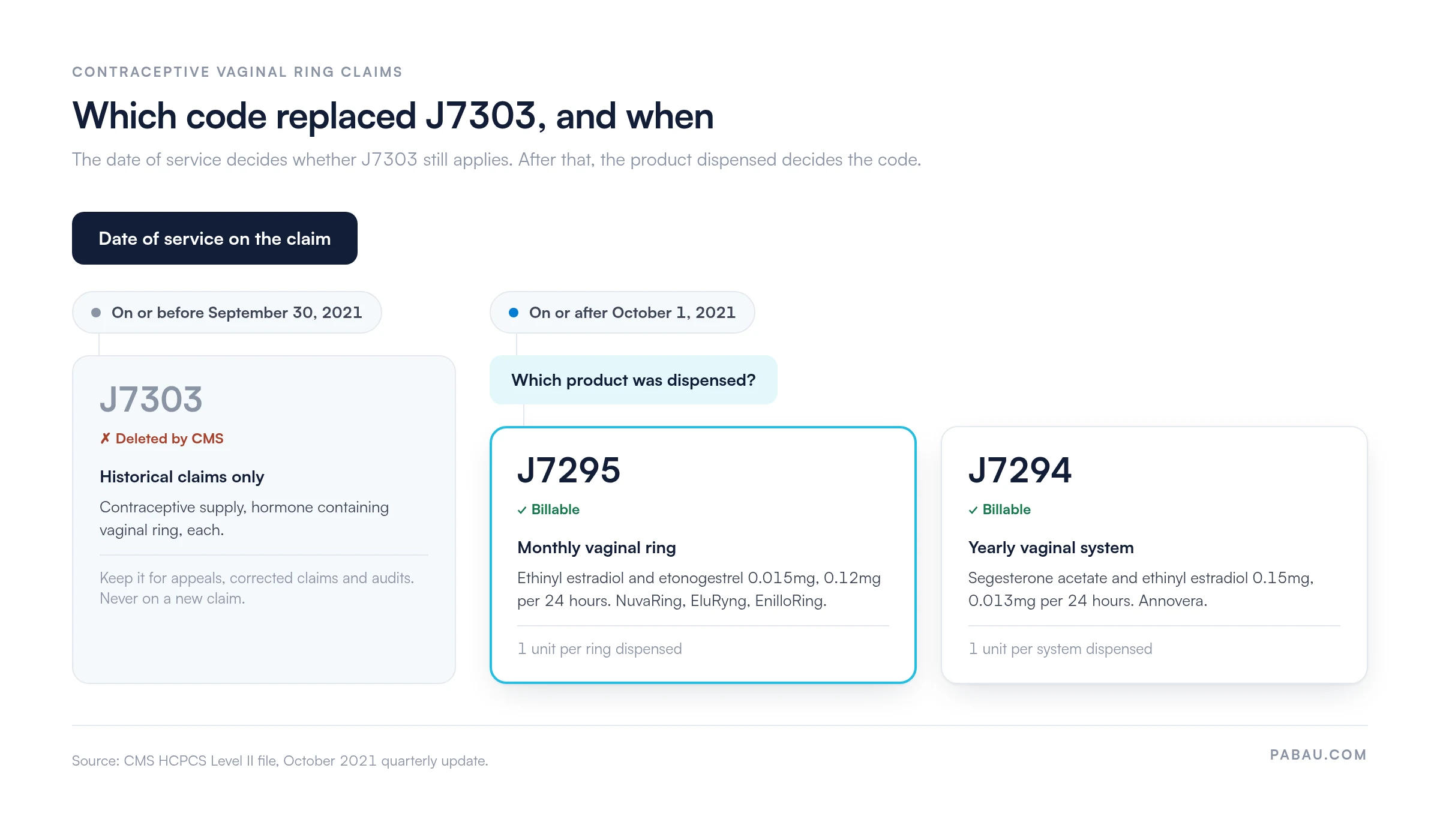
J7295 covers the etonogestrel and ethinyl estradiol ring worn for three weeks out of every four. NuvaRing from Organon is the reference brand. The descriptor names no brand, so ANDA generics and authorized generics are reported under the same code with their own NDC on the claim line.
Bill one unit per ring. A three-month supply handed over at one visit is three units on that date of service. Most payers expect that quantity to match the NDC quantity on the same line.
J7294 covers Annovera, a segesterone acetate and ethinyl estradiol vaginal system the patient reuses for up to one year. The same system is removed and reinserted across thirteen 28-day cycles, so one dispensing event equals one billable unit for that year.
CMS created J7294 in response to a request from the product’s manufacturer, so that Title X family planning clinics could be reimbursed for dispensing it. Annovera is now distributed by Mayne Pharma. Coverage is more variable than for monthly rings, and prior authorization is common on commercial plans.
Medicaid and many commercial payers require an NDC on the claim line in addition to the J-code. Omitting it is one of the most common causes of denial on drug and supply claims. The NDC goes in the shaded portion of Box 24 on the CMS-1500 form, or in Loop 2410 of the 837P electronic claim.
The table below lists the product NDCs currently published in the FDA National Drug Code Directory for each code. Always confirm against the carton you dispensed, since labelers and package configurations change.
Those NDCs are published in the 5-3-2 segment format. Claims need the 11-digit 5-4-2 format, so pad the middle segment with a leading zero. NuvaRing 78206-146-03 becomes 78206014603, and Annovera 68308-752-01 becomes 68308075201. Report the unit qualifier UN with the quantity dispensed.
Search the charge master for J7303 and give it an end date of September 30, 2021 rather than deleting the line. That keeps the code available for appeals and audits on older dates of service, while stopping it from reaching a new claim.
Three variables decide whether a vaginal ring claim pays. They are the units reported, where the code and NDC sit on the claim, and whether a modifier applies. Each has a predictable failure mode.
Both codes are billed per item supplied. For J7295 that means one unit per monthly ring. For J7294 it means one unit for the yearly system, billed once at dispensing rather than once per cycle.
Billing J7294 thirteen times for the thirteen cycles the system covers is a straightforward overpayment risk. The descriptor prices the whole year into a single unit.
Report the J-code in Box 24D of the CMS-1500 paper form. The NDC, unit qualifier, and quantity go in the shaded portion of Box 24 when the payer requires them. On an 837P electronic claim the NDC populates Loop 2410. Place of service 11 applies to in-office dispensing.
Neither code carries a routine modifier requirement across all payers. Three situations do trigger one.
Coverage follows the payer type rather than the code. The deletion of J7303 left the payer rules untouched, so what applied before October 2021 still applies now.
Medicare Part B does not cover hormonal contraceptives. The Part B drug benefit is limited to drugs administered incident to a physician service or supplied through covered durable medical equipment. A contraceptive vaginal ring dispensed to the patient meets neither condition.
Individual Medicare Advantage plans may add contraceptive coverage as a supplemental benefit, though the benefit is optional. Verify with the plan before you dispense. When you bill traditional Medicare knowing the item is excluded, append GY and issue an advance beneficiary notice.
Medicaid is the main government payer for both codes. Family planning services are a mandatory Medicaid benefit, and FDA-approved contraceptives sit inside it. Three pathways matter in practice.
State preferred drug lists decide which specific products are reimbursable. Annovera in particular is more likely to sit behind prior authorization than a monthly ring. Check the current list before dispensing rather than after the denial arrives.
The Affordable Care Act requires most non-grandfathered commercial plans to cover FDA-approved contraceptive methods with no cost-sharing. Hormonal vaginal rings fall inside that preventive services mandate, so J7295 and J7294 usually process at zero patient responsibility.
Two exceptions come up often. Grandfathered plans are not bound by the preventive mandate, and certain employers hold religious or moral exemptions. Confirm plan type during eligibility verification, because a no-cost-sharing claim filed against a grandfathered plan will come back.
The contraceptive supply family runs from J7294 to J7307. Most of these codes are brand-specific, which is the same direction of travel that retired J7303. Picking by device class instead of by product is the error that produces most cross-coding denials in family planning.
The distinction that matters most on a claim is ring against intrauterine system against implant. IUD codes are reported with the insertion procedure billed separately, and J7307 works the same way. A vaginal ring is dispensed to the patient, so no insertion code accompanies J7295 or J7294.
Retired codes linger in charge masters and in staff memory long after CMS drops them. These are the patterns worth checking before your next claims run. Knowing the common denial codes helps you catch most of them before submission rather than on appeal.
Run three checks before you submit a vaginal ring claim. Confirm the product matches the code, the 11-digit NDC and quantity are on the line, and the plan is ACA-compliant rather than grandfathered.
Deleting a code does not invalidate the claims that already used it. J7303 remains the correct code for any date of service on or before September 30, 2021. That distinction matters in three situations that still come up.
Practically, the code stays available for lookup and reporting while it comes off every charge line and order set that raises a new claim. Keeping both states straight is easier when the charge master carries an end date on the retired line rather than a hard deletion.
Most of the denials above start in the same place. The dispensing is recorded in one system, the charge is raised in another, and the code is chosen from memory in between. A retired code survives that handoff for years.
Practice management software like Pabau keeps the encounter, the dispensing record, and the invoice on one patient file. The billing team then works from what the clinician documented at the visit.
Pabau’s claims software for billers pulls that existing record data into a pre-filled claim. It then routes the claim to your clearinghouse for submission and tracking. Your coders still decide the code and the NDC, which is where that judgment belongs.
For a family planning or reproductive health team, the path from visit to clean claim gets shorter. A retired code has fewer places left to hide.

Pabau keeps the encounter, the dispensing record, and the invoice on one patient file. Claim data is pre-filled from that record and routed to your clearinghouse for submission and tracking. See how it works for family planning and reproductive health teams.

The deletion is now years old, and the two codes that replaced it are stable. What still breaks claims is a leftover J7303 line in a charge master nobody has audited since 2021.
End-date that line rather than deleting it. New charges then go out under J7295 or J7294, while the appeals, corrected claims and audits that still need J7303 keep it. That single change closes off most of the denial patterns above.
The rest is product matching. The ring in the patient’s hand decides the code, and the NDC on the claim line has to agree with it. To see how Pabau keeps dispensing records and claims on the same patient file, book a demo.

Need to understand how medical billing works end to end? What is medical billing walks through the full revenue cycle from encounter to payment.
Looking for denial prevention strategies beyond code selection? Denial management in healthcare covers root-cause analysis and appeal workflows.
Billing the etonogestrel implant as well as rings? HCPCS code J7307 explains how the Nexplanon supply code pairs with its insertion CPT code.
Billing another code in the contraceptive family? HCPCS code J7298 covers the Mirena levonorgestrel IUD, from unit rules to Medicare and claim submission.
No. CMS discontinued J7303 with a last effective date of September 30, 2021. Claims for later dates of service use J7295 for a monthly vaginal ring, or J7294 for the Annovera yearly vaginal system. J7303 stays correct only for dates of service on or before September 30, 2021.
Two product-specific codes replaced it on October 1, 2021. J7295 covers ethinyl estradiol and etonogestrel 0.015mg, 0.12mg per 24 hours, monthly vaginal ring, each. J7294 covers segesterone acetate and ethinyl estradiol 0.15mg, 0.013mg per 24 hours, yearly vaginal system, each.
Use J7295, the monthly vaginal ring code. It also covers generic etonogestrel and ethinyl estradiol rings such as EluRyng and EnilloRing, plus authorized generics. The descriptor names no brand, so report the NDC of the product you dispensed on the claim line.
Use J7294, the yearly vaginal system code. Bill one unit per system dispensed, rather than one unit per 28-day cycle. Many commercial plans require prior authorization for Annovera, and some state Medicaid preferred drug lists restrict it, so verify coverage before dispensing.
Report the J-code in Box 24D of the CMS-1500 form. The NDC, unit qualifier, and quantity go in the shaded portion of Box 24. On an 837P electronic claim the NDC populates Loop 2410. Use the 11-digit 5-4-2 NDC format.