CCSD code H4430: Examination of rectum under anaesthetic
CCSD code H4430 pays for the examination alone CCSD code H4430 is the UK private...

Last Updated: Oct 20, 2026
J3145 is the HCPCS Level II code for injection, testosterone undecanoate, 1 mg.
The unit count is where these claims go wrong. A standard injection is 750 mg, so the claim reports 750 units. It does not report one vial or three milliliters.
J3145 is active for the 2026 code year and paid by Medicare Part B under average sales price methodology. It also carries an FDA-mandated REMS program that decides where the drug can be given, which shapes every claim you send.
Let Pabau's smart automation suggest the right codes, reduce claim denials, and keep your practice compliant—effortlessly.
Automate repetitive tasks and focus on what matters most—your patients.
Reduce coding errors and ensure compliance with the latest regulations.
Clean claims, fewer denials, and faster reimbursements.
Powerful insights and reporting to help your practice thrive.
HIPAA compliant SOC 2 certified GDPR-compliant Trusted by 4,000+ clinics worldwide

HCPCS code J3145 covers injection of testosterone undecanoate, 1 mg per unit, the drug sold as Aveed 750 mg/3 mL.
A standard 750 mg dose bills as 750 units of J3145, paired with CPT 96372 for the intramuscular injection.
Medicare Part B pays J3145 under ASP methodology, and CMS updates that rate every quarter.
Most commercial payers require prior authorization, with lab-confirmed hypogonadism and AVEED REMS enrollment on file.
Practice management software like Pabau submits claims electronically, checks eligibility in real time, and tracks each claim’s status.
HCPCS code J3145 is a Level II Healthcare Common Procedure Coding System code maintained by the Centers for Medicare and Medicaid Services (CMS). Its official long descriptor is: Injection, testosterone undecanoate, 1 mg. The code represents a single milligram of testosterone undecanoate, the active ingredient in Aveed. Aveed is a long-acting injectable testosterone therapy from Endo Pharmaceuticals.
Aveed is supplied as a 750 mg/3 mL vial for intramuscular administration. The FDA approved it for hypogonadism, or testosterone deficiency, in adult males. Because J3145 is billed per 1 mg, billing teams at men’s health and hormone therapy practices report 750 units for a standard injection. That unit definition is the most common source of J3145 billing errors.
J3145 is billed per milligram. So the unit count on every claim tracks the dose administered, never the number of vials opened.
The standard Aveed dose is 750 mg. Because J3145 is defined as 1 mg per unit, one standard injection requires 750 units on the claim. Do not bill 1 unit for the vial or 3 units for the milliliter volume. Bill 750 units for 750 mg administered.
The whole claim carries four lines, and only the drug line moves with the dose.
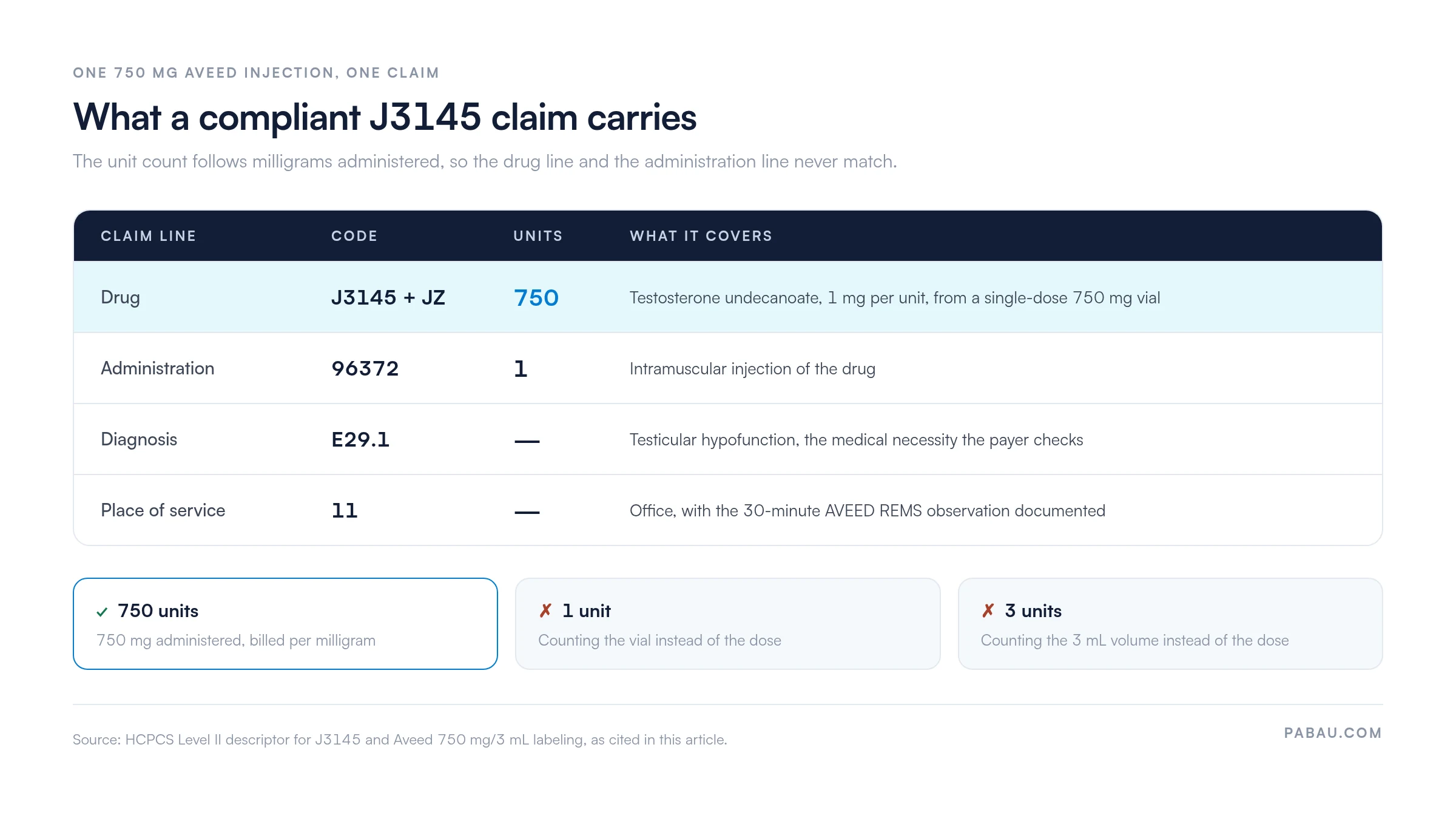
J3145 covers only the drug cost. A separate CPT administration code has to appear on the same claim to bill for the injection itself. That code is CPT 96372 (therapeutic, prophylactic, or diagnostic injection, intramuscular or subcutaneous), and it is the only administration code that fits Aveed.
Report one unit of 96372 per injection, even though the drug line carries 750 units. Chemotherapy administration codes such as 96401 never apply here, because testosterone undecanoate is a hormone rather than an anti-neoplastic drug.
Medicare requires a discarded-drug modifier on single-dose container drugs billed under Part B. JZ attests that no drug was discarded. JW reports the discarded amount on a separate line when some of the vial is not administered.
Aveed ships as a single-dose 750 mg vial, and a standard dose uses the whole vial. So most J3145 lines carry JZ. Confirm your payer’s current modifier policy, since Medicare Advantage and commercial plans phase these requirements in at their own pace.
J3145 is administered in a non-facility setting, typically a physician office or practice (place of service 11). The AVEED REMS program requires in-office administration with a 30-minute post-injection observation period, so facility-based outpatient billing is uncommon for this drug.
Documentation has to support three things: the ICD-10 diagnosis on the claim, the dose administered in milligrams, and provider certification under the REMS program. Record all three in the patient chart at the time of the visit, not at the end of the month.
Audit J3145 claims before they go out. Check that the units match the milligrams administered, not the vial count. Check that CPT 96372 sits on the same claim. Check that the payer accepts the ICD-10 code you used. Those three checks catch most Aveed denials.
Medicare Part B reimburses J3145 under its average sales price (ASP) methodology, the standard approach for physician-administered drugs billed under HCPCS Level II. ASP-based payment is calculated from the manufacturer’s reported sales data across commercial purchasers, not from a fixed negotiated price.
CMS publishes updated ASP pricing quarterly, so the rate for J3145 changes four times a year. Verify the current figure against the CMS ASP drug pricing files before you estimate revenue. The physician fee schedule lookup prices the administration code, not the drug.
Standard Medicare payment for Part B drugs is ASP plus 6%, which covers handling and overhead. Sequestration adjustments can reduce the effective rate in any given quarter. The administration code has its own split, and the non-facility rate for 96372 is higher because office overhead is not reimbursed through a facility fee.
CMS publishes its Medicare Part B drug payment limit tables each quarter, and those files are the only first-party source for the current J3145 rate. Quarter-to-quarter changes are material on a drug at this price, so a quarterly check belongs in the billing calendar of any practice using Aveed regularly.
Most commercial payers and many state Medicaid programs require prior authorization before they approve a J3145 claim. The requirement reflects the cost of the drug and the clinical standard for testosterone therapy. That standard expects lab confirmation of low testosterone before treatment starts.
Typical prior authorization criteria for J3145 include:
These policies are not universal. Medicare generally does not require prior authorization for J3145 under Part B when medical necessity is documented, but commercial and Medicaid payers differ materially. Read each payer’s current coverage policy before you assume approval, and check eligibility at the point of scheduling so any authorization starts early.
Every J3145 claim needs a supporting ICD-10-CM diagnosis code to establish medical necessity. The primary diagnosis has to reflect the clinical indication for testosterone undecanoate therapy. Because Aveed is approved specifically for male hypogonadism, off-label indications should not be coded or implied on the claim.
E29.1 is the diagnosis most coding references pair with J3145, though payer acceptance varies. Always check the payer’s local or national coverage determination. Some plans require E29.1 as the primary code and will not accept E23.0 without documentation of pituitary pathology.
Some payers want the national drug code (NDC) on the claim alongside J3145. NDC reporting is payer-specific rather than a universal Medicare requirement, but commercial and Medicaid managed care plans increasingly ask for it.
When it is required, the NDC goes in a set format on the CMS-1500 form next to the HCPCS code. Take the number from your own vial, wholesaler record, or the Aveed billing support material. Manufacturing changes can alter an NDC, so a figure copied from an old claim is a denial waiting to happen.
The FDA mandated the AVEED risk evaluation and mitigation strategy (REMS) program for testosterone undecanoate. The reason is the risk of pulmonary oil microembolism and anaphylaxis after injection. Those safety rules decide how and where Aveed can be given, which in turn sets the billing context for every J3145 claim.
REMS requirements with billing implications:
REMS non-compliance can also void the insurer’s obligation to reimburse the claim, which makes it a revenue question as well as a compliance one. Confirm your certification renewal every year and record provider enrollment status in the billing system. Drugs under a REMS program need the clinical team and the billing team working from the same record.
Billing teams working with J3145 meet several related codes in everyday workflows, and knowing which one applies prevents both underbilling and wrong substitution. Any claims software for practices still depends on someone linking the drug code, the administration code, and the diagnosis correctly on each claim.
When a payer has no J3145 on its fee schedule, or returns a code-not-covered edit, J3490 is the standard fallback. Billing J3490 means attaching the drug invoice and a narrative identifying the drug as testosterone undecanoate. Some payers price it the same as J3145. Others want a separate prior authorization for the unclassified code.
Check the payer’s HCPCS fee schedule before you fall back to J3490. Some commercial payers have added J3145 to the formulary but have not updated their provider portal. A call to provider relations can confirm J3145 is accepted, which saves the documentation burden that comes with the unclassified code.
J3145 is confirmed active for the 2026 HCPCS code year. The code was created to give testosterone undecanoate its own billing vehicle after FDA approval, separating Aveed from the unclassified J3490. Its official descriptor has not changed since assignment.
Like every HCPCS Level II drug code, J3145 goes through annual review by the CMS HCPCS Workgroup. CMS publishes the full update files, including any mid-year additions or deletions. Our HCPCS code library tracks the sibling J-codes a testosterone practice bills most often. Pricing moves faster than the descriptor, so run the ASP check every quarter.
Most practices billing Aveed work across three screens. The chart holds the dose and the observation note. A payer portal says whether the plan is active. A third system tells them, days later, that the claim came back rejected.
Pabau is an all-in-one practice management system, so the encounter and the claim sit in the same patient record. Its claims management submits claims electronically, runs real-time eligibility checks before the appointment, and tracks the status of each claim after submission. Electronic remittance advice lands back in the same place.
So your billing team can see where a J3145 claim stands without logging into a payer portal. Eligibility problems surface before the patient is in the chair. Your team still decides the units, the modifier, and the diagnosis. Pabau handles the submitting, the checking, and the follow-up.

Pabau submits claims electronically, checks patient eligibility in real time, and tracks claim status as it changes. So your team stops chasing injectable drug claims through a payer portal.

J3145 is a simple code with one hard trap. Bill 750 units for a standard 750 mg dose, put 96372 on the same claim, and keep the REMS record with the chart. Get those three right and the claim rarely comes back.
The two items worth a standing habit are the quarterly ASP check and the payer’s prior authorization rules. Both change quietly, and both decide whether an injection you have already given gets paid. A practice that reviews them each quarter loses far less revenue to timing than one that reviews them after a denial.
Pabau’s claims management software submits claims electronically, checks eligibility in real time, and tracks claim status, so your team spends less time in payer portals. Book a demo to see how it handles injectable drug billing for men’s health and hormone therapy practices.

Need the administration code rules too? CPT code 96372 covers the units, modifiers, and documentation payers expect for injection administration.
Billing a shorter-acting testosterone instead? HCPCS code J1071 sets out the unit math and coverage rules for testosterone cypionate.
Prior authorization holding up the injection? The prior authorization process maps the workflow from request to approval, step by step.
Want fewer drug-code denials overall? What makes a clean claim explains the accuracy standards that keep HCPCS claims from bouncing.
HCPCS code J3145 bills the injection of testosterone undecanoate, sold as Aveed, at 1 mg per unit. It applies to intramuscular administration in an office setting for adult males diagnosed with hypogonadism. The code is maintained by CMS and is active for 2026.
Bill 750 units for a standard 750 mg Aveed injection. J3145 is defined as 1 mg per unit, so the dose in milligrams is the unit count. Billing one unit for the vial, or three for the milliliters, is a common source of underpayment and claim edits.
Most commercial payers and many Medicaid programs require prior authorization for J3145. They typically want documented low testosterone lab values, and sometimes evidence that other formulations were tried first. Medicare Part B generally does not require it when medical necessity is documented, but policies vary by payer.
CPT 96372 is the administration code billed alongside J3145 on the same claim. It covers a therapeutic, prophylactic, or diagnostic injection given intramuscularly or subcutaneously. J3145 pays for the drug, and 96372 pays for injecting it. Chemotherapy administration codes do not apply to testosterone undecanoate.
Medicare Part B reimburses J3145 at average sales price plus 6%, and CMS updates the rate quarterly. Payment per unit therefore shifts four times a year with manufacturer-reported sales data. Check the current quarter’s ASP pricing file before you submit claims or forecast revenue.