CCSD code M2920: Endoscopic ureteric prosthesis billing guide
CCSD code M2920 is the ureteric stent insertion and removal code CCSD code M2920...

Last Updated: Nov 9, 2026
83013 is the CPT code for Helicobacter pylori; breath test analysis for urease activity, non-radioactive isotope (eg, C-13).
CPT code 83013 is the laboratory analysis component of the Helicobacter pylori urea breath test (UBT). It covers the isotope ratio measurement used to detect active H. pylori infection from a breath specimen. It is usually billed with companion CPT 83014, which covers the drug (urea) administration. Claims that conflate the two, omit required ICD-10 pairings, or miss CLIA waiver requirements are common causes of UBT denials.
Let Pabau's smart automation suggest the right codes, reduce claim denials, and keep your practice compliant—effortlessly.
Automate repetitive tasks and focus on what matters most—your patients.
Reduce coding errors and ensure compliance with the latest regulations.
Clean claims, fewer denials, and faster reimbursements.
Powerful insights and reporting to help your practice thrive.
HIPAA compliant SOC 2 certified GDPR-compliant Trusted by 4,000+ clinics worldwide

CPT code 83013 covers breath specimen analysis only, while the urea drug administration bills separately under CPT 83014.
The 13C urea breath test is CLIA-waived with an FDA-approved kit, and the radioactive 14C test is reported under CPT 78267 and 78268, not 83013.
ICD-10-CM B96.81 and the K29.0x gastritis series are the primary diagnosis codes that establish medical necessity for payers.
In Pabau, the practice management platform we build, claim validation catches missing or invalid details before an 83013 claim is submitted.
CPT code 83013, as maintained by the American Medical Association (AMA), describes: Helicobacter pylori; breath test analysis for urease activity, non-radioactive isotope (eg, C-13). The code belongs to the Chemistry subsection of the Pathology and Laboratory section of the CPT code set.
The code captures the laboratory measurement of isotope-labeled CO2 in an exhaled breath sample, which shows whether H. pylori urease is breaking down ingested urea. It does not capture the urea drug itself, its preparation, or its administration to the patient.
The urea breath test detects active H. pylori infection by measuring whether the bacteria’s urease enzyme breaks down ingested labeled urea into labeled CO2 in the patient’s breath. Knowing each step tells coders which codes apply and what the chart has to show.
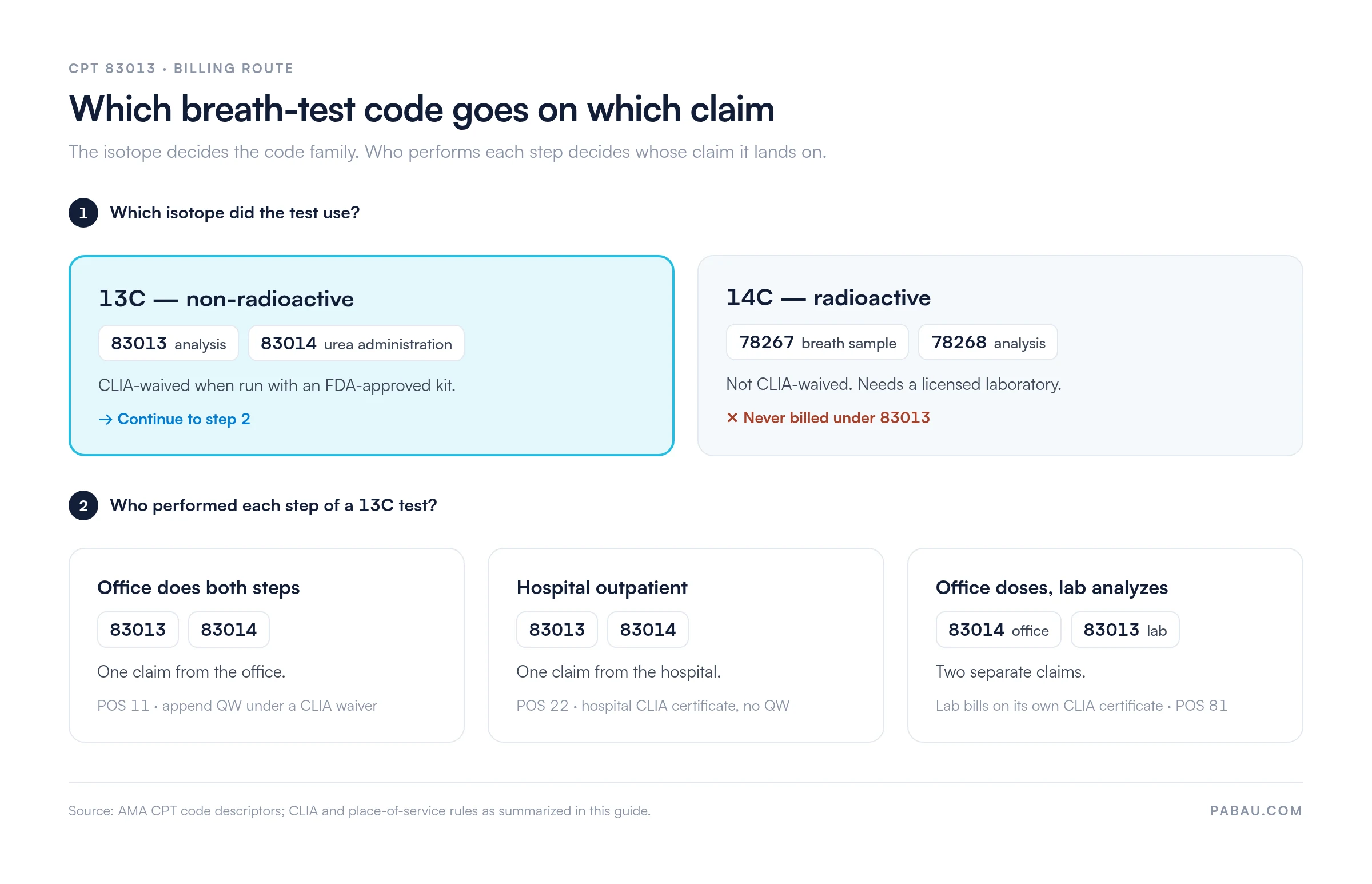
14C vs. 13C distinction: The 14C radioisotope test follows the same clinical procedure but uses a radioactive isotope. It is not CLIA-waived, requires Nuclear Regulatory Commission licensing in some jurisdictions, and is contraindicated in pregnant women. CPT code 83013 covers the 13C test only. The 14C test is reported under CPT 78267 (acquisition of the breath sample) and CPT 78268 (analysis), not 83013.
CPT 83013 and CPT 83014 are a commonly paired set of codes, billed together when one provider does both steps. 83013 covers the analytical measurement of the breath specimen, while 83014 covers the drug (urea) preparation and administration. The two codes serve different functions and may be billed by different providers.
When a physician’s office administers the urea and runs the in-office analyzer, both 83013 and 83014 are billed on the same claim. Sometimes the office administers the drug but sends the breath specimen to a reference laboratory. Then the office bills 83014 and the lab bills 83013 on separate claims. The diagram below maps both decisions, starting with the isotope and ending with whose claim each code goes on.
Three CPT codes cover the main non-invasive H. pylori tests, alongside the 14C breath test codes covered above. Each represents a different testing methodology with different clinical indications. Picking the wrong one is a frequent H. pylori billing error.
Coding decision: Use CPT code 83013 when the physician orders a breath test specifically. Do not substitute 83013 for 87338 (stool antigen) or 86677 (antibody serology) based on what the lab performed. The ordered and performed test must match the submitted code. A mismatch counts as upcoding or downcoding and can trigger an audit.
Always confirm which test the lab ran before coding. A physician may order a breath test but the lab may default to a stool antigen (CPT 87338) due to kit availability. Submitting 83013 when 87338 was performed is a clinical documentation mismatch that creates a CO-11 denial and potential compliance exposure.
Payers require a diagnosis code on every 83013 claim that establishes medical necessity for the test. The ICD-10-CM codes below are common pairings, but each MAC’s LCD sets the accepted list.
Critical documentation point: The diagnosis code must reflect what is documented in the physician’s note, not what the coder infers from the order. If the note documents only “epigastric pain” (R10.13), without a gastritis or H. pylori ICD-10, some payers will deny the claim as non-covered. The physician must document the clinical indication for the test.
Medicare covers CPT code 83013 when medical necessity is documented per the applicable Medicare Administrative Contractor (MAC) Local Coverage Determination (LCD). Coverage is not uniform nationally, because each MAC (Novitas, CGS, Palmetto, WPS, First Coast and others) sets its own LCD for H. pylori testing. Always check the LCD for your geographic jurisdiction before billing.
Each LCD for non-invasive H. pylori testing lists its covered indications, such as active peptic ulcer disease, post-treatment test-of-cure, or initial diagnosis of H. pylori-associated conditions.
Medicare pays CPT 83013 under the Clinical Laboratory Fee Schedule (CLFS), not the Physician Fee Schedule. CMS updates CLFS rates annually, and the current national limit for 83013 is listed in the CMS CLFS files. Commercial payers set their own lab rates by contract.
Pabau’s billing software connects to the Claim.MD clearinghouse to submit 83013 claims electronically to thousands of US payers, including Medicare MACs. The integration supports 837P claim transmission and 835 remittance advice (ERA) receipt, so practices can match each payment to its invoice from the remittance.
Medicare generally does not require prior authorization for CPT 83013, but commercial payers vary significantly. Some Blue Cross Blue Shield plans and United Healthcare plans require prior auth for laboratory UBT testing. Meeting medical billing compliance requirements means checking each payer’s current authorization policy before the encounter, not after a denial arrives.
What documentation supports medical necessity for most payers:
Post-treatment test-of-cure: When 83013 is ordered to confirm H. pylori eradication after treatment, the chart must document the prior positive test result, the treatment regimen administered, and the minimum 4-week post-treatment interval before retesting. Missing this chain of evidence is a frequent reason eradication-confirmation claims fail medical necessity review.
An incorrect place of service (POS) code can trigger an automatic denial, and it determines whether modifier QW applies. Getting medical billing fundamentals like POS selection right prevents routine 83013 rejections.
When a physician office performs 83013 using an FDA-approved 13C kit under a CLIA waiver certificate, modifier QW must be appended to the claim. The QW modifier signals to Medicare that the test was performed as a CLIA-waived procedure. Some practices hold only a CLIA waiver, not a standard certificate. For them, submitting 83013 without QW from a POS 11 setting is a common cause of denials from Medicare and commercial payers.
Modifier 59 applies to CPT code 83013 when a same-date procedure would otherwise trigger a bundling edit (CO-97 denial). The modifier documents that the UBT is distinct from the other service and not incidental to it. Document the clinical rationale for both services in the same encounter note. For submitting a clean claim, include the modifier only when a specific edit requires it. Overuse of modifier 59 draws OIG audit attention.
Denials on 83013 claims follow predictable patterns, and each code below comes with the documentation or coding fix to make before resubmission. A strong denial management workflow addresses these at the source rather than waiting for the EOB.
Reviewing denial reason codes in medical billing alongside your MAC’s LCD before submitting 83013 claims helps cut first-pass denials. Build a pre-submission checklist that covers ICD-10 pairing, QW modifier status, POS code, and the ordering provider NPI in Box 17 of the CMS-1500 form.
Many 83013 rejections trace back to a claim that left the office with a missing or invalid detail. Checking each claim by hand against the payer’s rules is slow, and the rejections that slip through still need chasing after the EOB arrives.
Pabau handles claim validation, electronic submission and rejection flagging in one claims workflow, so a practice billing CPT code 83013 sees where each claim stands. Those steps run through its claims software for practices. No software can guarantee a payer accepts a claim, so ICD-10 pairing and QW status still need a coder’s review.

Pabau’s claim validation catches missing or invalid details before each 83013 claim goes out, and rejected claims land in a Needs action queue. See how it fits your lab billing workflow.

CPT code 83013 pays only when the claim matches what happened during the test. Settle the isotope first, then who ran each step, and the code choice follows from those two facts.
The trade-off sits with documentation. A breath test is quick to run but easy to lose on a missing diagnosis or modifier. The chart note deserves the same care as the claim.
Claim validation in Pabau catches missing or invalid details before submission. Rejected claims are flagged as Needs action, so your team sees which 83013 claims need fixing. Book a demo to see how it fits your lab billing workflow.

Need a clearinghouse that handles Medicare and commercial payers? Our Claim.MD clearinghouse guide explains how electronic claims submission reduces payment delays for lab codes like 83013.
Want to understand what makes a claim payable the first time? Clean claim submission best practices covers the fields, modifiers, and documentation that determine first-pass acceptance rates.
Seeing recurring denials across your lab codes? Revenue cycle management fundamentals explains how to build denial prevention into your front-end workflow rather than chasing EOBs.
CPT code 83013 covers the breath specimen analysis component of the Helicobacter pylori urea breath test. That is the isotope ratio measurement that detects whether H. pylori urease is active. It does not cover the urea drug preparation or administration, which bills separately under CPT 83014.
CPT 83013 covers the laboratory analysis of the exhaled breath specimen; CPT 83014 covers the urea drug administration. When one provider performs both steps, both codes are billed together on the same claim. When the drug is given in the office but the specimen is sent to a reference lab, each provider bills only their component.
The most broadly accepted pairings are ICD-10-CM B96.81 (Helicobacter pylori as cause of disease) and the K29.0x gastritis series. K25.9 (gastric ulcer) and Z87.11 (personal history of peptic ulcer disease, used for test-of-cure claims) may be accepted depending on the MAC’s LCD. Always verify against your specific MAC’s current LCD before submitting.
Yes, Medicare covers CPT code 83013 when medical necessity is documented per the applicable MAC Local Coverage Determination. Coverage is set by each MAC’s LCD, and criteria vary by MAC jurisdiction, so confirm your specific MAC’s LCD before billing.
Four denial codes come up often. CO-50 means the ICD-10 diagnosis is not on the payer’s covered list, and CO-97 means bundling with a same-date service without modifier 59. CO-4 flags a missing QW modifier on a CLIA-waived office test. CO-11 means the diagnosis code is inconsistent with an H. pylori breath test. Each has a specific documentation or coding fix prior to resubmission.
Yes, provided the office holds a valid CLIA waiver certificate and uses an FDA-approved 13C urea breath test kit (such as BreathTek UBT from Otsuka). The claim must be submitted with modifier QW appended to 83013 and place of service code 11. 14C testing is not CLIA-waived and is reported under 78267/78268, not 83013.