CPT code 36468: Injection sclerotherapy of telangiectasia billing guide
CPT code 36468 covers spider veins on a limb or the trunk CPT code 36468 reports...

Last Updated: Nov 13, 2026
72193 is the CPT code for computed tomography, pelvis; with contrast material(s). It covers a pelvis-only CT acquired in a contrast-enhanced phase, with no non-contrast series before it.
A study that adds a non-contrast series first is reported with 72194. A combined abdomen-and-pelvis scan with contrast is reported with 74177.
Let Pabau's smart automation suggest the right codes, reduce claim denials, and keep your practice compliant—effortlessly.
Automate repetitive tasks and focus on what matters most—your patients.
Reduce coding errors and ensure compliance with the latest regulations.
Clean claims, fewer denials, and faster reimbursements.
Powerful insights and reporting to help your practice thrive.
HIPAA compliant SOC 2 certified GDPR-compliant Trusted by 4,000+ clinics worldwide

CPT code 72193 covers a CT of the pelvis with contrast only, while a study that adds a non-contrast series first is 72194.
The radiology report must confirm contrast administration, and a missing contrast note is a common denial trigger.
A combined abdomen-and-pelvis CT takes one code, such as 74177, rather than 72193 plus an abdomen code.
Medicare Physician Fee Schedule rates differ by component: modifier 26 (professional), TC (technical), or global billing.
Pabau’s claim validation catches missing or invalid claim details before you submit.
CPT code 72193 describes “Computed tomography, pelvis; with contrast material(s),” a pelvis-only CT acquired after contrast is given.
The AMA’s CPT code set places it in the Diagnostic Radiology subsection. Its neighbors are CPT 72192 (without contrast) and CPT 72194 (without contrast followed by with contrast). The scan covers the bladder, uterus, ovaries, prostate, rectum, pelvic floor muscles, and nearby blood vessels.
The phrase “with contrast material(s)” means contrast was given and images were acquired in the enhanced phase. The radiology report must document the route of administration. Intravenous iodinated contrast is most common, and oral or rectal contrast may supplement it. The report must also confirm that the contrast-enhanced acquisition was completed. Without that documentation, a claim for CPT code 72193 is open to denial.
The three pelvic CT codes map directly to the contrast protocol, so start by confirming what the radiologist performed. The protocol in the final report can differ from the one that was ordered. Anatomy matters too, because a combined abdomen-and-pelvis scan moves to its own set of codes, as the grid below shows.
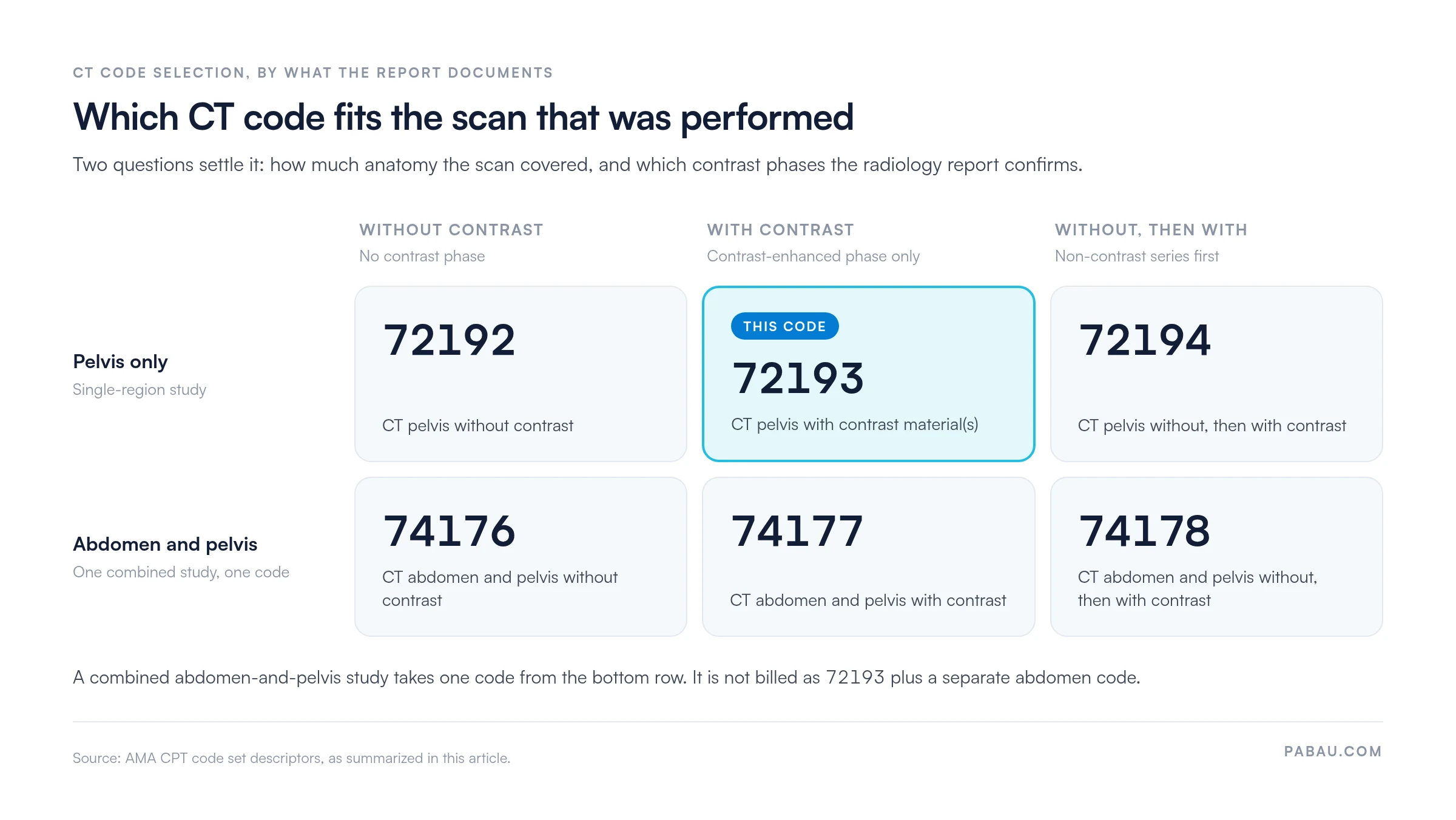
When to bill 72192: No contrast was given at any point in the study. Common indications include renal calculi evaluation and patients with an iodine allergy, where contrast is contraindicated.
When to bill 72193: Contrast was administered and the study was acquired in a contrast-enhanced phase only. The report confirms “IV contrast administered” and shows no non-contrast series before it. This is the standard protocol for characterizing pelvic masses, staging cancers, and evaluating inflammatory disease.
When to bill 72194: The protocol included a non-contrast acquisition followed by a contrast-enhanced acquisition, and the report references both phases. Clinicians order it when they need to compare non-enhanced and enhanced images, such as for subtle lesion enhancement or calcification alongside a mass. A CT urogram is a separate case, because it usually covers the abdomen as well (see the CT urogram section below).
The most common selection error is billing 72193 when the report describes a without-then-with protocol, or billing 72194 when only a with-contrast phase was performed. Neither substitutes for the other, because the AMA CPT code set treats each as a distinct procedure.
Documentation requirements for CPT code 72193 follow from what separates it from the neighboring codes. The radiology report must contain each of the following for the claim to hold up at audit or during payer review.
Coders cannot supplement or correct the radiology report. If contrast administration is not documented, the appropriate code is 72192 until the radiologist amends the report. Submitting 72193 without contrast documentation in the report is incorrect coding and exposes the practice to audit risk.
CPT 74177 describes CT of the abdomen and pelvis with contrast, and it is the correct single code for a combined abdomen-and-pelvis protocol. Its neighbors are 74176 without contrast and 74178 without then with contrast. Billing both 72193 and 74177 for the same encounter typically triggers an NCCI edit, because the combined study already includes the pelvic component.
The National Correct Coding Initiative (NCCI) publishes bundling edits quarterly. Verify the current edit status before submitting both codes for the same date of service. Edit pairs can be added, removed, or made modifier-bypassable between releases.
Some payers permit separate billing when a clinically distinct pelvis-only study answered a different anatomical question from the combined abdomen-and-pelvis study. That rationale must be documented in the medical record, and certain payers require a modifier to bypass the NCCI edit. Verify individual payer policy before submission.
Before billing CPT 72193 alongside CPT 74177, download the current NCCI edit table from the CMS website. The pelvis-only code bundles into the combined code in most configurations. If your practice often performs separate pelvic and abdominal studies on one date, add a payer-specific review step before claims go out.
CT urography is a multi-phase protocol that images the whole urinary tract, including the kidneys, ureters, and bladder. Coders sometimes ask whether CPT code 72193 applies to a CT urogram. In most cases it does not.
A CT urogram usually opens with a non-contrast acquisition to detect calcification, followed by one or more contrast-enhanced phases. Many protocols end with a delayed excretory phase, though the phases vary by facility. The study covers the abdomen and pelvis together, so it is normally reported with one combined code. It is not billed as 72194 plus separate renal or ureteral codes. That code is usually 74178 (abdomen and pelvis, without then with contrast), or 74177 when only contrast-enhanced phases were acquired.
Radiologists and coding staff should confirm together which phases were performed and which regions were covered. Applying 72193 to a full CT urogram understates the study and may undervalue the claim. The American College of Radiology appropriateness criteria help establish which protocol was clinically indicated.
Run a quarterly audit of CT urogram claims. Pull every claim where 72193 was billed with urinary tract ICD-10 codes, and compare it against the radiology report. If the report documents a non-contrast phase and abdomen-and-pelvis coverage, the study likely belonged under 74178, not 72193. Systematic under-coding on urogram studies is revenue you can recover.
Medicare payment for CPT code 72193 is based on the annual Physician Fee Schedule (PFS). It varies by geographic locality, by Medicare Administrative Contractor (MAC) jurisdiction, and by how the service is billed. Rates change each January 1, so always specify the fee schedule year when quoting a reimbursement figure.
Three billing configurations apply, and each produces a different payment amount:
Use the CMS Physician Fee Schedule lookup tool to retrieve the current non-facility and facility rates for CPT 72193 in your MAC jurisdiction. For RVU breakdowns (work, practice expense, malpractice), the FastRVU 2026 lookup provides current Medicare data without a subscription.
Hospital outpatient departments bill under the Outpatient Prospective Payment System (OPPS) using Ambulatory Payment Classifications (APCs), not the PFS. OPPS rates differ from PFS rates and are updated separately.
Prior authorization for CPT code 72193 varies by payer, plan, and clinical indication. No universal rule applies, so coders and revenue cycle staff must verify requirements with each payer before the study is performed.
Documented clinical indications that typically support medical necessity for pelvic CT with contrast include:
A vague indication such as “pelvic pain” without more clinical context raises the denial risk.
The ICD-10-CM diagnosis code on the claim must reflect the clinical indication documented in the radiology order and report. Payers cross-reference the diagnosis against their coverage policies and medical necessity criteria. Pelvic pain coded as R10.2 is a frequent example, and it holds up best when prior imaging results are on file. Generic or unspecified codes without supporting documentation are a leading denial trigger.
When the clinical indication involves a suspected malignancy, payers often require documentation that less invasive workup (ultrasound, clinical exam) was inconclusive before approving CT. Including that history in the authorization request reduces denial rates for oncologic indications.
Radiology billing teams see the same denial patterns on pelvic CT claims again and again. Each has a preventable root cause, and the payer’s remittance names it with one of the standard denial codes.
When a denial does arrive, a set denial management process routes it, corrects it, and resubmits it before the payer’s filing limit runs out.
Several of the denials above start before submission, with a claim that leaves the practice missing a detail or carrying an invalid one. Without a check at that point, billing teams find out only when the payer rejects the claim.
Pabau, the practice management platform we build, includes claims management software for practices that bill US insurance. Its claim validation catches missing or invalid claim details before you submit. Claims then go out through Claim.MD, the clearinghouse Pabau integrates with, which connects to thousands of US payers.

The result is fewer claims bouncing back for missing details. Your team spends its time on coding decisions, such as 72193 versus 72194, instead of on rework.

Pabau’s claim validation catches missing or invalid claim details before you submit. Claims then go out through Claim.MD to thousands of US payers.

Code CPT 72193 from the final radiology report, never from the order. Bill it only when the report confirms a pelvis-only, contrast-enhanced study with no non-contrast series first. When the scan also covered the abdomen, or added a non-contrast phase, a different single code applies.
That report check costs a few minutes before coding, while a denied claim costs a resubmission and a delayed payment. Practices that bill insurance in the US submit claims through Pabau and Claim.MD, so missing details surface before the claim leaves. Book a demo to see how Pabau checks your imaging claims before they reach the payer.

Need a clearinghouse that validates CPT codes before submission? Claim.MD clearinghouse overview explains how Pabau’s US clearinghouse integration handles 837P claim validation across thousands of US payers.
Want to know what a clean claim requires? Clean claim requirements in medical billing covers the data elements and documentation standards that keep claims out of denial queues.
Looking for the full picture on medical billing compliance? Medical billing compliance guide covers the regulatory requirements that apply to radiology and imaging billing teams.
CPT code 72193 is the billing code for computed tomography of the pelvis with contrast material. It covers contrast-enhanced CT imaging of pelvic structures, including the bladder, uterus, ovaries, prostate, and rectum. It applies only when contrast was given and the study was acquired in a contrast-enhanced phase, with no non-contrast series first.
72192 is CT pelvis without contrast, 72193 is CT pelvis with contrast only, and 72194 is CT pelvis without contrast followed by with contrast. The key distinction between 72193 and 72194 is whether a non-contrast series was performed first. Billing the wrong code is a common denial trigger for pelvic CT claims.
Yes, Medicare covers CPT code 72193 when medical necessity is documented. Medicare Advantage plans typically require separate prior authorization. Rates vary by MAC jurisdiction and billing configuration, so check the current CMS Physician Fee Schedule for your locality.
Generally no. CPT 74177 (CT abdomen and pelvis with contrast) includes the pelvic component. Billing 72193 alongside it on the same date of service typically triggers an NCCI bundling edit. Verify the current edit status quarterly using the CMS NCCI edit files. Payer-specific modifier bypass rules may apply in limited circumstances.
The most common reasons are a wrong code (72192 or 72194 billed instead of 72193) and a report that does not explicitly document contrast administration. Others are an NCCI bundling conflict with CPT 74177 and a non-specific or mismatched ICD-10 code. Missing prior authorization from a Medicare Advantage or commercial payer rounds out the list.
Medicare reimbursement for CPT code 72193 varies by MAC jurisdiction, fee schedule year, and billing configuration. The configurations are the professional component (modifier 26), the technical component (modifier TC), and global billing. Use the CMS Physician Fee Schedule lookup tool at cms.gov for current rates in your locality, and note that rates reset each January 1.