

HCPCS Code L0472: Hyperextension TLSO billing guide
HCPCS code L0472: Official descriptor and device definition HCPCS code L0472 des...

Last Updated: Nov 5, 2026
Billable Code
CPT code 72194 is the billing code for computed tomography of the pelvis without contrast material, followed by contrast material(s) and further sections. Both series are acquired in the same session, so the report must document a pre-contrast and a post-contrast series.
Coders most often confuse 72194 with 72193, which covers the contrast-enhanced series only. Reports do not always state both phases, so the deciding detail is easy to miss.
Let Pabau's smart automation suggest the right codes, reduce claim denials, and keep your practice compliant—effortlessly.
Automate repetitive tasks and focus on what matters most—your patients.
Reduce coding errors and ensure compliance with the latest regulations.
Clean claims, fewer denials, and faster reimbursements.
Powerful insights and reporting to help your practice thrive.
HIPAA compliant SOC 2 certified GDPR-compliant Trusted by 4,000+ clinics worldwide

CPT code 72194 requires a pre-contrast and a post-contrast series of the pelvis in the same session. A single contrast-enhanced series maps to 72193 instead.
Modifier 26 applies when the radiologist bills interpretation only; modifier TC applies when the facility bills equipment and technical staff only.
Medicare does not routinely require prior authorization for pelvic CT under traditional Part B, but Medicare Advantage and radiology benefit managers often do.
The Medicare rates on this page are 2025 national averages, so confirm current-year figures in the CMS lookup tool before you rely on them.
Pabau, the practice management platform we build, checks eligibility through Claim.MD and scrubs each 72194 claim for missing or invalid details before submission.
CPT code 72194 is the American Medical Association (AMA) code for “Computed tomography, pelvis; without contrast material, followed by contrast material(s) and further sections.” The patient is scanned once without contrast and again after contrast, in the same session. Unlike CPT 72193, which covers a single contrast-enhanced acquisition, 72194 needs both a pre-contrast and a post-contrast series of the pelvis.
Coders most often confuse 72193 and 72194 because the radiology report does not always spell out both phases. That ambiguity is behind many of the denials for this code.
The code sits in the Diagnostic Radiology subsection of the AMA CPT code set. It covers the bony pelvis and the pelvic organs (bladder, uterus, ovaries, prostate and rectum). The pelvic vessels and adjacent soft tissues from the iliac crest to the acetabulum are included too.
The abdomen above the iliac crest, the perineum and the proximal femur fall outside 72194. When the ordering provider requests the abdomen and pelvis together with contrast, the correct code is CPT 74177, not two separate pelvic codes. Billing 74177 and 72194 on the same date without documented, distinct clinical indications triggers a National Correct Coding Initiative (NCCI) bundling denial.
The 72192-72193-72194 family maps directly to contrast phase count, and the radiology report is the deciding document. If the report documents only a post-contrast series, bill 72193. If it documents a pre-contrast series followed by a post-contrast series, bill CPT code 72194. Billing 72194 when only a single contrast phase was performed is upcoding. Payers flag it through automated audits that compare the claimed code against the report narrative.
CPT 74177 introduces a scope distinction rather than a contrast-phase distinction. It covers the abdomen and pelvis together with contrast. Ordering providers sometimes request a “CT abdomen and pelvis with contrast” when the clinical question concerns only the pelvis. The order then no longer matches the anatomy the scanner covered. Billers should confirm with the radiologist whether the full abdomen was imaged before choosing between 74177 and CPT code 72194.
Two checks settle the choice, and the diagram below runs them in order. Read the field of view first, then count the contrast series in the report.
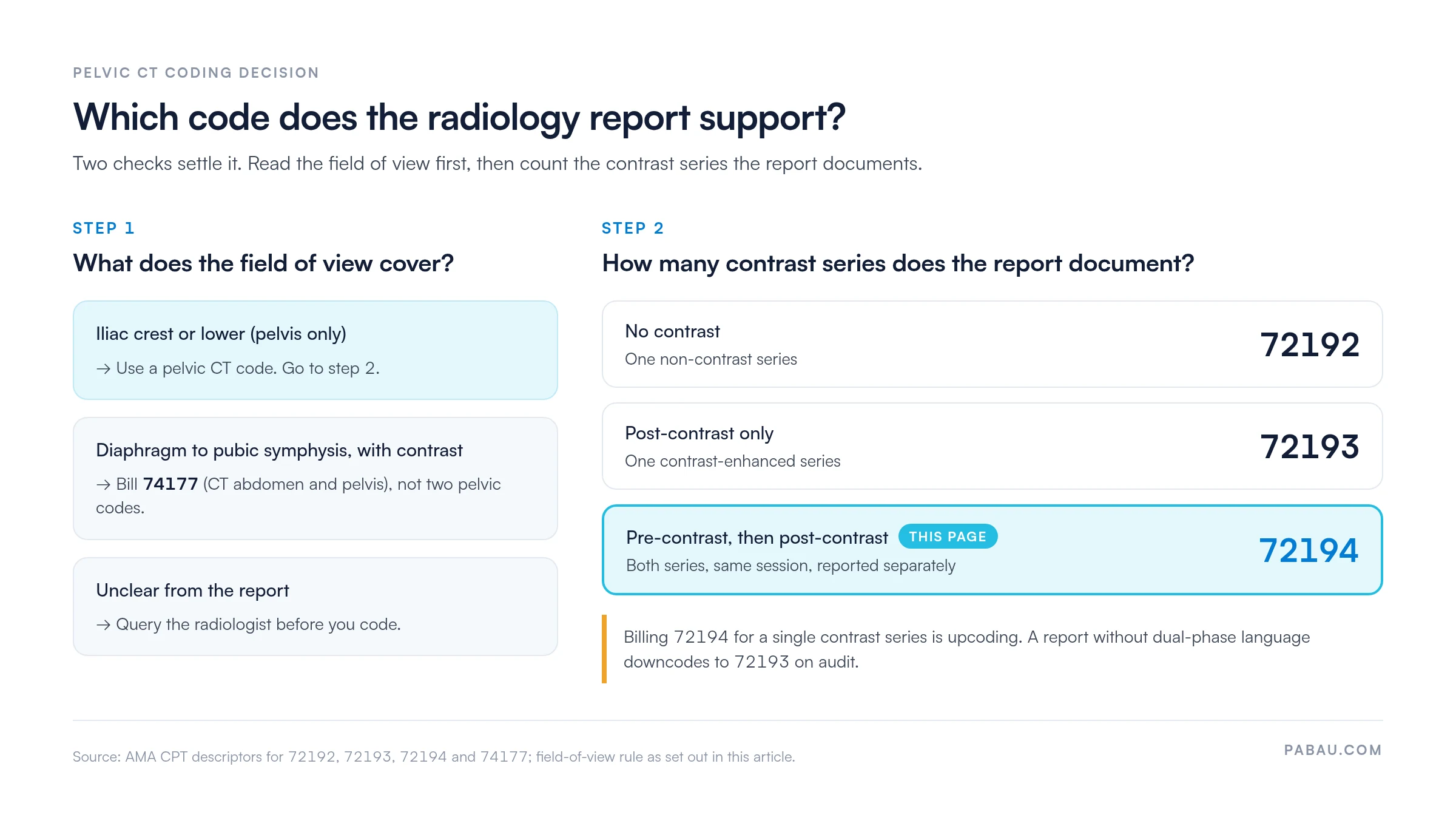
Check the radiology report’s field-of-view notation before coding. A report that documents coverage from the diaphragm to the pubic symphysis supports 74177. A report that documents coverage from the iliac crest or lower supports a pelvic code such as 72194. When the field of view is ambiguous, query the radiologist rather than default to the higher-reimbursing code.
A clean 72194 claim rests on two documents: The ordering provider’s clinical note and the radiologist’s report. Both must support medical necessity on their own, because payers audit each one separately in post-payment reviews.
Ordering provider’s note must include:
Radiology report must include:
Reports that never mention the pre-contrast series are a common finding in radiology denial management reviews. A report that says only “CT pelvis with contrast performed” does not establish a pre-contrast series. On audit, that claim downcodes to 72193.
The diagnosis codes below commonly support medical necessity for CPT code 72194. Payers evaluate both specificity and clinical logic. An unspecified pelvic pain code paired with a dual-phase contrast study faces more scrutiny than a staging code for confirmed ovarian cancer.
Radiology billing splits CPT code 72194 into professional and technical components when the interpreting radiologist and the imaging facility are billed separately. A wrong split is one of the most frequent denial reasons for this code.
Modifier 59 needs documentation showing the pelvic and abdominal studies were ordered for distinct clinical indications on the same date. Without that record, payers treat the modifier as a way around NCCI edits. Expect them to request the clinical notes on appeal.
Prior authorization requirements for CPT code 72194 depend on the payer type and plan year. Verify them against the current payer policy before imaging is performed.
Practices using Pabau’s Claim.MD clearinghouse integration can run real-time eligibility checks before the appointment. Coverage issues then surface before claim submission, while there is still time to fix them.
The Centers for Medicare and Medicaid Services (CMS) publishes allowed amounts for CPT code 72194 each year in the Medicare Physician Fee Schedule (MPFS). The rates below are 2025 national averages, and the 2026 MPFS now in force may have changed them. Geographic practice cost index (GPCI) adjustments also raise or lower the allowed amount by location. Always verify current-year figures using the CMS Physician Fee Schedule lookup tool.
Facility rates apply when 72194 is performed in a hospital outpatient department (HOPD). There, the hospital bills its side under the Outpatient Prospective Payment System (OPPS), using an Ambulatory Payment Classification (APC) rather than the MPFS. That payment often differs from the MPFS technical rate. Ambulatory surgery centers (ASCs) do not generally receive separate payment for diagnostic CT. The radiologist still bills the professional component at the MPFS rate using modifier 26.
Claim denials for CPT code 72194 cluster around a predictable set of billing errors. Each one is preventable with the right pre-submission checks.
Pabau’s claims management software scrubs each claim for missing or invalid details before it leaves Pabau. The CMS-1500 claim then reaches the clearinghouse complete, which removes the easiest denials before a payer sees them.
Practices using the electronic remittance advice (ERA) workflow can reconcile each denial code against the original claim. That shows whether a 72194 denial was a modifier issue or a medical necessity issue, so each one goes to the right fix.

Billing CPT code 72194 in an ambulatory surgery center or hospital outpatient department follows a different payment pathway than a freestanding radiology practice. Knowing which entity bills which component prevents duplicate billing and facility-side denials.
Multi-site radiology groups should revisit how OPPS and MPFS payments split each year, because APC groupings and rates update every January. Newer billers can start with the medical billing fundamentals that sit under both systems.
ASC billing for CT imaging deserves a separate compliance review each plan year. CMS updates the ASC-covered procedures list annually, and a code that was payable last year in an ASC may not be this year. Pull the current ASC-covered procedures addendum from the CMS OPPS update page and cross-reference 72194 before billing any ASC-based pelvic CT as a standalone study.
The denials in this guide share a pattern. A report without dual-phase language, an authorization obtained under 72193 or a wrong 26/TC split all happen before the claim is built. Billers usually find out from the remittance, weeks after the scan.
In Pabau, eligibility is checked in real time through the Claim.MD integration before the patient arrives. Claim validation then scrubs each claim for missing or invalid details before it leaves Pabau.
Your billing team fixes a missing modifier or diagnosis code while the radiology report is still open. Nobody waits for the payer to reject the claim first. Fewer claims come back, and the ones that do are easier to trace.

Pabau checks patient eligibility through Claim.MD and scrubs each claim for missing or invalid details, so fewer pelvic CT claims come back denied.

Bill 72194 only when the report proves two series. If the radiologist names a pre-contrast and a post-contrast acquisition, the code holds up on audit. If the report names one, bill 72193 and keep the claim defensible.
The trade-off is a few minutes at the front of the workflow. Querying the radiologist about an unclear field of view or a missing phase is far cheaper than a downcode or a recoupment later.
Pabau’s claim validation scrubs each claim for missing or invalid details before it leaves the practice, which keeps more clean claims paid on first submission.
Book a demo to see how Pabau keeps your diagnostic imaging claims accurate from order to payment.

Need to understand how claims clearinghouses work? Medical claims clearinghouse overview explains how 837 files move from practice to payer and where edits are applied.
Working through a radiology denial and need to decode the reason code? Denial codes in medical billing maps CARC codes to corrective actions for common imaging denials.
Want to see how Pabau connects to Claim.MD for pelvic imaging claims? Claim.MD clearinghouse guide covers the integration, payer network, and real-time eligibility verification workflow.
CPT code 72194 covers computed tomography of the pelvis performed without contrast material and then again with contrast material in the same session. It includes the bony pelvis, pelvic organs (bladder, uterus, ovaries, prostate, rectum), and pelvic vessels, but excludes the abdomen and perineum.
The 2025 national average Medicare allowed amount was approximately $230-$260 for global billing. The professional component (modifier 26) was about $60-$75, and the technical component (modifier TC) about $165-$195. These figures may have changed under the 2026 MPFS, and local rates vary by geographic practice cost index (GPCI) adjustment. Verify current figures using the CMS Physician Fee Schedule lookup tool.
CPT 72193 covers a CT pelvis with contrast only (a single post-contrast acquisition). CPT 72194 requires both a pre-contrast series and a post-contrast series in the same session. If the radiology report documents only one contrast phase, the correct code is 72193. Billing 72194 when only one phase was performed is upcoding.
Modifier 26 is appended by the radiologist when billing interpretation only. Modifier TC is appended by the facility when billing equipment and technical staff only. No modifier is used for global billing when the same entity performs both components. Modifier 59 is appended when 72194 is billed alongside 74177 on the same date with distinct clinical indications.
Traditional Medicare Part B does not routinely require prior authorization for pelvic CT. Medicare Advantage plans and radiology benefit managers, such as Carelon Medical Benefits Management (formerly AIM Specialty Health), often do. Commercial payers typically require prior authorization, and Medicaid requirements vary by state. Always verify with the specific payer before imaging.
Commonly accepted ICD-10-CM codes include C56.1 (malignant neoplasm of right ovary), C67.9 (bladder malignancy), N83.201 (ovarian cyst), R19.00 (pelvic mass), and C61 (prostate malignancy). More specific codes are better accepted. Vague diagnosis codes paired with a dual-phase study will face higher scrutiny and should be supported by documentation of prior inconclusive imaging.
The most common reason is a radiology report without explicit dual-phase language, which downcodes the claim to 72193. Others include missing or mismatched prior authorization and an ICD-10 code that does not support medical necessity. NCCI bundling conflicts with CPT 74177 and 26/TC modifier errors round out the list.



