CCSD code XR940: Foreign body retrieval billing guide
CCSD code XR940 is the UK private healthcare code for retrieval of a foreign bod...

Last Updated: Nov 26, 2026
54450 is the CPT code for foreskin manipulation, including lysis of preputial adhesions and stretching.
The clinician separates adhesions between the prepuce and the glans by hand, then stretches a tight foreskin opening without an incision. The code pairs with diagnoses such as N47.1 (phimosis), N47.2 (paraphimosis) and N47.5 (adhesions of prepuce and glans), and carries a 0-day global period.
Let Pabau's smart automation suggest the right codes, reduce claim denials, and keep your practice compliant—effortlessly.
Automate repetitive tasks and focus on what matters most—your patients.
Reduce coding errors and ensure compliance with the latest regulations.
Clean claims, fewer denials, and faster reimbursements.
Powerful insights and reporting to help your practice thrive.
HIPAA compliant SOC 2 certified GDPR-compliant Trusted by 4,000+ clinics worldwide

CPT code 54450 covers foreskin manipulation with lysis of preputial adhesions and stretching. It does not include circumcision or a dorsal slit.
Primary ICD-10 pairings are N47.1 (phimosis), N47.2 (paraphimosis), N47.5 (adhesions of prepuce and glans), and N47.0 (adherent prepuce, newborn). Non-specific codes trigger payer denials.
The global period is 0 days, so a separately identifiable E&M service on the same date needs modifier 25 to avoid a bundling denial.
The 2026 work RVU is about 1.09, which puts the national Medicare rate near $72 non-facility and $50 facility before GPCI.
Pabau, a practice management platform with built-in claims management, sends CPT 54450 claims as 837P files through Claim.MD after an eligibility check.
CPT code 54450 describes foreskin manipulation, including lysis of preputial adhesions and stretching of the prepuce. The code belongs to the AMA’s CPT code set, in the Male Genital System series (54000-55899). It is usually performed in an office or outpatient setting without general anesthesia.
The procedure has two billable components captured under a single code. The clinician first separates adhesions between the inner prepuce and the glans by hand. Controlled stretching then widens a constricted foreskin opening. Both components must be performed and documented for the claim to meet the full descriptor.
Use the table below as a fast lookup before building or reviewing a claim for this code.
RVU and allowed-amount figures change annually. Confirm the current-year values using the CMS Physician Fee Schedule lookup tool before submitting or modeling reimbursement for CPT code 54450.
CPT code 54450 is appropriate when a documented foreskin condition has not resolved with first-line care. That care is typically a course of topical corticosteroids. The two most common presentations are phimosis (N47.1) and preputial adhesions that restrict retraction of the prepuce over the glans. Both occur in pediatric and adult patients.
Accepted clinical indications include:
54450 is not appropriate as a first-contact code without documentation that conservative therapy was attempted. Missing that documentation is one of the leading denial triggers for this code.
The procedure covered by CPT code 54450 is usually performed without general anesthesia in an office setting. A topical anesthetic may be applied to the prepuce, but the manipulation itself is non-incisional.
The procedure note must document all of the following for the claim to survive payer review:
A note that says only “foreskin manipulation performed” will not support the full CPT 54450 descriptor, because it names neither the lysis nor the stretching. Payers increasingly apply pre-payment clinical edits that flag vague procedure notes on this code.
Use a structured procedure note template for 54450 with checkboxes for lysis, stretching, and failed conservative therapy. A reviewer at a payer’s medical-review desk can then find both descriptor components in seconds.
Every CPT code 54450 claim requires at least one valid ICD-10-CM diagnosis code that establishes medical necessity. Payers question an unspecified code when a more specific N47 code matches the documented finding. For cross-referencing CPT-to-ICD-10 medical necessity crosswalks, the CrossCoder lookup tool can help confirm accepted pairings.
Confirm all ICD-10-CM codes against the current-year tabular list published by the CDC, because subcategory assignments within N47 have been revised in prior update cycles. Payers frequently question N47.8 (other disorders of prepuce). Document the specific clinical finding rather than defaulting to it.
Reimbursement for CPT code 54450 is set annually through the Medicare Physician Fee Schedule. The 2026 MPFS assigns the code a work RVU of about 1.09, with total RVUs of 2.15 non-facility and 1.51 facility. Total allowed amounts differ between the two settings because practice expense RVUs change by site of service.
These national figures use the 2026 conversion factor of $33.4009 and change each January 1 when CMS publishes the final MPFS rule. Use the FastRVU lookup tool to pull the current-year wRVU and locality-adjusted allowed amount for CPT code 54450 before modeling revenue. Commercial payer rates are negotiated separately and vary by contract.
The 0-day global period on CPT 54450 decides how a same-day visit is billed. Any E&M service performed on the same date of service needs modifier 25 to show it was significant and separately identifiable. Without it, the E&M bundles into the procedure payment and the practice loses that revenue entirely.
Before applying modifier 59 to a bundled pair, verify the NCCI (National Correct Coding Initiative) edit pairs for CPT 54450 in the current CMS manual. NCCI edits are updated quarterly, so a pair that was billable separately last year may carry a Column 1/Column 2 restriction today.
CPT code 54450 is the non-surgical manipulation code in the penile foreskin series. The codes most often confused with it involve a surgical incision (dorsal slit) or removal of the prepuce (circumcision). Those procedures carry higher RVUs and different documentation requirements. Billing 54150 or 54000 when 54450 fits the note is upcoding, and billing 54450 after a surgical procedure is undercoding.
The sharpest clinical distinction is between 54450 and CPT 54000/54001. If a blade or scissors slit the prepuce, the correct code is 54000 or 54001, even for a minor lateral slit in the office. The word “manipulation” in the 54450 descriptor means manual force only. For detailed code-range lookups, the AAPC Codify CPT lookup includes full descriptor text for each code in the 54000 series.
Circumcision itself splits by age, so a surgical excision in a baby 28 days old or younger is 54160 rather than 54161. Adhesions that form after a prior circumcision have their own code, 54162. The decision path below runs from the most invasive procedure to the least.
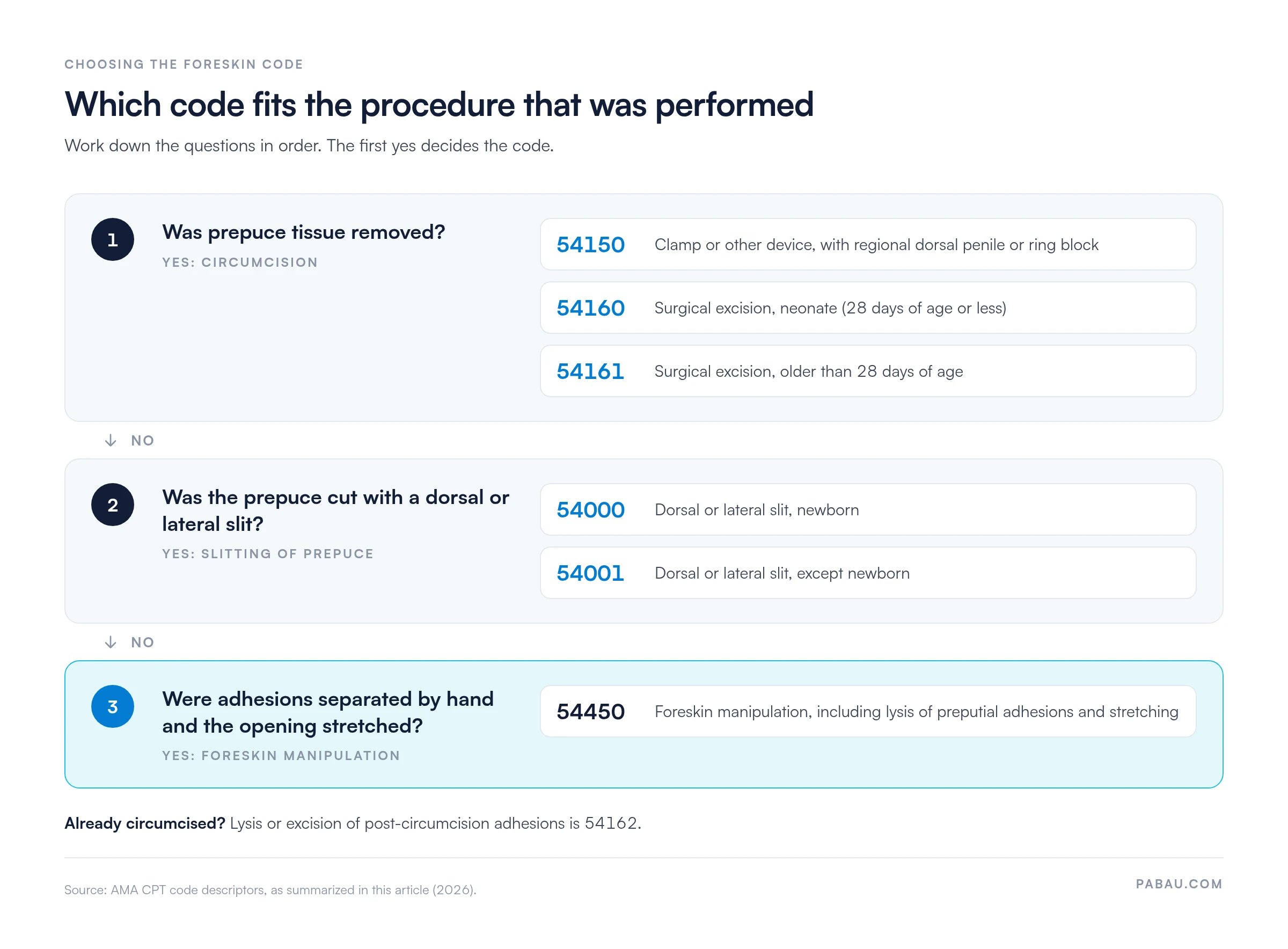
Knowing the boundaries of CPT code 54450 prevents upcoding errors and misapplication to procedures that have their own distinct codes.
Denials for CPT code 54450 follow a predictable pattern, and the same six root causes recur once a practice bills the code at volume. A structured denial management workflow catches most of them before submission rather than after. For the reason codes payers attach to rejections, see the guide to denial codes in medical billing.
Prior authorization for CPT code 54450 is not universally required, and Medicare typically does not mandate it for in-office performance. Some commercial payers and Medicaid managed-care plans do require it. This is most common for adult patients, where phimosis treatment falls under a local coverage determination (LCD) with specific criteria.
Medicare Administrative Contractors (MACs) publish LCDs that define medical necessity criteria for male genital procedures. Not all MACs have an active 54450-specific LCD. Where one exists, it specifies the diagnosis requirements, documentation elements, and any prior-treatment-failure criteria the claim must meet. Check the CMS LCD database for your MAC jurisdiction before assuming coverage applies.
Setting up CPT code 54450 correctly in a practice management system (PMS) stops denials at claim creation, before they reach the payer’s desk. Configure the code once with its usual diagnosis pairings, modifier reminders and place of service. Each new claim then starts from a correct template.
A well-configured medical claims clearinghouse connection adds a second layer of validation. It runs eligibility checks before the patient arrives, then scrubs the claim for missing modifiers or mismatched diagnosis codes before the 837P is transmitted. For a claim as simple as 54450, pre-submission scrubbing stops the common errors before they turn into a rework cycle.
Key setup steps for CPT 54450 in any PMS include:
First-pass clean claim submission matters most for a low-value code like 54450 billed at high volume. Reworking a claim worth about $70 can cost more in staff time than the claim pays.
Run a quarterly audit of every 54450 claim submitted in the prior 90 days. Pull each denial, group by reason code, and identify whether the root cause is documentation, modifier, ICD-10, or POS. A few hours of analysis often points to one systemic fix behind the repeat denials.
In many urology and men’s health practices, a 54450 claim passes through several hands. The clinician writes the note, someone codes it, and a biller keys the claim into a separate clearinghouse portal. Each handoff is another chance to drop the modifier 25 line or attach a vague N47 code.
Pabau, a practice management platform with built-in insurance billing, keeps the procedure note and the claim in the same system. US claims go out as 837P files through Claim.MD, a clearinghouse that reaches thousands of US payers. Eligibility checks run before submission, and ERA remittances come back into Pabau, so the biller reconciles each 54450 claim without switching tools.
For payers that require prior authorization, the auth code, dates and sessions sit on the patient’s case, and Pabau warns when one is missing. Fewer 54450 claims then come back for a reason the front desk could have caught.

Pabau sends 837P claims through Claim.MD, runs eligibility checks before submission, and tracks prior authorizations on the patient’s case. See how it works for urology and men’s health practices.

CPT code 54450 pays modestly, so a denial costs more to fix than the claim earns. The work worth doing happens before the first claim goes out. That means a note template that records both descriptor components, a modifier 25 rule for same-day visits, and N47 pairings that match the documented finding.
Set those three up once and 54450 pays on first submission far more often. Leave them to memory, and the same denials return every quarter.
Pabau sends those claims through Claim.MD with an eligibility check first and keeps the auth record on the patient’s case. Book a demo to see how it works for a urology or men’s health practice.

Need to understand how clearinghouse submission works for CPT codes? Medical billing fundamentals covers the end-to-end claim lifecycle from charge capture to payment posting.
Seeing ERA remittance data you can’t reconcile? Electronic remittance advice explained breaks down how to read 835 remittance files and match them to your 54450 claims.
Want to reduce rework on urology claims across your team? Medical billing compliance outlines the documentation standards and audit-readiness checks that prevent downstream denials.
Billing a neonatal circumcision instead? CPT code 54160 covers surgical excision circumcision in babies 28 days old or younger, with its own RVUs and denial patterns.
CPT code 54450 covers foreskin manipulation, including lysis of preputial adhesions and stretching of the prepuce. It is a non-surgical procedure for phimosis and preputial adhesions, usually done in the office. Both the lysis and the stretching must be performed and documented for the code to match its full descriptor.
Modifier 25 matters most. Append it to any same-day E&M service so the visit is not bundled into the 54450 payment. Modifier 52 applies when the procedure is not completed. Modifier 59 applies when 54450 is billed with a distinct procedure that NCCI edits would otherwise bundle, so verify the edit pair first.
The primary pairings are N47.1 (phimosis), N47.2 (paraphimosis), N47.5 (adhesions of prepuce and glans penis), and N47.0 (adherent prepuce, newborn). N47.6 (balanoposthitis) is a secondary pairing when recurrent infection drives the stretching. Use N47.8 (other disorders of prepuce) only when no more specific code applies, because payers frequently question it.
CPT 54450 is a non-surgical manipulation code with no incision and no tissue removal. CPT 54150 is circumcision using a clamp or other device with a regional dorsal penile or ring block. CPT 54160 is circumcision by surgical excision in a neonate, and 54161 covers the same excision after 28 days of age. All three remove the prepuce, while 54450 only manipulates it.
Not universally. Medicare generally does not require prior authorization for in-office 54450, but some commercial payers and Medicaid managed-care plans do, particularly for adult patients. Verify the requirement against the payer’s current policy before the procedure, because coverage criteria vary by plan and jurisdiction.
The global period for CPT 54450 is 0 days. Post-procedure care on the same date falls inside the global package. A separately identifiable E&M on that date must carry modifier 25 to keep it from bundling into the 54450 payment.