CCSD code H4430: Examination of rectum under anaesthetic
CCSD code H4430 pays for the examination alone CCSD code H4430 is the UK private...

Last Updated: Oct 20, 2026
CCSD code C4710 is the procedure code for repair of a corneal wound. A surgeon uses it after stitching a cut or perforated cornea so the eye is watertight again. It sits in Chapter 4 of the CCSD Schedule, Eye and orbital contents.
The fact to hold onto is scope. C4710 covers the closure only. Suture removal later is billed as C4730, and a corneal graft can never go on the same claim. For billing teams, that boundary decides whether a claim pays first time or comes back queried. The sections below cover the diagnosis codes that fit, the note insurers want and a quick check before you submit.
Let Pabau's smart automation suggest the right codes, reduce claim denials, and keep your practice compliant—effortlessly.
Automate repetitive tasks and focus on what matters most—your patients.
Reduce coding errors and ensure compliance with the latest regulations.
Clean claims, fewer denials, and faster reimbursements.
Powerful insights and reporting to help your practice thrive.
HIPAA compliant SOC 2 certified GDPR-compliant Trusted by 4,000+ clinics worldwide

CCSD code C4710 covers repair of a corneal wound, such as suturing a traumatic corneal laceration or perforation.
Pair it with an S05 ICD-10 code, such as S05.3 for an ocular laceration without tissue prolapse.
CCSD lists C4710 as an unacceptable combination with the corneal graft codes C4620, C4630 and C4650.
The operative note should record wound depth, suture details and the Seidel test result.
Removing the corneal sutures later is a separate episode, billed as C4730.
CCSD code C4710 is the procedure code for repairing a corneal wound. Surgeons use it after closing a cut or perforation in the cornea, the clear front window of the eye. It sits in Chapter 4 of the CCSD Schedule, Eye and orbital contents, within the cornea section.
UK private medical insurers (PMIs) process specialist and hospital invoices using CCSD codes for specialists. The Clinical Coding and Schedule Development (CCSD) Group publishes each code and its narrative.
Insurers then set their own fees. Bupa, for instance, places C4710 in its MINOR 5 fee category, as Bupa’s fee schedule shows.
That modest fee band fits a short, focused operation. Before you look at neighboring codes, it helps to picture what happens in the operating room.
In short, the surgeon stitches the wound shut under an operating microscope, then checks for leaks. Very fine sutures, commonly 10-0 nylon, make the eye watertight again. Next, a Seidel test with fluorescein dye confirms that no aqueous fluid is escaping.
A full-thickness laceration counts as an open globe injury. These are usually repaired under general anesthesia. If iris tissue has pushed out through the wound, the surgeon repositions or removes it before closing the cornea.
You’ll typically see C4710 in three situations:
Afterward, the sutures often stay in for weeks or months. Their removal is a separate clinic visit, billed as C4730. That split is the first of several code boundaries worth knowing.
Most coding errors on corneal claims come from picking a code for a related procedure. The quickest fix is to ask four questions in order, as the guide below shows.
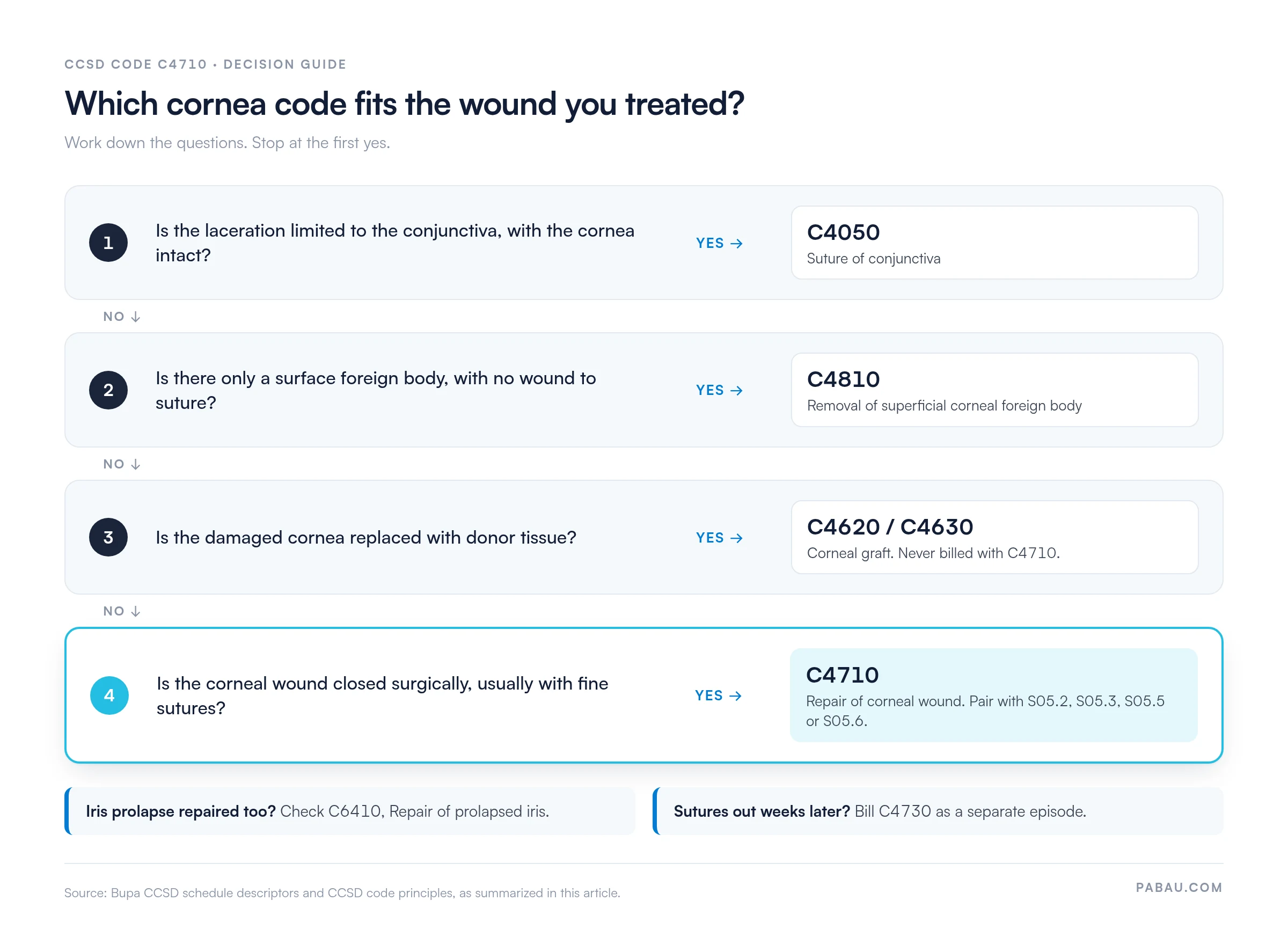
For quick reference, the table sets each neighbor beside C4710. Descriptors follow Bupa’s CCSD schedule, summarized in our Bupa CCSD codes guide.
Iris prolapse deserves a second look. When the surgeon repairs prolapsed iris tissue as its own step, check whether C6410 applies.
Tension sutures are a separate entry in the same cornea section. When the operative note describes tension sutures rather than closing the wound itself, C4980 is the code to check.
Grafts work differently. CCSD’s code principles for C4620, C4630, C4650, C4690 and C4020 list C4710 as an unacceptable combination. So a wound repair can’t be billed with a corneal graft, a graft revision, corneal ring implants or symblepharon removal.
The full principles sit behind the CCSD Schedule login, so check them before adding a second code.
UK insurers expect a WHO ICD-10 diagnosis code next to the CCSD code. For corneal wounds, the right one sits in category S05, Injury of eye and orbit.
Here’s how that plays out. A patient cuts their cornea on broken glass, and no tissue has prolapsed. The claim carries C4710 with S05.3. If the insurer asks how the injury happened, add an external cause code as well.
Two codes look close but don’t fit. S05.0 covers a corneal abrasion, and T15.0 covers a foreign body in the cornea. Neither describes a wound that needs suturing, so pairing either with C4710 invites a query.
Insurers query corneal repair claims when the note doesn’t show why sutures were needed. A detailed note settles that before anyone asks. Use this checklist when you write or review one:
With a complete note in hand, the next hurdle is timing.
Most corneal lacerations arrive as emergencies, and that changes the authorization picture. Many UK PMI policies exclude emergency treatment. As a result, an open globe repaired in an NHS eye casualty unit rarely becomes a private claim.
Private C4710 claims more often follow a semi-urgent listing. Others involve a patient already under private eye care. Whenever the timeline allows, contact the insurer for authorization before operating.
If surgery can’t wait, notify the insurer as soon as possible afterward. Then record why authorization came later. A typical request includes:
Requirements differ by insurer and change over time. Bupa publishes a code search, and AXA Health runs a specialist forms portal. Check the current rules there before each request.
Ask at intake whether someone else caused the eye injury. Insurers often ask this on accident claims, and an unanswered question can hold up payment for weeks.
Denied corneal repair claims usually trace back to one of seven mistakes. Scan for each one before the claim leaves the practice.
First, get the reason in writing. For an administrative denial, fix the missing detail and resubmit through the insurer’s standard route. A clinical denial needs more work. Send a consultant letter explaining why the wound needed surgical closure, with the operative note attached. Then track every appeal deadline in the patient record.
Avoiding those errors is easier when the claim moves through a fixed routine. Here’s the sequence, from checking cover to receiving payment.
Many eye surgery teams still copy CCSD codes, authorization numbers and consultant details into insurer portals by hand. Every re-keyed field is another chance for a rejection.
Pabau, the practice management platform we build, takes most of that retyping away. Its digital forms turn the documentation checklist above into required fields. That way, a corneal repair note can’t leave the operating room half-finished.

The Healthcode integration then sends the CCSD-coded claim straight from the patient record. Before it goes, the claims management tools check required fields such as membership and authorization numbers. Claim status and payment reconciliation sit in the same place.
Because the note, consent form and claim share one record, answering a query takes minutes. Your team sends the supporting note without chasing paper files.
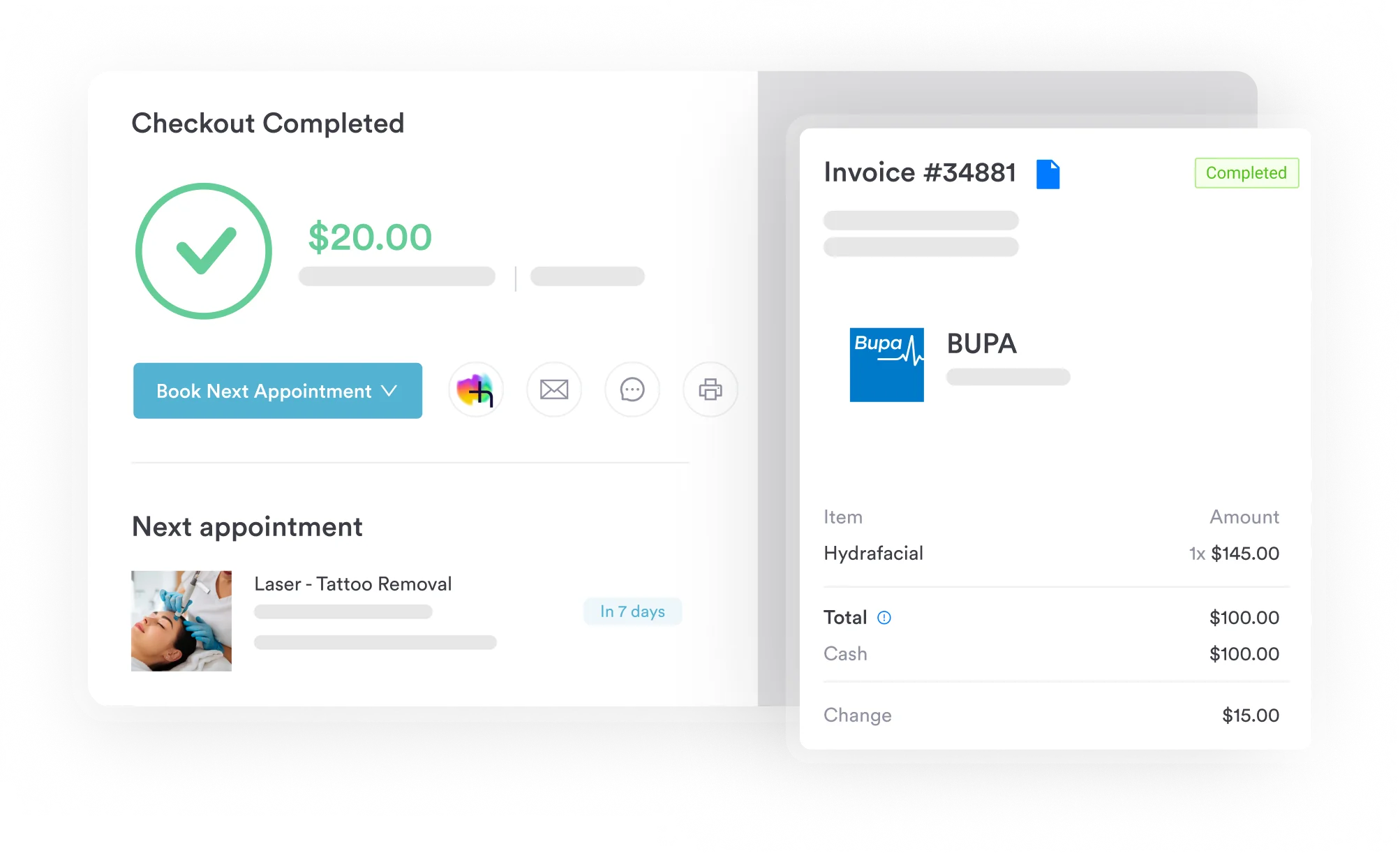

Pabau submits CCSD-coded claims through Healthcode from the patient record and checks required fields first. Your team spends less time reworking rejected eye surgery claims.

Corneal repair claims rarely fail on the code itself. They fail when the note, the diagnosis and the invoice tell slightly different stories about the same wound.
So treat the operative note as the source for everything else. Once it records the depth, the sutures and the Seidel result, choosing C4710 and the S05 code becomes simple. Set a reminder for the C4730 visit on the same day, because suture removal is easy to forget weeks later.
Want that link between note and claim built into your workflow? Book a demo to see how Pabau connects the operative note, the authorization and the Healthcode claim for your eye surgery patients.

Coding the iris repair that sometimes comes with a corneal wound? CCSD code C6410 covers repair of prolapsed iris, including the documentation insurers expect.
Need a reference for other CCSD codes used by Bupa? Bupa CCSD codes guide explains how Bupa’s procedure code schedule maps to the CCSD standard.
Checking which fee band a procedure falls into? Bupa procedure codes and fee schedule lists Bupa’s codes alongside their fee categories.
Billing other private eye surgery? CCSD code C7520 walks through cataract surgery with lens implant, from coding to claim.
Want to cut administrative claim errors across your practice? Pabau’s claims management software supports CCSD-coded claim submission, required-field checks and payment tracking.
A Seidel test checks a corneal wound for leaks. The clinician paints fluorescein dye over the wound and looks under blue light. If aqueous fluid is escaping, it dilutes the dye into a visible bright stream.
An open globe injury is a full-thickness wound through the wall of the eye, meaning the cornea or sclera. It covers lacerations from sharp objects and ruptures from blunt force. Both are treated as emergencies.
It means two codes shouldn’t appear on the same claim for the same episode. Usually one procedure already includes the other, or the pair makes no clinical sense together. Insurers reject claims that break these code principles.
CCSD doesn’t set fees, so the amount depends on the insurer. Bupa places C4710 in its MINOR 5 fee category, and its published schedule sets the fee for that band. Other insurers set their own rates.
OPCS-4 is the NHS classification for recording operations and procedures in hospital data. CCSD codes are the private-sector schedule insurers use for specialist and hospital invoices. For a private claim, the CCSD code is the one that matters.