HCPCS Code G0163: Skilled nursing observation and assessment
What is HCPCS Code G0163? HCPCS Code G0163 is a deleted Level II code for skille...

Last Updated: Oct 15, 2026
C6410 is the CCSD code for repair of prolapsed iris in UK private practice. It applies when a surgeon returns herniated iris tissue to the anterior chamber, or excises tissue that cannot be repositioned. Closure of the wound the iris prolapsed through is part of the same code.
Most claims follow wound dehiscence after cataract surgery, or penetrating ocular trauma. Every major private medical insurer recognises the code. Elective cases normally need a pre-authorisation number before surgery, while emergency cases use a retrospective route.
Let Pabau's smart automation suggest the right codes, reduce claim denials, and keep your practice compliant—effortlessly.
Automate repetitive tasks and focus on what matters most—your patients.
Reduce coding errors and ensure compliance with the latest regulations.
Clean claims, fewer denials, and faster reimbursements.
Powerful insights and reporting to help your practice thrive.
HIPAA compliant SOC 2 certified GDPR-compliant Trusted by 4,000+ clinics worldwide

CCSD Code C6410 covers surgical repair of a prolapsed iris, which is distinct from the standalone iridectomy codes.
Post-cataract wound dehiscence and penetrating ocular trauma are the two most common indications behind a C6410 claim.
Most UK PMIs want a pre-authorisation number for elective repairs, while emergency cases use retrospective authorisation.
Missing laterality and a vague surgical indication are the two most common reasons C6410 claims are denied.
Practice management software like Pabau attaches C6410 to the right encounter and flags pre-auth status before submission.
CCSD Code C6410 is the Clinical Coding and Schedule Development procedure code for repair of a prolapsed iris. UK private ophthalmology practices assign it to encounters where a surgeon restores iris tissue that has herniated through a surgical or traumatic wound. Like the rest of the CCSD codes, it sits in a numbered chapter: chapter 4, Eye and orbital contents, under iris and anterior chamber.
All major UK private medical insurers (PMIs) recognise the code, including Bupa, AXA Health, Aviva, Allianz Care, Vitality, and Healix.
NHS settings do not use CCSD. The NHS codes procedures in OPCS-4. Healthcare Resource Groups (HRGs) are casemix groupings derived from OPCS-4 procedures and ICD-10 diagnoses, and they drive payment rather than procedure coding.
CCSD Code C6410 applies only to UK private practice billing. Consultants moving across from NHS ophthalmology usually meet it for the first time when a private patient develops a post-cataract complication.
Iris prolapse occurs when iris tissue herniates through a break in the corneoscleral wound, leaving pigmented tissue visible at or beyond the wound edge. The anterior chamber shallows, intraocular pressure may fall, and the eye faces infection risk if the surgeon does not correct the prolapse promptly.
The surgical approach depends on how long the prolapse has been present and whether the tissue remains viable. Surgeons use two techniques:
Both approaches fall within CCSD Code C6410. Record clearly in the operative note whether the surgeon repositioned or excised the iris. Payers may query whether a separate iridectomy code applies, and the note has to show that repair was the surgical intent.
Iris prolapse after cataract surgery accounts for the majority of C6410 encounters. Three clinical scenarios generate most claims:
Vitreous loss during cataract surgery does not by itself generate a C6410 claim. Where vitreous prolapse occurs without iris incarceration, the correct code is for anterior vitrectomy. C6410 applies only when iris tissue has also prolapsed, and both interventions then need separate documentation.
Before deciding whether an additional code is appropriate, coders need to know what C6410 already bundles. The Bupa CCSD code schedule and most major PMIs follow the bundling principles in the CCSD technical guide closely.
The most common coding error around C6410 is selecting the iridectomy code when repair, rather than excision, was the primary intent. The key difference is the surgical objective. C6410 applies when the goal is to restore iris anatomy or clear tissue blocking wound closure. An iridectomy code applies when the planned goal is therapeutic excision of iris tissue, for example to relieve pupillary block in angle-closure glaucoma. Where the iris stayed in place, code the wound itself: C4710 for a corneal wound, C5720 for a scleral laceration.
When you review an operative note for code selection, look at two elements. The first is the stated surgical indication. The second is the description of what the surgeon did to the iris. If the note says ‘prolapsed iris returned to the anterior chamber and wound closed’, that is C6410 territory. The same applies to ‘prolapsed iris tissue excised flush with wound as it could not be safely repositioned’. If it says ‘peripheral iridectomy performed to relieve pupillary block’, select the iridectomy code instead.
An operative note that does not answer the payer’s core questions will fail at adjudication. The elements below are what a UK PMI looks for on a C6410 claim. Capturing them at the point of care is faster than piecing them together from memory weeks later.
Every C6410 operative note must include all of the following to support a valid claim:
Pre-authorisation requirements vary by insurer and by policy type, so always check the specific PMI’s guidance before assuming a rule applies in every case. Which route a C6410 claim takes comes down to whether the practice booked the repair in advance or treated it as an emergency.
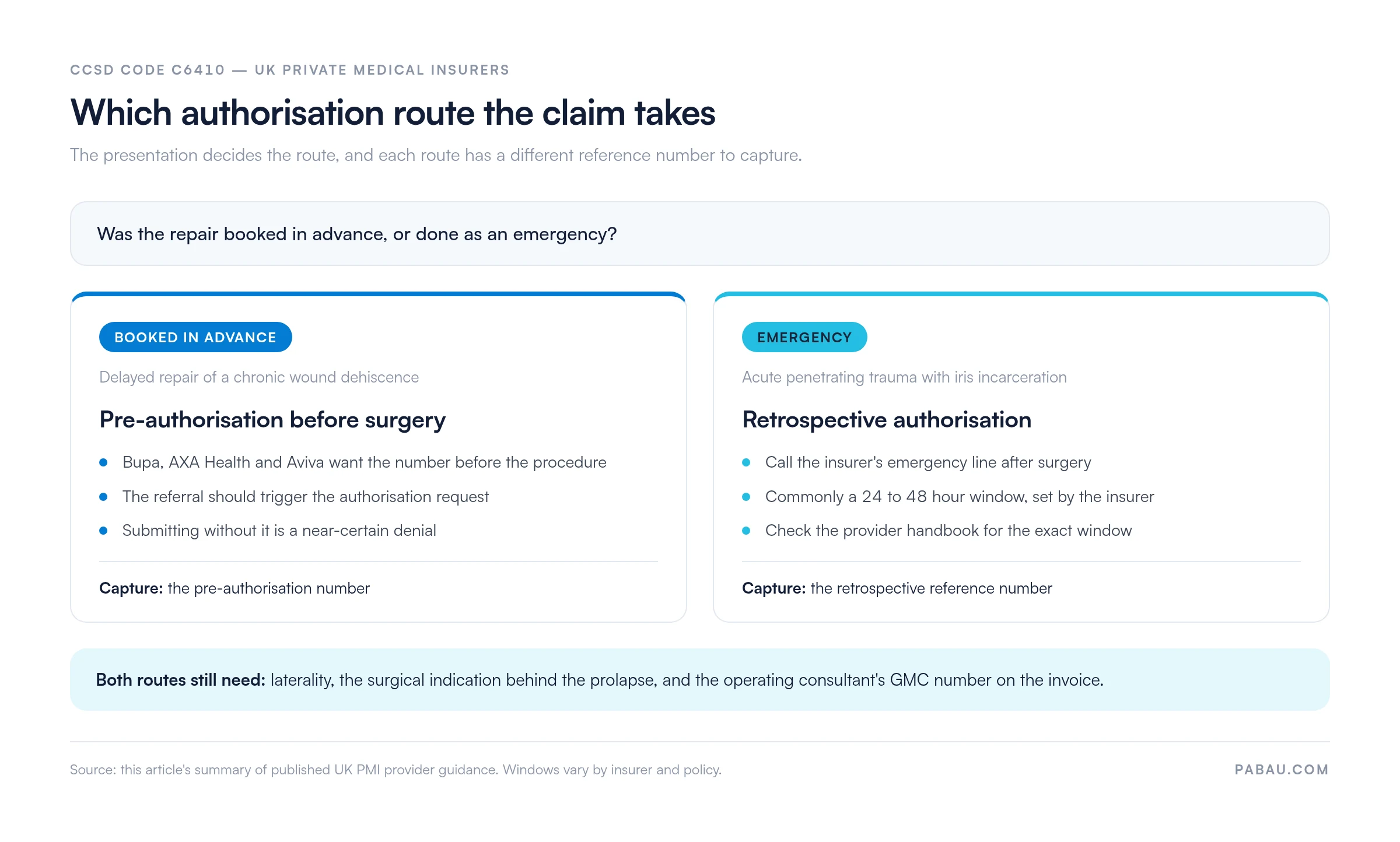
In general, UK PMI practice around C6410 follows these patterns:
The patterns below account for most C6410 rejections across the major UK PMIs. Practices can prevent each one at the point where the surgeon writes the operative note.
Run a monthly audit on the C6410 claims from the previous quarter. Check that every claim carries a pre-authorisation number or a documented emergency pathway. Check that every operative note states laterality. Check that the surgical indication in the note matches the code billed. Three passes over a short list catch most denial causes before they compound.
The Healix billing rules and the CCSD technical guide shape what can sit alongside C6410 on a single claim.
Whether a secondary code is acceptable depends on whether each procedure was clinically distinct, whether the surgeon documented it separately, and whether it required its own operating time and clinical decision-making.
UK ophthalmology practices billing private patients under the CCSD schedule lean on their software for three jobs. It has to handle code attachment, pre-authorisation tracking, and operative note storage without manual workarounds. Pabau is practice management software built around that kind of workflow.
Pabau’s claims management software attaches CCSD Code C6410 to the correct patient encounter record. It flags whether a pre-authorisation number was obtained before the case reaches billing. Operative documentation is stored against the appointment, so coders can find the note, the code and the authorisation reference in one place.
Post-cataract complications and trauma cases arrive on different authorisation routes. Flagging the emergency pathway and recording the retrospective reference in the same system cuts the admin load of juggling several PMI rulebooks. It also means the documentation a UK insurer asks for months later is still attached to the case.
Fewer denials at first pass, faster reimbursement, and more consistent operative notes across the consultant team are what an integrated CCSD workflow buys. Book a demo to see how Pabau handles CCSD billing for UK private ophthalmology.

Pabau attaches CCSD Code C6410 to the right encounter, tracks pre-auth requirements, and stores operative documentation. Your team spends less time chasing denials.

CCSD Code C6410 is a narrow code. It covers repair of a prolapsed iris and nothing beyond that. The three failure modes are familiar. A note omits laterality or the surgical indication, the iridectomy code gets billed instead, or wound closure that belongs to the repair is unbundled.
An operative note template that prompts for those fields, plus a pre-submission check on every C6410 claim, prevents each one. Both are workflow changes, and they are where first-pass acceptance improves.
Getting that right keeps cash moving instead of sitting in a denials queue. Book a demo to see how Pabau keeps CCSD claims, authorisations and operative notes on one record.

Coding a foreign body in the iris? CCSD code C6450 covers its removal and the note insurers expect.
Billing the cataract procedure that came first? CCSD code C7123 sets out phacoemulsification without lens implant and the authorisation route it takes.
Injecting into the anterior chamber? CCSD code C6930 explains when the injection is billed on its own and what the operative note must record.
Working through a vitreoretinal case? CCSD code C5480 walks through removal of silicone oil, its pre-authorisation route and its denial triggers.
Checking what Bupa recognises? Bupa CCSD codes explains how the schedule is structured and where recognition fees sit against each code.
CCSD Code C6410 covers surgical repair of a prolapsed iris. That includes repositioning displaced iris tissue back into the anterior chamber, and excising incarcerated tissue where repositioning is not possible. It does not cover a standalone elective iridectomy, which has its own CCSD code.
C6410 applies when the surgical intent is to repair a prolapsed iris after wound dehiscence or trauma. That holds even where iris tissue is excised as part of the repair. An iridectomy code applies when the planned intent is elective excision of iris tissue, for example to relieve pupillary block in angle-closure glaucoma. The surgical indication stated in the operative note decides it.
C6410 can be billed alongside a cataract code where the iris repair happened at a separate return-to-theatre visit from the original cataract extraction. Where both interventions happened in the same sitting, bundling rules may apply and payer confirmation is advisable. Document the two surgical steps clearly in the operative note to support separate billing.
Coverage depends on the individual patient’s policy terms. Most comprehensive UK PMI policies cover surgical repair of complications arising from a covered procedure such as cataract surgery. Cover for trauma-related iris prolapse repair may be subject to specific policy exclusions, so verify the patient’s policy before the procedure.