CPT Code 62284: Injection procedure for myelography
CPT Code 62284: official descriptor and procedure overview The American Medical ...

Last Updated: Oct 19, 2026
A2953 is the CCSD code for excision of acoustic neuroma (vestibular schwannoma) performed by a single surgeon. It applies where the tumour is more than 2.5cm or compressing the brainstem, and either criterion qualifies on its own.
Smaller tumours without brainstem compression fall under A2952, which is also a single-surgeon code. When a combined oto-neurosurgical team operates, the correct code is A2954, whatever the tumour size.
Let Pabau's smart automation suggest the right codes, reduce claim denials, and keep your practice compliant—effortlessly.
Automate repetitive tasks and focus on what matters most—your patients.
Reduce coding errors and ensure compliance with the latest regulations.
Clean claims, fewer denials, and faster reimbursements.
Powerful insights and reporting to help your practice thrive.
HIPAA compliant SOC 2 certified GDPR-compliant Trusted by 4,000+ clinics worldwide

CCSD Code A2953 covers acoustic neuroma excision by a single surgeon where the tumour is more than 2.5cm or compressing the brainstem.
A2952 is the single-surgeon code for tumours under 2.5cm without brainstem compression, and A2954 covers excision by a combined oto-neurosurgical team at any size.
Every claim requires documented tumour size on pre-operative MRI, confirmed brainstem compression where applicable, and a detailed single-surgeon operative note.
All major UK private insurers require pre-authorisation before the procedure. A claim submitted without prior approval is rejected, however strong the clinical case.
CCSD Code A2953 describes the excision of an acoustic neuroma (vestibular schwannoma) by a single surgeon. It applies where the tumour is more than 2.5cm in diameter or is compressing the brainstem. The code is one of the neurosurgery CCSD codes published and maintained by the Clinical Coding and Schedule Development Group.
Two criteria determine eligibility. The tumour must meet the size or compression threshold, and a single surgeon must perform the excision. When a combined oto-neurosurgical team operates, the case is billed under A2954 instead.
Acoustic neuromas are benign tumours arising from the Schwann cells of the vestibulocochlear nerve (cranial nerve VIII). Most grow slowly. Tumours beyond 2.5cm carry much higher surgical risk because they sit close to the brainstem, the facial nerve and the cochlear nerve.
Brainstem compression, whatever the absolute tumour size, signals a degree of mass effect that places surgery in the higher-complexity category. The CCSD descriptor uses “or” rather than “and”, so either criterion alone qualifies a case for A2953.
CCSD Code A2953 covers the surgical episode of care for removing a qualifying acoustic neuroma. This includes the craniotomy, microsurgical tumour dissection, facial nerve monitoring and intraoperative preservation manoeuvres. One surgeon carries out all of it within a single operating episode. It does not cover the anaesthetic (billed separately by the anaesthetist), assistant surgeon fees, or post-operative follow-up consultations.
Several scenarios fall outside A2953:
Vestibular schwannoma, acoustic neurinoma and CN VIII tumour are all clinical synonyms for acoustic neuroma. The operative note can use any of them without changing the code selection.
A frequent coding error on acoustic neuroma claims is picking the wrong code from the A295x series. A2953 and A2952 are both single-surgeon codes. The only difference between them is tumour size or brainstem compression, and A2952 covers tumours under 2.5cm with no compression.
A2954 is the two-surgeon code, used when a combined oto-neurosurgical team performs the excision at any tumour size. Check each descriptor against the current CCSD Technical Guide before billing, because descriptors can change when the schedule is updated. The choice comes down to two questions, in the order shown below.
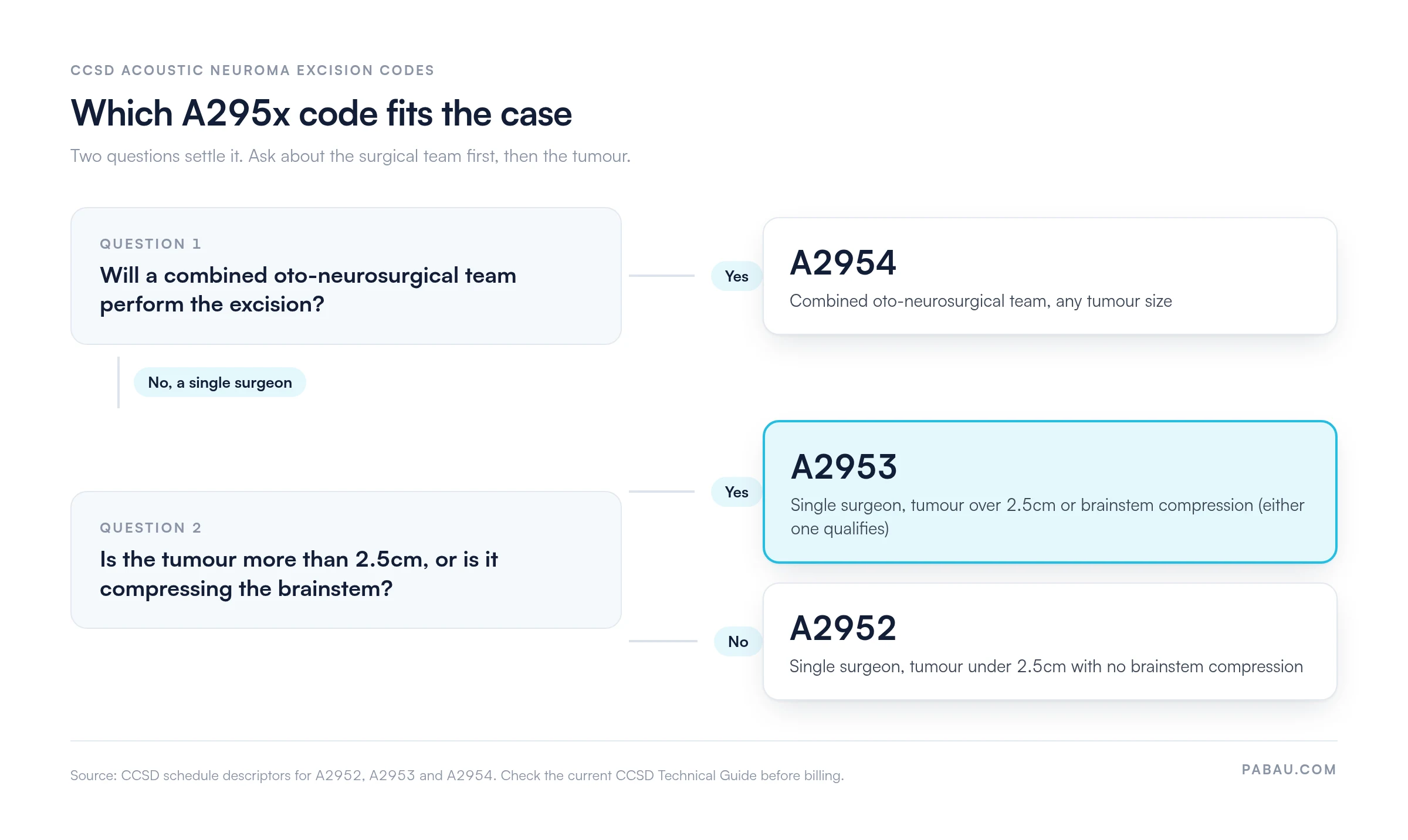
Applying A2953 to a tumour below the size and compression threshold is upcoding. So is using it for a combined-team case that belongs under A2954. Applying A2952 to a case that meets the A2953 criteria leaves the surgeon underpaid. Both errors are avoidable when the pre-operative documentation is reviewed before the claim goes in.
Acoustic neuroma excision reaches the tumour through one of three main surgical corridors, each offering different trade-offs between hearing preservation and access. CCSD Code A2953 applies whichever approach the surgeon uses. The corridor changes only the rationale documented in the operative note.
The operative note must name the approach and describe the extent of tumour excision. It should also confirm that facial nerve (CN VII) continuity was assessed throughout. Intraoperative neurophysiological monitoring (IONM) of the facial and cochlear nerves is standard practice for tumours of this size. Document its use even when no separate IONM code is claimed.
A complete and defensible A2953 claim rests on documentation that mirrors the code descriptor exactly. Insurers scrutinise three points: the tumour qualification (size or brainstem compression), the single-surgeon confirmation, and the accuracy of the paired ICD-10 diagnosis code. Missing any one of them is grounds for rejection.
The minimum documentation set for an A2953 claim:
Avoid generic neoplasm codes (such as D36.9, benign neoplasm of unspecified site) for A2953 claims. Generic codes trigger clinical review because they do not confirm the anatomical specificity the code descriptor requires. Always verify the current NHS Classifications or insurer-preferred coding against the NHS Classifications Browser.
Every major UK private insurer treats acoustic neuroma excision as a high-complexity elective procedure requiring pre-authorisation before surgery. Proceeding without written approval typically results in the entire claim being declined, regardless of how well-documented the procedure itself is. This applies to Bupa, AXA Health, Aviva, Vitality, WPA, and Cigna, though the specific pre-auth pathway differs by insurer.
The pre-authorisation process usually runs in five steps:
For Bupa specifically, the Bupa CCSD codes guide outlines which neurosurgery codes need pre-auth. It also explains how to submit authorisation requests through the Bupa provider portal. Aviva’s fee schedule, accessible via their provider fee schedule page, lists CCSD-coded procedures and the associated pre-auth requirements for each chapter. WPA publishes its neurosurgery requirements through its medical fees page for recognised providers.
Insurer-specific pre-auth requirements change periodically. Always verify against each insurer’s current provider handbook before submission, particularly after annual CCSD schedule updates.
Build a pre-auth tracker in your practice management system with a field for each insurer’s reference number. Flag any CCSD Code A2953 case as requiring pre-auth at the point of booking, not at the point of billing. A missing authorisation reference on an invoice is the single fastest path to a complete claim rejection.
Rejected A2953 claims tend to trace back to the same few documentation and coding failures. Pin down the insurer’s exact reason first, because the appeal letter has to answer that specific objection. A general defence of clinical necessity leaves the stated reason unanswered, and the claim stays rejected.
Appeals should reference the relevant CCSD Technical Guide descriptor and attach the supporting documentation directly. Sometimes the insurer’s clinical assessor has missed the brainstem compression criterion in the A2953 descriptor. A brief citation of the code’s published wording often resolves that dispute without escalation.
A2953 covers the primary surgical episode only. Several additional services are legitimately billable alongside it, subject to insurer-specific bundling rules. Knowing which services sit outside A2953 prevents both undercharging and accidental overbilling. Record each insurer’s co-billing rules in the billing workflow so the team applies them consistently.
Never include the anaesthetic or assistant surgeon fees on the operating surgeon’s invoice for A2953. UK private insurers process each provider’s claim separately, and conflating fees on a single invoice creates audit risk and delays payment for all parties.
Check each insurer’s current provider handbook before billing any co-codes alongside CCSD Code A2953. Bupa, AXA, and Aviva all publish bundling guidance that changes with annual CCSD schedule updates. What was separately billable in a previous schedule year may now be considered inclusive within the primary surgical fee.
Without a shared system, A2953 paperwork gets chased at invoice time. The pre-authorisation reference sits in one inbox, the MRI report in another system and the operative note in a third.
Practice management software like Pabau keeps the patient, treatment and insurer details on one record. Its medical claims management tool pulls those details into a pre-filled Healthcode submission with the invoice attached. It also checks that the membership number and authorisation code are in place before the claim goes out.
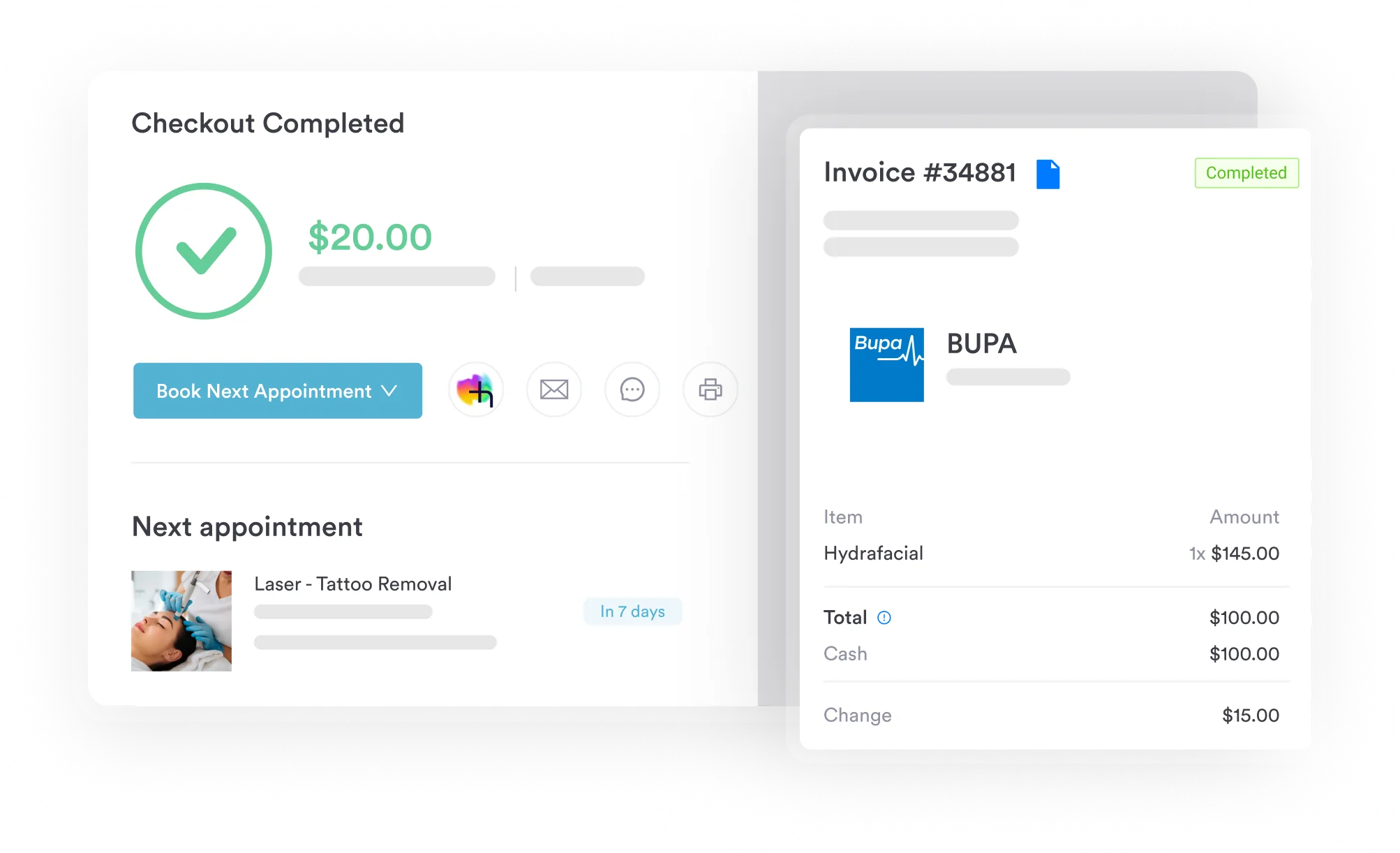
Each claim then moves through clear stages, from pending and submitted to paid or error, in a single view. Your billing team sees a rejected A2953 claim the day it happens, while there is still time to appeal.

Pabau pre-fills Healthcode claims from the patient record, checks that authorisation codes are in place, and tracks each claim from submission to payment.

The costly mistake with A2953 is choosing the code after surgery, when the documentation can no longer change. Settle it at the pre-authorisation stage instead, using the MRI report and the planned surgical team.
If a combined oto-neurosurgical team will operate, the claim belongs under A2954. If the tumour is under 2.5cm with no brainstem compression, it belongs under A2952. Any single-surgeon case that meets the size or compression threshold is A2953.
Writing the operative note to the descriptor during the episode takes minutes, and reconstructing it after a rejection takes weeks. Book a demo to see how Pabau keeps authorisation codes and claim status together for your highest-value surgical invoices.

Need a framework for the Bupa CCSD schedule? Bupa CCSD codes guide covers the Bupa procedure code structure, chapter navigation, and which codes require pre-authorisation.
Billing another intracranial nerve excision? CCSD Code A2900 explains how to code excision of a lesion of a cranial nerve inside the skull.
Coding spinal tumour surgery as well? CCSD code V4980 walks through billing for excision of an intramedullary tumour.
Looking up a different procedure code? CCSD codes brings together Pabau’s guides to the codes UK private insurers use.
CCSD Code A2953 covers excision of an acoustic neuroma (vestibular schwannoma) by a single surgeon. The tumour must be more than 2.5cm in diameter or compressing the brainstem. It applies whichever surgical approach is used (retrosigmoid, translabyrinthine or middle fossa). UK private insurers including Bupa, AXA Health and Aviva use it for billing.
No. The A2953 descriptor states the procedure must be performed by a single surgeon. When a combined oto-neurosurgical team operates together, the correct code is CCSD code A2954, whatever the tumour size. An assistant surgeon in a subordinate role does not make it a combined-team case. The operative note should describe the assistant’s limited role clearly.
The threshold is more than 2.5cm in maximum diameter on pre-operative MRI. Brainstem compression is an alternative qualifying criterion, so a smaller tumour that compresses the brainstem on MRI may also qualify for A2953. Either criterion is sufficient on its own, and both do not need to be present.
D33.3 (benign neoplasm of cranial nerves) is the primary ICD-10 diagnosis code accepted by most UK private insurers for acoustic neuroma claims. H93.3 (disorders of acoustic nerve) is accepted by some insurers as an alternative or secondary code. Avoid generic neoplasm codes such as D36.9, as these trigger clinical review due to insufficient anatomical specificity.