

CCSD code G5100: Bypass of duodenum billing guide
CCSD code G5100 bills a bypass that leaves the duodenum in place CCSD code G5100...

Last Updated: Oct 16, 2026
A2900 is the CCSD code for excision of a lesion of a cranial nerve through an intracranial approach. It covers open surgical removal of a lesion on a cranial nerve inside the skull. Trigeminal, facial, and lower cranial nerve schwannomas and neurofibromas are the usual indications.
Acoustic neuroma (vestibular schwannoma) is not coded A2900. It has its own codes, A2952, A2953, and A2954. UK private insurers, including Bupa and AXA Health, require pre-authorization before the procedure. The operative note must name the nerve, the approach, and the extent of resection.
Let Pabau's smart automation suggest the right codes, reduce claim denials, and keep your practice compliant—effortlessly.
Automate repetitive tasks and focus on what matters most—your patients.
Reduce coding errors and ensure compliance with the latest regulations.
Clean claims, fewer denials, and faster reimbursements.
Powerful insights and reporting to help your practice thrive.
HIPAA compliant SOC 2 certified GDPR-compliant Trusted by 4,000+ clinics worldwide

CCSD Code A2900 covers excision of a lesion on a cranial nerve through an open intracranial approach, and it excludes extracranial and stereotactic procedures.
Trigeminal, facial, and lower cranial nerve schwannomas, neurofibromas, and lesions adherent to a cranial nerve are the usual A2900 indications.
Acoustic neuroma (vestibular schwannoma) excision is not coded A2900; it has its own codes, A2952, A2953, and A2954.
Bupa and AXA Health both require pre-authorization before A2900 procedures, and a missing authorization number is the leading cause of claim rejection.
Practice management software like Pabau keeps A2900 documentation, pre-authorization tracking, and claim submission in one system for UK private practices.
CCSD Code A2900 is the Clinical Coding and Schedule Development (CCSD) procedure code that describes excision of lesion of cranial nerve (intracranial). It sits in the neurosurgery section of the schedule of CCSD codes, which governs how UK private medical insurers process surgical claims.
The code applies to open surgical removal of a pathological lesion on a cranial nerve inside the skull. That separates it from peripheral nerve excision and from non-surgical treatment such as stereotactic radiosurgery. Removing a lesion from a peripheral nerve instead carries its own entry, CCSD code A6110, in sub-section 3.6.
The CCSD is governed by four UK private medical insurers: Bupa, Vitality, AXA Health, and Aviva. Its schedule gives surgeons and insurers one standardized procedure language, and other UK insurers also accept it.
Every surgeon billing A2900 must use the exact code descriptor from the current schedule. Paraphrasing the descriptor can lead to the claim being mapped to a different code on adjudication.
The CCSD schedule groups codes by anatomical region and procedure type. A2900 sits in Chapter 2 (brain, cranium and other intracranial organs), under the Nerves category, and is rated CMO 5 (Complex). Directly beside it are A2952, A2953, and A2954, the dedicated codes for acoustic neuroma excision.
Codes in this chapter generally carry higher fees than peripheral nerve codes. The surgical complexity, operating room time, and intraoperative monitoring explain the difference. Coders should verify the current edition of the CCSD schedule for the active fee band, as fee values are commercially negotiated and updated periodically.
Freeing a peripheral nerve from compression and then re-routing it is a different operation. That work is billed under CCSD code A6810, which sits in Chapter 3 rather than Chapter 2.
A2900 describes an open intracranial procedure performed by a consultant neurosurgeon to remove a discrete lesion from a cranial nerve. The approach, duration, and complexity vary by the nerve affected and the lesion’s size and position, but all A2900 procedures share the core elements below.
The operative note must document each of these stages explicitly. Insurers use the operative note as the primary evidence that the A2900 procedure took place. A note that simply states “cranial nerve lesion removed” without the intracranial approach will often trigger a documentation query.
A2900 applies when a discrete intracranial lesion on a cranial nerve requires open surgical excision. The lesion type must be confirmed or strongly suspected on preoperative imaging and, where possible, confirmed by postoperative histopathology.
Surgeons moving from NHS to private neurosurgical practice should expect closer scrutiny of code choice. Private insurers review claims more closely than NHS episode coding.
The acoustic neuroma row is the exclusion that trips coders most often. CCSD coding follows the most specific code available, and vestibular schwannoma has three dedicated codes. A2900 is for cranial nerve lesions that no other CCSD code describes.
The meningioma row carries a similar exclusion. A tumor taken from the meninges alone, without cranial nerve involvement, is coded A3810 instead.
Trigeminal neuralgia caused by vascular compression, without a discrete lesion, does not fall under A2900. That presentation is addressed by microvascular decompression codes, not excision codes. That decompression is coded A3200 when the approach is a craniotomy. Coders should confirm the operative note specifies a lesion was present and excised, not merely that decompression was performed.
A2900 is one of several intracranial neurosurgery codes in the CCSD schedule. Selecting the wrong code is a common source of claim rejections and audit queries. The table below highlights the codes most frequently confused with A2900 and the key differentiator for each.
Gamma Knife or CyberKnife treatment for a cranial nerve schwannoma should never be coded under A2900. The descriptor explicitly specifies excision, meaning open surgical removal. Radiosurgery has its own dedicated CCSD codes and a different fee band. Verify the current CCSD schedule for the exact neighboring code numbers, as these can be renumbered in schedule updates.
The four checks below run in the order a coder meets them in the operative note.
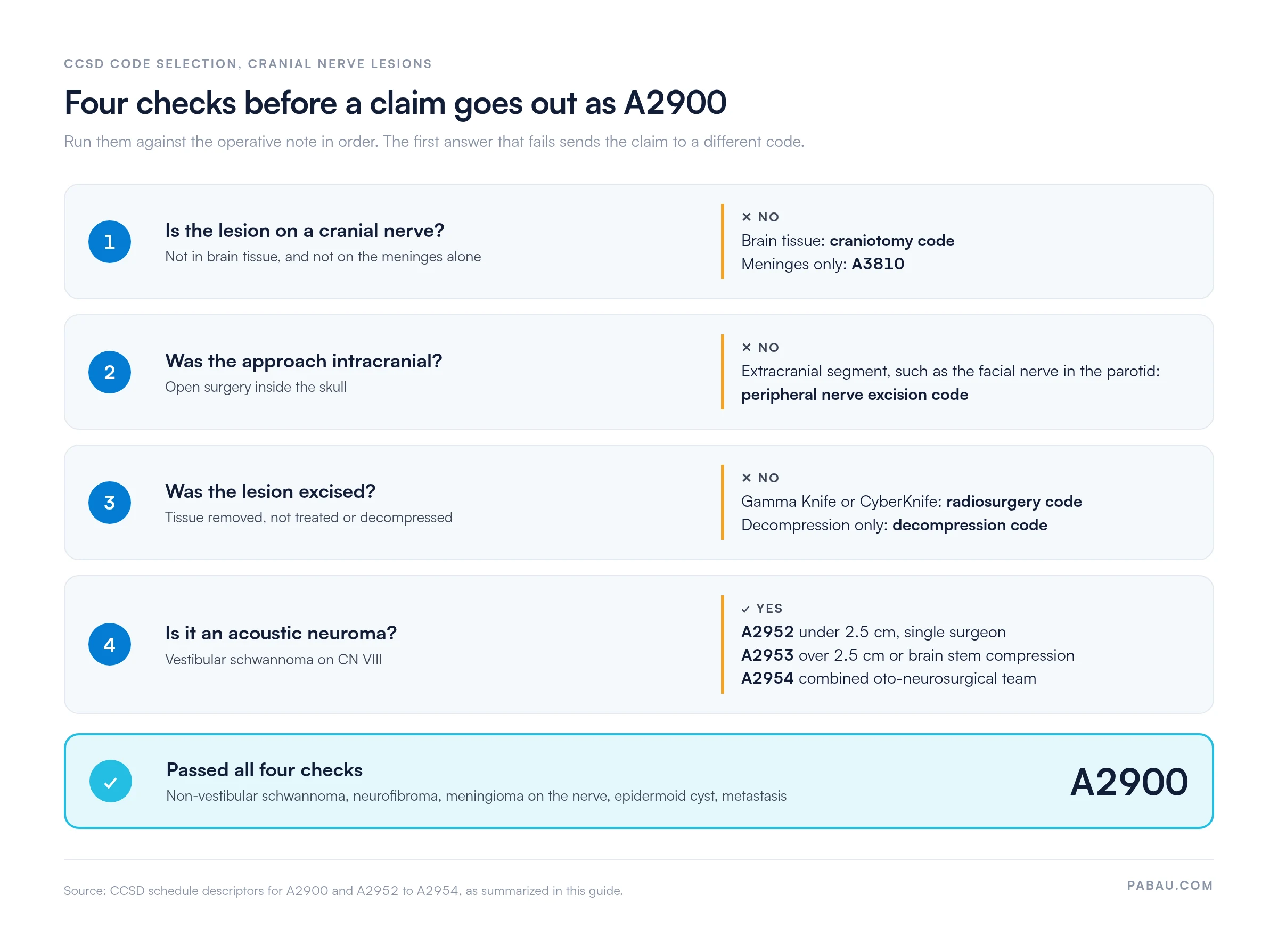
Before selecting A2900, confirm two things in the operative note. First, the lesion was on a cranial nerve, not in adjacent brain parenchyma or the meninges, and was not a vestibular schwannoma. Second, the approach was intracranial (open surgical). If either criterion is absent, a different code applies. Insurers increasingly use automated audit tools that flag claims where the operative note terminology does not align with the code descriptor.
All UK private medical insurers treat A2900 as a major surgical procedure requiring pre-authorization before the operation takes place. A claim with authorization obtained after surgery, or never obtained, is almost always rejected.
The Bupa fee schedule requires that consultants or their billing teams obtain an authorization number before submitting any major intracranial surgical claim. Confirm requirements directly with each insurer before proceeding, as policies are updated periodically.
The typical pre-authorization process for A2900 runs as follows:
Typical authorization turnaround is three to 10 business days, though urgent cases may be processed faster. Some emergency intracranial procedures cannot wait for pre-authorization. In that case, the billing team should call the insurer’s emergency line straight after surgery and record the clinical urgency in the patient file. Confirm the insurer’s emergency authorization process before relying on retrospective approval.
Insurers judge an A2900 claim on its documentation, first at submission and again in any post-payment audit. The clinical record needs each of the elements below for the claim to hold up.
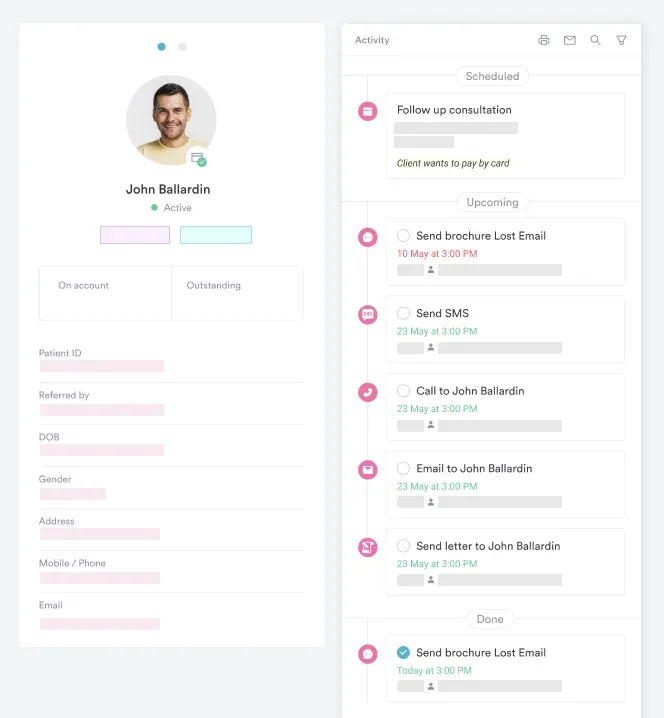
Submitting an A2900 claim follows a standard private insurer workflow, with minor portal and form differences between insurers. The steps below apply across Bupa, AXA Health, Aviva, and Vitality. Verify each insurer’s current portal requirements before submission.
Claim processing for major intracranial procedures typically takes 15 to 30 business days. If the claim is not adjudicated within that window, follow up with the insurer’s provider services team using the claim reference number. Tracking each claim in claims management software cuts chase time and flags stalled claims before they age into write-offs.
A2900 denials follow a recognizable pattern across UK private insurers. Each one below has a fix a billing team can apply before submission. Where a patient has moved between NHS and private care, also confirm which payer is responsible for the claim.
A2900 is sometimes performed alongside procedures billed as companion codes. Bundling rules vary by insurer and change with each schedule revision. The safest approach is to verify the companion code position with the relevant insurer’s provider services team before submission. Recording which codes were billed, and why, in the patient file protects against audit queries on companion billing.
Several clinical scenarios sit in grey territory for A2900 coding. These are the situations where a reflexive code selection based on the procedure name alone leads to claim rejection or audit. Each scenario below comes up in UK private neurosurgery billing, and each needs specific documentation to support the code choice.
In neurofibromatosis type 2 (NF2), schwannomas can affect several cranial nerves on both sides, such as bilateral trigeminal or lower cranial nerve tumors. Any vestibular schwannoma in that picture is still coded A2952, A2953, or A2954, not A2900.
For the other nerves, the general rule is one A2900 claim per surgical episode. If both sides are addressed in one operation, agree the coding approach with the insurer’s clinical coding team before submitting. Some insurers apply a bilateral procedure rule that reduces the fee for the second nerve.
A2900 applies to revision surgery for a recurrent cranial nerve lesion just as it does to the first operation. The operative note must still document that a lesion was excised. The revision context does not change the code.
However, some insurers may require an updated pre-authorization even if the original procedure was authorized, because the clinical situation has changed. Confirm the pre-authorization status before proceeding with revision surgery and note the recurrence in the operative note.
A cranial nerve lesion is sometimes discovered during surgery planned for a different indication. An incidental lower cranial nerve schwannoma found during a posterior fossa exploration is one example. A2900 applies only if the lesion was excised during that procedure. Discovery alone does not justify the code. The operative note must state that excision was performed.
If the excision was not the authorized indication, a separate retrospective pre-authorization may be needed. Contact the insurer immediately after surgery in these circumstances and document the clinical rationale for proceeding with excision at that time.
A2900 covers both complete and partial excision of a cranial nerve lesion. The operative note must document the extent of resection and the reason for leaving residual tissue, such as adhesion to the facial nerve.
Insurers may query claims where the histopathology report confirms only a small fragment was removed. The operative note must justify partial resection in clinical terms, not simply state “partial removal performed.”
For every A2900 edge case, contact the insurer’s provider services team before submitting and note the conversation in the patient file. A phone confirmation before submission, with the name of the person and the date, often prevents a denial based on unusual circumstances.
An A2900 claim draws on records held in different places. The authorization number sits in an email, the operative note in the hospital system, and the histopathology report arrives weeks later. One missing piece is enough to send the claim back.
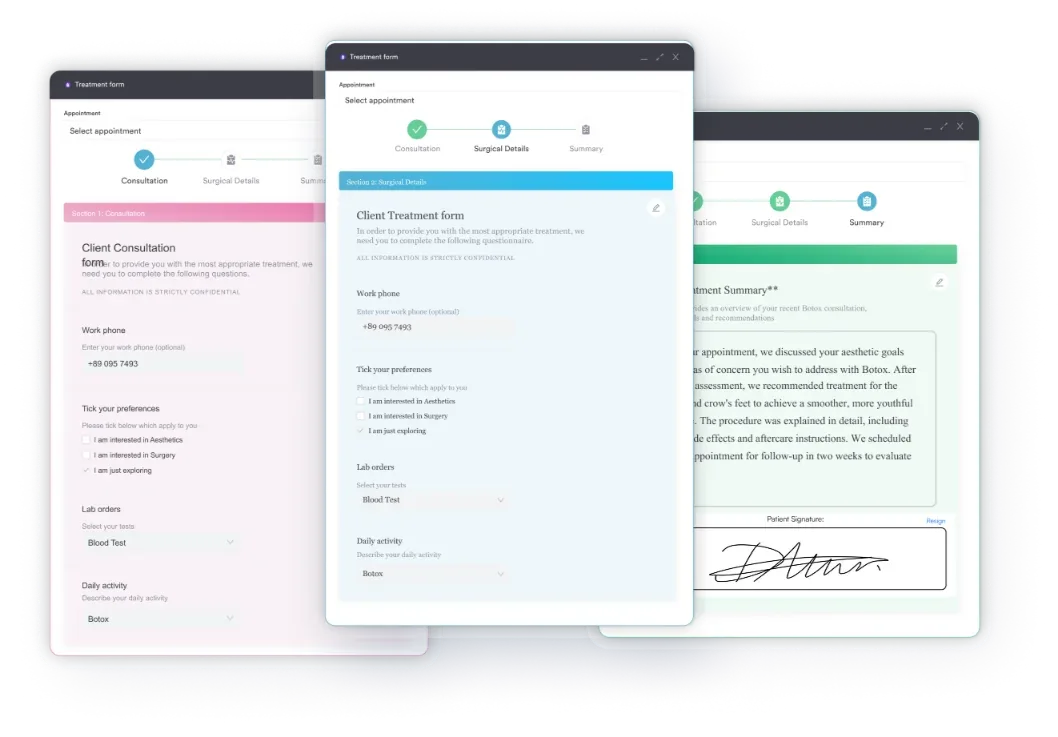
Practice management software like Pabau keeps those records on one patient file. Digital forms capture consent and intake details before surgery. The authorization reference is stored against the booking, so it is on hand when the claim is built.
Operative note templates can carry the A2900 fields: the named cranial nerve, the approach, and the extent of resection. When the histopathology report lands, it is added to the same record and attached to the claim without a search.

Pabau tracks pre-authorization, stores operative documentation, and manages CCSD claim submissions in one system. See how it works for your neurosurgery or private specialist practice.

A2900 has a narrow scope: open intracranial excision of a lesion on a cranial nerve that no more specific CCSD code covers. Acoustic neuroma sits outside it and goes to A2952, A2953, or A2954.
The cheapest point to fix an A2900 claim is before the authorization request goes in. Check the operative note against the descriptor at that stage. A note that names the nerve, the approach, and the extent of resection supports both the code and the claim.
Book a demo to see how Pabau tracks pre-authorization and operative documentation before a CCSD claim goes out.

Need a full reference for CCSD codes accepted by Bupa? Bupa CCSD codes covers the full schedule of procedure codes accepted for Bupa claim submissions.
Repairing a cranial nerve rather than removing a lesion? CCSD code A3000 covers intracranial cranial nerve repair and how to document it.
Coding a lesion inside the dura of the spine? CCSD code A5110 walks through excision of an intradural lesion, from pre-authorization to claim.
CCSD Code A2900 covers excision of lesion of cranial nerve (intracranial). That means open surgical removal of a pathological lesion on a cranial nerve inside the skull. It does not cover extracranial nerve surgery, stereotactic radiosurgery, or cranial nerve decompression without lesion removal.
Qualifying lesions include trigeminal, facial, and lower cranial nerve schwannomas, neurofibromas, meningiomas arising from or encasing the nerve, epidermoid cysts, and cranial nerve metastases. Vestibular schwannoma (acoustic neuroma) does not qualify, because it has its own codes. Trigeminal neuralgia from vascular compression without a lesion uses decompression codes instead.
No. Excision of an acoustic neuroma (vestibular schwannoma) has three dedicated CCSD codes. A2952 covers tumors under 2.5 cm and A2953 covers larger tumors or brain stem compression, both by a single surgeon. A2954 covers a combined oto-neurosurgical team at any size.
Yes, Bupa requires pre-authorization for all major intracranial surgical procedures, including A2900. The authorization must be obtained before the operation, and the authorization number must appear on the claim submission. Emergency procedures should be reported to Bupa immediately after surgery with clinical documentation of the urgency.
A2900 claims require a detailed operative note from the consultant neurosurgeon and a gadolinium-enhanced MRI report confirming the lesion. They also need a histopathology report, an anesthesia record, and the pre-authorization letter with its authorization number. The claim must be submitted under the operating consultant’s GMC number.
The leading denial reason is missing or retrospective pre-authorization. An operative note without intracranial approach details is another. Claims also fail when a peripheral nerve or radiosurgery code replaces A2900, or when the consultant is not recognized by that insurer. Policy exclusions for pre-existing conditions are a secondary denial category.
The operating surgeon does not bill anesthesia codes alongside A2900. The anesthesiologist submits their own separate CCSD claim for the intracranial anesthesia. Intraoperative neurophysiological monitoring may be billable separately depending on the insurer, but should be confirmed with each payer before submission as rules vary.
Yes, AXA Health uses CCSD codes including A2900 for neurosurgical procedure claims, as do Aviva, Vitality, WPA, Healix, Allianz Care, and Cigna UK. The code descriptor is standardized across all CCSD-adopting insurers, though each insurer’s portal, pre-authorization process, and companion code rules differ and should be confirmed individually.



