CPT code 93503: Swan-Ganz catheter billing and modifiers
CPT code 93503: Official descriptor and procedure overview In the AMA CPT code s...

Last Updated: Oct 23, 2026
A1250 is the CCSD code for creation of subcutaneous cerebrospinal fluid reservoir. It sits in the Brain section of the CCSD schedule. It is the surgeon's fee for implanting a reservoir, such as an Ommaya, with its ventricular catheter.
A1250 is a creation-only code. Later visits that access the reservoir to aspirate CSF or inject drugs are not billed under A1250.
Let Pabau's smart automation suggest the right codes, reduce claim denials, and keep your practice compliant—effortlessly.
Automate repetitive tasks and focus on what matters most—your patients.
Reduce coding errors and ensure compliance with the latest regulations.
Clean claims, fewer denials, and faster reimbursements.
Powerful insights and reporting to help your practice thrive.
HIPAA compliant SOC 2 certified GDPR-compliant Trusted by 4,000+ clinics worldwide

CCSD Code A1250 covers surgical creation of a subcutaneous CSF reservoir, not later aspiration or injection through it.
The Ommaya reservoir is the device most often implanted under A1250, typically for intraventricular chemotherapy or CSF sampling.
All major UK private insurers, including Bupa, AXA Health and Aviva, require pre-authorisation for elective A1250 procedures. Emergency implantation needs retrospective justification instead.
The anaesthetist bills separately under the insurer’s anaesthetic fee schedule, so anaesthesia is never bundled within A1250.
Pabau, the practice management platform we build, supports CCSD code entry on invoices and records the authorisation code on each claim.
CCSD Code A1250 covers the creation of a subcutaneous cerebrospinal fluid reservoir. The CCSD schedule defines it, and the Clinical Coding & Schedule Development Group (CCSD) maintains that schedule. The code applies when a surgeon implants a reservoir under the scalp and connects it by catheter to the ventricular system or subdural space.
Later aspiration, injection or revision through the reservoir is not A1250. Code and bill those visits according to the CCSD technical guide and the insurer’s own rules.
Coders and billing teams should read A1250 as a creation-only code. Billing it for an outpatient appointment where an implanted reservoir is accessed for chemotherapy or CSF sampling is an unbundling error. It is also a common trigger for claim refusal.
A subcutaneous cerebrospinal fluid reservoir is a small dome-shaped silicone device implanted beneath the scalp. A catheter connects it to the lateral ventricle or subdural space. Cerebrospinal fluid lines the brain and spinal cord. The reservoir gives clinicians a port into that system through the skin, without repeated lumbar punctures or open neurosurgical access.
The Ommaya reservoir is the most widely used device in this category, though the Rickham and Salmon-Rickham reservoirs are also in clinical use. All three sit under the scalp on the skull. Clinicians can feel them through the skin and reach them by needle through intact skin.
The CCSD descriptor uses the term “subcutaneous cerebrospinal fluid reservoir” for the device class rather than any single manufacturer’s product. So A1250 applies to Ommaya, Rickham and similar devices.
Surgeons most often perform the procedure covered by CCSD Code A1250 to deliver intraventricular chemotherapy. Patients usually have leptomeningeal carcinomatosis or carcinomatous meningitis, where cancer cells have seeded the leptomeninges and need direct CNS drug delivery. Patients tolerate repeated lumbar puncture poorly over long treatment courses, so the reservoir offers a more reliable route.
Beyond cancer care, clinical indications include:
The indication must appear in the operative note and, where insurers require it, in the pre-authorisation request. A vague indication such as “CNS disease” will not satisfy most private medical insurers’ clinical evidence requirements.
The consultant neurosurgeon carries out the procedure under general anaesthesia in an operating theatre. Each step below falls within A1250, which helps billing teams see what the code covers.
A1250 covers the whole sequence above, while the anaesthetist bills separately. Later use of the reservoir, such as injecting chemotherapy, aspirating CSF or sampling for culture, is not A1250. Code those encounters according to the CCSD technical guide and the insurer’s rules.
Private insurers and their clinical reviewers apply the CCSD technical guide’s bundling rules when assessing A1250 claims. The table below shows what the code covers and what you bill separately.
Several CCSD codes sit near A1250 in the Brain section of the schedule, and picking the wrong one is a frequent error on CSF-related claims. The CCSD technical guide gives the official definitions. For codes outside this family, see our CCSD reference for coders.
Never use A1250 for a shunt revision or a VP shunt procedure. The clinical descriptions differ clearly, and insurers’ clinical reviewers will spot the mismatch. Bill a VP shunt under A1240 and a standalone ventricular puncture under A2080.
A complete operative note is the main supporting document for any A1250 claim. Building it as one of your digital forms reduces the risk of missing details that trigger insurer queries. The note must include:
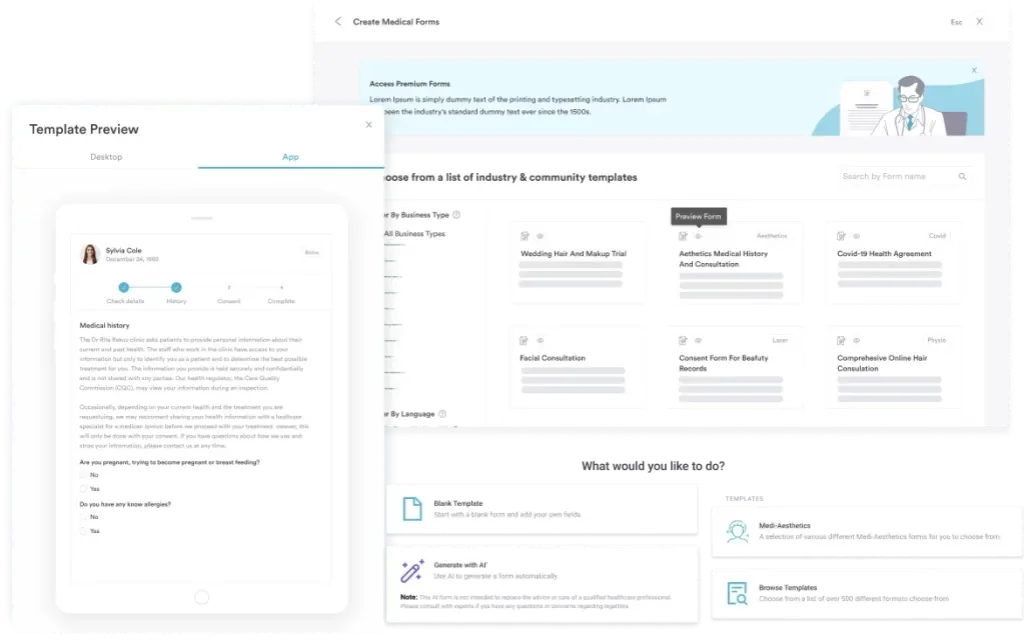
Insurers may also ask for a pre-operative MDT letter or the oncology consultant’s recommendation, mainly for cancer-related indications. Include it in the claim pack from the start rather than waiting for an information request.
Draft a standard A1250 operative note template with every mandatory field as a fixed heading. It prevents the three omissions that most often delay payment. Those are a missing device name, absent imaging confirmation and no GMC number on the invoice.
All major private medical insurers operating in the UK require pre-authorisation for elective neurosurgical procedures, and A1250 is no exception. The requirement applies to insured patients, whether treated in a private hospital or a private-patient unit in an NHS facility.
Teams new to private practice billing should build pre-authorisation checks into their workflow from day one. Retrospective authorisation is not guaranteed and often results in non-payment.
Policies change, so verify current pre-authorisation requirements on each insurer’s provider portal before submission. For a code-level overview of Bupa’s billing rules, see Bupa CCSD procedure codes.
A1250 claims fail for a handful of repeat reasons, and a tighter billing workflow prevents most of them.
When a claim is denied, ask the insurer for its written refusal reason. Insurers overturn most denials for documentation gaps on first appeal once you provide the complete operative note. Keep the pre-authorisation reference, the operative note and all insurer correspondence in the patient’s billing record.
After each A1250 procedure, set a follow-up task to code the later reservoir access visits. Code them according to the CCSD technical guide and each insurer’s rules, never under A1250. Tracking the whole episode prevents errors when different team members code access visits weeks later.
A1250 is the surgeon’s fee code. It covers the consultant neurosurgeon’s time, skill and intraoperative decision-making. Two other billable components are always present in an A1250 procedure, and you bill both separately, as the diagram below shows.
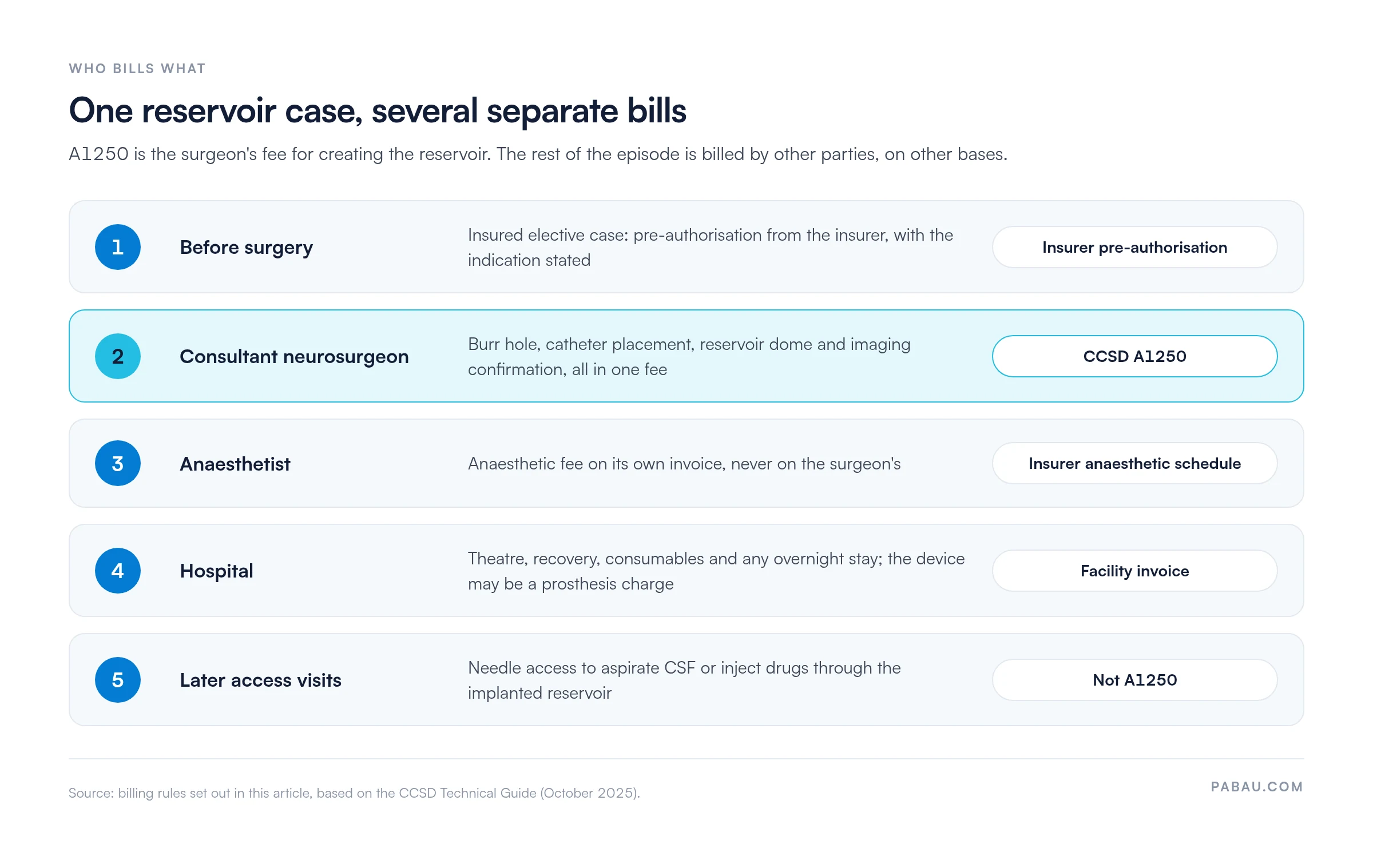
Anaesthesia: the anaesthetist bills under the insurer’s anaesthetic fee schedule, which is linked to the surgical procedure’s CCSD code or category. CCSD itself is a surgical procedure schedule with no anaesthesia codes. Anaesthetic fees should never appear on the surgeon’s invoice, and a combined line item triggers manual review.
Facility and theatre fees: the private hospital or independent sector treatment centre bills separately for theatre time, recovery, consumables and any overnight stay. The facility may bill the device itself, such as the Ommaya reservoir, as a prosthesis charge, depending on the insurer’s agreements.
Ask the facility’s billing department whether the device cost sits inside the theatre fee or on a separate line. Double-billing for device costs is a common audit trigger.
Each A1250 case runs from pre-authorisation through surgery to a series of outpatient reservoir access visits. Those visits sit outside A1250 and follow each insurer’s own rules. Across several insurers, that leaves neurosurgical practices exposed to code errors and missed authorisations.
In Pabau’s claims software for practices, CCSD codes are entered straight onto the invoice. Your team records the authorisation code on the claim, and the Send button stays disabled until the required details are in. The operative note can sit on the billing record too.
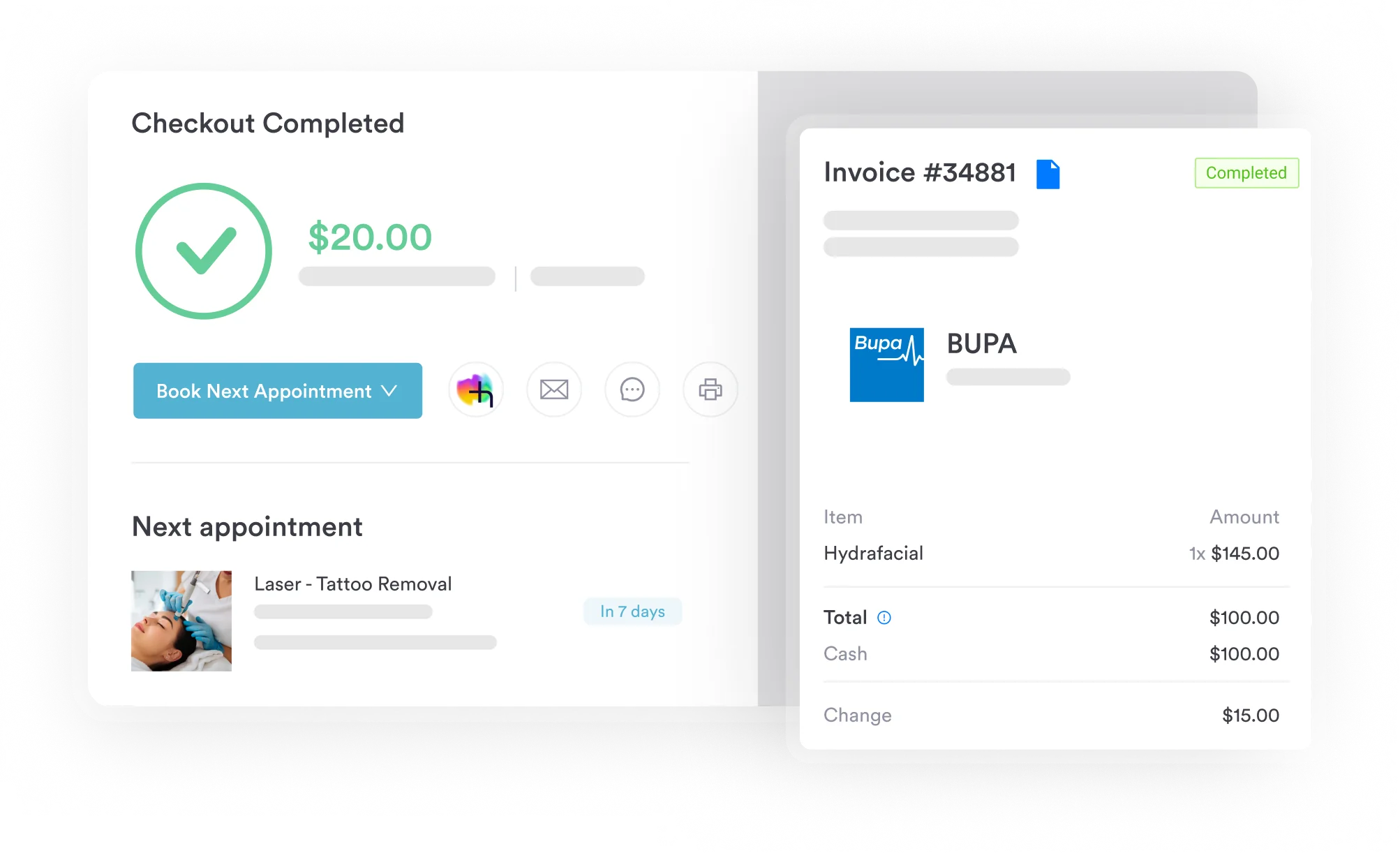
For neurosurgical consultants, Pabau’s practice management software keeps scheduling, patient records, consent and billing on one platform. That cuts the admin work between clinical and administrative teams. The audit trail at each billing step supports PHIN transparency reporting and insurer information requests.

Pabau lets neurosurgical practices enter CCSD codes on invoices and record authorisation codes on claims, so billing teams spend less time chasing refusals.

Treat A1250 as the surgeon’s fee for creating the reservoir and nothing more. Code the anaesthetic fee, the facility charges and every later access visit on their own terms, and the claim holds up under clinical review.
Most refused A1250 claims trace back to a missing pre-authorisation or an incomplete operative note. Put an authorisation check and a standard note template in place before surgery, and far fewer claims come back queried.
Book a demo to see how Pabau keeps CCSD codes, authorisation codes and operative notes together for every neurosurgical claim.

Need a complete reference for Bupa’s CCSD coding rules? Bupa CCSD procedure codes covers Bupa’s CCSD code schedule, fee conventions, and submission requirements.
Looking for a billing platform built for UK private practice? Pabau claims management supports CCSD code entry on invoices and records the authorisation code on each claim.
Coding a ventriculoperitoneal shunt instead? CCSD Code A1240 covers creation of a VP shunt, with its own indications and documentation.
Puncturing the ventricle without implanting a reservoir? CCSD Code A2080 covers ventricular puncture as a sole procedure.
Comparing billing systems for a UK private practice? Best medical billing software in the UK compares the main options for insurer billing.
CCSD Code A1250 covers the surgical creation of a subcutaneous cerebrospinal fluid reservoir. That includes the burr hole, catheter placement into the ventricular or subdural space, and implantation of the reservoir dome. Later aspiration, injection or revision through the reservoir is not A1250. Code those visits according to the CCSD technical guide and the insurer’s rules.
Yes. The Ommaya reservoir is the most commonly implanted subcutaneous CSF reservoir, and A1250 applies when one is surgically created. The code covers the device class rather than one manufacturer’s product, so it also applies to Rickham and Salmon-Rickham reservoirs.
No. Reservoir access visits for aspiration or injection are not billed under A1250. Code and bill them according to the CCSD technical guide and the insurer’s rules. Billing A1250 for an outpatient access visit is an incorrect code selection and a common denial trigger.
All major UK private medical insurers, including Bupa, AXA Health, Aviva, Vitality and Healix, require pre-authorisation for elective A1250 procedures. Policies differ in the clinical evidence required and in how emergency cases are handled. Always verify current requirements on each insurer’s provider portal before scheduling the procedure.
Only when the craniotomy is a separate procedure, performed in the same session for a different clinical purpose. Where reservoir creation is the only procedure, use A1250 alone. If a medically necessary craniotomy is also performed, check the CCSD technical guide’s rules on concurrent procedures. Ask the insurer before you submit both codes.