CPT Code 69610: Tympanic membrane patch repair (myringoplasty)
CPT code 69610: official descriptor and procedure overview CPT code 69610 descri...

Last Updated: Oct 19, 2026
25160 is the CCSD code for a trigeminal ganglion radiofrequency lesion performed under X-ray control. A radiofrequency electrode is passed through the cheek and the foramen ovale to the Gasserian ganglion, where controlled heat destroys the fibers carrying facial pain.
UK private medical insurers expect the code to be paired with ICD-10 diagnosis G50.0 and supported by an operative note that states fluoroscopy was used. Prior authorization is required before the procedure, and claims without it are rarely paid.
Let Pabau's smart automation suggest the right codes, reduce claim denials, and keep your practice compliant—effortlessly.
Automate repetitive tasks and focus on what matters most—your patients.
Reduce coding errors and ensure compliance with the latest regulations.
Clean claims, fewer denials, and faster reimbursements.
Powerful insights and reporting to help your practice thrive.
HIPAA compliant SOC 2 certified GDPR-compliant Trusted by 4,000+ clinics worldwide

CCSD code 25160 describes a percutaneous trigeminal ganglion radiofrequency lesion under X-ray control, not a peripheral nerve block or injection.
Fluoroscopic guidance is part of the procedure definition, so claims without operative-note confirmation of imaging are routinely denied.
G50.0 (Trigeminal neuralgia) is the primary ICD-10 diagnosis code, and a missing or mismatched code triggers insurer queries.
Prior authorization is required by all major UK private insurers before the procedure, and post-procedure requests are rarely accepted.
Pabau’s claims management software lets UK private practice teams attach ICD-10 codes, flag prior-auth status, and submit CCSD-coded invoices electronically.
CCSD code 25160 is the procedure code for a trigeminal ganglion radiofrequency lesion (under X-ray control). It is defined by the Clinical Coding and Schedule Development (CCSD) Group, which maintains the procedure code schedule used by UK private medical insurers.
The descriptor is precise. The procedure must target the trigeminal (Gasserian) ganglion specifically, and it must use a radiofrequency electrode to create a controlled thermal lesion.
It must also be performed under real-time X-ray (fluoroscopic) guidance. Balloon compression of the ganglion and destruction of a peripheral trigeminal branch carry their own codes and their own documentation requirements.
A percutaneous radiofrequency trigeminal rhizotomy is a minimally invasive neurosurgical procedure. It uses controlled heat to damage the pain fibers at the Gasserian ganglion. Knowing the technique matters here because the operative note has to describe it accurately for the claim to be paid.
Each of these steps must be reflected in the operative note to satisfy insurer documentation requirements. A note describing “radiofrequency treatment to the trigeminal nerve” leaves out too much.
Without confirmation of fluoroscopic guidance, electrode positioning at the ganglion, and lesioning parameters, the insurer has grounds to query or downcode the claim.
Radiofrequency ablation for trigeminal neuralgia is a second-line treatment. UK private insurers expect evidence that the patient has already failed conservative management before they approve CCSD code 25160. The recognized indications are:
The prior-authorization documentation submitted to the insurer should make at least one of these indications explicit. A submission citing “facial pain” without the trigeminal neuralgia diagnosis or the treatment history is a reliable route to a pre-approval delay or a refusal.
Fluoroscopy belongs to the procedure definition in CCSD code 25160. The X-ray control phrase in the official descriptor means real-time intraoperative fluoroscopic guidance. It confirms needle placement through the foramen ovale and at the Gasserian ganglion. Perform the procedure without it and the work no longer matches what 25160 describes.
Two billing consequences follow. First, where fluoroscopy was not used and not documented, the procedure cannot legitimately be coded as 25160. The consultant then needs to find the CCSD code that describes the work performed.
Second, insurers may treat an unstated imaging step as an absent one. The note should record that “real-time fluoroscopic guidance was used throughout needle insertion and positioning” rather than leaving it implied.
Whether fluoroscopy can be billed separately alongside CCSD code 25160 depends on the individual insurer contract. The CCSD schedule generally bundles intraoperative imaging within the procedural code, but specific insurer fee agreements vary. Check the relevant insurer’s billing guide before submitting a separate imaging charge.
The same question comes up on other image-guided CCSD codes. On 25012, the sacral root block, X-ray control sits inside the descriptor, so imaging is part of the code rather than a separate charge.
Every CCSD-coded claim submitted to a UK private insurer requires a paired ICD-10 diagnosis code. For CCSD code 25160, the primary code is G50.0 (Trigeminal neuralgia). Submitting without a diagnosis code, or with a mismatched one, is a leading cause of claim rejection. The table below covers the primary and most common secondary codes.
One point catches out practices that work across both markets. UK insurers use the World Health Organization ICD-10, where post-herpetic facial pain sits at B02.2. The five-character codes in the US clinical modification, such as B02.22, belong to ICD-10-CM and are not used on UK private claims.
Laterality matters too. When the procedure is performed on the left or right side, the operative note and discharge summary should specify the side clearly. Some insurers flag claims where the documented side differs from prior imaging or referral letters in the patient’s file.
CCSD code 25160 belongs to a small group of procedures used to treat trigeminal neuralgia. Picking the wrong code from that group is a frequent error, partly because the codes do not run in a tidy numeric sequence. The table below compares the ones most often confused.
Only 25150 and 25160 sit next to each other in chapter 3 of the schedule. Branch destruction and balloon compression carry AA-prefixed codes, and open microvascular decompression is coded as a cranial nerve decompression. Check the current schedule before you submit, because CCSD revises code numbers between annual editions.
The trigeminal ganglion is not the only site where a radiofrequency lesion carries its own CCSD code. Facet joint radiofrequency thermocoagulation under X-ray control is coded A5730. A dorsal root ganglion block made with radiofrequency is coded 25130, and that operative note has to name the technique used.
A claim for CCSD code 25160 needs specific documentation at each stage of the patient pathway. Digital forms help here, especially when several team members contribute to one patient record. The required elements are:

Those six elements are created at four different moments by three different people, which is why they go missing. Mapped against the stage each one belongs to, the claim reads as a single chain. Each link then carries its own denial reason.
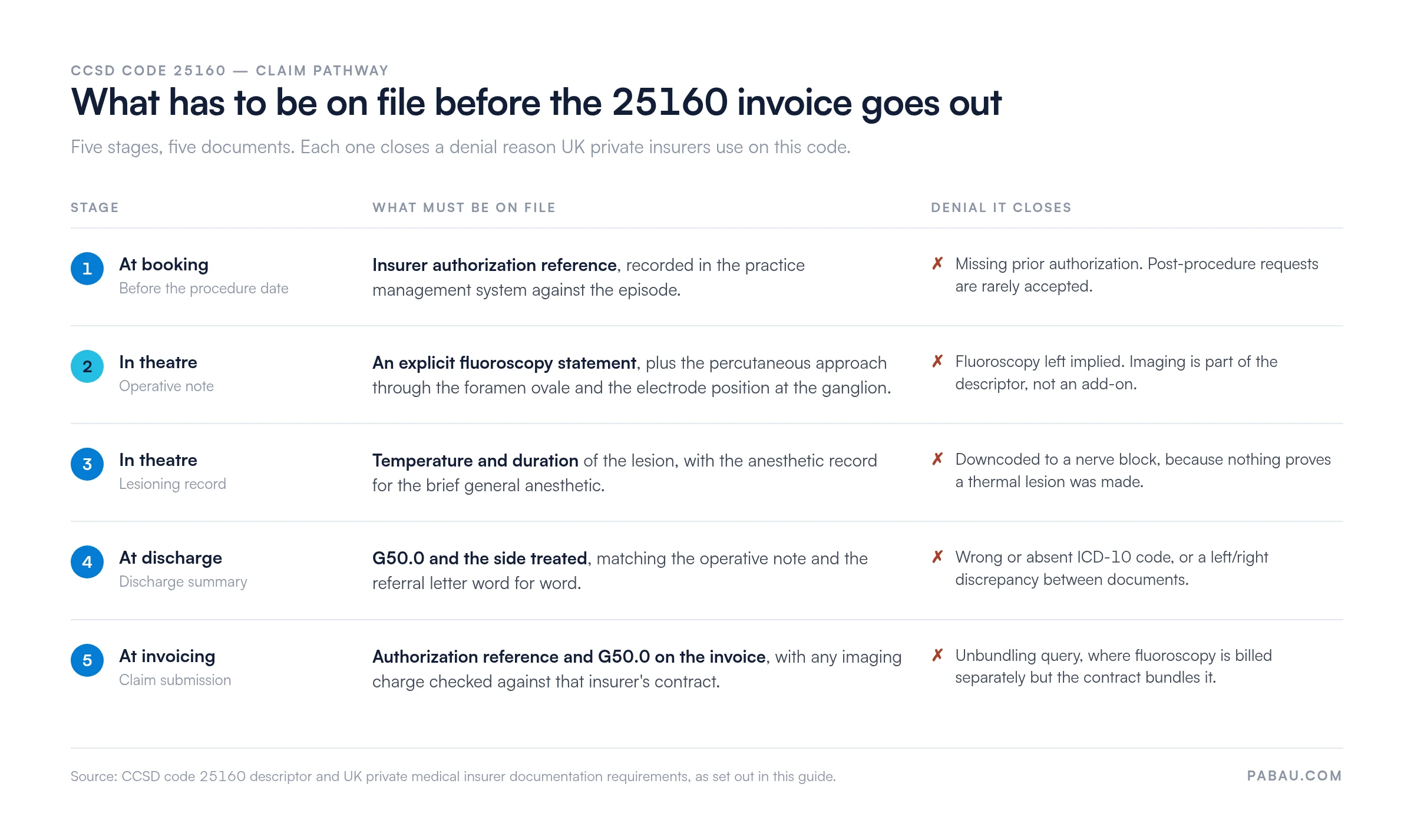
Building these checks into the post-procedure step, before the invoice is generated, is what keeps the chain intact. Chasing an anesthetic record or a set of lesion parameters after the patient has gone home adds weeks. Insurers query an incomplete file.
Run a documentation checklist against every CCSD code 25160 operative note before the invoice is raised. Confirm fluoroscopy in the note, lesion temperature and duration, laterality, the GA record, and the authorization number. Five minutes here prevents a four-to-six-week denial resolution cycle.
UK private insurers treat CCSD code 25160 as an elective neurosurgical procedure requiring pre-procedure authorization. Post-procedure requests are unlikely to succeed. The requirements are broadly consistent across major PMI payers, though each insurer runs its own forms and processes.
The typical insurer evidence pack for a CCSD code 25160 authorization request includes:
Facility registration matters at this stage too. Insurers may ask for confirmation that the site is registered with its regulator before they approve procedures there, as part of their credentialling checks.
CCSD code 25160 sits in chapter 3 of the CCSD schedule, covering the spine, spinal cord and peripheral nerves. Actual reimbursement is set by each insurer’s own fee schedule, agreed contractually with recognized consultants.
The Bupa CCSD fee schedule and the equivalent documents from AXA Health and Aviva are the operative references for payment amounts.
Complexity banding is worth checking separately, and it surprises people. CCSD owns the code and its narrative, but it does not set fees or complexity, so each insurer bands the code itself.
Bupa’s own CCSD reference puts 25160 in Major 2, while Freedom Health Insurance’s Freedom Elite schedule bands it as Intermediate. Same procedure, same descriptor, two different bands and two different fees.
Additional codes typically submitted alongside CCSD code 25160 in a single episode include:
For published fee information, the Aviva fee schedule and the Vitality Health fee finder both let recognized consultants look up CCSD reimbursement amounts directly.
Claims for CCSD code 25160 fail for predictable reasons. The table below maps the most common denial triggers to their prevention actions. If you want the wider picture, the same patterns show up across the common denial codes used throughout medical billing.
Unbundling errors occur when a practice separately bills a component that the primary code already includes, producing an invoice that overstates what was done. For CCSD code 25160, the main unbundling risk concerns intraoperative fluoroscopy.
As the fee schedule section above sets out, separate billing for fluoroscopy is insurer-specific. The Healix fee schedule gives detailed unbundling guidance for CCSD codes, and other insurers publish equivalent rules in their provider billing manuals. When in doubt, do not submit a separate imaging charge without confirming the insurer’s position in writing.
What can be billed alongside CCSD code 25160 without unbundling concerns:
Most practices still assemble a 25160 claim after the fact. The authorization number sits in an email and the operative note sits in the clinical system. Days later, the billing team reconstructs the episode from both. That is where the fluoroscopy statement and the lesion parameters go missing.
Practice management software like Pabau holds the episode together instead. The claims management software keeps the CCSD code, the ICD-10 pairing, the authorization reference, and the supporting documents on one record. Your billing team can therefore raise the invoice from the record itself, rather than chasing three systems for the evidence.
For every 25160 episode, the workflow runs like this:
Standardizing those five steps at the point of discharge, rather than leaving them to the billing team days later, cuts the rate of missing-documentation queries. Everything the insurer might ask for already sits on the patient record, so nobody is searching for it after the fact.
Set up a CCSD code 25160 invoice template with G50.0 pre-loaded as the default ICD-10 code and a mandatory prior-auth reference field. That removes two of the most common submission errors before the invoice is ever created.

Pabau helps UK private practices attach ICD-10 codes and manage prior-authorization references. CCSD-coded invoices go out electronically to Bupa, AXA Health, Aviva, and other major PMI payers. Book a demo to see how it works for neurosurgery and pain teams.

Nothing about CCSD code 25160 is ambiguous at the coding level. The descriptor names the target, the mechanism, and the imaging, and G50.0 is the diagnosis in almost every case.
What decides payment is whether five documents still agree with each other by the time the invoice goes out. Three people create them across four separate moments.
So treat this code as a records problem rather than a coding one. Capture the authorization number at booking and write the fluoroscopy statement into your operative note template. Then hold the discharge summary until the side and the diagnosis code match. The trade-off is a few minutes of structure per episode against a denial cycle that runs four to six weeks.
Get that discipline into the system your team already works in and it stops depending on anyone remembering. Book a demo to see how Pabau keeps the operative note, the authorization reference, and the CCSD-coded invoice on one patient record.

Need a broader reference for Bupa CCSD billing? Bupa CCSD procedure codes covers the full CCSD code set as Bupa uses it, with guidance on code selection and submission.
Looking up a different CCSD code? CCSD codes is the index of every CCSD billing guide on the site, grouped by chapter.
Billing another image-guided pain procedure? 25120 covers the dorsal root ganglion block, which sits in the same chapter and carries similar imaging documentation rules.
CCSD code 25160 covers a trigeminal ganglion radiofrequency lesion performed under X-ray (fluoroscopic) control. It describes a percutaneous neurosurgical procedure in which a radiofrequency electrode is placed at the Gasserian (trigeminal) ganglion via the foramen ovale. Controlled thermal energy then creates a focal lesion in the pain-carrying fibers, to treat trigeminal neuralgia.
CCSD code 25150 is a trigeminal ganglion injection of local anesthetic under X-ray control, while 25160 is a radiofrequency lesion of the same ganglion. Both are percutaneous and both use fluoroscopy, but 25150 produces a temporary or diagnostic block and creates no lesion. Code 25160 requires a radiofrequency electrode, a recorded temperature and duration, and a brief general anesthetic for the lesioning phase.
G50.0 (Trigeminal neuralgia) is the primary ICD-10 diagnosis code paired with CCSD code 25160 on the large majority of claims. G50.8 may be used for TN variants, and B02.2 (Zoster with other nervous system involvement) applies where the pain is post-herpetic in origin. UK insurers use the WHO version of ICD-10, so the five-character ICD-10-CM codes used in the US do not belong on a UK private claim.
Yes. Fluoroscopic guidance belongs to the procedure definition in CCSD code 25160. Where imaging was not used, or where its use is not explicitly confirmed in the operative note, the claim may be queried, downcoded, or denied. Whether intraoperative fluoroscopy can be billed separately alongside 25160 depends on the individual insurer contract. Verify it with each payer before submitting a separate imaging code.
UK private insurers require a pre-procedure authorization reference and an operative note explicitly confirming fluoroscopic guidance, with the lesioning temperature and duration recorded. They also expect an anesthetic record for the brief GA and a laterality statement consistent across all documents. The discharge summary must give the ICD-10 diagnosis code and the clinical indication, including evidence of failed prior medical management.
The most common denial reasons are fluoroscopy not documented explicitly in the operative note, and missing or post-procedure prior authorization. A wrong or absent ICD-10 diagnosis code also features heavily, since insurers expect G50.0 for classical TN. Laterality discrepancies between documents and unbundling errors, where a separately billed imaging charge is not permitted under the contract, complete the list.
Reimbursement for CCSD code 25160 is set by each insurer’s own contracted fee schedule. It varies by insurer and by the individual consultant’s recognition terms. Insurers also band the code differently: Bupa’s CCSD reference places it in Major 2, while Freedom Health Insurance’s Freedom Elite schedule bands it as Intermediate. Recognized consultants can look up current amounts via the Aviva fee schedule, the Vitality fee finder, and Bupa’s code search.
The procedure is performed percutaneously. Under fluoroscopic guidance, a radiofrequency cannula is inserted through the cheek and advanced through the foramen ovale to the Gasserian ganglion. The patient stays awake for sensory testing to confirm correct electrode positioning, and a brief general anesthetic is then given before thermal lesioning. The whole procedure typically takes under an hour, as a day case or an overnight admission.