

CPT Code 30801: Superficial turbinate ablation billing guide
CPT Code 30801: Official descriptor and procedure overview The American Medical ...

Last Updated: Nov 27, 2026
25110 is the CCSD code for a therapeutic coeliac plexus block, splanchnic nerve block, or hypogastric block, with or without image guidance. It covers blocks that use local anesthetic, with or without corticosteroid, to relieve visceral abdominal or pelvic pain.
Image guidance is bundled into the single 25110 fee, so no separate guidance code is billed. Diagnostic blocks of the same structures are coded 25100, and neurolytic blocks with alcohol or phenol take a separate CCSD code.
Let Pabau's smart automation suggest the right codes, reduce claim denials, and keep your practice compliant—effortlessly.
Automate repetitive tasks and focus on what matters most—your patients.
Reduce coding errors and ensure compliance with the latest regulations.
Clean claims, fewer denials, and faster reimbursements.
Powerful insights and reporting to help your practice thrive.
HIPAA compliant SOC 2 certified GDPR-compliant Trusted by 4,000+ clinics worldwide

CCSD code 25110 covers three therapeutic blocks only: coeliac plexus, splanchnic nerve, and hypogastric block.
Therapeutic means local anesthetic with or without corticosteroid. Neurolytic agents (alcohol, phenol) are coded separately.
Image guidance (fluoroscopy, CT, ultrasound) is bundled into 25110. Name the modality in the operative note, and bill no separate guidance code.
Most UK private insurers require pre-authorization before the procedure. Missing pre-auth is the leading denial reason.
CCSD code 25110 covers a coeliac plexus block, splanchnic nerve block, or hypogastric block performed as a therapeutic intervention.
It is part of the CCSD schedule of procedure codes, the standard code set for the UK private healthcare sector. The official descriptor reads Coeliac plexus block, splanchnic nerve block, hypogastric block – therapeutic +/- image guidance. The word “therapeutic” limits the code to pain relief with local anesthetic, with or without corticosteroid. Neurolytic destruction and diagnostic test blocks fall outside it.
The schedule groups the three procedures because each targets a visceral autonomic plexus or nerve that relays pain from abdominal or pelvic organs. A pain management consultant performing any one of them in a UK private hospital or practice bills 25110 for the procedure itself. Image guidance is bundled into that fee, while any additional anesthetic services are coded separately.
Each procedure targets a distinct anatomical structure at a different spinal level, with its own primary indications.
The coeliac plexus block is the most frequently performed of the three. Its strongest evidence base is in upper abdominal malignancy, particularly unresectable pancreatic cancer, where it can relieve pain that oral opioids no longer control. The British Pain Society and Faculty of Pain Medicine both include it in their guidance on interventional cancer pain management.
The splanchnic nerve block reaches the same pain pathway at a higher level. It is sometimes preferred when the retrocrural approach is anatomically difficult. The hypogastric block serves a different indication, targeting pain that arises from the pelvic organs.
The agent injected decides whether CCSD code 25110 applies at all. The table below maps each procedure intent to the agent involved and the correct CCSD coding approach.
The operative note must state the agent used. If a coder sees alcohol or phenol listed as the injectate, 25110 does not apply. Neurolytic procedures have higher clinical risk, require different consent documentation, and are separately reimbursed. Applying 25110 to a neurolytic procedure is both a coding error and a potential compliance issue.
A test block of the same three structures, given to confirm the pain source before neurolysis, is billed as CCSD 25100. Its descriptor carries the same “+/- image guidance” wording.
Imaging guidance is bundled into CCSD code 25110. The descriptor reads “+/- image guidance”, so one fee covers the block with or without fluoroscopy, CT, or ultrasound. The table below summarizes the common approaches and what the note should record for each.
Record the modality in the operative note, and confirm that guidance was used in real time to position the needle. Equipment that was only available in the room does not count. No guidance code is added to the claim. Healix, Allianz Care, and WPA each publish their own unbundling rules, so check the insurer’s terms if a claim is queried.
Most major UK private insurers treat interventional pain procedures as specialist services that need pre-authorization. Without it, a CCSD code 25110 claim is refused before anyone assesses the clinical grounds.
At the pre-auth stage, most insurers ask for five details:
Pabau, a practice management platform, tracks the authorization code, dates and sessions on the patient’s case and warns when one is missing. That check reduces the risk of treating without cover.
A complete operative note is the foundation of every successful CCSD code 25110 claim. Insurers cross-reference the clinical record against the submitted code when auditing or querying claims. The following elements should be present in every procedure note.
A pre-structured procedure note template reduces transcription errors and keeps every field above from being skipped. A missing agent volume or an absent imaging note is enough to trigger a clinical query that holds up payment.
Denial patterns for CCSD code 25110 cluster around six predictable failure points. Each has a direct fix.
Four of the six failure points are settled before the procedure date, at pre-authorization. The other two are coding errors that a claim check catches, using what the operative note records.
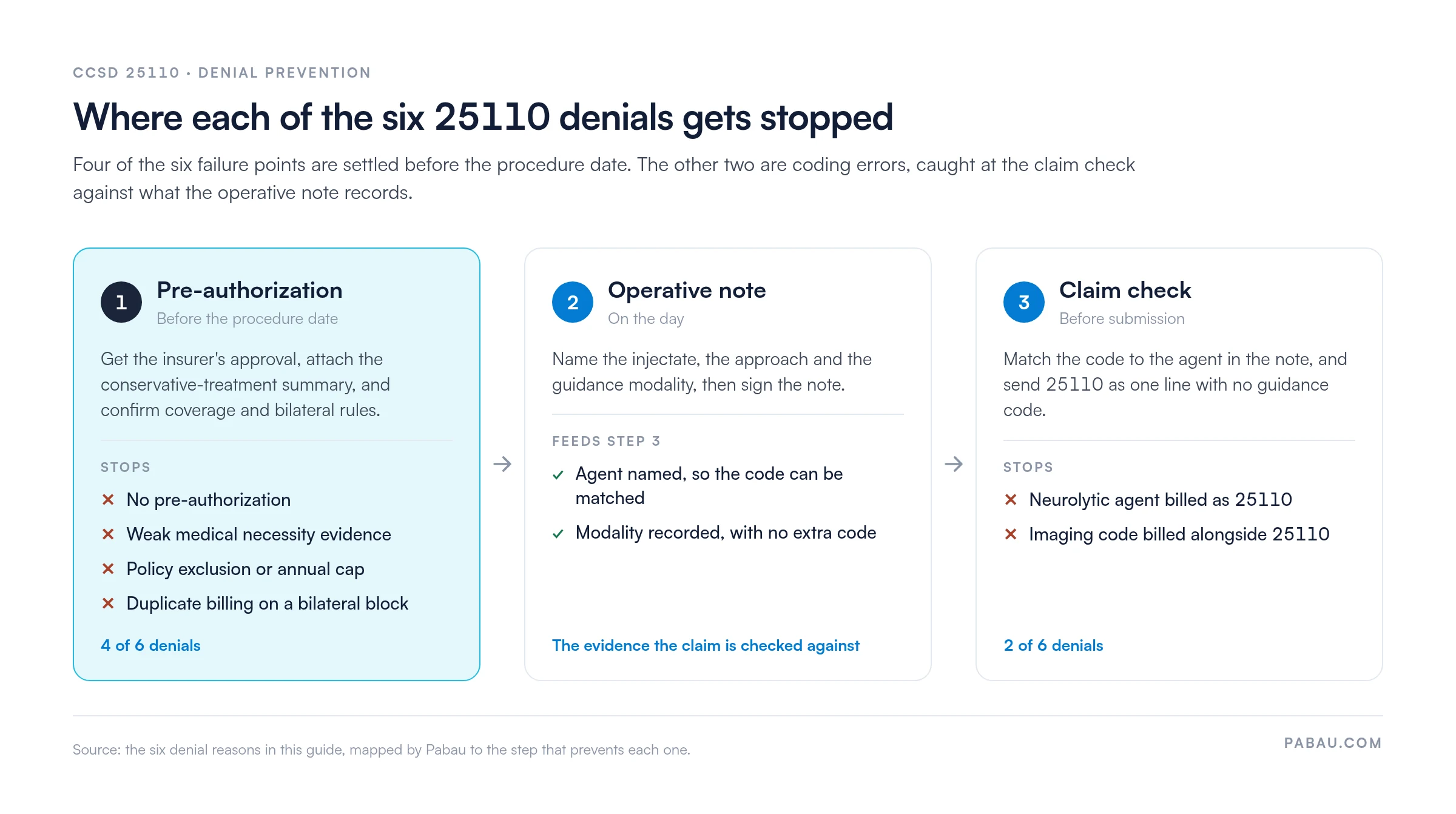
Checking each claim against these points before every submission cycle cuts rework for the billing team.
Before submitting any CCSD 25110 claim, run a three-point check. First, the pre-authorization reference number is on file. Second, the operative note names the injectate agent explicitly. Third, the note names the guidance modality and no separate imaging code is on the claim, because guidance is bundled into 25110.
The coeliac plexus and splanchnic nerve blocks are commonly performed bilaterally: Two needles placed symmetrically to cover both sides of the autonomic plexus. Whether a bilateral approach is billed as one or two units of CCSD code 25110 is not settled uniformly across payers.
Bupa, AXA Health, and Aviva each maintain their own fee schedules and unbundling rules. Some reimburse bilateral sympathetic procedures at a single fee. Others permit a bilateral modifier or second unit. Confirm with the specific insurer at the pre-auth stage, before the procedure takes place. Submitting two units without payer confirmation is a reliable route to a duplicate-billing denial.
A coeliac plexus block and a hypogastric block in the same session, for upper abdominal and pelvic pain, are two separate procedures. Each maps to CCSD code 25110 on its own, but each charge needs a distinct clinical indication in the operative record. Without that, the insurer may decline the second charge as a duplicate.
UK pain management practices billing CCSD code 25110 repeat the same steps for every case. Each one needs a pre-auth confirmation, a structured operative note, a recorded guidance modality and a correctly coded claim before the invoice leaves the practice.
Pabau’s claims software for practices supports CCSD code entry for UK private billing teams. It holds the authorization code, dates and sessions on each patient’s case and warns when one is missing. That warning surfaces the leading 25110 denial before the procedure date rather than after the claim comes back.

Pabau helps UK private practice teams track pre-authorizations, record procedure documentation, and submit CCSD-coded claims from one patient record.

The 25110 descriptor answers the two coding questions on every claim. The injectate decides the code, because alcohol or phenol takes the claim out of 25110 entirely. Image guidance sits inside the fee, so the modality belongs in the note and never on the claim as a second line.
What remains is insurer-specific: pre-authorization, bilateral rules and policy limits. Settle those at the pre-auth stage, and the operative note only has to confirm what was agreed. Book a demo to see how Pabau tracks authorizations and CCSD claims for pain management practices.

Need a full reference for Bupa procedure codes? Pabau’s Bupa CCSD billing guide covers the complete Bupa CCSD schedule with submission rules and fee context.
Billing the diagnostic block first? CCSD code 25100 covers the test version of the same three blocks, with image guidance bundled the same way.
Looking up a neighboring procedure? The CCSD codes index lists the schedule’s procedure codes by chapter, with a billing guide for each.
Want to reduce claim rejections across your practice? Claims management software from Pabau records the authorization code, dates and sessions on each case and flags a missing one.
CCSD code 25110 covers three therapeutic sympathetic nerve blocks: coeliac plexus block, splanchnic nerve block, and hypogastric block. All three are performed as therapeutic (pain-relief) interventions using local anesthetic with or without corticosteroid. Neurolytic procedures and diagnostic blocks are excluded and must be coded separately.
A therapeutic block uses local anesthetic to achieve temporary pain relief. A neurolytic block uses alcohol or phenol to permanently destroy nerve tissue. CCSD code 25110 applies only to therapeutic blocks, and using it for a neurolytic procedure is a common denial trigger.
Imaging guidance is bundled. The descriptor reads “+/- image guidance”, so one fee applies with or without fluoroscopy, CT or ultrasound. No additional guidance code is needed. Still name the modality in the operative note.
Bupa, AXA Health, Aviva, Vitality Health and Cigna UK require pre-authorization for interventional pain procedures. WPA’s requirement varies by policy type, so confirm it before each case. Pre-auth must be obtained before the procedure date, and retrospective requests are routinely refused.
Yes, if each procedure has a separate clinical indication documented in the operative record, each may be billed as CCSD code 25110. Insurers vary on whether they reimburse both charges in a single session. Confirm with the specific payer at the pre-authorization stage before treating.
CCSD 25110 covers therapeutic blocks of the coeliac plexus, splanchnic nerves and hypogastric plexus. CCSD 25120 is a different procedure, a dorsal root ganglion block with local anesthetic or a neurolytic agent. Neurolytic blocks of the coeliac, splanchnic or hypogastric structures take a separate CCSD neurolysis code, so check the schedule. Diagnostic blocks of the same structures are coded 25100.




