How to Start a Med Spa in 2026: Complete Step-by-Step Guide
The medical spa industry surpassed $21 billion in 2024 and shows no signs of slo...

March 31, 2026


Buy now, pay later is now available in Pabau

Follow the full patient journey. Effective plastic surgery marketing supports discovery, evaluation, booking, and return visits.
Choose channels based on performance. Local SEO, social media, and email marketing deliver reliable results when tied to clear booking paths.
Prioritize execution. Response speed, follow-up processes, and tracking accuracy have a direct impact on consult volume.
Reduce complexity in your systems. Pabau brings booking, patient records, marketing, and campaign tracking into one platform.
Plastic surgery practices generate plenty of attention. The real challenge is turning that attention into booked consultations.
This guide covers the plastic surgery marketing strategies that drive real bookings in 2026. It breaks down which channels to prioritize, which KPIs to track, and which mistakes to avoid.
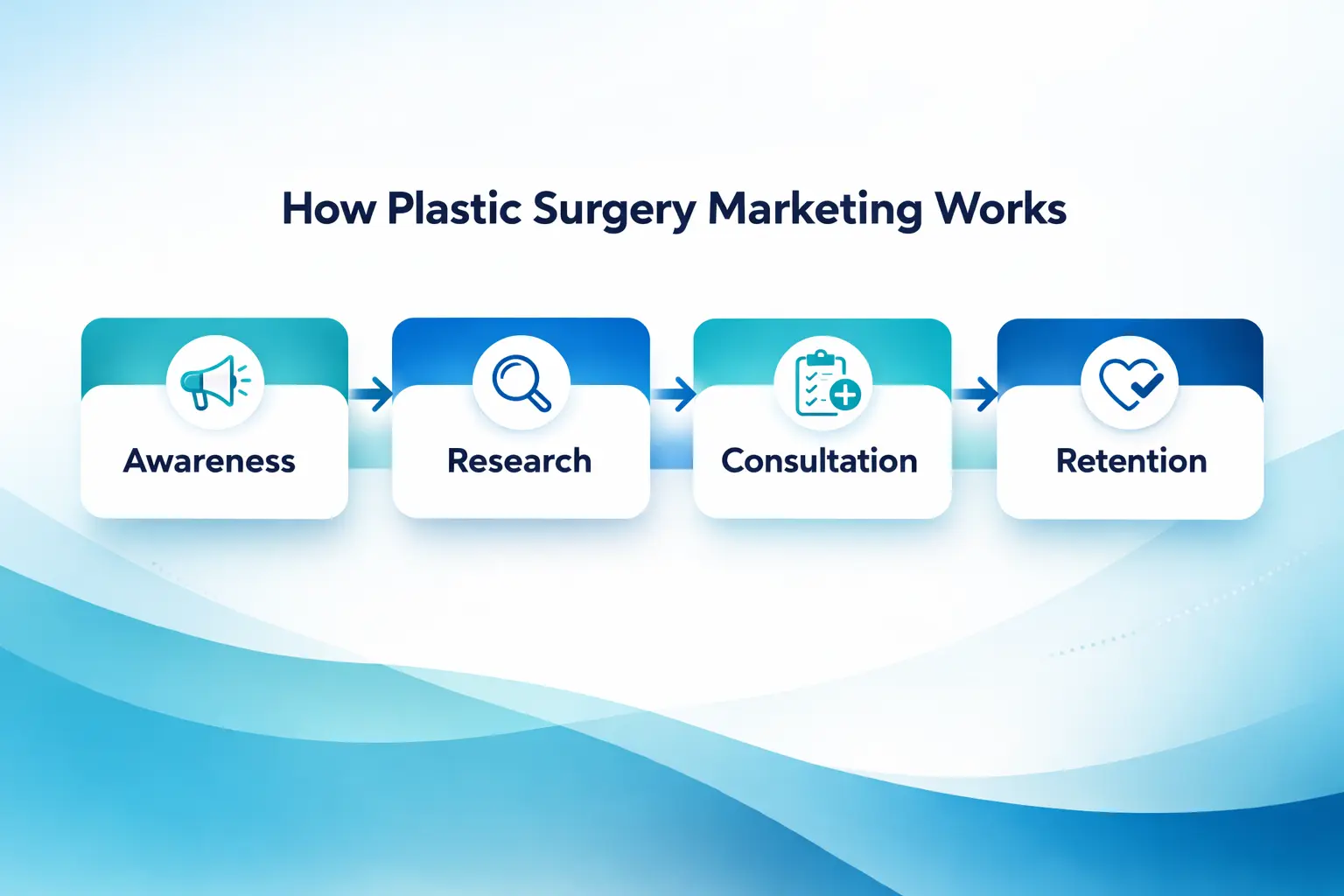
Marketing for plastic surgeons follows the patient journey. That journey typically moves through four stages: awareness, research, consultation, and retention.
A potential patient might see a before-and-after photo on Instagram, then run an internet search for a specific procedure. From there, they read online reviews, compare a few providers, and eventually book a consult.
Your digital marketing strategy needs to meet them at every one of those stages:
Note: Marketing content should educate and build trust, but it should never replace clinical advice. Always encourage patients to consult a qualified surgeon for personalized treatment guidance.
The cosmetic surgery market is growing fast.
Global revenue is projected to rise from $61.32 billion in 2026 to $83.33 billion by 2034, according to Fortune Business Insights.
Patient demand is already high, too. Nearly 38 million cosmetic procedures were performed worldwide in 2024, based on the ISAPS Global Survey.
More growth means more practices competing for the same patients.
Plastic surgery is elective, so patients take their time. They research clinics, read patient reviews, and expect a professional patient experience before they book. Without a system in place, practices often face:
A clear marketing strategy changes that. It gives plastic surgeons a predictable path from patient interest to booked consultation.
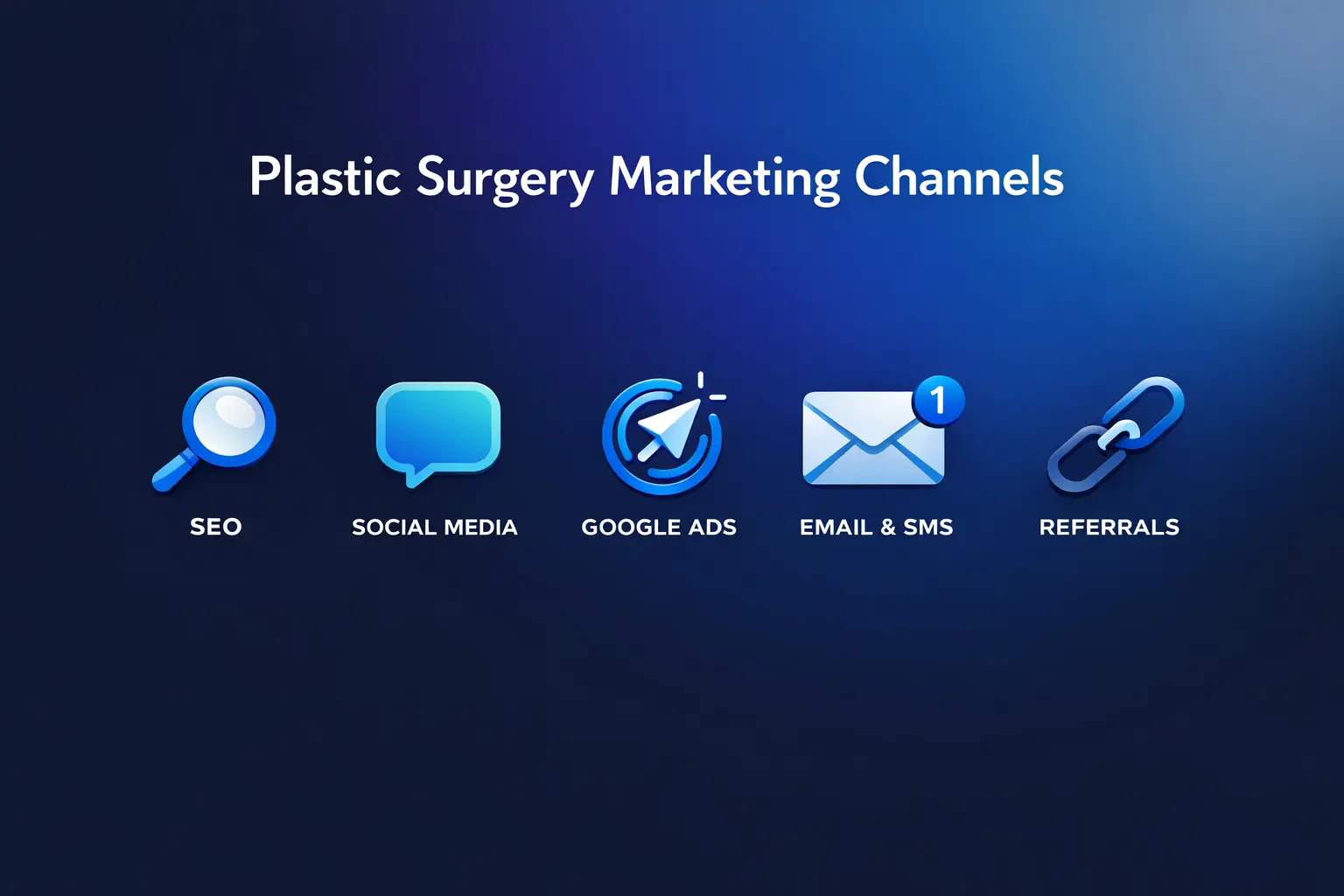
Marketing channels don’t perform the same for every practice. Budget, growth stage, and local competition shape results.
Below is a breakdown of the key channels used in plastic surgery digital marketing.
Best for: Practices targeting high-intent, procedure-specific searches.
Local SEO puts your practice in front of patients actively searching for procedures in your area. Think “rhinoplasty in [city]” or “breast augmentation near me.”
Results typically take three to six months to build. But once Google rankings hold, this channel delivers leads without ongoing ad spend.
Key risk: Ignoring your Google My Business profile. An incomplete or outdated profile pushes you out of local map results, which is where most clicks happen.
Best for: Building trust and visibility before patients are ready to book.
A 2024 systematic review published in Cureus analyzed 25 studies involving nearly 14,000 participants. The findings were clear: social media significantly influences decisions to undergo cosmetic procedures. For plastic surgeons, a strong online presence influences decisions well before consultation.
Short-form video, before-and-after galleries, and educational content consistently outperform other formats. Social media platforms like Instagram and TikTok are particularly effective for visual results and patient education.
Key risk: Posting without a plan. Inconsistent content creation erodes trust rather than building it. A clear social media marketing calendar keeps things on track.
Best for: Practices that need consult volume quickly, especially for high-margin procedures.
Paid search places your practice at the top of the results immediately. PPC campaigns perform best for procedures where search intent is already strong, such as:
In these cases, patients are actively looking for a provider and are often close to booking.
Key risk: Sending paid traffic to a slow website or a generic page. Every ad should point to a dedicated landing page with a clear booking path.
Best for: Nurturing leads and re-engaging past patients.
Email and SMS give you direct access to your patient list without relying on paid reach. Automated email sequences work particularly well for:
Key risk: Sending the same message to everyone. Segment your email list by procedure interest, visit history, or consultation stage for better results.
Best for: Practices with high patient satisfaction looking to grow through word of mouth.
In plastic surgery, personal recommendations carry outsized weight. Referral marketing makes that behavior repeatable and trackable.
Key risk: Overcomplicating it. A simple incentive paired with a digital referral link will outperform printed cards every time.

Want to streamline your operations? Compare the best plastic surgery software for scheduling, records, and marketing.
Looking for easier self-service? Review top patient portal software for bookings and messaging.
Need to understand your market? Learn how to run a competitive analysis and find gaps to exploit.
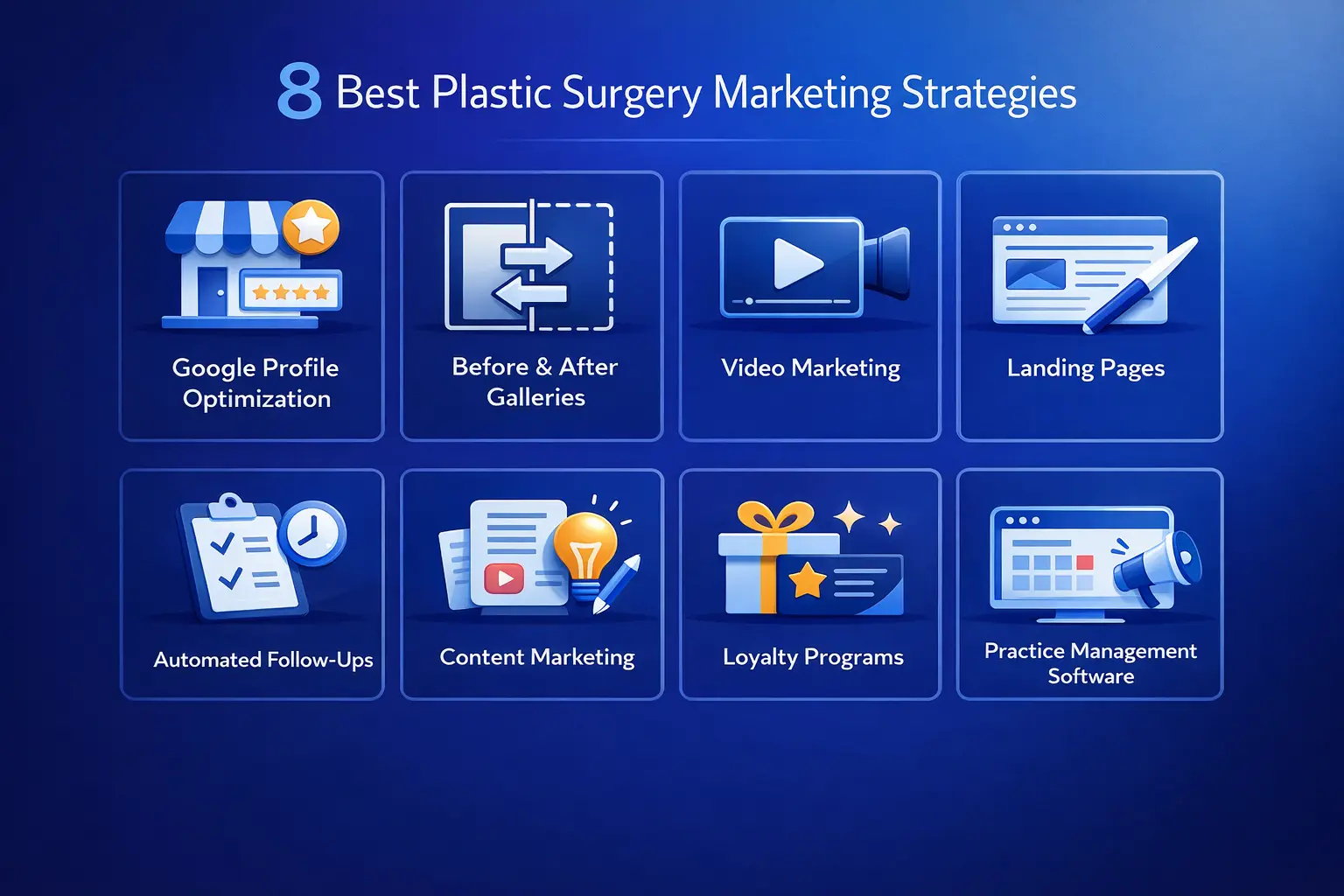
These plastic surgery marketing tips are practical digital marketing strategies that tie directly to consultation bookings. They work best when used together.
Your Google Business Profile (also known as Google My Business) is often the first touchpoint a potential patient has with your practice. In plastic surgery, early impressions and online reputation are closely linked.
According to the ASDS 2025 Consumer Survey, 94% of consumers say review sites influence their choice of provider.
That makes the basics worth getting right:
Encourage patient reviews after every consultation. They build patient trust with prospective clients who are still comparing providers.
Before-and-after photos remain one of the highest-converting content formats in cosmetic surgery marketing. They show results in a way that written content simply can’t replicate.
What makes a gallery effective:
Share gallery highlights across social media platforms to reach a wider audience, with clear patient consent in place. For plastic surgeons, this extends visibility without extra ad spend.
Video lets patients see the surgeon, the environment, and real outcomes before they walk through the door.
What tends to work well:
These don’t need to be polished productions. Authentic, well-lit clips tend to outperform heavily produced video content. It’s also one of the simplest forms of content creation for building a strong social media presence.
Generic pages rarely convert well for plastic surgery.
Someone searching for “tummy tuck in [city]” wants a page about that specific procedure, with relevant photos, FAQs, and a clear path to book.
Each landing page should include:
This also strengthens your SEO. Well-structured landing pages improve search engine rankings for procedure-based local keywords. They also support lead generation by giving each visitor a focused path to convert.
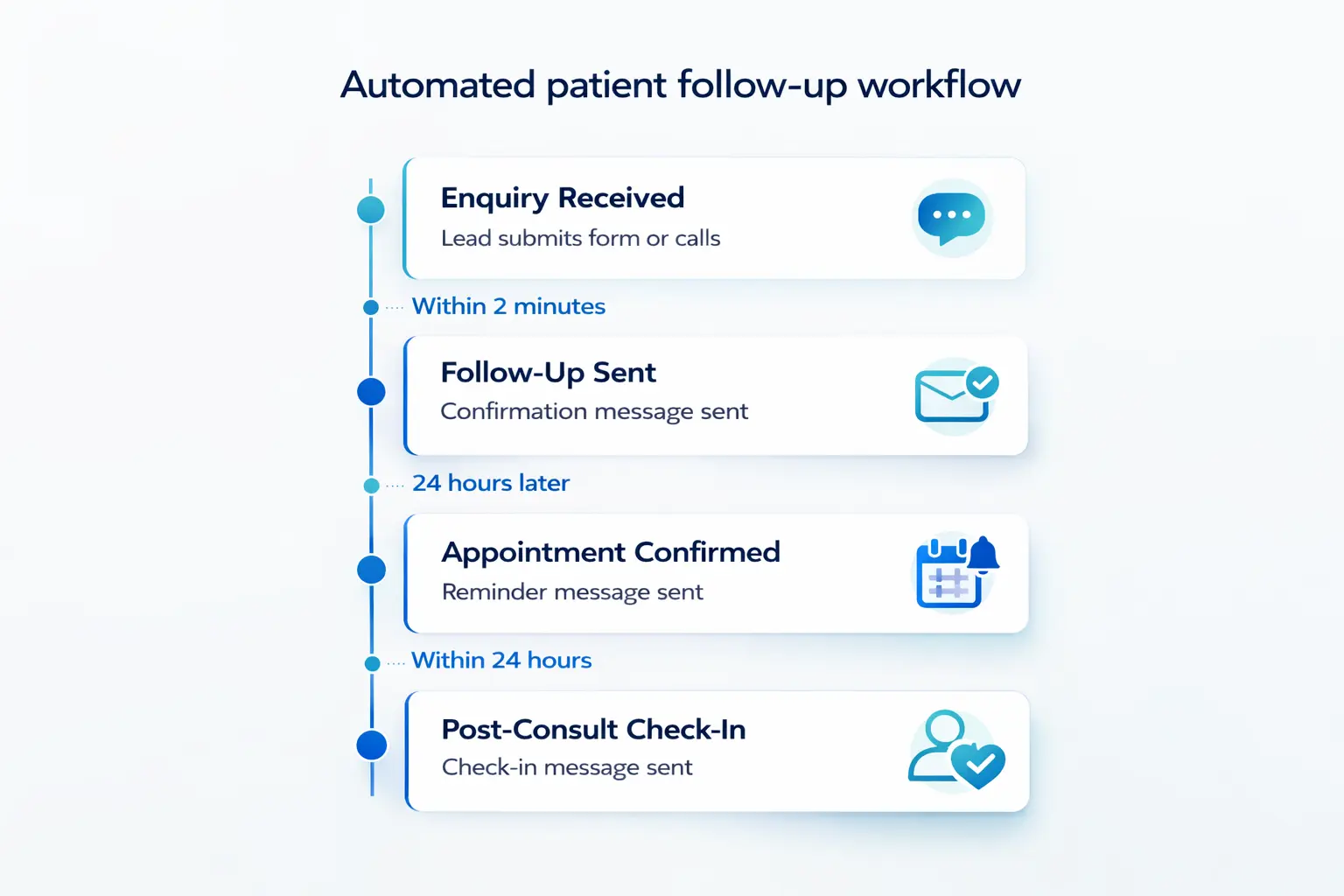
Fast follow-up has a direct impact on consultation bookings. Leads that don’t hear back quickly often book with the practice that responds first.
Automated follow-up handles this without adding to your team’s workload:
The goal is speed without sacrificing the patient experience. Automated messages should still reflect how your team actually communicates.
“Pabau has reduced our time in the office by, I would say at least 10 minutes per patient. So from the old system compared to the new system, it’s been a huge time saver.”
Plastic surgery content marketing positions your practice as a trusted resource. It also supports your SEO, social media, and email marketing efforts simultaneously.
Focus on answering the real questions patients ask during their research:
Each piece of content should serve a clear purpose in the patient journey. Awareness-stage content brings in new visitors. Decision-stage content moves them toward booking.
If content creation feels overwhelming, consider working with a marketing agency that specializes in plastic surgery. They can help you develop a content plan aligned to your target audience while you focus on patient care.
Retention has a direct impact on long-term profitability. Keeping existing patients engaged is often more predictable than relying on new patient acquisition alone.
Many cosmetic surgery patients return for additional treatments over time. A structured retention system helps make those return visits consistent rather than incidental.
In practice, this includes:
Start with your highest-value treatments. Set up automated recalls for procedures with natural follow-up intervals, like injectables or laser, and build from there.
Every strategy above stands on its own. Combined in one system, they go further. That’s where practice management software like Pabau comes in.
Pabau has built-in marketing tools that connect directly to the patient record:
Loyalty programs, memberships, and gift cards
Exploring more scalable plastic surgery marketing ideas? Pabau’s Marketing Plus supports advanced segmentation and automated campaigns.
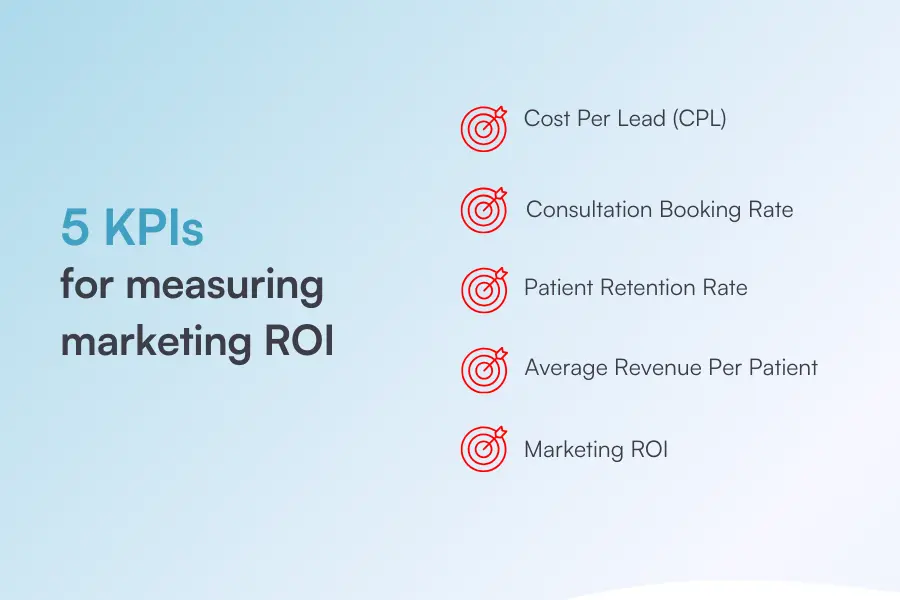
Marketing ROI starts with income. The KPIs below tie your marketing directly to booked consultations and revenue.
Cost per lead (CPL) shows how much each enquiry or consultation request costs to generate.
Track it by channel to see where performance is strongest. If Google Ads brings leads at $40 and Facebook Ads at $120, you know exactly where to shift spend. This is especially important when running PPC campaigns, where costs can escalate quickly without close monitoring.
Consultation booking rate is the percentage of leads that become confirmed consultation appointments.
If CPL is low but bookings lag, the issue usually sits after the lead arrives. In most cases, it’s follow-up speed or the intake process rather than the marketing itself.
Patient retention rate shows how many patients return after their first visit.
Retention has a direct impact on lifetime value and long-term revenue. When this number drops, practices often lean harder on acquisition.
That’s usually a sign that follow-up, rebooking, or patient engagement need attention first.
Average revenue per patient shows how much revenue each active patient generates over time.
This metric reflects how effectively treatments are structured and priced. Flat or declining numbers often point to gaps in treatment planning.
Marketing ROI compares revenue generated against cost, broken down by channel.
This metric justifies your marketing budget. Track it monthly and tie performance to booked procedures rather than website traffic. It separates channels that drive revenue from channels that just drive clicks.
These KPIs are much easier to track when your reporting and analytics connect directly to bookings and patient records. Disconnected tools make it hard to see the full picture.
Plastic surgery practice marketing works better when patient information sits in one place.
Pabau’s plastic surgery EMR is built to support that. It brings together:
Want to see how this fits your practice? Book a free demo.
It depends on the channel. Google Ads and PPC campaigns can generate consults within days. SEO and content marketing typically take three to six months to build consistent traffic and bookings.
Both. Procedure-specific landing pages and content drive targeted search traffic. Brand-level marketing builds recognition and trust across your full treatment offering.
Yes, if you operate in different cities or regions. Each location needs its own Google Business Profile and localized landing pages. Location-specific content helps improve visibility in local search results.