









Massage Gift Card Template
A massage gift card template is a fill-in-the-blank certificate you customize wi...

5
Last Updated: Sep 11, 2026


A spa intake form template collects personal details, medical history, allergies, and treatment preferences before the first visit
Including skin type and lifestyle questions helps therapists personalise every treatment safely
Digital intake forms reduce check-in time and automatically populate client records
GDPR-compliant consent and declaration sections protect your spa legally
Download our free spa intake form template below and customise it for your clinic in minutes
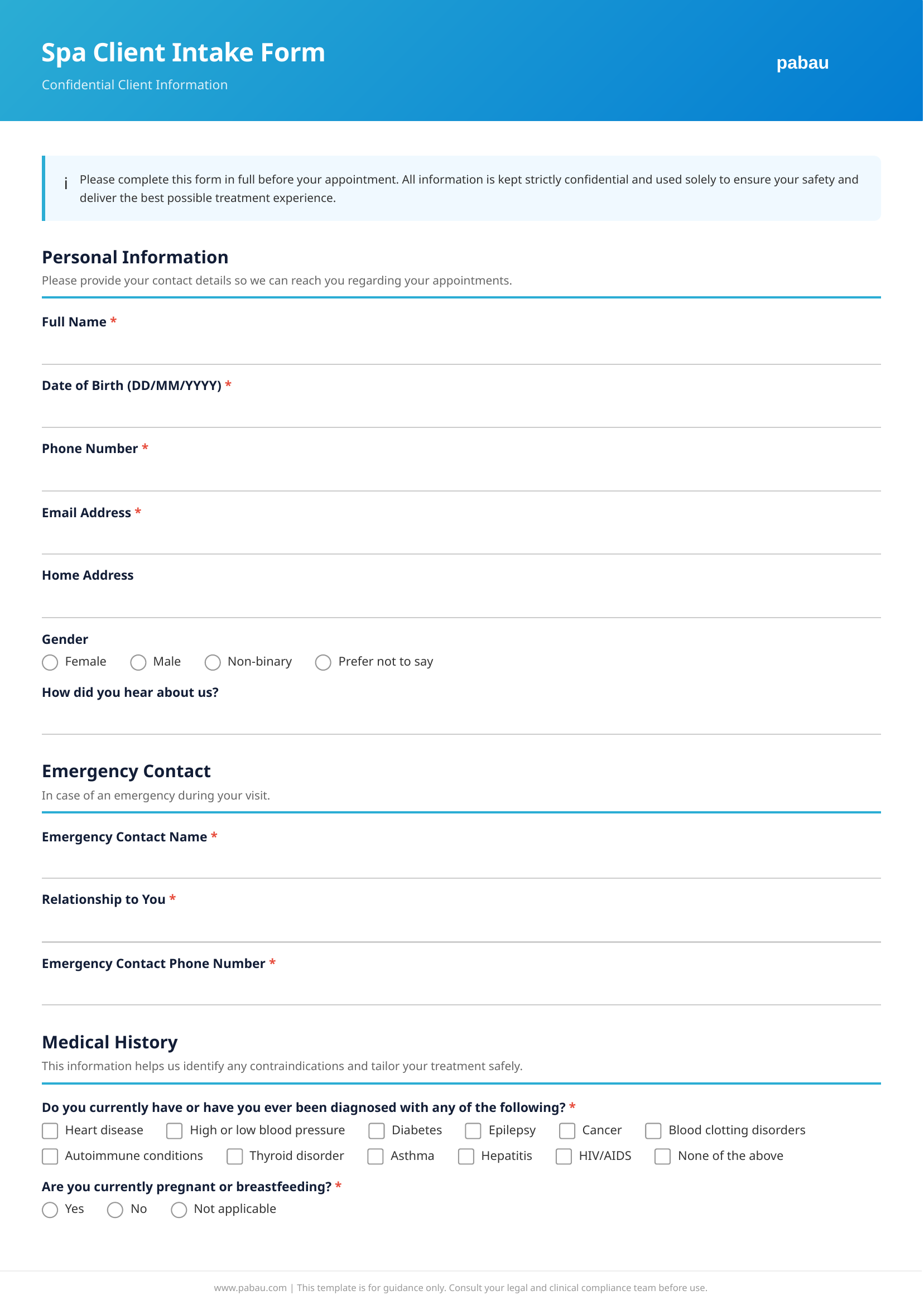
A professionally designed, printable intake form covering personal details, medical history, skin concerns, treatment preferences, and consent. Ready to use or customise for your spa.
Download templateA spa intake form is a document that new clients complete before their first treatment. It collects essential information about the client's health, skin type, allergies, and treatment goals. In turn, this helps therapists deliver safe and personalised services from the very first appointment.
Unlike a consent form, which focuses on agreeing to specific treatment risks, a spa intake form template gathers the broader picture. For example, it captures personal contact details, medical history, current medications, and lifestyle habits. Consequently, your team can identify contraindications, tailor recommendations, and build a complete client profile before the session begins.
Most spas use intake forms for every new client. However, returning clients should also update their forms periodically to reflect any changes in health or medication. As a result, your records stay accurate and your treatments remain safe.
Without a proper intake process, your spa risks delivering treatments that could harm a client. For instance, a client with a latex allergy receiving a body wrap with latex gloves could experience a serious reaction. Similarly, performing a chemical peel on someone using retinoids could cause burns or scarring.
A well-designed spa intake form template protects your business in several ways. First, it identifies allergies and medical conditions that may contraindicate certain treatments. In addition, it documents informed consent and data processing permissions, which is essential for GDPR compliance.
Furthermore, intake forms create a professional first impression. Clients appreciate when a spa takes their health seriously. This builds trust and encourages repeat visits. Meanwhile, your front desk team benefits from a streamlined check-in process rather than scrambling to collect details on the day.
From a legal standpoint, having documented client information protects your spa if a complaint arises. Therefore, every spa, whether a day spa, destination spa.
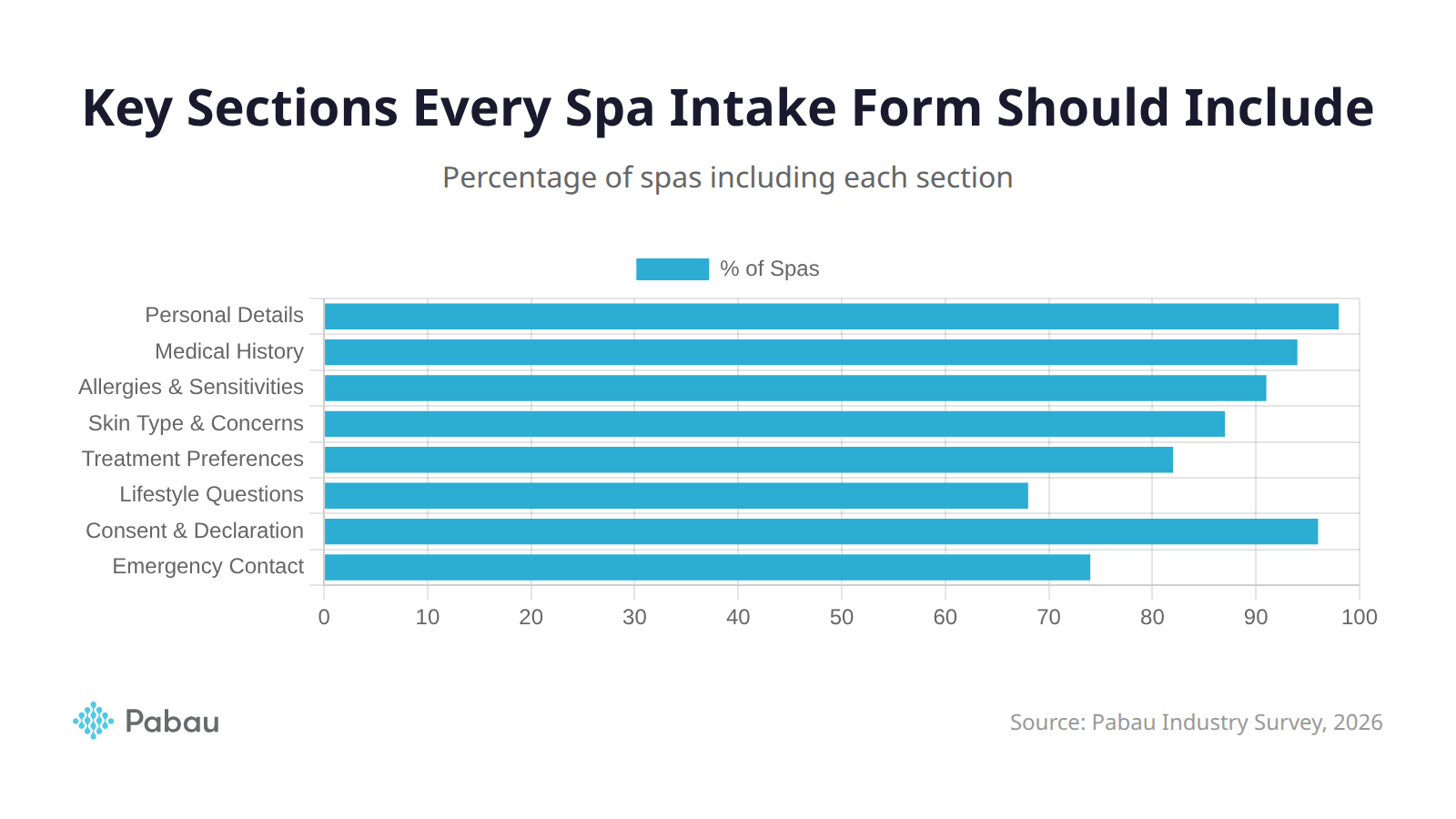
A comprehensive spa intake form template covers eight key sections. Each one serves a specific purpose in protecting your clients and improving their experience.
Start with the basics: full name, date of birth, phone number, email address, and home address. This section also includes gender and referral source. These details help you contact the client, verify their identity, and track your marketing channels.
Always collect the name, relationship, and phone number of an emergency contact. In the event of an adverse reaction or medical emergency during treatment, your team needs someone to call immediately.
This section is arguably the most important. Include a checklist of common conditions such as heart disease, diabetes, epilepsy, blood clotting disorders (for example. Additionally, ask whether the client is pregnant or breastfeeding, as many spa treatments are contraindicated during pregnancy.
Ask clients to list all known allergies, including latex, fragrances, essential oils, nuts, and plasters. For example, many massage oils contain nut-based ingredients. As a result, missing this information could trigger a dangerous allergic reaction.
For facial and body treatments, understanding the client's skin type is essential. Include options for normal, dry, oily, combination, and sensitive skin. In addition, add checkboxes for common concerns like acne, rosacea, hyperpigmentation, fine lines, and sun damage. This section also helps you determine whether the client has used retinoids or chemical peels recently. For facial-specific treatments, an esthetician consultation form adds deeper skin type assessment and product history to this screening.
Allow clients to select which services interest them, from facials and massage to laser treatments and body wraps. Furthermore, include a textarea for them to describe their goals in their own words. This gives therapists valuable context before the appointment.
Questions about water intake, smoking habits, sun exposure, and stress levels provide a holistic view of the client's wellbeing. Consequently, your therapists can make more informed product and treatment recommendations.
Every spa intake form template should end with a clear declaration. Include checkboxes for confirming the accuracy of information, consenting to data storage under data protection regulations, and acknowledging the responsibility to report health changes before future visits.
Software built for skin clinics links documents like this to each client’s treatment history.
Our free downloadable spa intake form template is designed for immediate use. However, you should customise it to match your specific services and branding. Here is a step-by-step guide to getting started.
Download the PDF template using the link above. Read through every section and field to familiarise yourself with the structure. In particular, check that the medical history checklist covers conditions relevant to your treatments.
If your spa specialises in specific treatments, adjust the form accordingly. For instance. Similarly, a spa offering laser services should add questions about recent sun exposure and photosensitivity.
Add your spa logo and contact details to the header before printing. A branded form looks more professional and reassures clients they are completing an official document.
You can print the form for in-clinic completion or convert it to a digital format. Digital forms are increasingly preferred because clients can complete them at home before their appointment. As a result, check-in becomes faster and your team spends less time on paperwork.
Ensure every receptionist and therapist understands the form's purpose. They should know which fields are mandatory and how to handle sensitive medical disclosures. For example, if a client discloses a serious condition.
Whether you use paper or digital forms, client data must be stored securely. Under GDPR, you need appropriate technical and organisational measures to protect personal data.
Medical guidelines and treatment offerings evolve. Therefore, review your spa intake form template at least once a year. Update the medical conditions checklist, add new treatment options, and ensure your consent language reflects current regulations.
Even with a good template, some spas make avoidable errors in their intake process. Here are the most common pitfalls.
First, asking too many questions creates form fatigue. Clients abandon overly long forms, especially on mobile devices. In most cases, two to three pages is the ideal length for a spa intake form template.
Second, some spas omit the allergy and medication fields entirely. This is a serious safety risk. Always include these sections, even for low-risk treatments like manicures.
Third, skipping the consent and declaration section leaves your spa legally exposed. Without documented consent, you have no proof that the client agreed to data processing or acknowledged treatment risks.
Fourth, relying solely on paper forms creates storage and retrieval challenges. Over time, paper files become difficult to search and are vulnerable to damage or loss. Transitioning to digital forms solves these issues.
Finally, failing to update forms after adding new services means your intake process falls out of sync with your treatment menu. Consequently, therapists may miss important screening questions for newer offerings.
Set a quarterly calendar reminder to review your intake form. Cross-reference it against your current treatment menu and flag any missing screening questions.
Paper intake forms served spas well for decades, but digital alternatives now offer significant advantages. For example. Clients complete them on their phone or laptop, and responses flow directly into their client record.
This eliminates manual data entry, reduces transcription errors, and frees your front desk team to focus on welcoming clients rather than processing paperwork. Furthermore, digital forms support conditional logic. If a client selects "Yes" for a medical condition, the form can reveal follow-up questions automatically.
With practice management software like Pabau, you can create custom digital intake forms linked to specific services. For instance. Each form auto-populates the client card, giving practitioners instant access to relevant information during the consultation.
Digital forms also simplify compliance. Audit trails, encrypted storage, and automatic retention policies ensure you meet GDPR requirements without manual record-keeping. As a result, transitioning from paper to digital is one of the most impactful operational improvements a spa can make.
“Since switching to digital forms, our check-in time dropped by 70%. Clients love completing their intake form at home, and our therapists walk into every appointment fully prepared.”
Dr. Saira Vasdev
Medical Director, Skin & Sanctuary MedSpa
Create custom digital intake forms, send them automatically before appointments, and let client responses flow straight into their record. No paperwork, no manual entry, no compliance headaches.
Watch a FREE demo
Offering lash lifts at your spa? lash lift aftercare template covers the 24-hour rules on water, makeup, and swimming after treatment.
Selling gift certificates at the spa? massage gift certificate template covers the eight required fields and the state rules on expiration.
Building out a full wellness plan next? personal wellness plan template is a three-page form covering goals, a health assessment, and progress tracking.
A spa intake form should collect personal details, emergency contact information, medical history, allergies, skin type and concerns, treatment preferences, lifestyle habits, and a signed consent declaration. This ensures client safety and helps therapists personalise each session.
No. A spa intake form collects broad client information such as medical history, allergies, and treatment goals. In contrast, a consent form focuses specifically on agreeing to the risks and procedures of a particular treatment. Most spas use both documents together.
Review your spa intake form template at least once a year. In addition, update it whenever you add new services, change products, or when regulations affecting data collection change. Regular reviews keep your screening process aligned with your current treatment menu.
Yes. Digital intake forms allow clients to complete the form at home on their phone or laptop. As a result, check-in is faster and your team has time to review responses before the session.
Not necessarily. A general spa intake form template works well for most services. However, specialised treatments like laser therapy, chemical peels, or IV drips may require additional screening questions. In these cases, consider creating service-specific supplementary forms.


