HCPCS Code J2941: Injection, somatropin, 1 mg billing guide
HCPCS Code J2941: Definition and code details J2941 is a CMS-maintained HCPCS Le...

Last Updated: Sep 16, 2026
Learning how to start a TRT clinic comes down to nine steps, from choosing a delivery model to marketing within ad-platform rules. The legal core is a business entity, state medical licenses, a DEA registration for Schedule III testosterone, and a licensed medical director. Budget roughly $40,000-$80,000 for a lean telehealth practice, or $100,000-$200,000 for an in-person one.
Demand is there. Testosterone deficiency is common in adult men and often goes undiagnosed, and the Endocrine Society’s clinical guideline sets the standard for diagnosing and treating it. The steps below cover what each stage costs and which federal and state rules apply.

Starting a TRT clinic requires a DEA Schedule III registration, state medical board licensing, and, in most states, a licensed medical director.
Testosterone cypionate and enanthate are controlled substances, so prescribing and recordkeeping must meet DEA and state requirements.
Remote prescribing without an in-person visit is allowed until December 31, 2026, so telehealth-first practices should plan an in-person pathway now.
TRT practices commonly run membership models ($150-$350/month) rather than fee-for-service, which shapes how you choose billing software.
Choose HIPAA-compliant software with digital intake forms, telehealth, and recurring membership billing before you see your first patient.
Men increasingly look for dedicated hormone health services instead of relying on generalist physicians, who often undertest and undertreat low testosterone.
The American Urological Association published its testosterone deficiency guideline in 2018. It recommends evaluation and treatment for symptomatic men with confirmed low levels, which moved TRT out of a niche corner of medicine.
Three trends are driving growth in TRT practices:
Today’s men’s health clinic software combines booking, intake, and membership billing. That lets a small team run a compliant practice without stitching separate tools together.
Your first structural decision is the delivery model. Each option carries different regulatory burdens, capital requirements, and patient acquisition strategies.
Online TRT practices face a specific federal hurdle. The Ryan Haight Act requires at least one in-person evaluation before a controlled substance like testosterone is prescribed by telehealth. DEA and HHS have extended the COVID-era telemedicine flexibilities through December 31, 2026.
Until then, remote Schedule II–V prescribing without a prior in-person visit is allowed. The final rule and the DEA’s Special Registration are still pending, so plan for the end of 2026.
If you’re building a telehealth-first model, use telehealth software that supports both the video consultation and an in-person intake pathway. Check the current DEA telemedicine rules before you prescribe remotely.
Testosterone clinic licensing covers four distinct layers. Miss any one of them and you’re either operating illegally or setting yourself up for a DEA audit.
Corporate practice of medicine (CPOM) laws prohibit non-physicians from owning a medical practice in many US states, including California, Texas, New York, and Illinois. If you’re a non-physician entrepreneur in one of these states, you can’t own the TRT clinic directly.
The standard workaround is a management services organization (MSO). A non-physician-owned MSO contracts with a physician-owned professional corporation to provide administrative and management services. The physician keeps clinical control, while the MSO runs operations and collects a management fee.
This arrangement is legal but complex, and CPOM rules vary significantly by state. Consult healthcare legal counsel before you form your entity.
A medical director for a TRT clinic is the licensed physician who provides clinical oversight and signs off on protocols. They also hold the DEA registration in states where the practice can’t hold its own. In non-physician-owned practices, the medical director is the legal anchor of the CPOM-compliant structure too.
What to look for in a TRT medical director:
You can find a medical director through healthcare staffing agencies, professional networks, or platforms that connect practices with supervising physicians. Expect to pay $2,000-$8,000 per month for a part-time medical director with TRT experience. The fee depends on your state and the scope of supervision required.
Your treatment protocols define what you prescribe, how you monitor, and which baseline labs you require. Write them with your medical director, and review them against the current Endocrine Society guideline for testosterone therapy in men.
A standard TRT protocol typically includes:
Most TRT practices source testosterone and ancillary medications through compounding pharmacies rather than retail chains. There are two types to understand.
503A pharmacies are traditional compounding pharmacies that fill patient-specific prescriptions. They require an individual prescription per patient and can’t manufacture in bulk ahead of orders.
503B outsourcing facilities are FDA-registered and can produce larger batches without patient-specific prescriptions. Practices that dispense medications on-site typically work with 503B facilities. Under the FDA’s compounding regulations, 503B facilities must meet current good manufacturing practice (CGMP) standards. That gives your supply chain a higher quality baseline.
Vet any pharmacy partner for DEA registration, state pharmacy board licensure, and third-party testing certificates before ordering.
Most successful TRT practices run on a membership model rather than fee-for-service. A patient pays a flat monthly fee ($150-$350 is a common range) that covers the consultation, medication, and monitoring labs. The model gives you predictable recurring revenue and tends to reduce churn compared with pay-per-visit billing.
Membership billing in Pabau, the practice management platform we build, handles recurring member payments natively. You don’t need a separate subscription tool to run it.
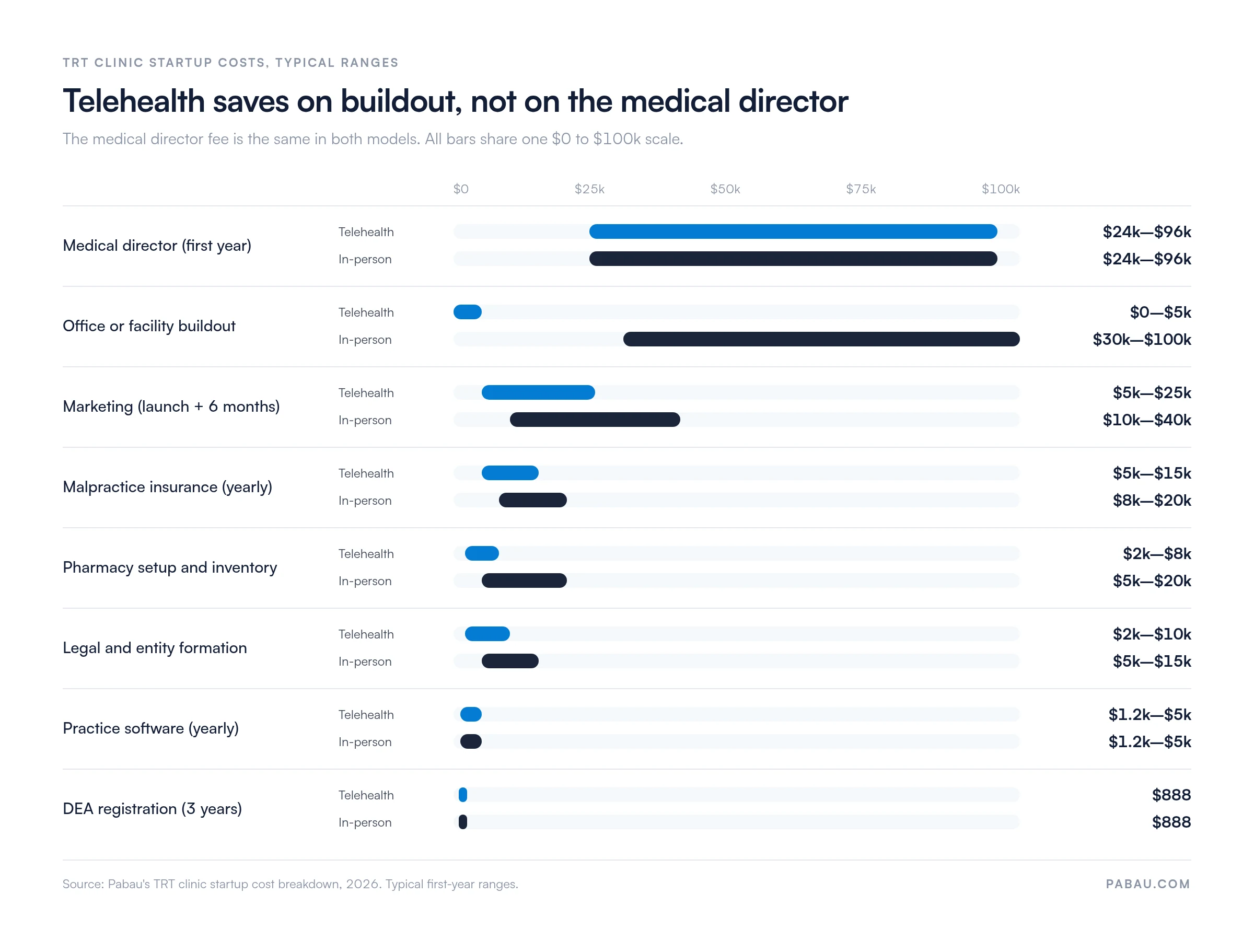
A lean telehealth TRT practice can launch for $40,000-$80,000 if the medical director is a working partner rather than a hired contractor. An in-person practice with a dedicated space and employed staff realistically needs $100,000-$200,000 before seeing a patient.
Neither estimate covers operating losses during the patient acquisition ramp. That ramp typically runs 3-6 months before a membership model reaches cash-flow positive. Laid side by side, the ranges show where the two models actually differ.
TRT clinic EHR software needs to do more than store clinical notes. Controlled substance prescribing, membership billing, telehealth delivery, and high-volume intake create requirements that most generic EHRs don’t handle well out of the box.
Check every vendor against this list before you sign. Specialist HRT clinic software should cover scheduling, intake, memberships, telehealth, and treatment notes in one system, so your team isn’t re-keying data between tools.
When evaluating EHR software for a TRT clinic, ask vendors whether they support controlled substance documentation logs. Also ask whether their subscription billing module retries failed payments automatically. Generic clinic software often handles neither without custom configuration.
HIPAA compliance for a TRT clinic covers the same obligations as for any medical practice. Protected health information (PHI) must be stored, transmitted, and accessed in ways that meet the HIPAA Security and Privacy Rules.
Telehealth TRT practices need to give three compliance areas extra attention:
A lean telehealth TRT practice can operate with three core roles, plus a billing specialist if you take insurance. An in-person or hybrid practice needs more people, but the same functional requirements apply.
Men’s health marketing needs a different approach from general medical marketing. Men research health concerns extensively online before booking, which makes content marketing and SEO one of the strongest acquisition channels for TRT practices.
If you run a physical location, a plan for local men’s health SEO helps you show up when patients search nearby.
Google and Meta restrict direct advertising of prescription testosterone treatments and hormone therapy services. Ads that mention specific controlled substances or make explicit treatment claims will typically be rejected or paused. Compliant alternatives include:
Revenue diversification matters more in a membership model than in fee-for-service, because your average revenue per member is fixed. Complementary services raise member lifetime value without new patient acquisition.
Many new TRT practices launch on a patchwork of tools. Bookings sit in one app, intake forms arrive as PDFs, and membership payments run through a separate billing service. Each lab recall then depends on someone remembering to send it.
Pabau brings scheduling, digital intake forms, memberships, telehealth, and treatment notes into one practice management system. Intake forms go out when a patient books, and member payments are collected each month without manual invoicing.
Your patient coordinator spends less time chasing forms and failed payments, and more time keeping members on their monitoring schedule. Automated reminders can prompt patients when their next lab check is due.

Pabau brings booking, digital intake, membership billing, and telehealth into one practice management system, so your team spends less time on admin. See how it fits a TRT practice.

Start with the legal structure, not the marketing. Your entity, CPOM setup, medical director contract, and DEA registration decide which delivery model you can legally run. They also take the longest to put in place.
If you plan a telehealth-first model, build an in-person evaluation pathway now. The telemedicine flexibilities run only to the end of 2026. A pathway set up at launch costs far less than one bolted on under deadline.
Then choose software that handles memberships and lab recalls from day one, because switching systems with hundreds of active members is much harder. Book a demo to see how Pabau can run intake, memberships, and telehealth for your TRT practice.

Adding pellet therapy to your menu? Hormone pellet insertion walks through the clinical procedure step by step.
Tracking estradiol on TRT patients? Male estrogen levels template gives you a ready-made chart for recording results against reference ranges.
Offering bioidentical hormones too? Bio-identical HRT template helps you document treatment plans and follow-up for each patient.
Planning the in-person evaluation? Genitourinary physical exam covers what the exam includes and how to document it.
Want local patients to find you? Local SEO for men’s health practices explains how to rank for nearby searches without paid ads.
A TRT clinic is a medical practice that diagnoses and treats testosterone deficiency in men with testosterone replacement therapy. It combines lab testing, prescribing, and ongoing monitoring under physician supervision. Most run as cash-pay or membership businesses, since payers often treat TRT as elective.
A telehealth TRT clinic can launch for $40,000-$80,000, covering legal formation, DEA registration, medical director fees, malpractice insurance, software, and marketing. An in-person clinic with dedicated space typically needs $100,000-$200,000 before the first patient. Neither figure includes operating losses during the patient ramp period.
Yes. In the vast majority of US states, a licensed physician must provide medical oversight for a TRT clinic. That can be a physician on staff or a contracted medical director. In states with corporate practice of medicine (CPOM) restrictions, the medical director also anchors the legal ownership structure. Supervision ratios and contract requirements vary by state.
TRT clinics need HIPAA-compliant practice management software that handles membership billing, digital intake forms, telehealth video, and automated lab follow-up reminders. Pabau brings scheduling, digital intake forms, memberships, telehealth, and treatment notes into one practice management system.
CPT code 11980 (subcutaneous hormone pellet implantation) is used for testosterone pellet insertion procedures. The code covers implanting hormone pellets under the skin. It’s separate from the evaluation and management codes used for TRT consultation visits. Verify current billing requirements with your payer mix before submitting claims.
Yes, but telehealth TRT clinics face specific federal rules. The Ryan Haight Act generally requires an in-person evaluation before prescribing a controlled substance like testosterone via telemedicine. DEA and HHS have extended the telemedicine flexibilities through December 31, 2026, so remote prescribing without a prior visit is allowed until then. Clinicians also need active licenses in every state where patients are located.