Greene climacteric scale: scoring and clinical guide
The Greene climacteric scale is a 21-item questionnaire on which the patient rat...

1
Last Updated: Nov 26, 2026
This hormone therapy SOAP note is a free PDF form for TRT and HRT follow-ups, with lab-review and dose-change fields a general SOAP note lacks. Each lab gets a date drawn, a date reviewed, the result, the prior result and a direction of change. Likewise, each dose change gets the previous dose, the new dose, the reason, the route or product and an effective date.
The form holds fields only, with no target lab ranges, intervals or doses, so review it with your medical director and legal counsel before use. What follows is the field list for each SOAP section and the lab-and-dose block. A monitoring map then ties each tracked item to its source, and a fill-in layout closes it.
A three-page printable SOAP note for TRT and HRT follow-ups, with Subjective prompts, vitals, an eight-row lab review table and symptom checks. The Plan page holds the dose-change table, a product-type checkbox, next labs due and a signature line.
Download template
The lab-and-dose block pairs a dated lab review table in Objective with a dose-change table in Plan, linked by the reason column.
Each lab row records date drawn, date reviewed, result, prior result and direction, so the note shows change without stating a target range.
The monitoring map ties 11 tracked items to the FDA label, FDA notice or society guideline that names each one.
Blood pressure gets its own line because FDA added a class-wide blood pressure warning to testosterone labels on February 28, 2025.
The form holds fields only, so your medical director and legal counsel decide which labs and intervals the practice uses.
A hormone therapy SOAP note is the visit record for a patient on testosterone or menopausal hormone therapy, in SOAP order. The note carries the monitoring items that labels name, such as the labs the AndroGel 1% prescribing information lists for periodic checks.
That label, revised in July 2025 and checked November 26, 2026, lists serum testosterone, PSA, hemoglobin, hematocrit, liver function tests and lipids. In contrast, a general SOAP template has one free-text “labs” line for all of that. A hormone replacement therapy SOAP note gives each item its own dated row, so the next clinician can see what changed and when.
We built the form for follow-up visits, which recur for as long as the patient stays on therapy. It also assumes you already know SOAP order and skips the basics.
A hormone follow-up note needs dated lab rows with prior results, a dose-change record, label-linked symptom checks and a product-type field that general templates omit.
Hormone care runs on comparison. The question at a follow-up is rarely “what is the result” and usually “what did it do since the last dose change”. Therefore, the table below sets the two note types side by side, field by field.
| Field | General SOAP note | Hormone follow-up note |
|---|---|---|
| Labs | One free-text line for results | A row per lab with date drawn, date reviewed, result, prior result, direction and source lab |
| Medication | Name, dose, route and frequency | Previous dose, new dose, reason, route or product, effective date and next labs due |
| Blood pressure | Part of the vitals line | Recorded at every visit, because testosterone labels now carry a blood pressure warning |
| Symptom checks | Review of systems, if used | Yes or no boxes for venous thromboembolism and sleep-apnea symptoms, with notes |
| Product type | Not recorded | FDA-approved product or compounded preparation |
| Reevaluation | Not recorded | Yes or no, with a date, for periodic reevaluation of continued therapy |
| Patient-reported change | Chief complaint and history of present illness | Symptoms since last visit, adherence and missed doses, and HRT bleeding pattern |
On paper, you write the new dose in the note, but the reason for the change and the lab that prompted it sit somewhere else. The dose-change table on this form, however, keeps the dose, the reason and the next draw on one line.
The Subjective section of a TRT or HRT follow-up records what the patient reports since the last visit, from symptoms and adherence to new questions.
Write it in the patient’s words where you can. The form gives each of these prompts its own box, so a missed dose or a new supplement does not disappear into a paragraph.
If your practice scores menopausal symptoms, attach the menopause rating scale to the visit and note the score here. The SOAP form deliberately carries no scale of its own, so you can use the instrument your practice already trusts.
The Objective section holds what you measured or reviewed at this visit, including vitals, exam notes, the lab review table and two symptom checks.
Vitals are blood pressure, heart rate and weight. Blood pressure also gets its own line, because the testosterone labels below ask for periodic monitoring. The symptom checks for venous thromboembolism and sleep apnea are yes or no boxes with a notes column, so you record a negative check too.
Record each lab as its own row, with date drawn, date reviewed, the result, the prior result and the direction of change. This table is the first half of the lab-and-dose block.
The rows are blank on purpose, because your practice decides which labs it tracks for each therapy, and the form never prints a target range. The direction column takes only up, down or unchanged, so the note shows movement without making a clinical call.
| Lab (practice-defined) | Date drawn | Date reviewed | Result | Prior result | Direction | Source lab |
|---|---|---|---|---|---|---|
| [Lab name] | [Date] | [Date] | [Value and unit] | [Value and date] | Up, down or unchanged | [Lab] |
| [Lab name] | [Date] | [Date] | [Value and unit] | [Value and date] | Up, down or unchanged | [Lab] |
Two dates matter more than they look. First, date drawn ties the value to where the patient was in the dosing cycle. Second, date reviewed records the day a clinician read the result. For menopausal patients, the menopause hormone levels template keeps a longer run of values beside this note.
The Assessment section records the clinician’s judgment on response, side effects and labs, plus the risk discussion and periodic reevaluation of continued therapy.
In an HRT progress note, this is where the clinician’s reasoning lives, so the form gives it six fields.
The reevaluation field comes from the labels and guidance, not from habit. For example, the Premarin prescribing information (revised April 2025) says clinicians should re-evaluate postmenopausal women periodically to decide whether treatment is still necessary. Similarly, the Menopause Society’s 2022 position statement calls for individualized treatment with periodic reevaluation, and sets no fixed interval.
For TRT, the Endocrine Society’s 2018 guideline recommends evaluating patients after treatment starts for response, adverse effects and adherence. A signed TRT consent form records agreement at the start, while this section records each later risk discussion. We checked both sources on November 26, 2026.
The Plan section records what happens next, from any dose change and next labs due to referrals, education, the follow-up date and the signature.
A testosterone follow-up note that says “continue current regimen” still needs a dated record that no change was made. The form has a “no change” checkbox for exactly that, so nobody has to guess at a blank dose table later.
Document a dose change as one row: previous dose, new dose, reason, route or product, effective date and next labs due. This table is the second half of the lab-and-dose block.
| Previous dose | New dose | Reason | Route or product | Effective date | Next labs due |
|---|---|---|---|---|---|
| [Dose, frequency] | [Dose, frequency] | [Lab row or symptom it responds to] | [Route, product name] | [Date] | [Date and which labs] |
The reason column should point back to a lab row or a Subjective entry. That link is what makes the lab-and-dose block one record instead of two lists. The next-labs column closes the loop, because the follow-up visit opens by checking the draw this row asked for.
Below the table, the product-type checkbox asks whether the patient is on an FDA-approved product or a compounded preparation. The FDA’s compounding questions and answers page (updated September 16, 2025) states that the FDA has not approved compounded drugs. The FDA does not verify their safety, effectiveness or quality before the products reach the market.
The form tracks 11 items, and each one maps to an FDA label, an FDA notice or a society guideline that names it. Finally, the map below is the third part of the lab-and-dose block. It shows where each item sits on the form and which source names it, with no intervals or thresholds.
| Item | Form field | Primary source | Date checked |
|---|---|---|---|
| Serum testosterone | Lab review table | AndroGel 1% label, revised July 2025 | November 26, 2026 |
| Hemoglobin and hematocrit | Lab review table | AndroGel 1% label; Depo-Testosterone label, revised October 2025 | November 26, 2026 |
| PSA | Lab review table | AndroGel 1% label (the Depo-Testosterone text does not list it) | November 26, 2026 |
| Liver function tests | Lab review table | AndroGel 1% label | November 26, 2026 |
| Lipids | Lab review table | AndroGel 1% label, section 5.13; Depo-Testosterone label (serum cholesterol may increase) | November 26, 2026 |
| Blood pressure | Vitals and blood pressure line | AndroGel 1% label, section 5.5; Depo-Testosterone label; FDA class-wide notice, February 28, 2025 | November 26, 2026 |
| Venous thromboembolism symptoms | Symptom check | AndroGel 1% label, section 5.3; Depo-Testosterone label | November 26, 2026 |
| Sleep-apnea symptoms | Symptom check | AndroGel 1% label, section 5.12 (the Depo-Testosterone text does not list it) | November 26, 2026 |
| Response, adverse effects and adherence | Subjective adherence box and Assessment | Endocrine Society testosterone guideline, 2018 | November 26, 2026 |
| Periodic reevaluation of HRT | Assessment reevaluation field | Premarin label, revised April 2025; Menopause Society position statement, 2022 | November 26, 2026 |
| Compounded preparation | Plan product-type checkbox | FDA compounding questions and answers, updated September 16, 2025 | November 26, 2026 |
The two testosterone labels differ, so the table credits each item only to the label that states it. The Depo-Testosterone label on DailyMed asks for periodic hemoglobin and hematocrit and periodic blood pressure checks. However, it does not list PSA or sleep apnea.
Blood pressure earned its own line after the FDA’s class-wide testosterone labeling changes of February 28, 2025. That notice also removed cardiovascular-outcome language from the boxed warning and required a blood pressure warning on every testosterone product.
Menopausal hormone therapy labels are changing too. By February 12, 2026, the FDA had approved labeling changes for six products, removing boxed-warning statements on cardiovascular disease, breast cancer and probable dementia. Labels now vary by product, so check the current label for the product you prescribe.
Use this form at every follow-up visit once a patient is on therapy. However, an initial visit needs a longer record, with full history, baseline labs and the treatment decision. A hormone therapy intake form covers that first visit, while this note picks up from the second.
Before the visit, copy the prior results into the lab review table so the comparison is ready. Then fill the sections in order. The layout below uses bracketed blanks only, and no patient data.
A follow-up note is shorter than an initial one, but it is still a dated legal record. Sign and date it on the day of the visit.
Pabau, an EHR and practice management platform, keeps this note in the patient record, next to the lab results the note is reviewing. That turns the lab-and-dose block from a page you fill by hand into a loop that runs from one visit to the next.
Quest orders go out from the patient record with the practice’s own Quest login, and results import automatically. For Labcorp, the practice places orders in Labcorp Link, and results sync back automatically. In addition, practices can switch on Labs per account.
A biomarker-over-time chart sits on the patient record, so earlier results stay on screen while you write the note. In addition, patients see trends on the results the practice has released to them. Finally, the diagram traces that loop from note to recall.
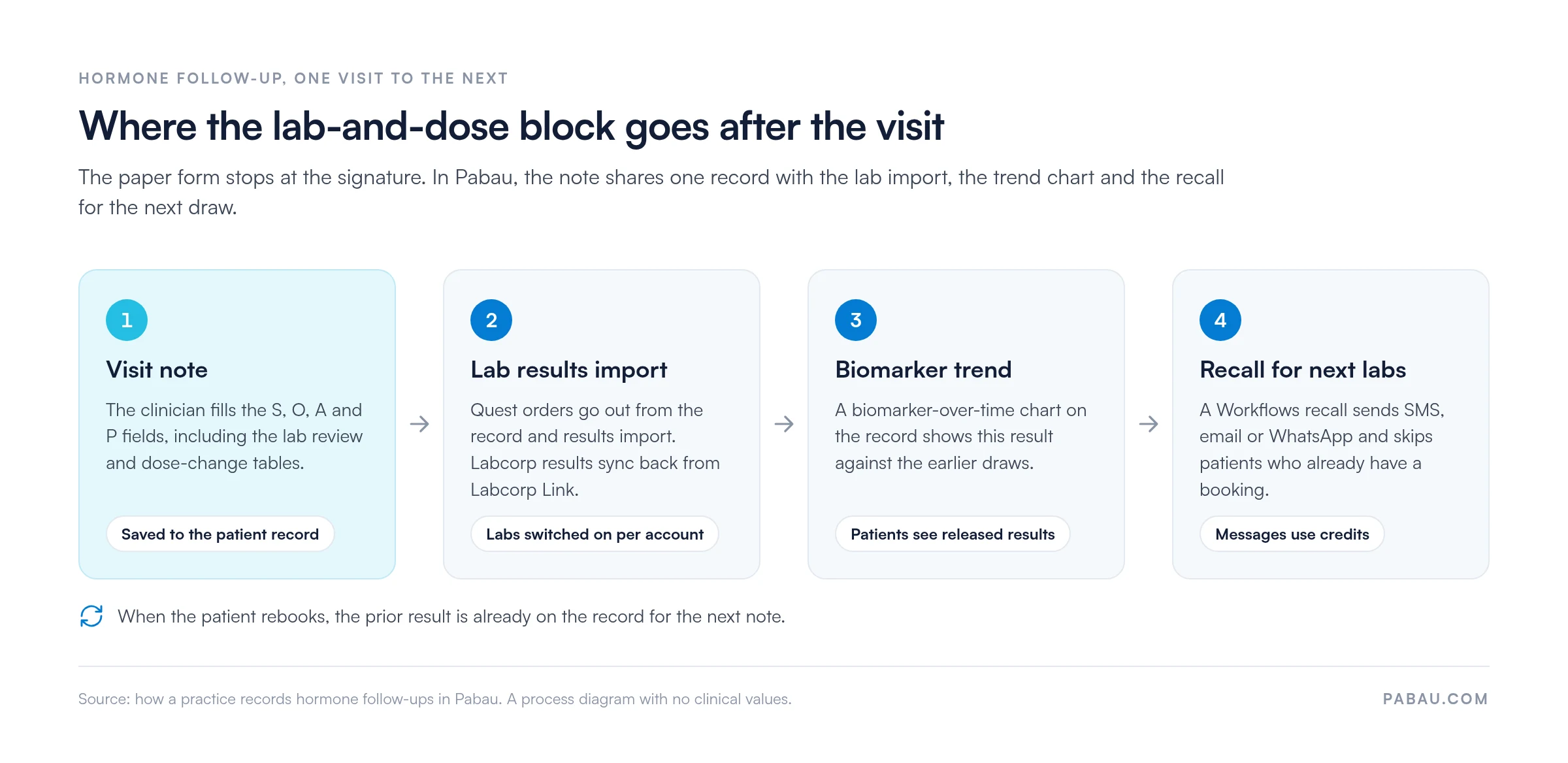
Recall workflows use 90-day and 6-month templates and send SMS, email or WhatsApp and skip patients who already have a booking. Pabau calls this feature Workflows. Messages run on credits, which are usage-based, so the cost grows with the number of reminders sent.
A paper or PDF note cannot fill itself, chart a trend or remind anyone about the next draw. The printed form works as it stands, but the table shows what removes each limit when the same note lives in Pabau.
| Limit of a paper or PDF note | What removes it in Pabau |
|---|---|
| Lab values are retyped from lab PDFs | Quest results import automatically, and Labcorp results sync back from Labcorp Link |
| No trend across visits | A biomarker-over-time chart on the patient record |
| No reminder when next labs are due | A Workflows recall by SMS, email or WhatsApp, using usage-based credits |
| Notes, labs and consent scattered across files | Notes saved in the patient record, beside the results they review |
Every Pabau plan includes the core features, and add-ons enhance the experience. In addition, practices comparing platforms can read our roundup of TRT clinic software. For the wider picture, see how Pabau works as HRT practice software.
For TRT-led practices, Pabau’s men’s health practice software keeps the follow-up note, the labs and the recall on one patient record. Onboarding is structured, with a dedicated coordinator to guide the setup.

Pabau saves the SOAP note in the patient record beside imported Quest and Labcorp results and a biomarker trend chart. A Workflows recall then reminds the patient when the next labs are due.

Start with the lab-and-dose block, even if you change nothing else in your notes. A covering clinician or an auditor looks for two things first. They want a dated lab row and a dose row with its reason.
Keep the form free of ranges and doses, and let your medical director decide what each practice tracks. The trade-off is a little more writing per visit, in exchange for a record that explains every change.
Book a demo to see how Pabau links hormone follow-up notes to imported labs and next-draw recalls.

Scoring menopausal symptoms at follow-up? Greene climacteric scale gives the scoring rules and a clinical guide for tracking symptoms across visits.
Starting a testosterone service from scratch? How to start a TRT clinic walks through the setup steps, from licensing to patient workflows.
Need the consent that comes before the first dose? TRT consent form covers the risks and alternatives a patient agrees to before therapy starts.
Tracking menopausal hormone values over time? Menopause hormone levels template keeps a longer run of results beside each follow-up note.
Clinicians use this testosterone follow-up note to record a visit in Subjective, Objective, Assessment and Plan order. The note covers symptoms, adherence, vitals including blood pressure, dated lab results and any dose change, so you can compare each visit with the last.
In most practices, the progress note for menopausal hormone therapy follows SOAP order, which makes it a hormone replacement therapy SOAP note. It also adds bleeding pattern, route tolerance and a dated field for periodic reevaluation of continued therapy.
A TRT SOAP note should carry adherence, side effects, blood pressure and dated lab rows with prior results. It also needs venous thromboembolism and sleep-apnea symptom checks. The Plan records any dose change with its reason, route or product, effective date and next labs due.