Peptide therapy clinic software: 8 picks scored on consent, dosing logs and memberships
The best peptide therapy clinic software for most practices is Pabau, the all-in...

Last Updated: Nov 18, 2026
Eight software platforms are compared for testosterone replacement therapy (TRT) clinics, based on post-consultation work: monitoring labs, injection recalls, prescriptions, memberships, and insurance billing.
Pabau, the practice platform we build, is one of the eight. It keeps all of these in a single patient record and is rated 4.7 on G2 (November 2026). Decoda Health is built for med spas and longevity practices that offer labs as a service. Charm Health and Practice Better have free entry plans, and OptiMantra suits budget-conscious integrative practices.
The criteria reflect our view of daily TRT practice needs. We checked each vendor’s own website on November 17, 2026, and did no hands-on testing of the other platforms products.

1. Pabau — best overall for practices that want labs, recalls, prescribing, memberships and insurance billing in one system.
2. Decoda Health — strongest rival on the loop, with Quest and LabCorp results in the chart and 90-day recall sequences.
3. Charm Health — the lowest-cost way in, with a free plan, Quest and LabCorp interfaces and an EPCS add-on.
4. OptiMantra — integrative and functional practices that want Quest and LabCorp ordering at a low starting price.
5. Cerbo — practices that want EPCS included in the prescriber seat and results pushed into the chart.
6. DrChrono — practices that want an established EHR with billing tools and can work from a custom quote.
7. Healthie — virtual-first practices that order labs through partner networks.
8. Practice Better — wellness practices adding prescribing, with EPCS inside the ePrescribe add-on.
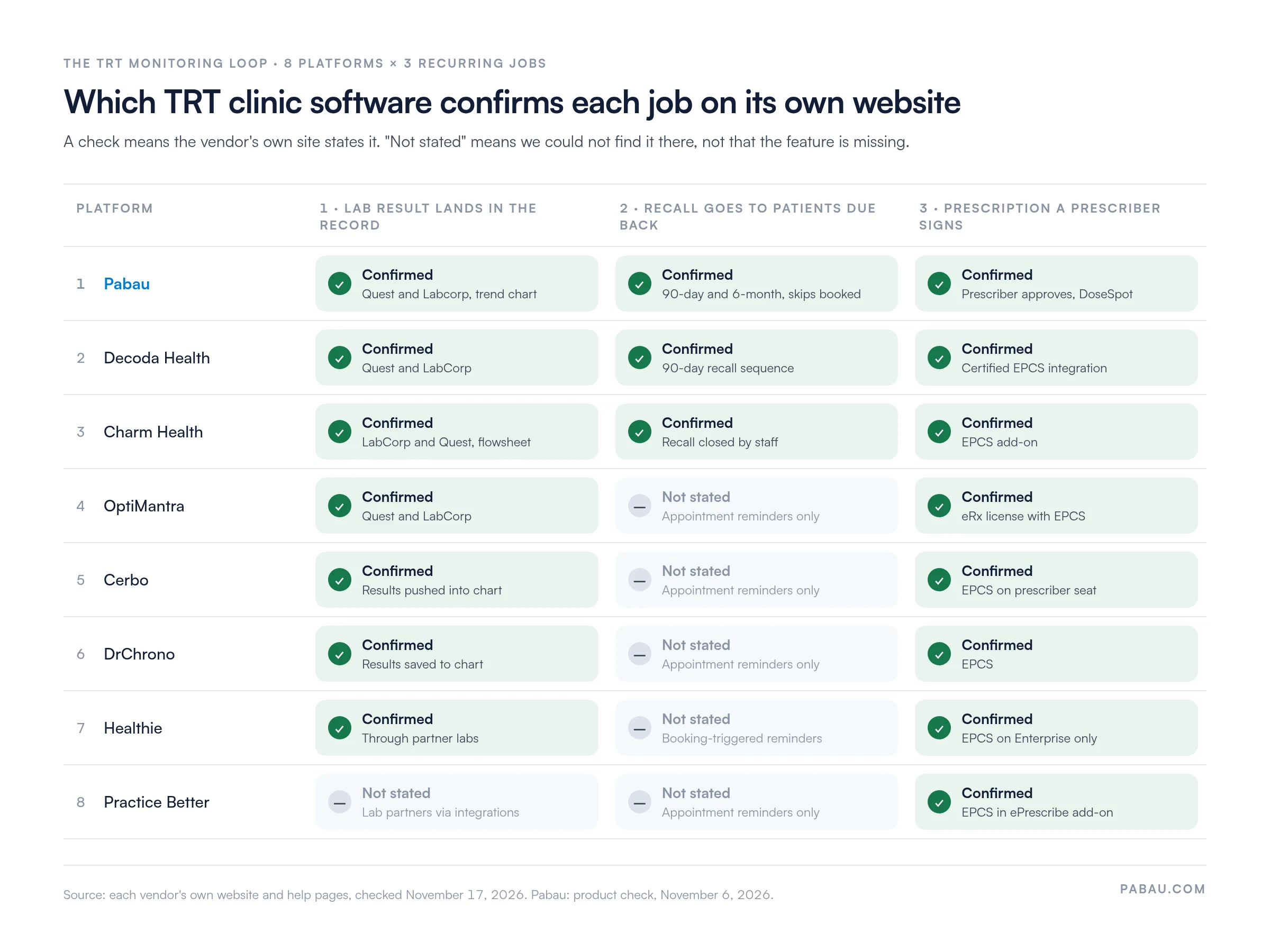
Each cell below says what the vendor’s own site confirms, or that the site does not state it. Prices are entry prices, checked November 17, 2026.
Labs, recalls, prescriptions, memberships and insurance claims share one patient record.
Pabau covers the clinical side and the business side of a TRT practice in the same system. That matters most after the first visit, when the work becomes labs, reviews and repeat injections.
In Pabau, the practice orders Quest tests from the patient record with its own Quest login, and the results import automatically. Labcorp orders are placed in Labcorp Link, and those results sync back automatically.
Practices can switch on labs per account. A biomarker-over-time chart sits on the patient record, so the prescriber sees the trend before the review call. Patients see trends on the results the practice has released to them.
Pabau’s recall Workflows send SMS, email or WhatsApp messages from 90-day and six-month templates, and they skip patients who already have a booking. A patient who rebooked at the front desk never gets a recall asking them to book.
In Pabau, a non-prescriber can draft a prescription, but only a prescriber can approve and send it. US e-prescribing runs through DoseSpot, so the renewal starts from the same record that holds the latest lab result.
Pabau fits a mixed practice best. A practice running TRT next to weight loss, aesthetics or ED and shockwave packages keeps one patient record for all of it.
Stock carries a batch number and an expiry date, and the lot is recorded against the patient and the appointment. The Care Plus add-on covers telehealth and Pabau Scribe, our AI scribe. With it, those minutes stop drawing on credits, except during a Care Plus trial.
“After setup, it’s genuinely helpful and cuts down a lot of the admin involved in running a business. It automates many tasks and makes note-keeping straightforward.”
“It’s very user-friendly and easy to learn, which makes it simple for our team to use every day. It works well for managing appointments, communicating with patients, storing patient information, and generating reports, all in one place.”
Every Pabau plan includes the core features, and add-ons enhance the experience. SMS, two-factor codes, telehealth and Scribe use credits, so the bill grows with use. Telehealth costs one credit per minute per staff member. There is no free trial, because onboarding is structured. Pabau’s pricing page lists the current plans.
The closest match to Pabau on the loop, aimed at med spas and longevity practices.
Decoda Health describes itself as one platform for med spas, with scheduling, charting, payments, inventory and marketing together. Its labs page says the product is built for longevity, hormone, weight loss and wellness practices that run labs as a core service line.
Decoda Health puts lab results in the chart. Its labs page says orders route through your own Quest or LabCorp contract, or through Decoda’s managed network across 20+ labs.
Decoda Health confirms recalls on its communications page. A 90-day recall sits in the automated sequence, and campaigns filter by treatment type, days since the last visit or membership status. Skipping patients who already booked is not stated.
Decoda Health states a controlled-substance e-prescribing integration on its medications page. The page says Drummond Group certified the integration against DEA EPCS requirements.
Decoda Health suits a med spa or longevity practice that wants a managed lab network with pre-negotiated rates instead of its own lab contracts.
A full EHR with lab interfaces, recalls and EPCS at the lowest published entry price.
Charm Health sells CharmHealth EHR as an online EHR, practice management and medical billing system. Its specialty pages include integrative medicine and family practice.
Charm Health lists ready-to-use lab interfaces for LabCorp and Quest on its EHR page. A flowsheet tracks vitals and lab results across visits from one screen.
Charm Health’s Patient Recall sends email, text and voice reminders asking patients to book follow-ups. Pending recalls show while staff book an appointment, and the front office marks the recall complete by hand.
Charm Health sells prescribing in two tiers on its eRx and EPCS page. Basic eRx covers non-controlled drugs only, and the EPCS subscription covers controlled and non-controlled drugs through Surescripts.
Charm Health wins for a solo prescriber who wants a free or per-encounter EHR before committing to a monthly subscription.
Charm Health lists these figures on its US pricing page. Text messaging starts at $20 a month for 250 messages or calls, and e-claims cost $0.25 per transaction above a $25 minimum.
Quest and LabCorp ordering plus EPCS at a low entry price, built for integrative practices.
OptiMantra is an EMR and practice management system for integrative, functional, med spa and multi-modality practices. One customer quote on its homepage describes a functional medicine hormone replacement practice.
OptiMantra’s integrations page says practitioners submit Quest and LabCorp orders from the platform and receive results electronically. Access and Rupa Health are listed too.
OptiMantra does not state recalls for patients who are due back. Its FAQ confirms text and email appointment reminders and mentions patient re-engagement tools without describing them.
OptiMantra’s FAQ confirms e-prescribing with controlled-substance (EPCS) capability inside the platform. The EPCS license is a paid add-on.
OptiMantra wins for an integrative practice that wants to start under $100 a month and add EPCS only when a prescriber joins.
OptiMantra lists these prices on its own pricing page. No setup fee is mentioned there.
A charting-heavy EHR that bundles EPCS into the prescriber seat.
Cerbo is a cloud EHR that sets each practice up on its own dedicated server. Its pricing FAQ says each practice builds its own charting templates, because stock templates are not offered yet.
Cerbo states that results-only and bi-directional lab integrations push results into Cerbo, where staff review and save them to the chart. Bi-directional labs also take electronic orders.
Cerbo does not state recalls for patients who are due back. Its FAQ confirms an initial email, an email reminder and a text reminder for booked appointments.
Cerbo’s FAQ says practices can e-prescribe standard medications, controlled substances and compounded medications. The prescribing provider seat lists eRx, eFax and EPCS as included.
Cerbo wins for a prescriber-led practice that wants EPCS priced into the seat and is happy to build its own chart templates.
Cerbo lists these prices on its own site. The patient portal costs $79 a month, and telemedicine costs $27 per provider per month.
An established EHR with EPCS and lab results in the chart, priced by quote.
DrChrono, now DrChrono by EverHealth, combines charting, scheduling, billing and patient engagement in one EHR with a mobile-first approach.
DrChrono states that practices can order labs and receive results directly, with results saved automatically to patient charts. An extended lab integration add-on covers over 40,000 labs and imaging centers.
DrChrono does not state recalls for patients who are due back. Its EHR page confirms scheduling, intake and appointment reminders on one platform.
DrChrono states that prescribers can handle controlled substances with EPCS from an iPad, an iPhone or a desktop.
DrChrono wins for a practice that wants revenue cycle workflows in its EHR and prescribers who chart from an iPad.
“Extremely easy to learn, very intuitive interface, highly customizable.”
DrChrono asks practices to request a quote for every plan. Its pricing page does publish some add-ons, including extended lab integration at $30 per provider per month and texts at $0.05 each.
A virtual-first EHR where labs come through partner networks and EPCS sits on Enterprise.
Healthie describes itself as an API-first EHR for virtual-first care. A TRT practice running mostly video follow-ups will recognize the model.
Healthie’s clinical care tools page says labs are ordered from the chart and results live alongside the patient’s record. Its help center routes LabCorp orders through Evexia, which pulls in PDF results.
Healthie does not state recalls for patients who are due back. Its workflow automations trigger reminders, confirmations and follow-ups when a patient books.
Healthie states that controlled substances can be prescribed on the Enterprise plan. Its pricing page lists EPCS as subject to approval, next to DoseSpot e-prescribing at $40 per clinician per month.
Healthie wins for a telehealth-led practice with developers who want to build on Healthie’s API.
Healthie lists these figures on its own pricing page. Its Claim.MD integration for insurance claims starts at $30 a month.
A wellness practice platform where EPCS comes free inside the ePrescribe add-on.
Practice Better is a practice platform for health and wellness practitioners, with scheduling, charting, programs and payments.
Practice Better does not state that lab results land in the patient record. Its integrations page lists labs among 36+ tools, naming Rupa Health and Fullscript.
Practice Better does not state recalls for patients who are due back. Its scheduling page confirms up to three email or SMS reminders per appointment.
Practice Better’s ePrescribe page says EPCS through DrFirst is included at no extra cost. Prescribers verify identity through ID.me and sign with two-factor authentication.
Practice Better wins for a nutrition or wellness practitioner who wants to test prescribing on a free or $35 plan first.
Practice Better lists these prices on its own site. ePrescribe adds $49 per practitioner per month plus $99 onboarding, and PDMP access adds $5 a month plus $399 per state.
The best TRT clinic software runs the TRT monitoring loop. Lab results land in the record, recalls skip booked patients, and a prescriber signs every renewal.
The TRT monitoring loop is the work that repeats after the first visit. A common pattern is one in-person start, then virtual lab-review follow-ups and repeat injection visits. If you are still building that model, our guide to starting a TRT clinic covers the setup.
Testosterone clinic software earns its fee on those three jobs. The scorecard below shows which vendors confirm each one on their own websites.
A TRT practice tracks hematocrit, PSA and estradiol alongside testosterone, so each result needs to reach the patient record as data. When results arrive as PDFs to download and attach, the prescriber has no trend line at the next review.
Our male estrogen levels template charts E2 and E1 readings for staff who review estradiol.
On sales calls with men’s health owners, we often hear that the next draw or injection date lives in the owner’s personal calendar. A reminder tool that cannot see the schedule then messages patients who already rebooked, which reads as careless.
Look for recalls on a fixed interval that check the calendar before they send. Appointment reminders alone only reach patients who already booked.
Testosterone is a Schedule III controlled substance, listed in 21 CFR 1308.13 (eCFR, checked November 17, 2026). Your software should let staff prepare a renewal while only a prescriber signs and sends it.
Telehealth prescribing of controlled medications currently runs under the DEA’s fourth temporary extension, published December 31, 2025. It runs through December 31, 2026, and no final special-registration rule had been published as of November 17, 2026.
Many TRT practices sell a monthly membership, and some add ED services such as shockwave packages. Your system should bill recurring memberships and packages, and still submit insurance claims for patients who use coverage.
We chose the best men’s health clinic software by scoring practice-side platforms on the TRT monitoring loop, using only what each vendor’s own site states. Pabau wrote this list, so the criteria reflect our view of a TRT practice’s daily work.
For the wider feature view, see our page on men’s health clinic software.
Pabau runs booking, charting, consent forms, payments and memberships for practices that offer aesthetics, hormone therapy, weight loss and longevity care in one system. Here is one patient’s loop, starting with a TRT consent form signed before the first visit.
Recurring memberships and treatment packages cover hormone, GLP-1 and longevity programs. Self-pay, membership and insurance billing run in the same system, for practices in the US, UK and Australia.
Every Pabau plan includes the core features, and add-ons enhance the experience. Pabau is rated 4.7 on G2 and Capterra.
Want to watch one TRT patient move from lab draw to renewal in Pabau? Book a demo and we will walk through your own loop.

Pabau brings Quest and Labcorp results, recall Workflows that skip booked patients and prescriber-approved prescriptions into one patient record. Your team stops tracking the next draw by hand.

Choose on the jobs your team repeats every week. A TRT practice lives on lab reviews, recalls and renewals long after the first visit.
If recalls still live in someone’s calendar, fix that first, because missed draws delay renewals. Book demos with two or three vendors and ask each to run one patient through the loop live.
Book a demo to see Pabau run labs, recalls and prescriber sign-off for your TRT patients in one system.

Tracking hormone results? Male monthly hormone cycle template helps patients log readings between reviews.
Offering pellets too? Hormone pellet insertion covers the procedure and what to document.
Running broader hormone care? HRT clinic software shows how Pabau supports hormone replacement practices.
An EMR for a TRT practice is an electronic medical record built around repeat monitoring. It stores lab trends, dose and injection history, recalls and prescriptions against one patient. The label also gets used for TRT software of any kind, so check what the record holds.
For a TRT or men’s health practice, the best practice management software is Pabau. Pabau keeps labs, injection recalls, prescriber-approved prescriptions, memberships and insurance billing in one system.
Yes, Pabau bills insurance. US claims run through Claim.MD with CMS-1500/837P claims, eligibility checks, ERA remittances and secondary claims. UK practices use Healthcode and BUPA, and Australian practices use Tyro Health. Canadian practices record policies, authorizations and superbills. Prior authorization is tracked on the case.
On November 17, 2026, published entry prices ran from free plans at Charm Health and Practice Better to $281 a month at Cerbo. Pabau starts at $104 a month per user, and the price depends on location and the number of users. A demo gives an exact quote, and SMS and telehealth credits grow with use. Several rivals charge extra for EPCS.