Hormone therapy SOAP note template: lab and dose changes
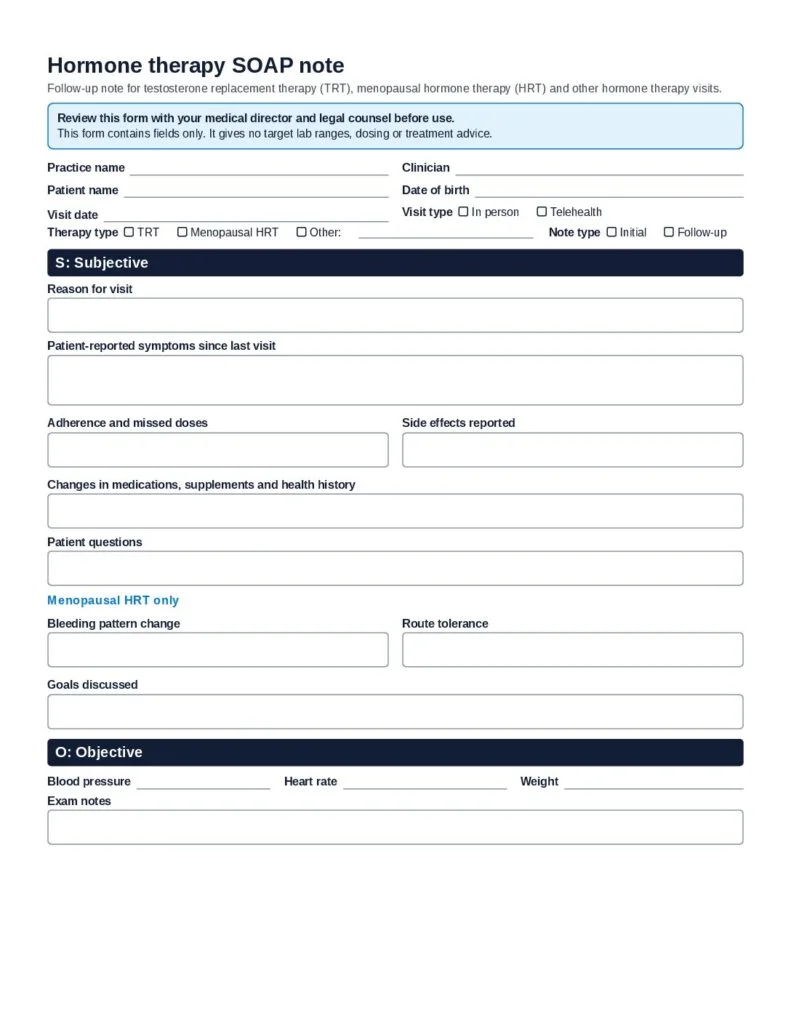
This hormone therapy SOAP note is a free PDF form for TRT and HRT follow-ups, wi...

1
Last Updated: Nov 26, 2026
The Greene climacteric scale is a 21-item questionnaire on which the patient rates each menopause symptom from 0 (not at all) to 3 (extremely). Summing the ratings gives psychological, somatic and vasomotor subscales, and the psychological score splits into anxiety and depression. Item 21 is a separate probe for sexual dysfunction.
RWS Life Sciences handles permission to use the scale. Use is free for academic researchers, while pharmaceutical companies pay per enrolled patient. The RWS pages, checked November 26, 2026, don’t address clinical use, so a practice should request permission in writing first.
What follows covers those license terms, the scoring rules and the Greene rollout checklist for recording comparable scores at every visit.
A one-page record sheet with a permission and form-control checklist. Its five-visit score table covers the psychological, anxiety, depression, somatic and vasomotor subscales plus item 21. It holds no Greene questions, so request the questionnaire from RWS Life Sciences.
Download template
The Greene climacteric scale has 21 items rated 0 to 3, summed into psychological, anxiety, depression, somatic and vasomotor subscale scores.
Permission comes from RWS Life Sciences, which licenses the scale free to academic researchers and at $10 per enrolled patient to pharmaceutical companies.
The RWS pages don’t address clinical use, website posting or downloads, so a practice should ask in writing before using the form.
The questionnaire loses the Greene Climacteric Scale name if anyone changes, adds or deletes a question or response.
The Greene rollout checklist keeps scores comparable: permission requested, wording unaltered, the same time window each visit and subscale scores recorded every time.
The Greene climacteric scale is a self-completed questionnaire that measures core menopause symptoms, with 21 items rated on a four-point scale from 0 to 3. RWS Life Sciences’ instrument page describes it as a brief, standard measure of core climacteric symptoms that takes about five minutes to complete.
Clinicians often shorten the name to the Greene scale. John Gerald Greene, a Glasgow clinical psychologist, set out the instrument in his 1998 Maturitas paper. That paper examined seven factor-analytic studies of climacteric symptoms and argued they agreed enough to support one standard scale.
RWS reports that those seven studies covered 3,124 subjects. In addition, only symptoms with a factor loading above 0.35 in three or more studies made it onto the scale. Two-week test-retest reliability in 50 menopausal women was 0.87 for the psychological scale, 0.84 for the somatic scale and 0.83 for the vasomotor scale.
The normative sample was menopausal and postmenopausal urban Scottish women. Researchers drew participants from the electoral roll or from consecutive referrals to a menopause clinic.
RWS Life Sciences administers permission to use the Greene scale through a license request, and its pages don’t say whether clinical use needs one. That silence is the reason to ask in writing before the form reaches a patient.
Here is what the RWS home page and the RWS FAQ page state, as of November 26, 2026.
The pages name no copyright holder. They also don’t say whether a practice may use the scale clinically, post it on a website or offer it as a download. As a result, permission is neither granted nor refused for a practice, so the written request settles it.
Also, review any form with the practice’s medical director and legal counsel before use. Then file the RWS reply with the master copy of the form, so the license trail sits next to the version staff send out.
Practices using the Greene climacteric scale in the UK have one more rule to respect in the messages around it. UK government guidance says you can’t advertise prescription-only medicines to the general public. Therefore, keep any invitation to complete the questionnaire free of named prescription products.
Greene climacteric scale scoring adds the 0-to-3 ratings within each subscale: psychological items 1 to 11, somatic 12 to 18 and vasomotor 19 to 20. The psychological score splits further into anxiety (items 1 to 6) and depression (items 7 to 11), per RWS’s scoring method.
Each rating uses the same four labels: not at all (0), a little (1), quite a bit (2) and extremely (3). Item 21, however, sits outside the subscales as a probe for sexual dysfunction.
| Subscale | Items | How the score is formed | Source |
|---|---|---|---|
| Psychological (P) | 1 to 11 | Sum of the ratings for items 1 to 11 | RWS scoring method |
| Anxiety (A) | 1 to 6 | Sum of items 1 to 6, a subdivision of P | RWS scoring method |
| Depression (D) | 7 to 11 | Sum of items 7 to 11, a subdivision of P | RWS scoring method |
| Somatic (S) | 12 to 18 | Sum of the ratings for items 12 to 18 | RWS scoring method |
| Vasomotor (V) | 19 to 20 | Sum of the ratings for items 19 and 20 | RWS scoring method |
| Sexual dysfunction probe | 21 | Stands alone, outside the four domains | RWS scoring method |
To score the somatic subscale for a visit, add the patient’s ratings for items 12 to 18. The result describes how severe she rated that group of symptoms on that day. In other words, it says how the patient felt, not why.
The RWS scoring method defines these subscale sums and no overall total. If the practice also adds all 21 items into one number, label that total as a house convention.
The RWS instrument page also lists recommended cut-offs of 10 or more on the anxiety subscale and on the depression subscale. It says these identify women who are severely and possibly clinically anxious or depressed, based on a comparison with the Hospital Anxiety and Depression Scale.
However, a climacteric symptom score on its own is not a diagnosis, and it doesn’t show whether treatment is needed. For this reason, agree with the medical director what a high subscale score triggers in the practice, such as a clinician review.
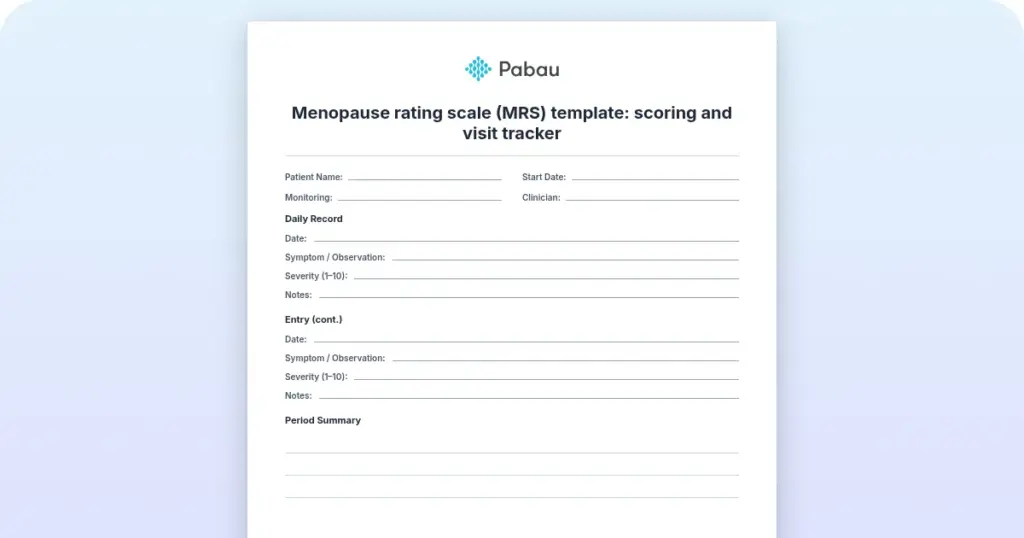
Alternatively, practices choosing between instruments can compare this with the menopause rating scale template, which groups its items into somatic, psychological and urogenital subscales.
The Greene rollout checklist keeps scores comparable across visits: permission requested, wording unaltered, the same time window and subscale scores recorded every time. A change between two visits only means something when the form, the timing and the scoring stayed fixed.
When we set up scored questionnaires with practices, the first question we ask is which file is the master copy. In fact, every score in the visit-to-visit series depends on staff sending that one file, unchanged.
In addition, practices that track lab results alongside symptoms can keep both in one patient file with a menopause hormone levels template. When a follow-up visit changes the HRT dose, an HRT follow-up SOAP note records the lab review and the new dose.
A paper or PDF Greene form can’t reach the patient before the visit or file itself in the patient record. As a result, staff end up carrying and retyping it. The table pairs each limit with how the practice records the same step in Pabau, a practice management system with built-in digital forms.
| Limit of a paper or PDF form | How the practice handles it in Pabau |
|---|---|
| Handed out in the waiting room, so the timing shifts from visit to visit | The practice sends the form before the appointment, alongside intake and consent forms. |
| A completed PDF sits in an inbox or folder, apart from the chart | The completed form lands in the patient record rather than as a separate PDF. |
| The patient can’t return or check documents between visits | Through the patient portal, patients fill in forms and view and upload documents. The practice switches each portal section on or off. |
| Practitioners away from a desk can’t see what came back | Pabau GO, our iOS app for practitioners, supports care-pathway forms and consents. |
| Patients due a follow-up drop out of the visit-to-visit series | Workflows send recall messages by SMS, email or WhatsApp and skip patients who already have a booking. |
However, one limit applies to every format. RWS says the scale was validated on paper and hasn’t been adapted for web use, so name the digital format in the permission request.
The flow below shows the single route each Greene form takes once the checklist is in place.
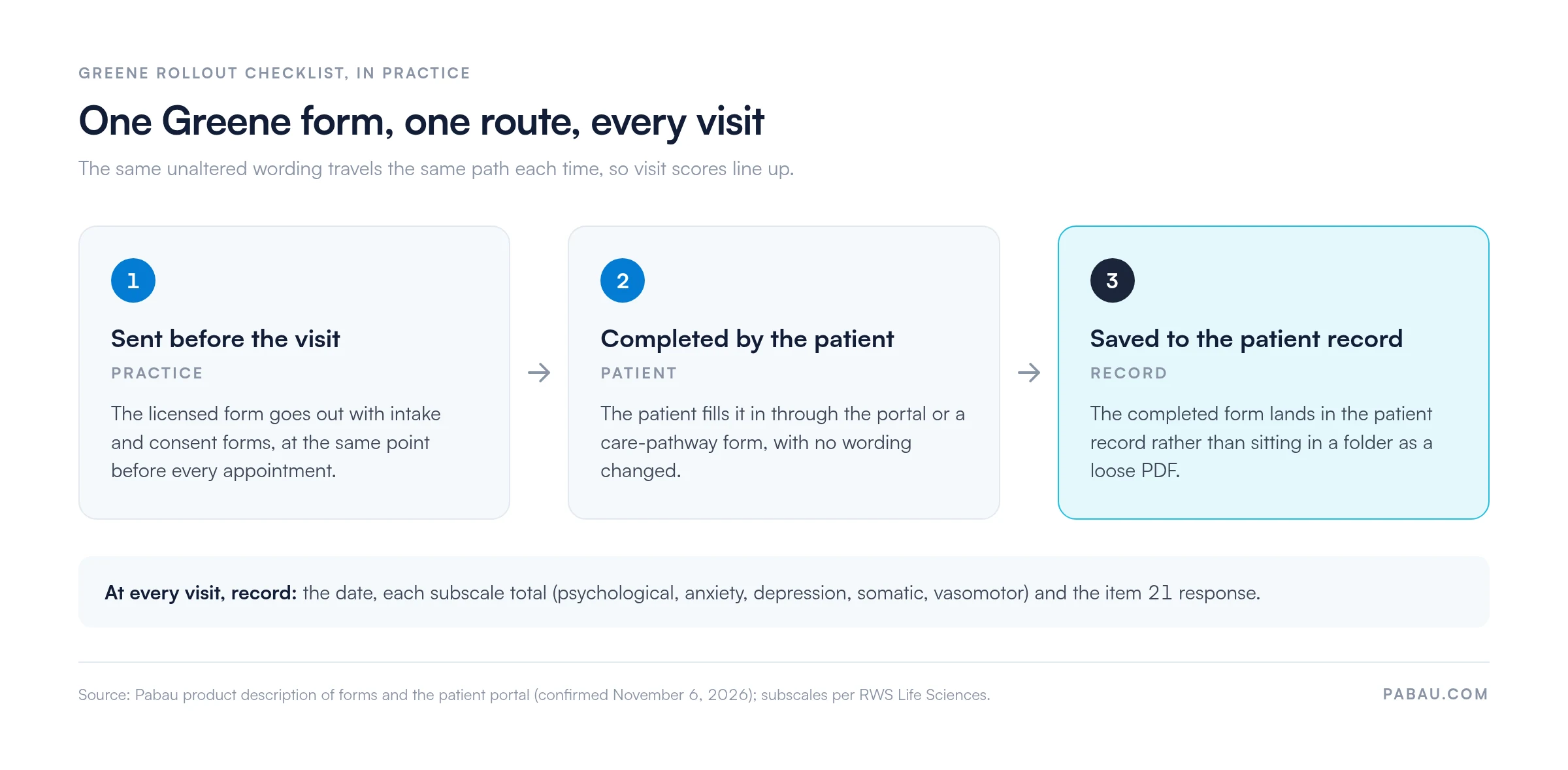
Today the Greene form often lives as a printout or an emailed PDF, and someone copies the scores into the chart by hand. In Pabau, the licensed form goes out with the intake forms before the visit and comes back into the patient record.
Clinicians then open each visit’s Greene answers next to the rest of the patient’s history, so nobody hunts for last month’s sheet. Practices running menopause and hormone services can see how forms fit the wider HRT clinic software setup. Practices that also run men’s hormone services use the same forms and patient records in Pabau’s men’s health clinic software.
Every plan includes the core features, forms and the patient record among them, and add-ons enhance the experience. Setup runs through structured onboarding, so we configure the Greene form before the first patient receives it.

Pabau sends your licensed Greene form with the intake forms and files the completed answers in the patient record. Your team stops retyping scores from paper.

Put the permission request first. The RWS pages are silent on clinical use, so a written answer is the only way to know where the practice stands. Also, ask about digital administration in the same email.
Once the license question is settled, the value of the scale comes from consistency. The same wording, timing and subscale scores at every visit turn separate questionnaires into a record a clinician can read across.
Book a demo to see how Pabau sends the Greene form before each visit and keeps every completed copy in the patient record.

Comparing menopause symptom scales? Menopause rating scale template covers the MRS subscales, its scoring and a visit tracker.
Tracking hormone results as well? Menopause hormone levels template gives the practice a place to log hormone levels across visits.
Moving a patient onto hormone therapy? BHRT consent form template collects consent and intake history before bioidentical hormones start.
Planning the first menopause appointment? Initial consultation template structures the history and notes for a first visit.
Permission to use the scale and its translations runs through RWS Life Sciences, so request a licensed copy there. This page offers a visit record for permission and scores, but doesn’t host the Greene climacteric questionnaire itself. RWS allows reformatting, such as a different font, boxes or blanks, but not changed questions or responses.
Practices use it to record how severe a patient rates her menopause symptoms at a point in time, then compare subscale scores at later visits. RWS describes it as a brief, standard measure of core climacteric symptoms. A climacteric symptom score supports a clinician’s review but doesn’t diagnose a menopause stage.
The Greene scale rates 21 items from 0 to 3, reports vasomotor symptoms as their own subscale and adds a separate sexual dysfunction probe. The Menopause Rating Scale uses somatic, psychological and urogenital subscales, as a 2000 Climacteric study describes. Each scale has its own items, so scores don’t transfer between them.