Free model waiver form + what it is and when your practice needs one
A model waiver form is a signed document that lets a healthcare practice use a p...

5
Last Updated: Sep 29, 2026
The best Pabau alternatives UK clinics can choose from are Calyx and Consentz, but Pabau scores highest on our own test. Pabau holds 4.5 of the five records a UK aesthetic clinic must produce on demand, and Calyx holds four. No platform on this list holds all five outright.
We build Pabau, the practice management software ranked first here, so read this list with that in mind. We scored our own platform on the same five records, from our own published documentation. The other eight were scored the same way, and every score can be checked against the vendor’s own site.
Every other shortlist ranks these platforms on features or usability. This one scores them on the five records a UK aesthetic clinic must produce on demand. Those are consent, prescriber authorization, product batch, photographs, and who treated whom.
Prices come from each vendor’s own website, in pounds, with a worked monthly total at a stated treatment volume. Pabau publishes no GBP price list, and this page says so rather than guessing.

1. Pabau — We build it, and it scores 4.5 of five records, the highest here.
2. Calyx — The strongest alternative at four of five, with POM prescriptions tied to an authorized prescriber.
3. Consentz — Aesthetics-only consent forms and photo mark-up, scoring three of five.
4. MERIDIQ — Records-first modules from £22 per user, with full audit logging.
5. e-clinic — Multi-site groups billing insurers through Healthcode, at £65 per user.
6. Semble — Doctor-led private clinics that prescribe inside the patient record.
7. Phorest — Consultation forms and time-stamped photos, with marketing as its strength.
8. Private Practice Software — The lowest published entry price at £16.80 per practitioner.
9. Fresha — Booking-led clinics on a small budget, holding one of five records.
Nine platforms sit in this comparison, one of them ours and eight of them alternatives to it. Three specialize in aesthetics, three serve UK private practice broadly, and two lead with booking. Starting prices are the lowest figure each vendor publishes on its own site.
Read the table by clinic type rather than by score alone.
Our comparison hub for clinics sets Pabau against each of these platforms one by one.
The Five-Record Test asks whether one system holds all five records a UK aesthetic clinic must produce on demand. Those five are consent, prescriber authorization, product batch, photographs and the practitioner record.
The prescriber is usually a doctor on the GMC register, or a nurse independent prescriber registered with the NMC. Either way, the authorization belongs in the patient’s record rather than in a message thread.
We scored all nine platforms from their own published feature documentation. A record counts as held when the vendor publishes the capability, and as partly held when the vendor implies it without documenting it. Partials count as a half.
Not every UK aesthetic clinic is registrable with the Care Quality Commission, and the distinction changes what the records are for. Registration attaches to regulated activities. The CQC’s own inspection reports state that dermal fillers sit outside its scope of registration.
Botulinum toxin for a medical condition such as hyperhidrosis is in scope, while the same product used cosmetically generally is not. Laser and IPL for cosmetic use also sit outside CQC registration in England, where licensing is handled locally.
The Five-Record Test is therefore about the records rather than the registration. A registered clinic shows them to an inspector. An unregistered clinic shows the same five to the Joint Council for Cosmetic Practitioners, to Save Face, or to an insurer.
The matrix below marks each record as held, partly held or absent, across all nine platforms.
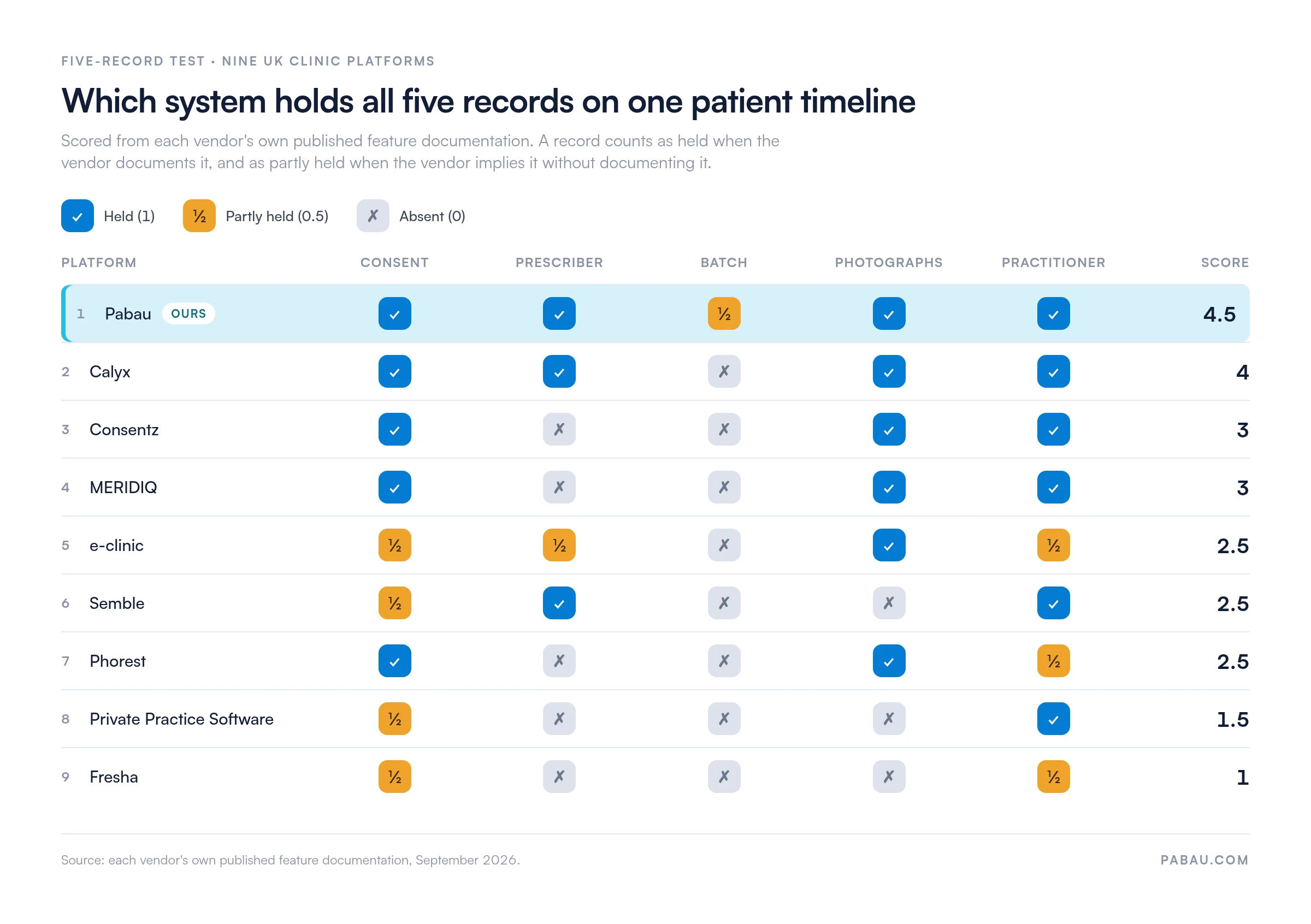
No platform on this list publishes all five records outright. Batch traceability is where the field thins out.
Pabau is the only one of the nine that publishes a batch-number field against the patient. Pabau publishes that field for vaccine doses rather than for injectable lots. On every other platform, the lot number of what you injected lives in a notebook or a stock report.
Three reasons send UK aesthetic clinics looking at Pabau alternatives. Those are practice size, depth in aesthetics specifically, and the cost model at low treatment volume.
Pabau is an all-in-one platform, carrying clinical records, payments, inventory, reporting and marketing in one subscription. Every subscription includes every feature. A single injector doing 20 treatments a month may want something narrower, and that is a fair reason to shop around.
The second reason is depth in one place. A clinic that only wants records and photographs will find a records-first tool cheaper and faster to learn. The third is the cost model. Pabau prices per user and per location, so a second site changes the number more than a second feature does.
The nine reviews below run in Five-Record Test score order. Pabau comes first, as the benchmark the other eight are measured against.
Pabau scores 4.5 of five records, the highest here, and is the only platform publishing a batch-number field on the patient record.
Pabau is practice management software built for medical aesthetics, and we build it. Pabau holds four of the five records outright and half of the fifth. Pabau’s Five-Record Test score is therefore 4.5, the highest on this page.
The prescriber record is where Pabau is strictest. UK prescribers enter their GMC or GDC number in their staff profile, and Pabau will not finalize a script without it. An audit of who authorized a POM is answered from the patient record.
Digital forms link to the service booked, so the right consent goes out before the treatment. Photographs save to the client card with automatic date and time stamps. Treatment notes name the practitioner who delivered the care. A records request is answered from one screen rather than five.
The batch record is the half point. Pabau logs every vaccine dose against the patient with the batch number, expiry, administration date and injection site. For injectables, Pabau logs the units in the clinical note and deducts them from stock automatically, with no lot number.
The missing lot number is why Pabau scores 4.5 rather than five. Owners we onboard test that half point first on a demo, and it is a fair question to ask.
Pabau plans are priced per location, except Enterprise, which covers multiple sites on one subscription. Annual billing saves up to 20%. Marketing Plus, Care Plus and Insight Plus are optional additions, and every plan already includes the platform in full.
The eight alternatives follow in score order, starting with Calyx.
Calyx holds four of the five records, including POM prescriptions linked to an authorized prescriber.
Calyx is a newer UK entrant, and it publishes the prescriber record as a first-class feature. Every POM treatment generates a prescription record linked to an authorized prescriber. Calyx supports both in-house and external prescriber routes.
That matters because of how POM prescribing works in UK aesthetics. GMC guidance is explicit that injectable cosmetic medicines must not be prescribed by phone, video, online or at another person’s request. The prescriber has to examine the patient, and something has to hold the evidence.
Around that prescriber record, Calyx carries consent forms on every tier, a custom form builder, before-and-after photos, three-view treatment mapping and inventory with supplier ordering. Batch numbers are not published as a traceable field, which is why it scores four rather than five.
Calyx prices per plan rather than per seat, and publishes a 1% card transaction fee on its free plan. Concierge data migration is included on every plan.
Consentz and MERIDIQ come next, and both sell the patient record itself rather than the whole operation.
Consentz holds consent forms and photo mark-up in an aesthetics-only system, and scores three of five records.
Consentz is built only for aesthetic clinics, and consent is its strongest record. The platform ships a library of consent forms you select, edit and approve, then captures a signature and shares the signed copy with the patient.
Photographs are handled properly too. Images are time and date tagged, and a ghosting tool lines up the before and after shots. A privacy setting hides intimate photographs from general view. Practitioners can record quantities administered while marking up an image.

Stock is where Consentz gets close to a batch record without reaching it. Stock reduces when you invoice an item or when a practitioner records usage against a photograph, and the history of stock movements is kept. Lot and batch numbers are not published as traceable fields.
Consentz publishes no prices on its own site and offers a free trial instead, so any budget comparison needs a quote first.
MERIDIQ publishes patient records at £22 per user, with audit logging that most aesthetics tools leave out.
MERIDIQ sells the patient record as the core and each other part as a module. The modular shape suits a clinic wanting clinical documentation without a full operations platform. Records include clinical notes, health declarations, consent forms with e-signatures, photo management and treatment templates.
Two published details lift its score. Patient data sits on servers in the EU or EEA with role-based access control and full audit logging. A separate management module holds policies, document control and structured reporting, which is the governance evidence an accreditation body asks about.
MERIDIQ is a Swedish company with a UK-facing site, UK support and prices shown in pounds. Prescribing and batch traceability are the two records it does not cover.
A two-user clinic taking all four modules pays £76 a month, and MERIDIQ states there is no setup fee and no lock-in.
The next two serve UK private practice more broadly, where insurer billing and multi-site control matter more than injectables do.
e-clinic publishes £65 per user a month and handles insurer billing that aesthetics-only tools skip.
e-clinic handles single sites through to multi-location groups, and its own website reports more than 1,200 UK practices. It also names UK groups among its customers. Treat that as positioning, and ask for references in your own specialty.
Billing is where e-clinic separates itself. The platform connects to Healthcode for private medical billing, which is how insurer claims get submitted and reconciled in the UK. Xero handles the accounting side and Pipedrive the inquiry pipeline.
Clinical records cover notes, templates, photo and document management on the aesthetics plan. Prescribing arrives on the higher plan through CloudRX and SignatureRX, alongside Nationwide Pathology and The Doctors Laboratory for labs. Advanced permissions and audit sit in the Enterprise tier rather than in every plan.
Card payments are billed separately, from 1.4% plus 25p per transaction through the embedded provider. Video calls cost 2p a minute, and Healthcode submissions carry a percentage fee.
Semble puts prescribing inside the record and reports itself as audit-ready, but publishes no prices.
Semble is built for UK private healthcare rather than for injectables, and it shows in who it names. The platform sells to GMC-registered consultants, GPs, psychiatrists and allied health teams, with a separate route for pharmacists and independent prescribers.
Prescribing sits inside the record, and the pharmacy network behind it includes CloudRx, SignatureRx and Pharmacierge. Lab partners include Nationwide Pathology and The Doctors Laboratory. Semble states that these integrations are included at no extra charge, and it offers an open GraphQL API.
For an aesthetic clinic the shortfall is visual documentation. Semble publishes audit-ready reporting and clinical governance for multi-site groups, but no before-and-after photo feature, and no batch traceability.
Semble publishes no price list on its own site, so a quote is the only figure you can plan against. Semble does state that its lab and pharmacy integrations carry no extra charge.
The last three score below half of the test. Phorest and Fresha are booking-led, and Private Practice Software leads on insurance billing. Our round-up of Treatwell alternatives covers the marketplace side of that trade-off in more detail.
Phorest carries consent forms and before-and-after photos on the client card, with marketing as its strength.
Phorest is stronger at marketing than at clinical records, and that trade-off decides most comparisons between the two platforms. It began in salons and added aesthetics later, so its center of gravity is still client retention, reviews, loyalty and campaigns.
The clinical side is better than that history suggests. Digital consultation forms gather safety disclosures and consent, sync to the client card, and can be pre-sent by SMS or email. Face-mapping, mark-ups and time-stamped before-and-after photos support treatment plans with course tables.
Where it stops is prescribing and product traceability. Stock and inventory reporting exists, but not lot-level batch traceability, and there is no prescriber authorization record. If your front desk spends more time on bookings and campaigns than on clinical notes, Phorest covers that ground well.
Phorest publishes plan names and a full feature comparison but no prices, and quotes on request instead.
PPS starts at £16.80 per practitioner and leans on insurance billing rather than aesthetic records.
PPS is the cheapest way onto a proper UK practice management system, and it earns that place with billing rather than clinical depth. Its own site describes users ranging from solo practitioners and independent clinics through to charities, hospitals and global providers.
The published feature set reflects that spread.
Document upload covers attachments, so photographs live as files rather than as a photographic record.
PPS also markets a 30-day free trial, which is genuinely useful for a physiotherapy or mixed practice. For an injectables clinic, the trial is less decisive than the missing prescriber and batch records.
Online booking, self-check-in, call handling and the PPS API cost £20 a month each. PPS Scribe is free at three sessions a week, or £45 a month unlimited.
Fresha charges per bookable team member and covers booking well, while holding only one of five records.
Fresha is the platform most often named as the free option, and it is no longer free. Its own site now shows two subscriptions, Independent and Team, charged per bookable team member. Each carries a seven-day trial.
What you get is a strong front desk. Calendar and scheduling, waitlists, point of sale, consultation forms, patch tests, memberships, packages and a marketplace listing all sit in the core plan. Card processing and marketing are optional add-ons you pay for by usage.
On the Five-Record Test it scores one. Consultation forms give a partial consent record and appointments tie to a bookable team member. There is no published prescriber record, no batch traceability and no clinical photo library. Clinics that want that booking strength with deeper records can weigh the alternatives to Fresha we reviewed separately.
Fresha shows its subscription in each market’s own currency, so a pound figure only appears when you view the pricing page from the UK. A one-time marketplace fee applies to brand new clients who find you through Fresha, in the markets where that fee is charged.
Published UK prices for Pabau alternatives run from £0 on a capped free tier to £499 a month for a three-location plan. Per-user pricing lands between £16.80 and £85. Pabau publishes no GBP figure at all.
Headline prices decide less than card processing does. The worked example below assumes two practitioners, 120 card payments a month, and an average treatment value of £180. Those figures give £21,600 of card turnover a month. The arithmetic is shown so you can rerun it on your own numbers.
Two conclusions fall out of that table. Card processing is the largest line for a busy clinic, so a 0.1% difference in rate outweighs most software savings. Six of the nine publish no card rate at all, and Pabau is one of them.
Switching clinic systems without losing patient records means exporting in a set order, then checking each record type as it arrives.
In the practices we onboard, photo libraries and signed consents are the two record types that need checking line by line after a migration. Both are special-category data under UK GDPR, so a broken link is a documentation problem as well as an inconvenience.
Portability is worth asking about before you sign. Pabau connects natively to more than 30 third-party tools. The Pabau API is open to every customer, for reading and writing appointments, patient records, invoices and clinical forms. Zapier and Make cover the tools without a native connection.
Ask each vendor the same three questions. Who does the migration, what does the export file contain, and how long are records kept? Many private clinics follow the NHS Records Management Code, which sets eight years after the last entry for adult health records.
Solo injectors are best served by MERIDIQ or the Calyx free plan. Clinics with two to five practitioners suit Pabau or Calyx, and multi-site groups suit Pabau or e-clinic.
The solo injector. Buy the records module first, and add the rest once the diary is full. MERIDIQ at £22 per user gives you consent, photos and audit logging for less than most booking tools. Calyx’s free plan covers two practitioners and 100 patients.
The two-to-five practitioner clinic. This is where the prescriber record starts to bite, because more than one person treats under one authorization. Calyx at £249 a month covers eight practitioners with no per-seat fee. Pabau is the other candidate, because a script will not finalize without the prescriber’s GMC or GDC number.
The multi-site group. Judge on reporting, permissions and insurer billing rather than on clinical features. e-clinic at £65 per user carries Healthcode submissions, and Semble sells clinical governance across sites. Pabau’s Enterprise plan covers multiple sites on one subscription. Ask all three for the audit trail as an export, not as a screen.
Our wider list of Pabau competitors and alternatives covers the platforms outside the UK market that did not make this shortlist.
Most aesthetic clinics keep the five records in five places. Consent sits in a forms tool, photographs on a phone, and batch numbers in a stock book. Prescriber authorization sits in an email thread, and the practitioner’s name in the diary.
Pabau holds them on one patient timeline instead. The consent form goes out when the appointment is booked. The photo is taken at arrival, and the note is written in the room. There is no re-keying at the end of the day.
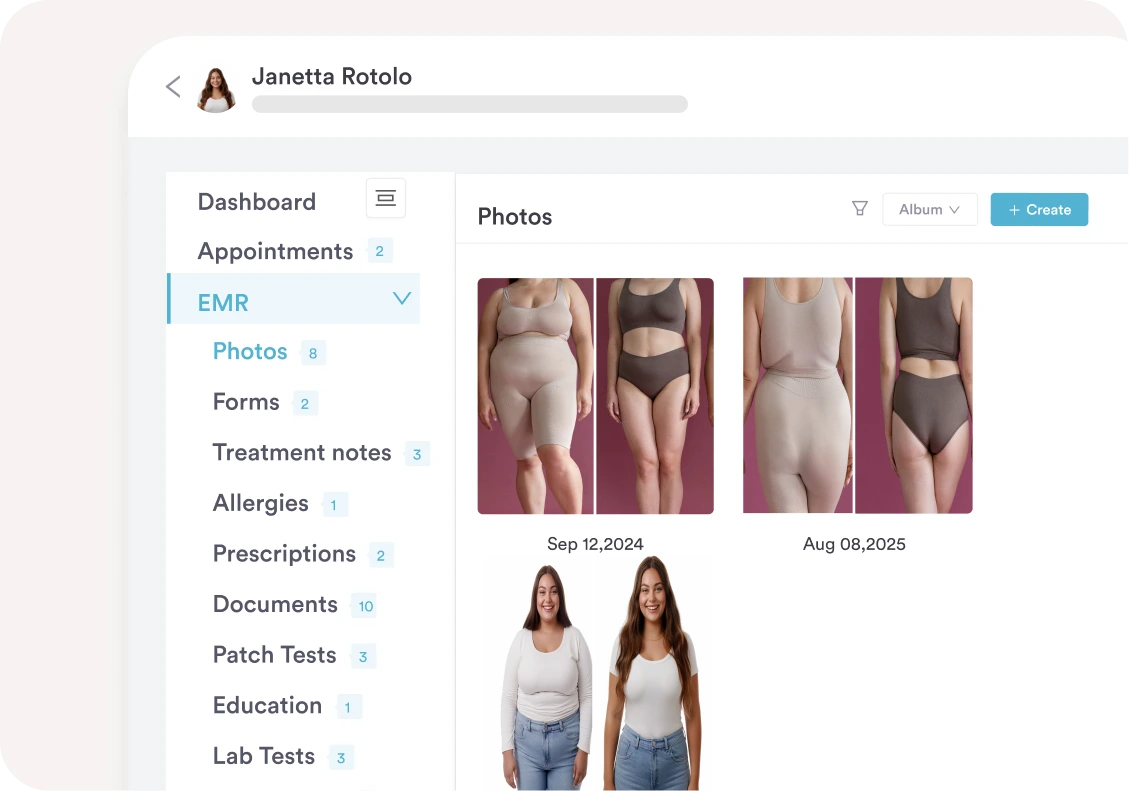
Pabau GO, our iOS app, prompts for the before photo when the client arrives. Pabau Scribe, our AI scribe, drafts the treatment note from the consultation, so the practitioner is not typing at 9pm. Our online booking portal takes the deposit at the point of booking.
Every subscription includes every feature, so none of this sits behind a higher tier. Setup is guided rather than self-service, with a dedicated Client Coordinator and a documented onboarding portal. The migration is run for you, so records arrive intact rather than rebuilt by hand.

Pabau holds treatment-specific consent, prescriptions, product stock, before-and-after photographs and the practitioner behind each entry in one patient record. So a records request, an insurer query or an inspection is answered from one screen.

Pabau scores highest on the Five-Record Test at 4.5 of five, and Calyx is the strongest alternative at four. Neither holds all five outright, and that is the honest state of the UK market.
A solo injector watching every pound should start with MERIDIQ. An aesthetics-only practice that wants consent and photo mark-up should look at Consentz. A group running several sites and billing insurers should look at e-clinic.
Run the Five-Record Test on whichever two you shortlist, and run it on the demo rather than on the marketing site. Ask the salesperson to produce a consent form, a prescriber authorization, a batch number, a photograph and the practitioner’s name from one patient screen.
The trade-off worth remembering is that a cheaper system usually moves a record somewhere else rather than removing the work. Book a demo to see how Pabau keeps all five records on one patient timeline for a UK aesthetic clinic.

Comparing booking-led platforms instead? Treatwell alternatives for UK salons and clinics weighs marketplace reach against owning the client relationship.
Moving off a salon-first system? The best Timely alternatives for clinics covers what changes when a clinic outgrows salon software.
Working to a tighter budget? GlossGenius alternatives for clinics compares the lower-priced end of the market on the features that decide a purchase.
Want the global shortlist rather than the UK one? Pabau competitors and alternatives reviews 15 platforms across every market we serve.
Yes. Calyx publishes the only free plan on this list, covering two practitioners and 100 patients, with a 1% card fee. Fresha is often named as the free option, and its own site now shows two paid subscriptions. No free plan here covers the prescriber or batch records in the Five-Record Test.
Yes. The Pabau API is open to every customer and reads and writes appointments, patient records, invoices and clinical forms. Pabau also connects natively to more than 30 third-party tools, including Stripe, Xero, CloudRx and Google Calendar. Zapier and Make cover tools without a native connection.
Phorest suits clinics whose growth depends on marketing and retention, while Pabau suits clinics whose day depends on clinical records. Phorest began in salons and added aesthetics later, so consent and photographs sit on a client card. Pabau was built for medical aesthetics, so they sit in a clinical timeline.
Pabau reviews on sites such as Capterra and G2 tend to praise the breadth of the platform and flag the setup effort that breadth brings. Treat those sites as reviews only. Prices quoted on review platforms go stale quickly, so check any figure against the vendor’s own website.
Yes. Request a full export of patients, appointments, clinical notes, forms, invoices and images, and confirm the file formats in writing first. Photographs and signed consents need checking on arrival, because those two lose their link to the patient record most often during a migration.
Some do. MERIDIQ publishes full audit logging and a governance module, Semble publishes audit-ready reporting, and e-clinic puts advanced permissions and audit in its Enterprise tier. Many injectables-only clinics are not CQC-registrable at all, so the same five records serve JCCP or Save Face evidence instead.
Pabau is priced per user and per location, by team size, from Solo through to Enterprise. No GBP figure is published on the pricing page, so the monthly cost is quoted on a demo call. Annual billing saves up to 20%, and every plan includes full access to the platform.
No. Pabau has no free plan and no free trial, and onboarding is structured instead. A dedicated Client Coordinator runs the migration and the setup with you. Calyx publishes the only free plan on this list, capped at two practitioners and 100 patients.