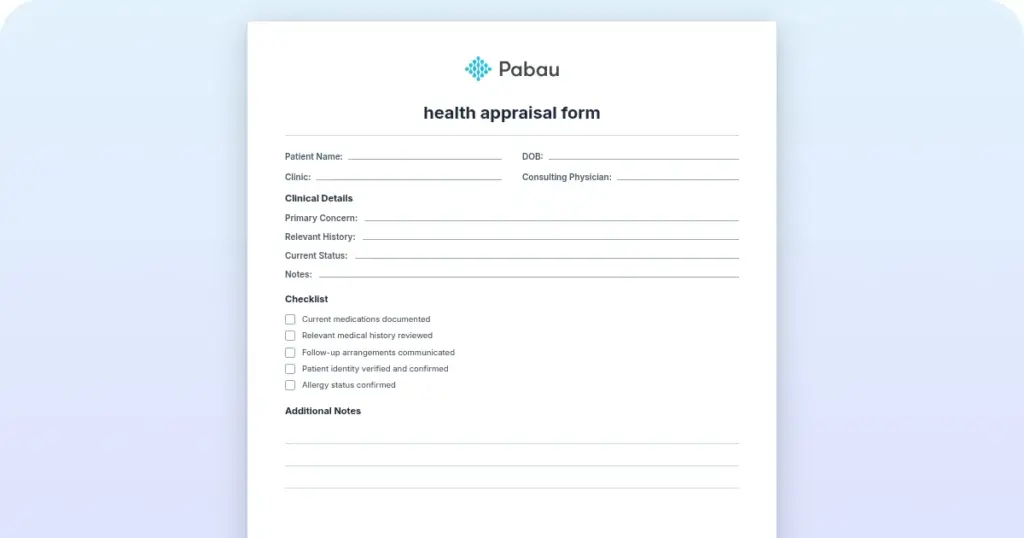
Health appraisal form
A health appraisal form is a record a licensed provider signs to document someon...

2
Last Updated: Oct 13, 2026

Birdeye leads on review generation and patient communication, while Yext leads on listings syndication and structured data accuracy.
Pricing is opaque for both platforms: Birdeye typically costs $299-$499/month per location, and Yext publishes no pricing and requires contacting sales for a quote.
Healthcare practices often outgrow both tools because neither integrates with clinical workflows, SOAP notes, or patient appointment data.
Pabau combines reputation management, automated review requests, and full clinical operations in one platform built specifically for healthcare.
Most practices comparing Birdeye vs Yext are trying to solve the same problem. Their online reputation is inconsistent, review volume is low, and business listings drift across Google, Yelp, and health directories. Both platforms promise to fix that, but they approach it very differently. The right choice depends on what your practice needs most.
This article covers the core differences between Birdeye and Yext across listings management, review generation, AI features, pricing, and healthcare-specific use cases. It also examines whether either platform is sufficient for practices that need more than just reputation tools.
Before diving into the feature-by-feature breakdown, here is how Birdeye vs Yext stack up across the categories that matter most to healthcare and multi-location businesses.
Listings accuracy is where Yext has built its reputation. The platform syncs business data across a proprietary publisher network of roughly 200 directories in real time. It uses structured data architecture to push updates instantly when a practice changes its address, hours, or phone number. Yext calls this “knowledge graph” management: rather than updating each directory independently, changes propagate from a single source of truth.
Birdeye also offers listings management, covering around 150 directories, but this is not its core strength. Birdeye handles updates and basic syndication effectively enough for most small and mid-sized businesses. Its listings tooling is less sophisticated than Yext’s at the enterprise level.
For a practice that needs maximum directory coverage and the fastest possible update propagation across dozens of locations, Yext is the stronger technical choice. For a practice that wants listings as part of a broader reputation and communication toolkit, Birdeye’s listings coverage is sufficient.
This is where Birdeye vs Yext has its clearest separation. Birdeye was built around review generation, and it shows. The platform automates review request campaigns via SMS and email, monitors over 200 review sites, and uses AI to suggest responses. Practices report meaningfully higher review volumes after implementing Birdeye’s automated request workflows, particularly when request timing is tied to completed appointments.
Yext, by contrast, is primarily a listings and search experience platform. Its review monitoring is adequate for tracking what customers are saying, but review generation is not a native capability. Practices that choose Yext for listings and later want active review solicitation typically need a separate tool for that. G2 reviewers consistently rate Yext’s review management capabilities lower than its listings accuracy and structured data features.
For any healthcare practice where new patient acquisition depends on Google review volume and rating, Birdeye’s review generation capabilities are significantly more developed than Yext’s. This difference alone drives most purchasing decisions when practices compare the two. You can explore how review management software works in practice-specific contexts to understand what features matter most at different practice sizes.
Both platforms have invested in AI, but for very different purposes. Birdeye’s AI suite, branded as BirdAI, focuses on the customer experience layer. It covers automated review responses, AI-powered webchat that handles inbound inquiries, and sentiment analysis that surfaces themes across large volumes of reviews. For a practice managing hundreds of reviews and wanting to respond promptly without dedicating staff time, BirdAI is a genuine time-saver.
Yext’s AI investment is directed at search experience management. Its AI features help businesses control how structured data surfaces in AI-powered search results. They also optimize knowledge graph entries for entity recognition and build conversational search experiences for a brand’s own website. These are valuable for large enterprise brands but less immediately applicable to a healthcare practice trying to improve its local Google presence.
Neither platform’s AI extends into clinical workflows. Both Birdeye and Yext are reputation and marketing tools, not clinical systems. Healthcare practices that want AI assistance in consultation notes, treatment documentation, or patient communication tied to clinical events need a different category of software.
Pricing transparency is a shared weakness for both platforms. Neither publishes clear public pricing, and both use sales-negotiated contracts that make direct comparison difficult. Based on widely reported user figures on review platforms, practices should budget accordingly.
One pattern Capterra and G2 reviewers flag consistently: both platforms can become expensive relative to their output. Review management tools do not replace the operational systems a practice still needs. Practices paying $400/month per location for Birdeye on top of their practice management system often question whether the value justifies the double investment.
When evaluating both platforms, ask the sales team for a line-item breakdown of which features are included at each tier. Review generation, AI responses, and messaging are often gated behind higher plan levels. What looks like a straightforward per-location fee can grow once you add the features your practice needs.
Both platforms are designed with multi-location businesses in mind, though their approaches reflect their core strengths. Birdeye provides a unified dashboard that aggregates reviews, messages, and performance data across all locations. That makes it practical for a regional healthcare group managing 5 to 50 sites. Location managers see their own data, while central teams get the consolidated view.
Yext’s multi-location tools are oriented around data management at scale: bulk listing updates, location group management, and centralized structured data control. Yext integrates well with enterprise CMS platforms, digital asset management systems, and marketing stacks that large brands use. Its integration partner ecosystem skews enterprise and horizontal rather than healthcare-specific.
Birdeye integrates with a broader range of practice management and CRM tools than Yext, per its own product documentation. Practices should still confirm specific integrations with sales before buying. Practices that want reputation management features built around healthcare workflows should weigh integration depth over the raw integration count.
Healthcare is one of the most active verticals for both platforms, with case studies in medical, dental, and aesthetics settings. Neither platform was built around patient safety and data privacy as clinical operating requirements, and that shows up in the specifics below.
For aesthetic practices and medical spas, reputation management increasingly comes built into medical spa software rather than shipping as a standalone subscription. The question of whether to invest in Birdeye or Yext often depends on whether a practice has already addressed its clinical management needs.
Review platform data gives the clearest picture of where each tool delivers and where it frustrates users.
Birdeye’s significantly higher review volume on G2 (2,390 vs 510) reflects its larger presence in the SMB and multi-location healthcare segments. Yext’s reviewers skew more enterprise, which partially explains the smaller review count alongside the stronger listings-focused praise.
Yes. Practice management software like Pabau builds reputation management directly into full clinical operations, a combination neither Birdeye nor Yext offers. Both tools sit outside the clinical workflow. A practice using either one still needs a separate system for appointments, patient records, consent forms, treatment notes, and billing. That means two subscriptions, two data silos, and two sets of integrations to maintain.
This fits practices in aesthetics, medical spas, and private practice settings especially well, since reputation, consent, and care already need to line up. Instead of adding a reputation tool on top of a separate practice management system, Pabau keeps reviews, patient communication, and clinical records together.
Pabau also runs AI agents for healthcare that draft patient outreach for staff approval, chasing missed calls, rebooking no-shows, and sending aftercare. Those agents work from the diary and patient records already in the account, so the outreach matches the appointment and treatment on file.
Pabau supports automated review requests alongside full clinical documentation, scheduling, digital consent forms, and SMS and email campaigns. Pricing starts from $104/month per location. That makes Pabau considerably more affordable than either Birdeye or Yext for practices that want reputation management built into a complete operational system.
Pabau holds a 4.7/5 rating based on 600+ verified reviews on Capterra.

Pabau combines review automation, patient communication, and full clinical management in one platform built for healthcare practices. See how it works in your setting.

The right answer depends on what your practice needs most and what it already has in place.
In the Birdeye vs Yext comparison, neither platform is universally better. Birdeye wins on review generation, customer communication, and overall user satisfaction scores. Yext wins on listings syndication accuracy and structured data management for enterprise deployments. Most healthcare practices lean toward Birdeye when review growth is the primary need. They lean toward Yext when managing a large multi-site brand with strict data accuracy requirements.
For most healthcare practices, though, the category matters more than the vendor. Reputation tools alone still leave scheduling, clinical notes, and billing running on a separate system. Pabau’s automated post-appointment review workflow delivers the same consistent review volume, without the second subscription or the reconciliation work between platforms. Book a demo to see how it fits a practice like yours.

Want to understand how reputation tools fit into a broader practice growth strategy? How to capture patient feedback covers the methods that drive the highest response rates for healthcare practices.
Managing reviews across multiple practice locations? Multi-location med spa management explores how centralized tools reduce the operational load of running reputation across several sites.
Concerned about HIPAA and online marketing? HIPAA and social media outlines what healthcare marketers need to know when soliciting or responding to patient reviews online.
Birdeye is primarily a review generation and customer communication platform. Yext is a listings management and structured data platform. Birdeye automates review requests and patient messaging, while Yext syndicates business data across a large directory network in real time. Most healthcare practices find Birdeye more useful for growing their online reputation. Yext better suits enterprise brands where listings accuracy at scale matters most.
Yes. Birdeye is specifically built around review generation, with automated SMS and email request workflows, 200+ site monitoring, and AI-powered response tools. Yext monitors reviews but does not offer native review solicitation features. For any practice where increasing Google review volume is a goal, Birdeye is the stronger choice between the two.
Neither platform publishes pricing publicly. Birdeye is typically reported by users at $299-$499 per location per month. Yext has no published pricing — its plans are fully custom and quote-based, so practices must contact sales for a number. Both require annual contracts and sales-negotiated pricing. Practices should request a full feature breakdown by tier before committing to either.
Birdeye serves healthcare practices more directly through its review automation and patient messaging tools. Yext is used in healthcare but focuses on listings data rather than patient communication. Neither platform connects reputation management to clinical records and appointment workflows. A purpose-built healthcare platform like Pabau does.
For standalone reputation tools, Podium, BrightLocal, and Reputation.com are the most commonly evaluated alternatives. For healthcare practices, Pabau combines automated review requests, patient communication, and clinical management in one system. That removes the need for a separate reputation tool subscription entirely.