Aesthetics & Beauty Cosmetic Surgery
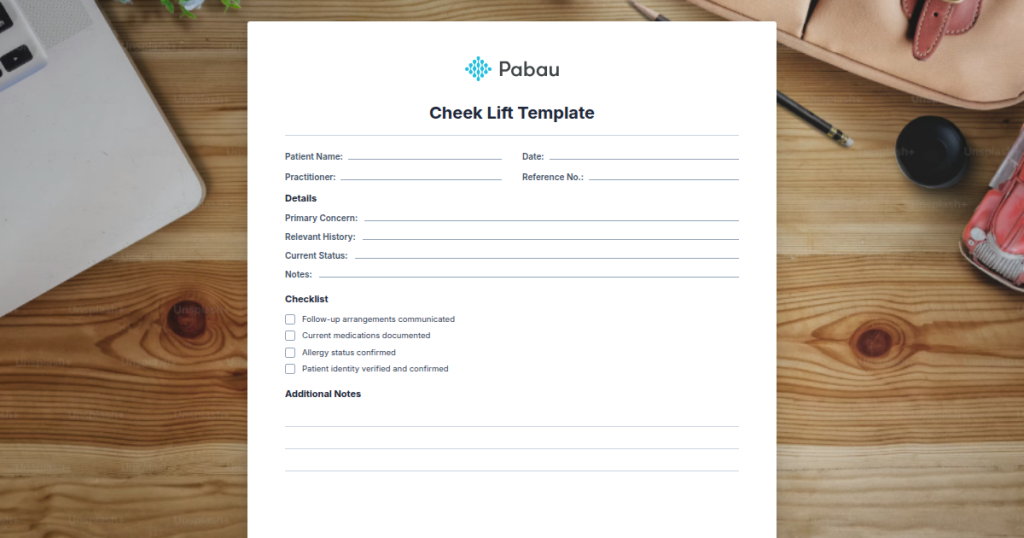
Cheek Lift Template
Download Your Free Cheek Lift Treatment Template Cheek Lift A comprehensive chee...

April 28, 2026


Buy now, pay later is now available in Pabau

A new client intake form template streamlines patient onboarding and ensures consistent data collection.
HIPAA-compliant intake forms protect sensitive health information and reduce legal risk.
Digital intake forms speed up clinic workflows and improve the client experience.
Customisable templates adapt to your practice type without extensive manual revision.
A new client intake form template is the foundation of safe, efficient client onboarding in healthcare practices. This form captures essential patient demographics, medical history, medications, allergies, and consent declarations during the first appointment. Using a standardised new client intake form template ensures every practice captures the same critical information, reduces documentation gaps, and maintains compliance with HIPAA and data protection regulations. Whether you run a med spa, private clinic, or wellness practice, a well-designed intake form sets the tone for professional, client-centred care from day one.
A ready-to-use intake form covering patient demographics, medical history, current medications, allergies, contraindication screening, consent declarations, emergency contact details, and signature blocks. Fully editable and HIPAA-aligned.
Download templateA new client intake form template is a standardised document that gathers vital patient information during the first appointment. It serves as the official record of baseline health status, enabling practitioners to deliver safe, personalised care. The form collects four key categories: demographic data (name, contact, date of birth, insurance), medical history (previous conditions, surgeries, family health), current medications and supplements, and formal consent for treatment.
Practices must legally obtain informed consent and document patient understanding of treatment risks and alternatives under HIPAA in the United States and GDPR in Europe. The form also serves as proof of due diligence during regulatory inspections. CQC-registered clinics in the UK must maintain accurate intake records showing assessment of patient suitability before treatment commences. A well-structured new client intake form template protects both the client-by ensuring their health needs are properly assessed-and the practitioner, by creating a documented baseline against which treatment outcomes can be measured.
Implementing a new client intake form template in your practice requires five straightforward operational steps.

Digital intake forms, automated workflows, and client record integration-all in one platform. Reduce admin time and improve compliance.

A new client intake form template applies across diverse healthcare settings. Med spas and aesthetic clinics use intake forms to screen for contraindications before injectables, laser, or chemical peel treatments. A client taking isotretinoin (Accutane) or on certain blood thinners represents a treatment risk that must be documented. Private practices-GPs, functional medicine clinics, wellness centres-rely on intake forms to establish baseline metabolic health and medication history before prescribing supplements or recommending lifestyle changes.
Mental health practices (psychiatry, psychology, coaching, therapy) use intake forms to assess suicide risk, substance use, and trauma history before therapeutic work begins. Physical therapy and sports medicine clinics need intake forms to capture injury history, current pain levels, and past surgeries before designing rehabilitation programmes. Even spa and salon businesses increasingly use simplified client intake forms to note skin sensitivities, allergies to products, and preferences for pressure during massage. The common thread: any practice that collects health information, makes clinical recommendations, or performs treatments on clients needs a compliant intake form to establish informed consent.
Legal protection and compliance: A signed intake form documents informed consent and creates a legal record of the client’s baseline health status. During complaints, regulatory inspections, or malpractice claims, the intake form proves you assessed the client for contraindications and obtained their permission before treatment. HIPAA audits and CQC inspections routinely check whether practices maintain complete, signed intake documentation.
Faster clinic workflows: Standardised intake forms eliminate the need for staff to improvise questions or chase missing information on the day of appointment. Clients who complete the form before arrival reduce check-in time from 15 minutes to 3-5 minutes, freeing your reception team for other duties. Every practice with 20+ appointments per week saves 5-10 hours monthly through streamlined intake.
Contraindication detection: A well-designed form explicitly asks about medications, allergies, and relevant health conditions. This structured format catches contraindications-blood thinners, pregnancy, autoimmune conditions-before treatment begins. A practice that screens for isotretinoin use before laser procedures avoids treating a client at severe risk of post-inflammatory hyperpigmentation and associated liability.
Improved client experience: Clients feel heard when practices ask comprehensive, thoughtful questions about their health. A detailed intake form demonstrates professionalism and reduces anxiety by showing the team cares about their safety. Clients who complete an intake form before arrival report higher satisfaction because the practitioner already understands their background during the consultation.
Audit readiness and data organisation: Digital intake systems create searchable records. Your team can instantly identify all clients with shellfish allergies, asthma, or migraine history to tailor recommendations. This capability supports clinical quality improvement, population health reporting, and regulatory compliance without manual chart review.
Store completed intake forms securely in a HIPAA-compliant system with access controls and encryption. Paper forms should be locked in a cabinet with access logs; digital forms should live in your practice management software with role-based permissions. Audit access logs quarterly to ensure only authorised staff view sensitive health data.
An intake form is the frontline tool for HIPAA compliance. It must clearly state how you collect, store, use, and protect patient health information (PHI). Many practitioners assume that simply asking for medical history satisfies HIPAA, but the law requires explicit notice of privacy practices before or at the time of first service.
Include a privacy acknowledgement section in your intake form: “I have received and reviewed the clinic’s Notice of Privacy Practices describing how my health information may be used and disclosed. I understand my rights regarding my medical records.” Require the client to initial or sign this box. In the UK and Europe, add a GDPR consent statement: “I consent to the processing of my health data for clinical care, regulatory compliance, and appointment reminders. I understand I can withdraw consent at any time.” Digital intake forms automatically timestamp and log these consents, providing proof of compliance during audits.
A generic intake form template works as a starting point, but the best practices customise their forms to reflect their clinical focus. An aesthetic clinic should emphasise contraindications for injectables: isotretinoin, blood thinners, anticoagulants, fillers, botulinum toxin allergies. A mental health practice must include detailed trauma history, substance use screening, and suicide risk assessment. A physiotherapy clinic needs detailed injury history, pain scales, and mobility baseline measurements.
Review your template against your top 5 clinical concerns. If you treat many pregnant clients, add an early-pregnancy screening question. If you manage pain, ask detailed questions about current pain medication and physical therapy history. Upload the completed form into your client management system to customise fields and access control by role. The goal is not to create a 20-page form that overwhelms clients-it’s to prioritise the 10-15 questions that truly inform your safety decisions and treatment plan. A focused, relevant intake form has higher completion rates and delivers better clinical insight than a generic catch-all form.

Need to automate intake workflows? Digital Intake Forms let clients complete forms before arrival, auto-populate client records, and flag missing information so staff verify completeness before appointments start.
Want to speed up clinical note-taking? Echo AI uses intake form data to generate structured clinical notes, so practitioners focus on client care rather than documentation.
Looking for HIPAA-secure storage? Client Record systems encrypt intake forms, control who can access health data, and audit every data access for compliance reporting.
A new client intake form template is not merely an administrative convenience-it’s a clinical safety tool and legal safeguard. By capturing structured health information, screening for contraindications, and documenting informed consent, intake forms reduce treatment risk, accelerate clinic workflows, and demonstrate compliance during regulatory review. A well-designed template adapts to your specialty, integrates with your practice management system, and supports your team’s ability to deliver safe, personalised care from the first appointment. Start with a standardised template, customise it to your clinical focus, and use digital tools to automate distribution and storage. Your clients and your compliance auditors will thank you.
You can use a core intake form for all clients (demographics, medications, allergies) but customise specialty-specific sections. An aesthetic clinic adds injectables contraindications; a mental health practice adds trauma screening. Core sections stay the same; supplementary sections vary by client type or service.
Aim for 1-2 pages or 10-15 minutes to complete. Shorter forms have higher completion rates. Prioritise questions that directly inform safety decisions or treatment planning. Leave non-essential questions for follow-up conversations after the client is comfortable.
Both are HIPAA-compliant if properly secured. Paper forms must be locked in a cabinet with access logs. Electronic forms should use encrypted systems with role-based access controls and audit trails. Digital storage is faster to search, easier to backup, and simpler to prove compliance during audits.
Document the intake form they returned, not what you later discover. Your legal protection comes from showing you asked the questions and the client signed that their answers were truthful. During consultations, ask follow-up questions to fill gaps. If a client later claims a contraindication was not identified, the signed form proves you asked and they answered.
Review your template annually or whenever regulations change (e.g. new HIPAA guidance, state-specific consent laws). If you add a new service, add corresponding contraindication questions. If clients consistently skip sections, simplify them. Use staff feedback to refine your form quarterly.
Yes. Electronic signatures via digital form platforms (e-signature services, practice management software) are legally binding under HIPAA and most state laws. Ensure your platform timestamps the signature and maintains an audit trail proving consent was obtained.