What do you think the one non-negotiable element that determines a hair transplant clinic’s long-term success?
Well, whether you’re offering surgical hair transplants or non-surgical hair replacement, no amount of fancy equipment or viral before-and-after photos can make up for ateamthat isn’t properly qualified.
On the contrary, it’ll create distrust in clients and compliance regulators, and your growth will hit a wall fast.
If you’re considering starting or scaling your hair transplant clinic, this blog is for you. Here, we’ll walk you through:
✔️Who needs what credentials?
✔️Which credentials matter?
✔️How to manage it all without turning into a full-time paperwork wrangler?
Let’s dive in and get your clinic set up for success!
Why qualifications matter in hair transplant clinics
Qualifications matter in hair transplant clinics because the surgical procedures they perform fall within the medical scope of practice.
Here’s why it’s so important:
🛡️Patient safety: Unqualified staff increase the risk of infections, scarring, poor results, or even permanent damage
📜Legal compliance: Many regions regulate who can perform which parts of a hair transplant procedure — licensed medical professionals are often required by law
🎯Better outcomes: Skilled practitioners ensure proper hairline design, graft placement, and technique, key to natural-looking results
When clients trust you with their scalp, appearance, and confidence, especially in the fight against baldness, it’s because your team is qualified, trained, and credible.
How qualifications build trust with patients
Patients do their homework — and rightfully so.
They Google your team, check credentials, and look for proof they’re in good hands when dealing with hair loss or baldness.
When patients trust your clinic because of qualified staff and solid results, it naturally boosts your marketing, especially through referrals and testimonials, some of the most powerful ways to attract new clients.
Your results speak for themselves, and word-of-mouth referrals start to grow.
Legal and ethical responsibilities of clinic owners
In the UK and the US, you have a legal duty to ensure staff have the right qualifications for the roles they’re performing. That means:
Missed licenses, expired credentials, or untrained staff? That could mean fines, lawsuits, or even losing your operating license. Not worth the risk.
Who needs to be qualified in a hair transplant clinic
Think of your hair clinic like a musical band. Each player needs to know their instrument and be qualified to play it.
Here’s who needs to be qualified and how.
Lead surgeon or physician
This is the person who’ll actually perform the hair transplant procedures.
They’re your clinic’s MVP and must be licensed medical doctors, either:
An MD or DO in the US
A GMC-registered physician in the UK
But that’s just the starting point. You should also look for an ABHRS (American Board of Hair Restoration Surgery) certification, which signifies a doctor has met rigorous standards of excellence and expertise specifically in hair restoration.
Additionally, an ISHRS (International Society of Hair Restoration Surgery) membership can serve as a badge of honor, confirming the doctor is recognized among their peers as an expert in the field of hair restoration.
Documented on-the-job experience in medical or surgical support roles
Don’t hire such staff based on a good chat and a neat resume. Your clinic’s success depends on this staff who bring both skill and reliability to the table.
Front desk or practice manager
They are the friendly faces your clients first meet when they enter your clinic.
While they might not be hands-on with the procedure, they’re the glue that holds the clinic together, from managing bookings to ensuring patient privacy.
🔍Look for candidates with:
Familiarity with basic medical terminology
Understanding of GDPR (UK) or HIPAA (US) requirements
Strong soft skills such as communication, problem-solving, and attention to detail
Experience with clinic or practice management software
They juggle the chaos so your clinic feels calm, organized, and ready for anything.
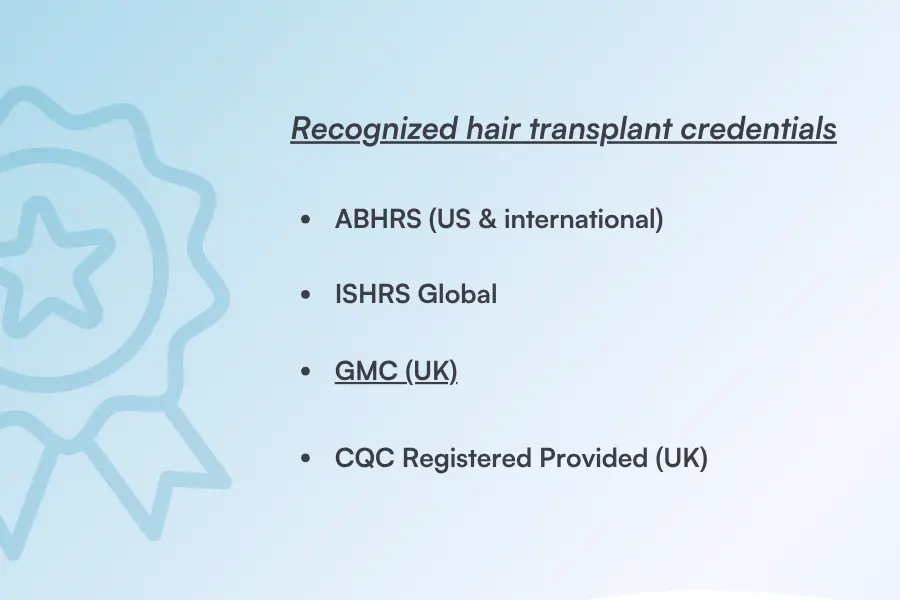
For hair transplant professionals, ABHRS is the gold standard for board certification, while ISHRS offers global training and ethical guidance. In the UK, practitioners must register with the GMC, and clinics must be CQC registered to offer regulated services.
✨Bonus points if the clinic or doctor has published in industry journals, spoken at ISHRS events, or trained under top surgeons.
Medical licensing and region-specific compliance
Licensing and compliance rules don’t always follow the same rules everywhere. What works in the US won’t always work in the UK, and vice versa.
✓ Physicians performing hair transplant procedures must hold a valid and active medical license in the state where they practice.
✓ These licences must be issued by individual state medical boards.
✓ In most states, only licensed medical professionals (MDs, DOs, or in some cases PAs and RNs) can make incisions or implant grafts.
✓ Clinic staff handling patient health information (PHI) must follow HIPAA rules to protect patient privacy.
UK:
✓ Doctors offering hair transplant procedures must be registered with the General Medical Council (GMC) and have a valid GMC number
✓ The clinic must register with the Care Quality Commission (CQC)
✓ Only licensed professionals can perform invasive parts of the procedure (like making incisions or implanting grafts).
✓ Clinics must also follow the General Data Protection Regulation (GDPR).
💡Tip: Keep a spreadsheet or list of each team member’s license and training certificate renewal dates, or better yet, use software that does it for you.
Common red flags: What to avoid when hiring or evaluating staff
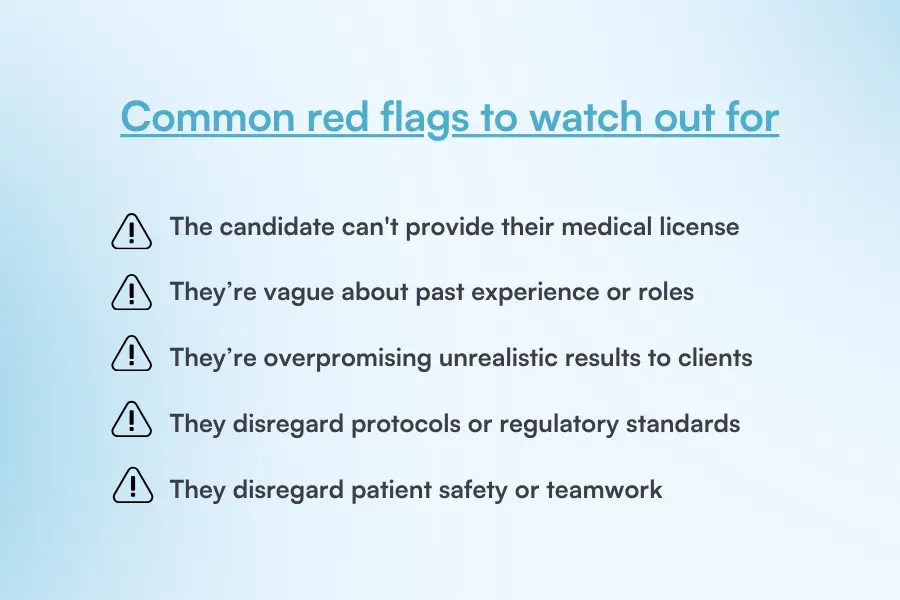
Not everyone who applies to your clinic is qualified or safe to have on your team. Here are a couple of big warning signs to watch out for.
Spotting these red flags early means you hire with confidence, protect your clinic’s reputation, and keep patient safety front and center.
Lack of verifiable credentials or clinical history
Imagine a candidate who claims to be a licensed hair transplant surgeon but can’t provide their medical license or refuses to share details about their previous work. That’s a huge red flag🚩
What you should always do with these candidates is:
Always request a copy of their medical license and certification documents.
Verify their membership with the relevant licensing board or certification body, for example, the ABHRS, to confirm they’re valid and current.
Be cautious of candidates or team members who guarantee clients impossible outcomes, like:
🚫100% hair regrowth after just one session
🚫Completely scar-free surgery with zero downtime
🚫No side effects or complications
These claims aren’t just unrealistic — they can seriously damage patient trust and put your clinic at legal risk. Staff who overpromise set false expectations that lead to unhappy clients, complaints, and even lawsuits.
How to stay on top of qualifications and compliance
Keeping track of everyone’s licenses and training can feel like juggling flaming swords. One wrong move and everything could go up in smoke.
Luckily, there’s a way to keep your sanity intact and your clinic running smoothly.
The risks of manual processes
When tasks like license renewals or training reminders are missed, they don’t just create headaches but will also undermine clients’ trust in your clinic’s reliability and professionalism.
Patients notice when things feel disorganized or rushed, and that doubt can quickly spread.
Beyond shaking client confidence, these oversights
Waste your team’s time
Drain your clinic’s resources
Can put you at serious risk of penalties from regulators
Nail these little details, and you’ll keep your clinic looking sharp, your clients smiling, and regulators off your back.
Using practice management software to track staff credentials
When starting a hair transplant clinic, whether in New York or Arizona, you can’t afford to guess who’s qualified to hold a punch tool. Keeping track of staff credentials, like licenses, certifications, and training, is necessary for safety, compliance, and patient trust.
With Pabau, you can upload certifications, licenses, or key documents directly to staff profiles and organize them into folders your way — so nothing gets lost or forgotten.
Build a trusted, compliant clinic with Pabau
At the end of the day, qualifications are more than just paperwork. They’re what keep your clinic safe, compliant, and credible.
The best way to stay on top of it all? By using technology.
With Pabau, you get the right tools to help you stay compliant and on top of staff credentials in one secure place. It’s an all-in-one practice management software that provides everything a hair transplant clinic needs to manage stuff, such as:
Unique staff profiles to keep all your essential team information in one place
Full control over what every member of your team can see and do in your clinic’s account
An intuitive and simplified appointment scheduling and online booking process
Staff payouts to take care of all your bookkeeping headaches
And more…
It frees up time, worries, and headspace. Have you tried it yet?!
Book a free demo with Pabau and see how easy managing compliance and your team can really be.