Free printable botox face chart
A free printable botox face chart maps injection sites and records unit dosages ...

73
Last Updated: Sep 22, 2026
Hair transplant clinic marketing gets your practice found by people researching the procedure, earns their trust, and turns their inquiries into consultations and surgeries. Search, paid ads and social media do the finding. Results galleries, reviews and surgeon credentials do the trust-building. Fast replies and easy online booking do the converting.
The pages that pay back first are your cost page and your results gallery. In US search data, people look up hair transplant cost about 38 times more often than they search for a consultation.
Below you’ll find nine hair transplant marketing strategies, a funnel formula for measuring them, and the 12-month results loop. That loop turns every patient into your next gallery entry, review and referral.

Hair transplant clinic marketing has three jobs: get found by researching patients, earn their trust, and convert inquiries into booked surgeries.
US patients search hair transplant cost 27,100 times a month and hair transplant consultation only 720 times, so build cost and results pages first.
A consultation click can cost over $100 in Google Ads, so fast follow-up and online booking decide whether paid search pays off.
The 12-month results loop schedules follow-ups with standardized, consented photos, then asks for the review and referral at the final result.
Measure cost per booked consultation and cost per completed surgery, not cost per click, to see which channels earn their budget.
Hair transplant patients search for cost and results far more than for a consultation, so those two pages decide who books. We pulled US Google search volume for the searches that mark each stage of the decision.
Those figures come from DataForSEO Google search volume data for the United States, pulled in September 2026. Cost searches outnumber consultation searches by roughly 38 to one.
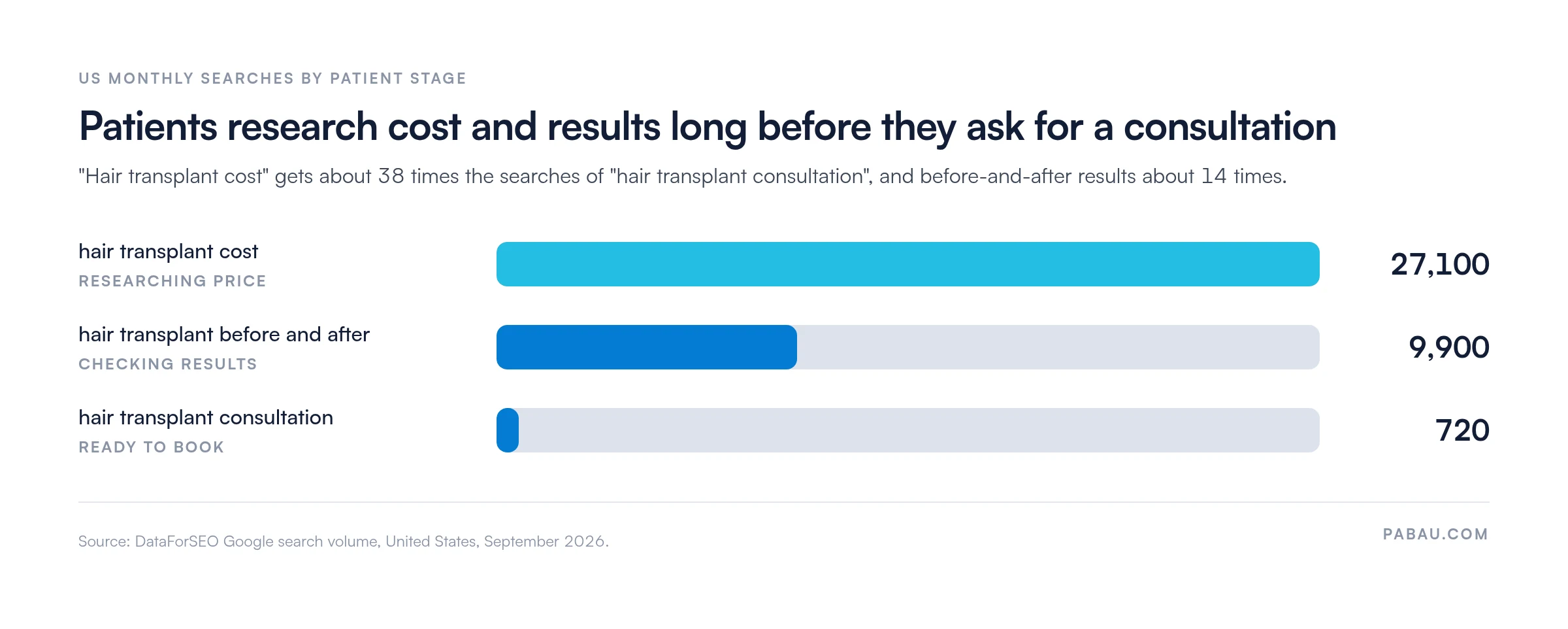
The decision rule is simple. Build the pages patients search 10 to 40 times more often before you pay for the page they search least. The consultation click is the most expensive to buy, so organic cost and results pages are where content earns its keep.
Behind those searches sit a few motivations you’ll hear in every consultation:
Consultation notes, Reddit threads and competitor reviews will tell you which of these drives your local market. Write your cost page, gallery and ads to answer them in that order.
The nine hair transplant clinic marketing strategies that book patients cover four stages: getting found, earning trust, converting inquiries, and bringing patients back as referrers. The table maps each strategy to its stage and the one number that shows whether it works.
| Strategy | Patient stage it serves | Best for | What to measure |
|---|---|---|---|
| 1. Website and landing pages | Convert | Turning researchers into booked consultations | Inquiry-to-consultation rate |
| 2. Reviews and before-and-after galleries | Trust | Answering “will it work for me?” | Review rating and gallery-page inquiries |
| 3. Video | Trust | Calming surgery and recovery fears | Inquiries from pages with video |
| 4. Social media and hair loss Facebook ads | Find and trust | Showing results to people not yet searching | Cost per lead from social |
| 5. Local SEO and content | Find | Cost, results and “near me” searches | Organic inquiries and map listing calls |
| 6. Email nurture | Convert | Leads who aren’t ready to book yet | Consultations booked from email |
| 7. Google Ads and PPC | Find and convert | Patients searching for a practice today | Cost per booked consultation |
| 8. Referral program | Return | Patients happy with their final result | Referred inquiries per completed surgery |
| 9. Slogans and USP | Trust | Standing apart from nearby practices | Ad click-through rate |
A hair transplant website converts when every landing page answers cost, results and next steps, then lets the visitor book a consultation without calling. Send each ad and each search topic to its own landing page, not your homepage.
A landing page that books hair transplant consultations carries:
Then answer fast. A Harvard Business Review study of 1.25 million sales leads found a clear speed effect. Firms replying within an hour were nearly seven times as likely to qualify a lead. Waiting 24 hours or more made them over 60 times less likely.
For a surgery patients research for months, a same-hour reply is often what separates you from the next practice they emailed.
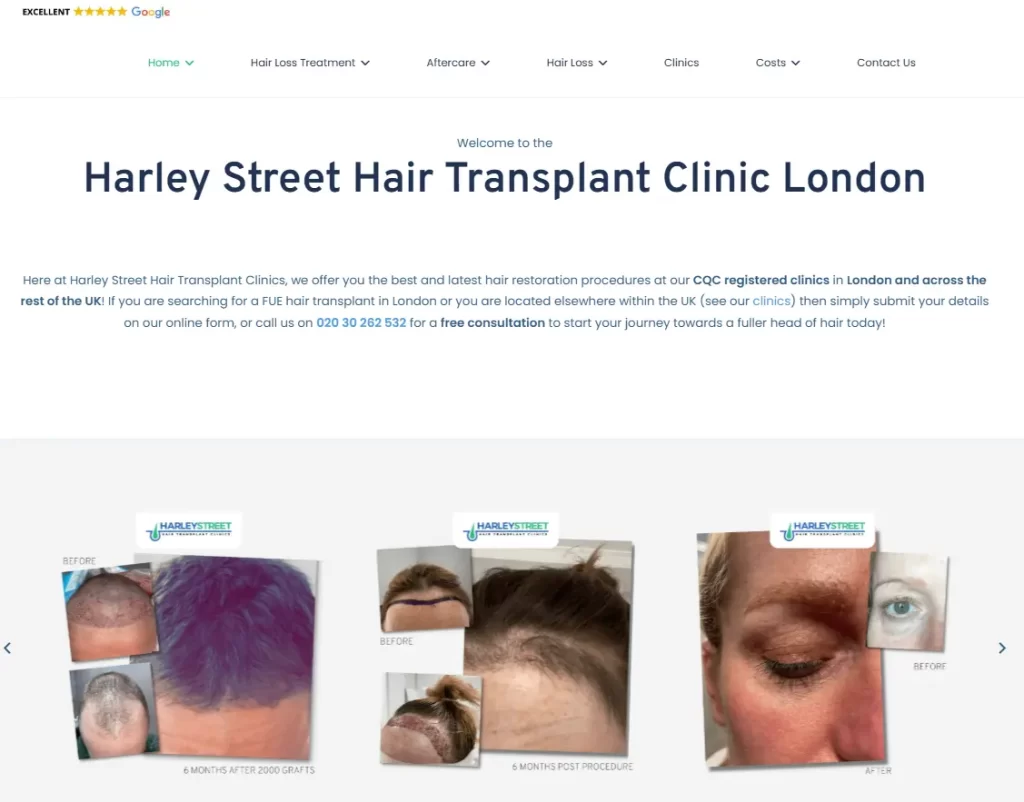
Reviews, testimonials and before-and-after galleries win trust because they show a stranger’s result, which a patient believes more readily than the practice’s own claims. They’re also what patients check against a cheaper quote.
Hair transplant before and after photos only persuade when they’re comparable. Shoot every case with the same lighting, angle, distance and hair styling, and never retouch the result. Label each case with graft count, technique and months since surgery, so visitors can judge like for like.
Credentials carry as much weight as photos. Name the surgeon who performs the procedure, list board certification and memberships, and explain who does which step. Our guide to hair transplant clinic qualifications covers who needs what.
The best photos and reviews only exist a year after surgery. The 12-month results loop below is how you collect them on schedule instead of by luck.
Video demystifies a hair transplant by showing the day, the recovery and the result, so patients arrive at the consultation with fewer fears. Start with the questions you answer in every consultation and film one short answer to each.
Cut each video into Instagram Reels, TikTok and YouTube Shorts, then embed the full version on the matching landing page.
Social media works best as the trust layer for a hair transplant practice, showing results to people who aren’t searching yet. Instagram, Facebook and TikTok are where patients compare practices’ before-and-after work.
Hair loss Facebook ads need a different setup than they did a few years ago. From January 19, 2022, Meta removed detailed targeting options that reference health causes. You can no longer aim ads at people by a hair loss interest.
So target by location and age, and let the creative do the qualifying. A 20-second before-and-after video with a clear consultation offer finds its own audience. Avoid copy like “Losing your hair?”, which implies you know the viewer’s condition and can get the ad rejected.
Put the surgeon on camera too. A face patients recognize at the consultation builds trust faster than a logo.
Local SEO puts a hair transplant practice in map results and “near me” searches. Educational content captures the cost and results research that comes first. Both keep working after you stop paying for them.
If you also offer aesthetic treatments, the same local SEO playbook applies to them. Med spa software can run both service lines from one calendar and one set of patient records.
Email nurtures the patients who inquire but aren’t ready, which is most of them for a surgery this considered. A short sequence keeps your practice in the running while they save up, compare quotes or wait for the right time off work.
Segment by the treatment the lead asked about. A hair transplant lead shouldn’t get your filler promotions.

Google Ads puts a hair transplant practice in front of people searching right now. Each click is expensive, so the landing page and follow-up matter most. Paid search is the fastest channel to a booked consultation.
The price of that speed is steep. DataForSEO data for the US in September 2026 puts the cost per click for “hair transplant consultation” at $101.89. Top-of-page bids run from $25.22 to $98.38.
Judge the campaign on cost per booked consultation, pulled from your booking system. Cost per click alone flatters the channel.
A hair transplant referral program works best when you ask at the 12-month result, when friends are noticing the new hairline. Ask on surgery day and the patient has no result to show yet.
A unique selling point (USP) gives patients one reason to pick you, and a slogan makes that reason easy to remember. Pick something you can prove: your surgeon’s case volume, a technique, transparent pricing or a year of scheduled follow-ups.
Good hair transplant slogans are short, specific and promise an outcome patients want. “Followed up for a full year” says more than a vague “Your hair, restored.” Use the same line on your homepage, ads and social bios, so every touchpoint carries the same promise.
Because hair transplant results take up to a year to show, a practice’s best marketing comes from follow-ups it schedules at set points after surgery. We call this the 12-month results loop.
Biology sets the timeline. The American Academy of Dermatology says transplanted hair falls out two to eight weeks after surgery. By the third month, hair may look thinner than before. Most patients see results between six and nine months, and some take 12.
So the gallery photo, the glowing review and the referral don’t exist on surgery day. A practice that stops contacting patients after the stitches check loses all three. The 12-month results loop fixes that with five checkpoints:
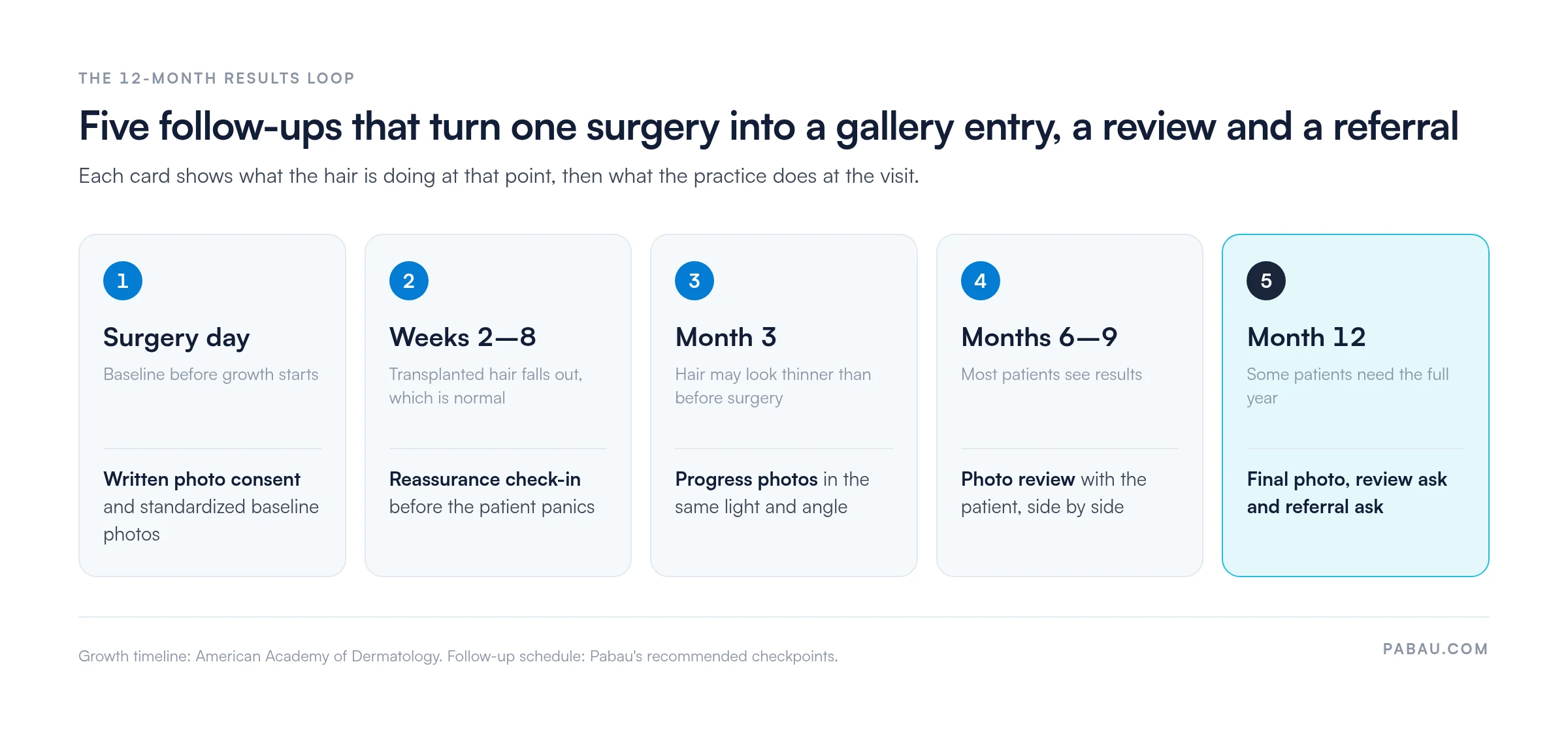
Ask for the review at the month-12 visit, while the patient is looking at their own before-and-after pair. That review describes the result, which a surgery-day review can’t.
Keep the loop honest. Use photos only with written consent, as our guide to before-and-after photo consent explains, and never retouch them.
The FTC’s Endorsement Guides also apply here. If a featured result isn’t what patients generally achieve, the ad must make the generally expected result clear.
Honest marketing is also the trust play. Patients have read plenty of warnings about slick hair transplant marketing, and a gallery of typical, unretouched 12-month results answers them.
You compete on hair transplant cost by publishing clear pricing, then selling the aftercare and follow-up schedule an overseas package can’t offer. Undercutting a Turkey package with flights and a hotel included is a race you won’t win.
Start with the price. With 27,100 US searches a month for hair transplant cost, a practice that hides its pricing sends researchers straight to competitors who publish theirs.
Patients even search graft counts, like “How much will 3,000 grafts cost?” Publish your price per graft or your price bands by graft count, with a worked example, so the answer comes from you.
Then make the comparison about what the price buys:
Say all of this on the cost page itself, before the consultation. By the time a patient calls, the price should already feel explained.
Hire a hair transplant marketing agency when paid search or SEO needs weekly specialist work you can’t staff. Keep marketing in-house when results and referrals drive growth. A split between the two suits many practices.
Whichever route you pick, make the agency report cost per booked consultation from your booking system, not clicks from its own dashboard. Keep ownership of your patient data and your ad accounts, so you keep both if you part ways.
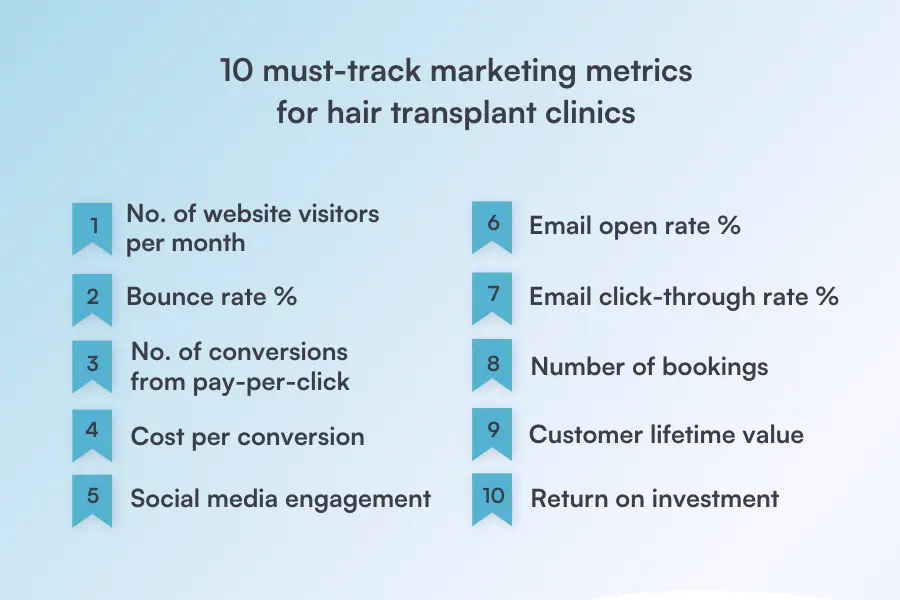
Track hair restoration marketing as a funnel from first inquiry to completed surgery, so each channel is judged on surgeries rather than clicks. Every patient passes through six stages:
Each conversion rate is the later stage divided by the stage before it. Each cost metric is your marketing spend divided by the count at that stage.
| Metric | Formula | Illustrative example |
|---|---|---|
| Cost per lead | Spend ÷ inquiries | $12,000 ÷ 200 = $60 |
| Booking rate | Consultations booked ÷ inquiries | 80 ÷ 200 = 40% |
| Show rate | Consultations attended ÷ consultations booked | 60 ÷ 80 = 75% |
| Close rate | Surgeries booked ÷ consultations attended | 24 ÷ 60 = 40% |
| Completion rate | Surgeries completed ÷ surgeries booked | 20 ÷ 24 = 83% |
| Cost per booked consultation | Spend ÷ consultations booked | $12,000 ÷ 80 = $150 |
| Cost per completed surgery | Spend ÷ surgeries completed | $12,000 ÷ 20 = $600 |
Run the table per channel, using the source recorded on each inquiry. A channel with a cheap cost per lead can still lose on cost per completed surgery if its leads never show up.
The weakest rate tells you where to work. A low booking rate points at reply speed and the landing page. A low show rate points at reminders, and a low close rate points at the consultation itself.
Practice management software like Pabau runs the steps after the click: the fast reply, the booked consultation, the reminders and the year of follow-ups. Pabau keeps that work in one place instead of a spreadsheet, an inbox and a phone camera roll.
Every practice has to decide early where its photos live and who has consent to use them. Pabau stores before-and-after photos and signed consent forms in the patient record, so the month-12 gallery photo is ready to use.
Every subscription includes every feature, and our onboarding team sets up the booking rules and follow-up sequences with you. See how the hair clinic CRM works, or compare the options in our roundup of hair transplant clinic software.

Pabau’s online booking, automated follow-ups and photo records run the 12-month results loop for you, so each patient becomes a review and a referral.

The hair transplant practice that wins locally is the one whose marketing keeps working 12 months after surgery. Ads and SEO bring in the first patients. Scheduled follow-ups, honest photos and well-timed asks bring in the next ones for far less.
If you only make two changes this quarter, publish your pricing and book every recent patient into the results loop. The trade-off is patience, because the payoff arrives a year later and compounds from there.
Book a demo to see how Pabau turns each hair transplant patient into a booked consultation, a finished result and a referral.

Choosing a system for your practice? Best hair transplant clinic software in the US compares the platforms built for booking, photos and follow-up.
Using patient photos in your marketing? Before and after photo consent form requirements explains what your consent form must cover.
Worried about advertising and records rules? Compliance for hair transplant clinics sets out the regulations your marketing and records must meet.
Need a consent form for surgery day? Hair transplant consent template gives you a ready-to-use form to download.
Want a smoother first consultation? Hair transplant intake form captures history and goals before the patient arrives.
The clinic marketing ideas that work best match where the patient is in their decision. Use local SEO and paid search to get found, reviews and results galleries to earn trust, and fast replies with online booking to convert. A hair transplant practice should also publish clear price ranges and schedule follow-up photos, so every surgery produces fresh proof.
The strongest plan sequences your channels by patient stage. Get found with local SEO and Google Ads, earn trust with results and surgeon credentials, and convert with same-hour replies and online booking. Then run the 12-month results loop, asking for the review and referral at the final result.
There is no standard figure, so set your budget backward from what you can afford to spend per completed surgery. Take your margin per procedure, decide what share you will spend to win one, then multiply by the surgeries you want each month. Test that budget channel by channel and move it toward the lowest cost per completed surgery.
Yes, a Turkey hair transplant package often costs a fraction of a US or UK procedure. That’s why price comes up in almost every consultation. You won’t win on price. Win on published pricing, local aftercare, surgeon credentials and a year of scheduled follow-ups that an overseas trip can’t include.
Pair a channel that captures people already searching, like Google Ads or local SEO, with proof that convinces them, like before-and-after galleries and reviews. Then make booking effortless. A fast landing page, a same-hour reply and online booking often lift results more than a bigger ad budget.
Paid search is the fastest. Google Ads puts your practice in front of patients searching for a hair transplant today, so consultations can start within days. SEO, content and social build cheaper, longer-lasting demand but take months, so many practices run paid ads while the organic channels grow.