HIPAA compliant texting: What you can send patients & how to communicate securely
HIPAA compliant texting is possible when a text holds no protected health inform...

Last Updated: Oct 16, 2026
Compliance for hair transplant clinics means every procedure meets medical, legal and ethical standards, through licensed surgeons, documented consent, an inspection-ready facility and honest marketing.
Hair transplant surgery cuts skin and implants live tissue, so state medical boards regulate it like any other surgery. In practice, six areas come under scrutiny:
The Compliance-by-role checklist further down shows exactly who may perform each step, and what each role needs on file.

State medical boards treat a hair transplant as surgery, so the surgeon needs an active, unrestricted MD or DO license.
Every step that involves a skin incision, including FUE punching and recipient site creation, must be performed by the licensed physician.
Technicians may dissect, sort and place grafts under physician supervision where state law allows, but they never make incisions.
Your facility classification and anesthesia level decide which state office-surgery or accreditation rules apply to you.
Signed informed consent, full operative records and HIPAA-compliant storage are your main defense if a patient complains.
Practice management software like Pabau keeps consent forms, treatment notes and photos on one audit-ready patient record.
Compliance matters because a hair transplant is surgery, so a lapse exposes patients to harm and the practice to lawsuits, board discipline and closure.
Making incisions and implanting follicles puts the work in the same category as other surgical services. Your state medical board, OSHA and HIPAA regulators all have a say in how the practice runs.
The stakes fall into four groups:
In practices we onboard, the documentation trail is usually weaker than the operating room. Consent sits on paper, op notes live in another system and photos stay on a phone.
Every US hair transplant practice must satisfy state medical board rules, OSHA workplace standards and HIPAA privacy rules, and should carry malpractice insurance.
The detail differs by state, whether you’re starting a transplant clinic or already running one. Use this checklist as the minimum:

Tip: Before you sign a lease, check your state medical board’s office-surgery and delegation rules with a healthcare attorney. Finding a blocking rule after the build-out costs far more than the consultation.
Only a licensed physician may perform the surgical steps of a hair transplant, while technicians and nurses need documented, procedure-specific training and physician supervision.
Hair transplants are medical procedures, so the bar for hair transplant clinic qualifications is set by medical law. The Compliance-by-role checklist below summarizes what each role needs on file.
| Role | License or certification | Training standard | Scope of practice | Malpractice coverage |
|---|---|---|---|---|
| Surgeon or physician | Active, unrestricted MD or DO license in the state of practice. ABHRS certification is voluntary but sets the specialty benchmark. | ABHRS experience route: three years in practice and 150 logged cases. Fellowship route: one year and 70 assisted cases. | Diagnosis, surgical planning, hairline design, donor harvesting and recipient site creation. | Own policy that covers hair restoration surgery. Legally required only in some states. |
| Medical director | A licensed physician on file. Ownership and supervision rules vary by state. | Hair restoration training if they supervise surgery. | Writes protocols and delegation orders, and answers to the medical board for delegated work. | Coverage for supervisory liability as well as procedures they perform. |
| PA or NP | State physician assistant or nurse practitioner license, with supervision terms set by state law. | Procedure-specific training under a hair restoration surgeon. | May assist with surgical steps under physician supervision, per ISHRS. | Individual policy, or named on the practice policy. |
| Technician or nurse assistant | Technicians need no license. Nurses hold an RN or LPN license, and BLS certification is standard. | Formal, documented training in graft handling, patient prep and aftercare. | Graft dissection, sorting and supervised placement where state law allows. Never incisions or FUE punching. | Covered by the practice policy. Confirm the policy names non-physician staff. |
Training figures come from the ABHRS candidate application brochure. Physician-only steps and the PA and NP role follow the ISHRS position statement, revised July 13, 2024. Technician tasks reflect common industry practice, and your state sets the final limits.
Hair transplant training for doctors starts with a full medical license, then adds supervised FUE and FUT cases, often through an ISHRS-recognized fellowship.
Doctors specializing in hair loss often come from dermatology or plastic surgery, then build surgical volume under an experienced hair restoration surgeon. The American Board of Hair Restoration Surgery (ABHRS) sets out two routes to certification:
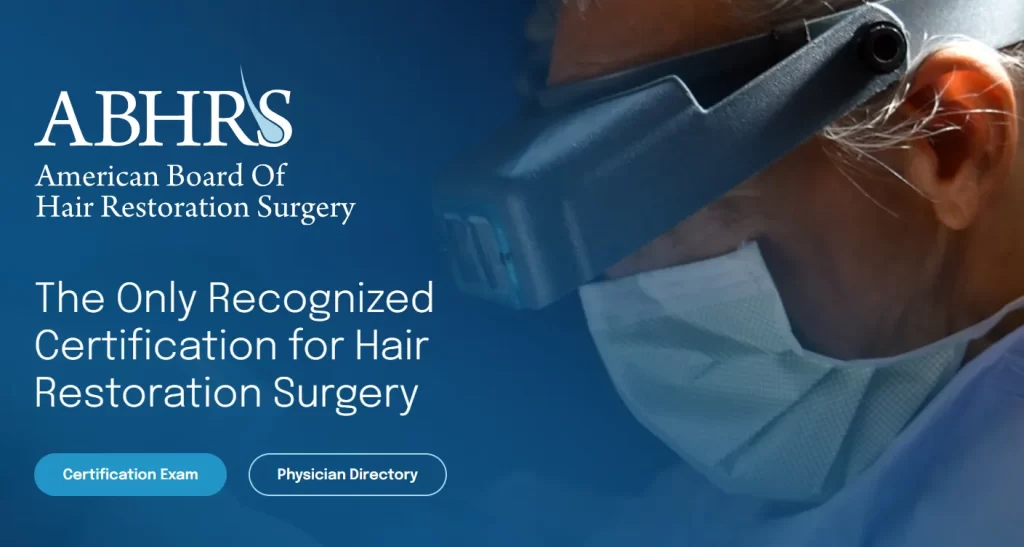
For a practice owner, those numbers double as a hiring screen. Ask hair transplant physicians for their case logs and certification status, and keep copies in their staff file.
Technicians may prepare patients, dissect and sort grafts, and place them into physician-made sites where state law allows, but they never make incisions.
The ISHRS position statement treats every FUE harvesting tool, robotic devices included, as an extension of the operator’s hand. A technician running an FUE punch is therefore performing surgery, whatever the job title says.
Physician assistants and nurse practitioners sit in between. ISHRS accepts them assisting with surgical steps under a supervising physician. The matrix below breaks the procedure into steps, so you can check your own delegation rules line by line.
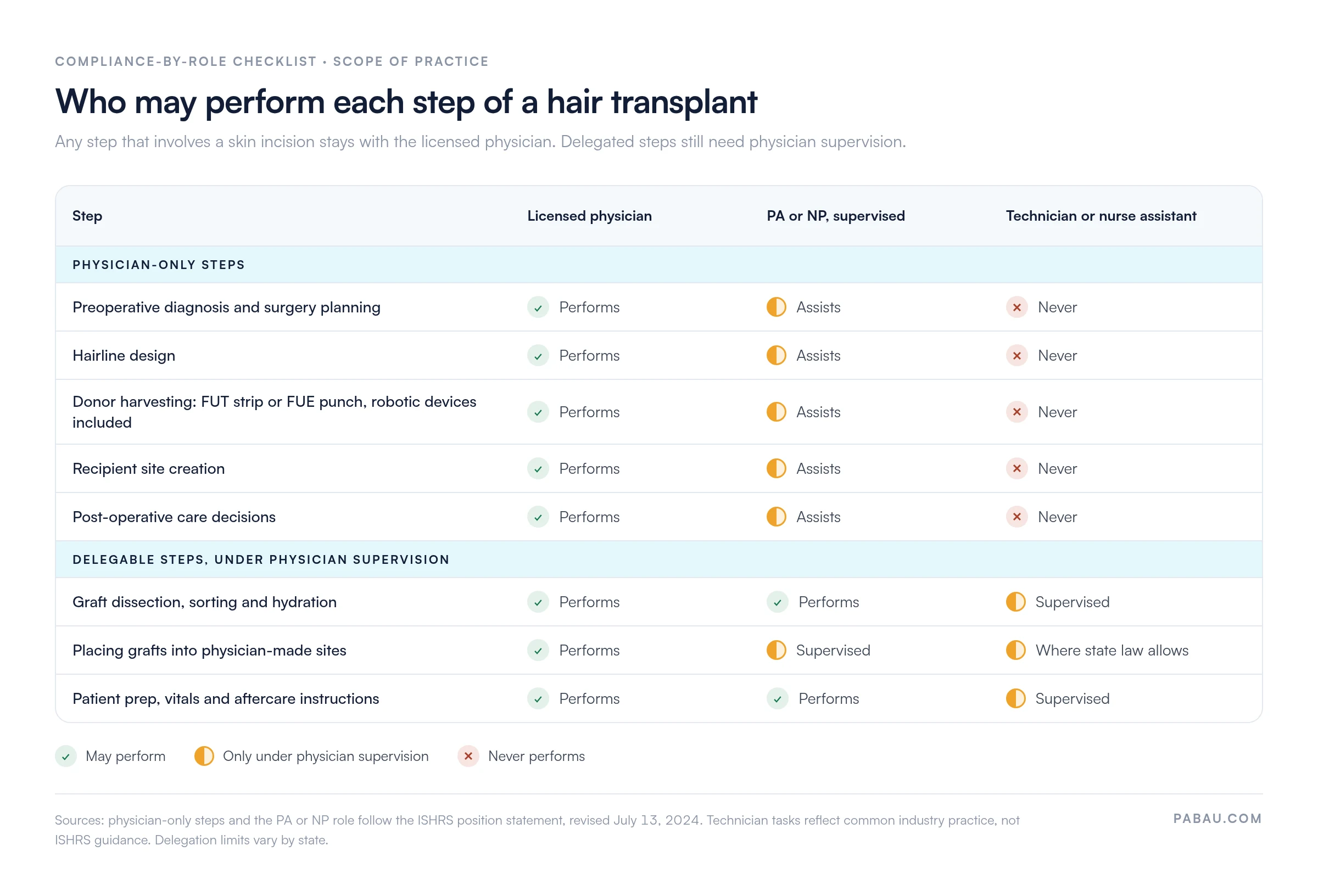
Keep a signed training record for every technician that lists the tasks they’re cleared for. If an inspector or an attorney asks who did what, the op note and that record answer it.
A compliant hair transplant suite meets medical-grade standards for sterility, emergency readiness and storage, and its licensing depends on how the facility is classified.
Most hair transplants run in outpatient clinics under local anesthesia, sometimes with light oral sedation. That usually falls under state office-based surgery rules rather than ambulatory surgery center (ASC) licensing.
Deeper sedation or general anesthesia can move you into an accredited or licensed ASC category, depending on state. Accreditation bodies include the Accreditation Association for Ambulatory Health Care (AAAHC) and The Joint Commission.
Inside the procedure room, inspectors and patients expect:
Log each check with a date and a name. To an inspector, an undocumented sterilization cycle is a cycle that never happened.
Signed informed consent, complete procedure records and HIPAA-compliant storage are what prove, after the fact, that a patient was informed and treated to standard.
Your documentation should cover:
HIPAA is the privacy framework that applies to a US practice, and GDPR only comes in if you treat patients from the EU. Before-and-after photos become protected health information (PHI) once they’re linked to a patient’s record.
Practice management software like Pabau captures consent digitally, storing the patient’s and practitioner’s signatures, names and dates on the patient record. Building the form on a hair transplant consent template keeps risk disclosures consistent across patients and surgeons.
Patients can complete consultation forms and medical questionnaires before they arrive. Surgery day then starts with a signed record rather than a clipboard.

Hair transplant marketing must be truthful and substantiated, and testimonials or before-and-after photos must reflect typical results under the FTC Endorsement Guides.
State medical boards can discipline physicians for misleading advertising, and the Federal Trade Commission (FTC) can act against the practice itself. Three claims cause most of the trouble:
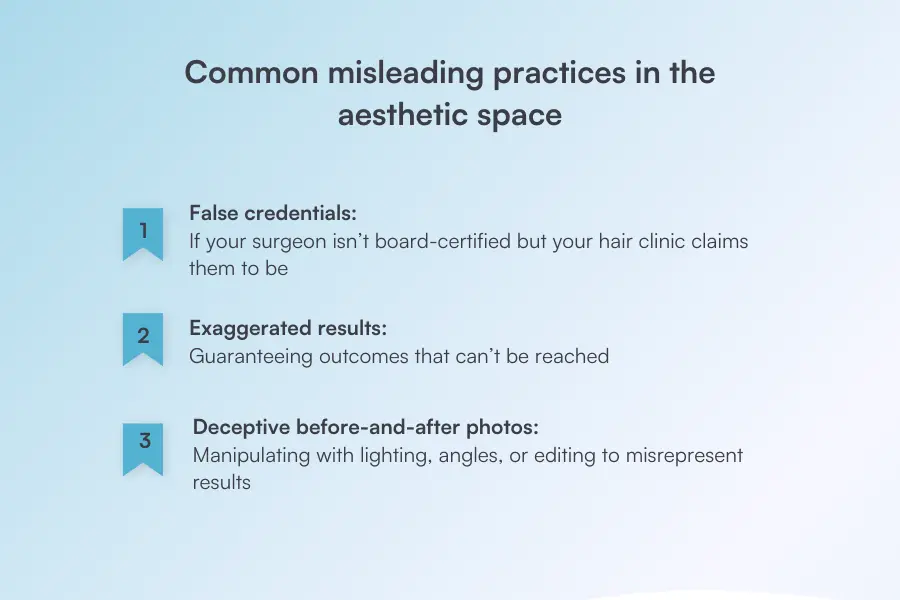
The ISHRS and ABHRS guidelines, together with FTC rules, add the specifics:
Breaking these rules can bring fines, license action, civil claims and lasting damage to your reputation.
One report on the hair transplant black market describes a Miami clinic shut down in 2021 after advertising itself as “the cheapest option in Florida”. According to that report, staff without medical training performed the procedures and patients reported infections.
Price-first advertising with no named surgeon is the pattern to stay well away from.
Every hair transplant patient needs a documented preoperative assessment covering medical history, labs, medications, allergies and psychological readiness before surgery is booked.
Record each result in the patient file and have the physician sign it off. Keep a written emergency transfer plan with a nearby hospital, and rehearse it with the team.
Running compliance on paper means consent in one folder, op notes in another and photos on someone’s phone. Pabau pulls those into one patient timeline:
Pabau also works as medical spa software, so a practice offering injectables alongside hair restoration keeps one system. The hair transplant clinic software page shows the consult-to-surgery workflow.
Every Pabau subscription includes the full feature set, and structured onboarding moves your existing forms and records across.

Pabau stores signed consent, operative notes and before-and-after photos on one HIPAA-compliant patient record. Your team can show an inspector the full surgical trail in minutes.

Inspectors don’t send calendar invites, and neither do attorneys. The practices that come through an audit or a complaint well are the ones whose records already answer the question.
Start with the Compliance-by-role checklist. If anyone on your schedule performs a step the checklist reserves for someone else, fix that first, because no paperwork covers it.
After that, the work is documentation: consent, op notes, training records and marketing sign-off, kept where you can find them. Book a demo to see how Pabau keeps your hair transplant records inspection-ready from consultation to follow-up.

Planning compliant patient acquisition? Marketing your hair transplant clinic covers the channels that bring in consultations without breaking advertising rules.
Choosing a system for your practice? Best hair transplant clinic software in the US compares the platforms that handle consent, records and scheduling.
Offering FUE procedures? FUE consent form: What to include lists the risk disclosures an FUE-specific form should carry.
Tightening your intake process? Hair transplant intake form gives you a patient screening template for the preoperative workup.
Hair transplant clinics must use a licensed physician for every incision, supervise technicians, follow OSHA infection control, protect records under HIPAA and advertise truthfully. The ISHRS and ABHRS publish the professional standards, while state medical boards enforce the law.
The ISHRS is a global nonprofit medical association for physicians who perform hair restoration surgery. It publishes position statements on safe practice, including which surgical steps only a licensed physician may perform, and recognizes fellowship training programs.
Yes. The procedure is lawful across the US when hair transplant physicians with an active state license perform the surgical steps. Most procedures happen in outpatient clinics under state medical board oversight. Some overseas medical-tourism markets have weaker facility licensing, which is why unlicensed technicians performing surgery is a recurring concern there.
Only a few states make malpractice coverage a legal condition of practice, but hospitals typically require it for privileges. Operating without it leaves the surgeon and the practice owner personally exposed to any claim.