Kate Tarrant
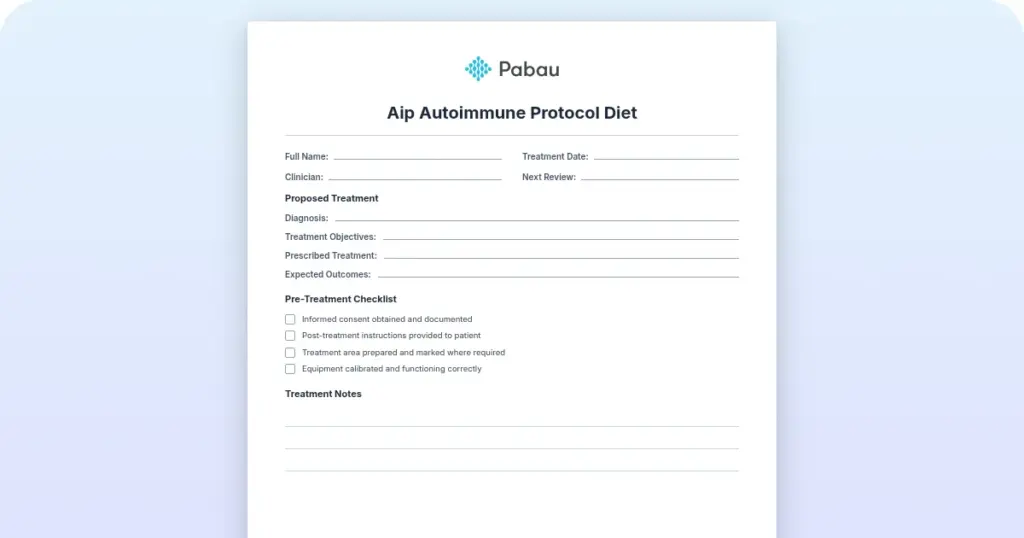
AIP autoimmune protocol diet template
What is an AIP autoimmune protocol diet template? An AIP autoimmune protocol die...

1
Last Updated: Oct 27, 2026
Free PDF 2 pages, print-ready Clinician-reviewed
A skin turgor test is one of the fastest bedside hydration checks a clinician can perform, but its diagnostic value depends entirely on consistent technique and consistent documentation. Without a structured form, findings vary by clinician, the assessment site is rarely recorded, and chart entries default to vague phrases like “turgor good” that mean little to the next provider on shift. This guide provides a free skin turgor test template ready to download, plus the clinical reasoning, workflow steps, and reliability caveats your team needs to interpret the test correctly.
A ready-to-use bedside assessment form covering pinch site selection, tenting duration, return-to-baseline observations, hydration status interpretation, contributing factors, and escalation criteria. Designed for nurses, physicians, and clinical aides in acute care, primary care, long-term care, and home health.
Start from scratch, or upload this PDF or any form you already use, and Pabau's AI Form rebuilds it with tick boxes, text fields and a signature. Attach it to the treatment once, and every patient gets it on time.
AI Form rebuilds the consent, history and aftercare forms you already use. You review each one, then publish.
Patients complete forms on their phone before they arrive, so the front desk stops retyping paper.
Every signed form is versioned and attached to the treatment record, ready when you need it.
Set how long a consent stays valid. Returning patients skip forms they have already signed.
Supports HIPAA and GDPR compliance AES-256 encryption 4.8 on G2 4.7 on Capterra Trusted by 4,000+ practices worldwide

Skin turgor is a bedside measure of skin elasticity that reflects hydration status and tissue perfusion in clinical assessment.
A skin turgor test template standardizes documentation of pinch test findings, tenting duration, and assessment location for consistency and compliance.
Normal skin turgor returns within 1-2 seconds; poor turgor (tenting longer than 2 seconds) may signal dehydration.
Skin turgor is unreliable in elderly patients due to age-related loss of dermal collagen and elasticity, and should be combined with other hydration markers (mucous membranes, capillary refill, urine output, BUN/creatinine).
Pabau’s digital forms and clinical documentation features streamline skin turgor assessment workflows and integrate findings into comprehensive patient records.
A skin turgor test template is a structured clinical documentation form that guides healthcare providers through the assessment of skin elasticity and hydration status. This simple bedside examination helps clinicians evaluate dehydration, fluid balance, and overall skin health by measuring how quickly skin returns to its normal position after being pinched. The template captures the pinch test technique, anatomical site, turgor findings (normal vs poor/tenting), and contextual clinical notes in a standardized format, ensuring consistent charting across all staff and visits.
According to MedlinePlus (NIH/NLM), the skin turgor test is performed by gently grasping skin (most commonly on the forearm, abdomen, sternum, or back of the hand) and observing how quickly it springs back into place. A skin turgor test template formalizes this observation, reducing variability and improving the quality of clinical documentation for dehydration screening, nutritional assessment, and fluid management decisions.
Standardized assessment tools reduce clinician variability and improve patient safety. A skin turgor test template ensures every clinician documents findings consistently: recording the exact anatomical site tested, the duration of skin tenting, and objective observations rather than vague impressions. This consistency is critical for regulatory compliance, clinical handovers, and tracking changes in hydration status over time.
A skin turgor test template simplifies the documentation workflow into five operational steps that any member of the clinical team can follow.
Pabau’s digital forms allow clinics to deploy this template on tablets and smartphones at the bedside, eliminating paper and automating data flow into the patient record for immediate visibility to the care team.
Teams using software to manage patient records can pull up prior scores before every reassessment.

Deploy structured skin turgor and hydration documentation forms across your team. Pabau’s digital forms route findings directly into the client record so clinicians can review trends and escalate dehydration risk at the point of care.

Nurses, clinicians, and healthcare aides in acute care, primary care, long-term care, and home health settings rely on skin turgor assessment to detect and manage dehydration. The template is particularly valuable in geriatric care (where skin elasticity declines and reliability drops), pediatric assessment (where age-specific reference values apply), post-operative recovery (fluid shifts), and chronic disease management (diabetes, renal disease). General practices, community health clinics, rehabilitation facilities, and occupational health services all use skin turgor assessment as part of routine physical examination.
When the focus is specifically on hydration status, a dehydration skin test template frames the same maneuver around detecting and grading fluid loss.
Skin turgor is a useful but imperfect bedside test, and the template prompts clinicians to interpret findings within the patient’s broader clinical picture. The most important caveat is age. In elderly patients, dermal collagen and elastin decrease with age, fat is redistributed, and skin loses its ability to recoil quickly even when the patient is well hydrated. As a result, prolonged tenting in an older adult does not reliably indicate dehydration, and a normal-appearing turgor in an older adult does not rule it out. The forearm and back of the hand are particularly affected; the sternum and the skin over the clavicle retain elasticity longer and are usually the more dependable sites in patients over 65.
Other factors that limit interpretation include obesity (subcutaneous tissue masks the pinch), edema (which falsely suggests good turgor), recent significant weight loss (which can mimic poor turgor), connective tissue disorders, and chronic corticosteroid use. Because of these limitations, skin turgor should never be used as a sole indicator of hydration status. Combine the finding with mucous membrane moisture, capillary refill time, blood pressure (orthostatic changes), urine output and concentration, and laboratory markers (BUN/creatinine ratio, serum sodium, hematocrit) for an accurate hydration assessment. The template includes a “contributing factors” field so the clinician records anything that may make the result less reliable, supporting safer downstream decisions.
In adults over 65, document turgor findings from the sternum or skin over the clavicle rather than the forearm or back of the hand, and always pair the result with at least two other hydration markers (mucous membranes, capillary refill, or recent urine output). A standalone ‘poor turgor’ note in an elderly chart is rarely sufficient to justify IV fluids and is a common audit finding.
Clinical accuracy: Standardized technique reduces observer error and improves diagnostic reliability of the pinch test across different clinicians and settings. Documenting the assessment site explicitly also makes serial comparisons meaningful, since the same site is reused across visits.
Legal and compliance protection: A signed, dated template with specific findings creates an audit trail that demonstrates the assessment was performed according to professional standards (ANA Standards of Practice, CMS documentation requirements, and The Joint Commission record-keeping expectations).
Workflow integration: Templates can be embedded in electronic client records, allowing clinical notes, lab results, and medication history to sit alongside turgor findings for a complete picture of hydration status and clinical context.
Faster handovers: A consistent format means the next clinician on shift can scan the form in seconds and identify trends, escalation triggers, and outstanding interventions without re-examining the patient.

Considering virtual visits for your practice? Telehealth adoption in GP clinics looks at what is driving practices toward virtual consultations and remote patient care.
Investigating chest pain with a normal ECG? Thallium stress test guide maps blood flow to the heart under stress and at rest to guide treatment.
A skin turgor test takes seconds to perform but its clinical value depends on consistent technique, the right anatomical site, and structured documentation that captures both the finding and the factors that may limit it. The template provided here gives your team a single, defensible format for recording pinch test results across acute care, primary care, long-term care, and home health, with built-in prompts for the elderly-reliability caveat that catches many clinicians out. Download it, integrate it into your bedside workflow, and pair it with complementary hydration markers (mucous membranes, capillary refill, urine output, and basic chemistries) so dehydration is identified early and documented in a way that supports safer downstream decisions.
See how Pabau supports bedside assessment and clinical documentation workflows across your team, with structured forms that flow directly into the client record.
No, skin turgor is unreliable in older adults. Age-related loss of dermal collagen and elastin causes prolonged tenting even in well-hydrated patients, while subcutaneous fat redistribution can mask dehydration. In adults over 65, test the sternum or the skin over the clavicle rather than the forearm or back of the hand, and never rely on turgor alone. Combine it with mucous membrane moisture, capillary refill time, orthostatic blood pressure, urine output, and serum chemistries (BUN/creatinine, sodium) for an accurate hydration assessment.
No single bedside sign is definitive, so guidelines recommend a combination of indicators: dry mucous membranes (lips, oral mucosa), capillary refill time greater than 2 seconds, sunken eyes, decreased urine output (less than 0.5 mL/kg/hour in adults), concentrated urine, orthostatic hypotension, tachycardia, weight change from baseline, and laboratory markers including elevated BUN/creatinine ratio (greater than 20:1), elevated serum sodium, and elevated hematocrit. In pediatric patients, capillary refill, respiratory pattern, and overall appearance often outperform skin turgor.
Normal turgor: skin returns to its baseline position immediately, within 1-2 seconds of release. Mildly decreased turgor: return takes longer than 2 seconds. Poor turgor or tenting: the skin remains pinched in place for several seconds before slowly flattening, suggesting moderate to severe dehydration in patients without confounding factors. Abnormal findings should always be interpreted in clinical context, since obesity, edema, recent weight loss, chronic steroid use, and advanced age can all distort the result.
Escalate immediately if poor turgor is accompanied by any of the following: dry mucous membranes, decreased urine output, altered mental status, tachycardia, hypotension or orthostatic changes, recent diarrhea or vomiting, fever, or known fluid loss. Order or recommend serum electrolytes, BUN, creatinine, and a urinalysis. The clinician will determine whether oral rehydration, IV fluids, or further workup is appropriate. In pediatric and geriatric patients, the threshold for escalation should be lower because they tolerate fluid loss less well.
For most adults, the forearm and abdomen are acceptable. For older adults, the sternum and the skin over the clavicle are generally the most reliable sites because they retain elasticity longer than the forearm or back of the hand. For infants and young children, the abdomen is the standard site. Whichever site is chosen, document it on the template so subsequent assessments use the same location and findings can be compared meaningfully across visits.