HCPCS Code A4627: Spacer and valved holding chamber
HCPCS Code A4627: official descriptor and code definition HCPCS Code A4627 is th...

Last Updated: Oct 21, 2026
G0252 is the HCPCS Level II code for PET imaging used in the initial diagnosis of breast cancer or in planning breast cancer surgery. Initial staging of the axillary lymph nodes is the typical use, and the scan must run on a full or partial-ring PET scanner.
Medicare lists G0252 with coverage code M, meaning non-covered, and pricing indicator 00, so Medicare makes no payment for the scan. National coverage policy in NCD 220.6.17 non-covers FDG PET for breast cancer diagnosis and initial axillary staging. Covered breast cancer PET, such as distant metastasis staging or restaging, is billed with CPT 78811-78816 instead.
Let Pabau's smart automation suggest the right codes, reduce claim denials, and keep your practice compliant—effortlessly.
Automate repetitive tasks and focus on what matters most—your patients.
Reduce coding errors and ensure compliance with the latest regulations.
Clean claims, fewer denials, and faster reimbursements.
Powerful insights and reporting to help your practice thrive.
HIPAA compliant SOC 2 certified GDPR-compliant Trusted by 4,000+ clinics worldwide

HCPCS code G0252 reports PET imaging for initial breast cancer diagnosis or surgical planning, such as initial axillary lymph node staging.
It is not a general oncologic PET code, so lung, lymphoma, and metastatic disease studies do not belong on it.
Medicare lists G0252 with coverage code M (non-covered) and pricing indicator 00, because national coverage policy excludes PET for these breast cancer indications.
Covered breast cancer PET, such as distant metastasis staging or restaging, is billed with CPT 78811-78816 plus the PI or PS modifier.
A signed ABN before the scan is what lets you bill a Medicare patient for G0252.
HCPCS code G0252 reports positron emission tomography (PET) imaging for the initial diagnosis of breast cancer. It also covers PET for breast cancer surgical planning. The descriptor gives initial staging of the axillary lymph nodes as its example. The study must run on a full or partial-ring PET scanner.
G0252 is a Level II G-code that CMS maintains, according to the CMS HCPCS Level II overview. It took effect on October 1, 2002. The table below shows the code attributes from the CMS October 2026 HCPCS file.
G0252 therefore describes a narrow set of breast cancer studies that Medicare does not pay for. It is not a fallback for oncologic PET that lacks a specific code.
Medicare does not cover HCPCS code G0252. The code carries coverage code M, which the CMS HCPCS file defines as non-covered by Medicare. That differs from coverage code S, which CMS reserves for services that the Medicare statute itself excludes.
The non-coverage comes from national coverage policy. NCD 220.6.17 nationally non-covers FDG PET for the diagnosis of breast cancer and the initial staging of axillary lymph nodes. Pricing indicator 00 confirms that Medicare assigns G0252 no payment amount.
A Medicare claim for G0252 will not produce a payment. The billing implications are:
Medicare does cover some breast cancer PET, but those studies are not billed with G0252. Covered FDG PET is reported with CPT 78811-78816. A PET/CT study from skull base to mid-thigh, for example, is reported with CPT 78815. The PI modifier marks a scan that informs the initial treatment strategy, and the PS modifier marks a scan for subsequent treatment strategy.
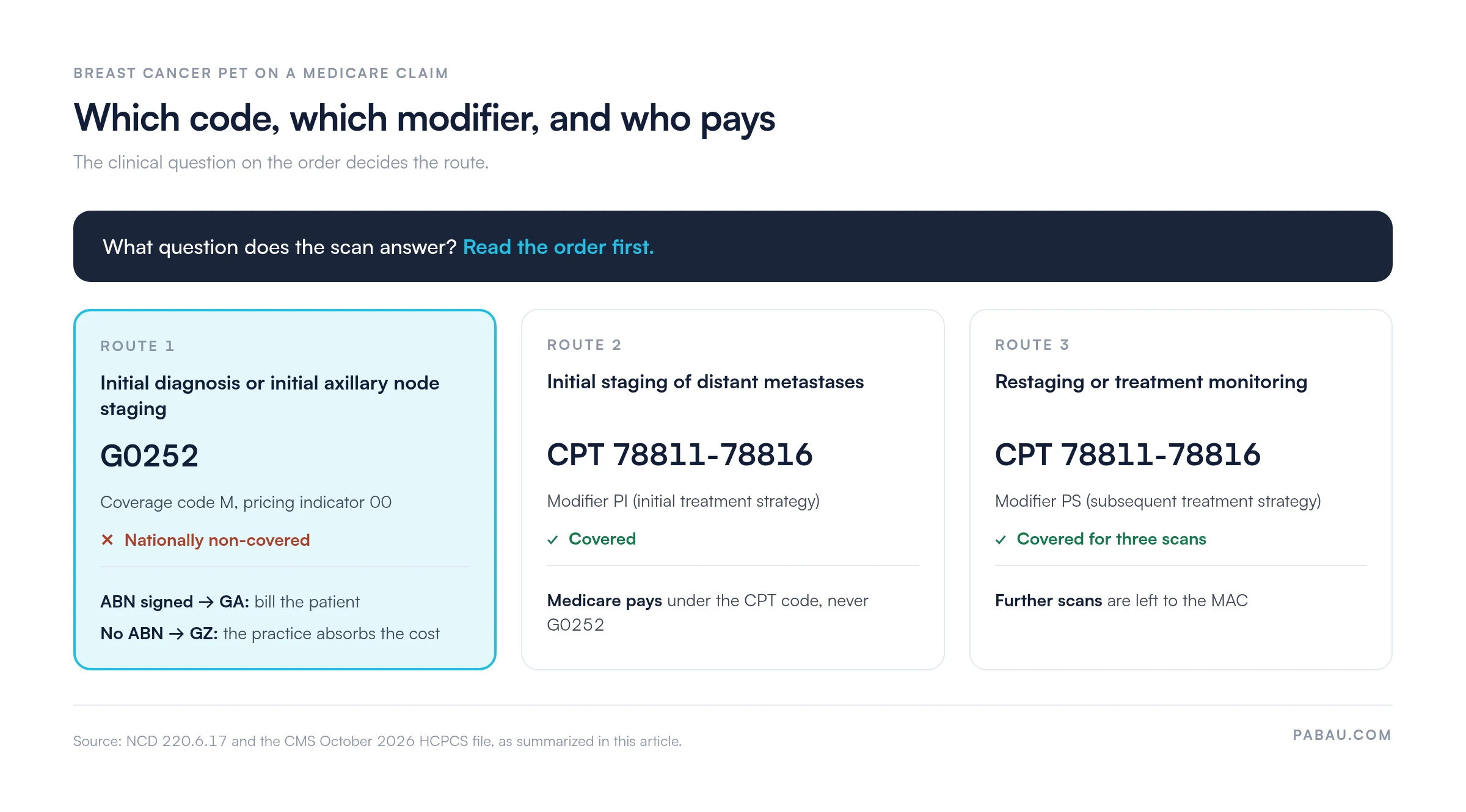
The order needs to state which question the scan answers. That clinical question decides whether the claim belongs on G0252 or on a covered CPT code. The diagram below adds the modifier and who pays on each route.
Even when a commercial payer covers breast cancer PET, the chart has to show why the scan was needed and what it was for. Good medical billing compliance practice means gathering these records when the scan is ordered, not after a denial.
Keep these records in the patient chart for at least seven years, or longer where state law requires it.
A clean G0252 claim depends on the right code choice, the right liability modifier, and a breast cancer diagnosis code. Mistakes at any of those points cause edits or denials. A solid revenue cycle management workflow catches them before the claim leaves the practice.
Before you code a breast cancer PET claim, read the clinical question on the order. Initial diagnosis or axillary staging points to G0252. Distant metastasis staging, restaging, or treatment monitoring points to CPT 78811-78816 with PI or PS.
Modifier use on G0252 is payer-specific, so confirm each payer’s rules before you submit. On Medicare claims, the liability modifiers below show whether an ABN is on file.
G0252 is a breast cancer code, so the diagnosis on the claim has to describe breast cancer or a suspected breast cancer. Code to the highest specificity the record supports, including site and laterality.
Until a biopsy confirms the cancer, code the finding that prompted the scan, such as R92.8 for abnormal breast imaging. Always check the payer policy for its accepted diagnosis list. A diagnosis outside breast cancer on a G0252 claim is a frequent denial trigger.
Several HCPCS G-codes once described PET imaging for specific cancers, but most were deleted in 2005, when CMS moved covered PET to CPT codes. The table compares G0252 with the PET codes it is most often confused with, using the CMS October 2026 HCPCS file.
G0252 survived the 2005 change because it describes indications that Medicare still does not cover. Report covered breast cancer PET with the CPT codes, never with G0252 or a deleted G-code. PET that has no site-specific code goes on G0235, which Medicare also lists as non-covered.
Prior authorization (PA) for G0252 depends on the payer and plan year. Medicare has no PA for G0252, because it does not cover the service at all. Commercial payers and Medicaid programs that cover breast PET often require PA before the scan.
G0252 claims deny for predictable reasons, and most can be caught before submission. Building denial management in healthcare into the scheduling workflow cuts the rework each denial costs. When a claim does come back, the remittance advice lists the denial codes that explain the refusal.
To bill a Medicare patient for a coverage code M service like G0252, you need a valid ABN (CMS-R-131). The ABN tells the patient, before the service, that Medicare will probably not pay and that they may have to pay.
G0252 carries pricing indicator 00, so CMS assigns it no payment amount on the Medicare Physician Fee Schedule (MPFS). You can confirm this in the CMS Physician Fee Schedule lookup tool for the current year.
Commercial payment rates are set by each payer and do not come from the MPFS. The allowed amount depends on the contracted rate, the payer’s imaging fee schedule, and any site-of-service adjustments. Confirm with each payer whether its fee schedule lists G0252 at all.
When a patient pays for G0252 after signing an ABN, charge the practice’s established self-pay price for PET imaging. Commercial allowed amounts do not set that price.
Review your payer contracts each year for changes to PET coverage. A commercial payer can change how it treats G0252 at contract renewal, so a yearly check stops claims going out under the old rules.
G0252 claims succeed or fail on paperwork gathered before the scan. That means the order, the breast imaging and pathology reports, and a signed ABN for Medicare patients. In many practices those records sit in different systems, and the billing team only finds a missing ABN after the denial.
Pabau, the all-in-one practice software we build, keeps those documents on one patient record. The ABN can go out as a digital form that the patient signs, and the signed copy is stored against their record.
For US practices, Pabau’s claims management software submits claims through Claim.MD and tracks their status. It pulls in the data already on the patient record, so the codes and modifiers your team chooses go out as entered.

Pabau stores signed ABNs, orders, and reports on the patient record, then submits and tracks claims through Claim.MD. Your team spends less time chasing paperwork after a denial.

Code a breast cancer PET from the clinical question on the order, not from the word PET. Initial diagnosis and axillary staging belong on G0252. Distant metastasis staging, restaging, and treatment monitoring belong on CPT 78811-78816 with PI or PS.
Because Medicare will not pay for G0252, the signed ABN decides whether the practice or the patient covers the cost. Get it signed before the scan, and a Medicare denial no longer leaves the practice with the bill. Book a demo to see how Pabau keeps signed ABNs, orders, and imaging reports on one record for your PET claims.

Need a structured framework for managing claim denials? Denial management in healthcare covers the end-to-end process for tracking, appealing, and preventing common denial categories across payer types.
Want to understand how claims reach the payer? What is revenue cycle management explains the full billing lifecycle from eligibility check through payment posting.
Looking for compliance guidance on HCPCS billing workflows? Medical billing compliance outlines documentation standards and audit-readiness practices for outpatient imaging and procedure codes.
Coding a patient with a past breast cancer? ICD-10 code Z85.3 explains how to report a personal history of breast cancer.
Billing a covered whole-body PET/CT? CPT code 78816 breaks down the whole-body PET/CT code used for covered oncologic imaging.
HCPCS code G0252 describes PET imaging on full or partial-ring scanners for the initial diagnosis of breast cancer or breast cancer surgical planning. Initial staging of the axillary lymph nodes is the example the descriptor gives. It does not cover PET for other cancers.
No. G0252 carries coverage code M (non-covered) and pricing indicator 00, because NCD 220.6.17 non-covers PET for breast cancer diagnosis and initial axillary staging. Issue a valid ABN before the scan if you plan to bill the patient.
Medicare assigns G0252 no payment amount (pricing indicator 00). Commercial payers set their own rates, so check each payer’s fee schedule and contract. Patients who sign an ABN pay the practice’s established self-pay price.
Modifier use on G0252 is payer-specific. On Medicare claims, GA shows a signed ABN is on file and GZ shows there is none. Use 26 or TC only where the payer accepts a component split for this code.
The most common reasons are billing Medicare without an ABN, or using G0252 for covered breast PET that belongs on CPT 78811-78816. Other causes are a diagnosis other than breast cancer, missing prior authorization, or thin documentation.
G0252 covers breast cancer initial diagnosis and surgical planning only. G0235 is PET imaging of any site, not otherwise specified, and G0219 is whole-body PET for non-covered melanoma indications. G0210-G0213 described lung and colorectal cancer PET, and CMS deleted them in 2005.