

CCSD code G5100: Bypass of duodenum billing guide
CCSD code G5100 bills a bypass that leaves the duodenum in place CCSD code G5100...

Last Updated: Oct 16, 2026
78816 is the CPT code for positron emission tomography (PET) with concurrently acquired computed tomography (CT) for attenuation correction and anatomical localization imaging, whole body.
The whole-body field runs from the vertex to the feet, so it covers the lower extremities that CPT 78815 leaves out. Coders reach for 78816 in oncology staging and restaging where disease may sit below mid-thigh. Choosing wrongly inside the 78814-78816 family is one of the top denial drivers on nuclear medicine claims.
Let Pabau's smart automation suggest the right codes, reduce claim denials, and keep your practice compliant—effortlessly.
Automate repetitive tasks and focus on what matters most—your patients.
Reduce coding errors and ensure compliance with the latest regulations.
Clean claims, fewer denials, and faster reimbursements.
Powerful insights and reporting to help your practice thrive.
HIPAA compliant SOC 2 certified GDPR-compliant Trusted by 4,000+ clinics worldwide

CPT code 78816 covers whole-body PET/CT from the vertex to the feet, including CT attenuation correction when performed.
78816 is the broadest code in the family. 78814 covers a limited area, and 78815 stops at mid-thigh.
The tracer is always billed separately, as A9552 for FDG or A9597 for an unclassified tumor-imaging agent.
Medicare covers 78816 under NCD 220.6.17, and every FDG PET oncology claim carries modifier PI or PS.
Pabau’s claims management software tracks prior authorization and attaches companion codes, so fewer 78816 claims come back denied.
CPT code 78816 describes a positron emission tomography (PET) scan of the whole body, performed with concurrently acquired CT for attenuation correction and anatomical localization.
The American Medical Association, which maintains CPT, separates 78816 from its neighbors by anatomical coverage. Whole body means vertex to feet, so the lower extremities sit inside the imaged field. If the scan stops at mid-thigh, CPT 78815 applies instead.
The code also incorporates the CT attenuation correction component when that is performed in the same scanner session. Billing that CT separately as a diagnostic study is not appropriate, because the attenuation correction CT is bundled. Getting this right prevents over-billing, and it prevents the revenue loss of filing an unbundled add-on the payer then denies.
The 78814-78816 family covers three anatomical scopes, and picking the wrong one is a frequent, avoidable claim error. The radiology report has to state the extent of the scan to justify whichever code is billed. The chart below maps each code against the body, so you can see where the boundaries fall.
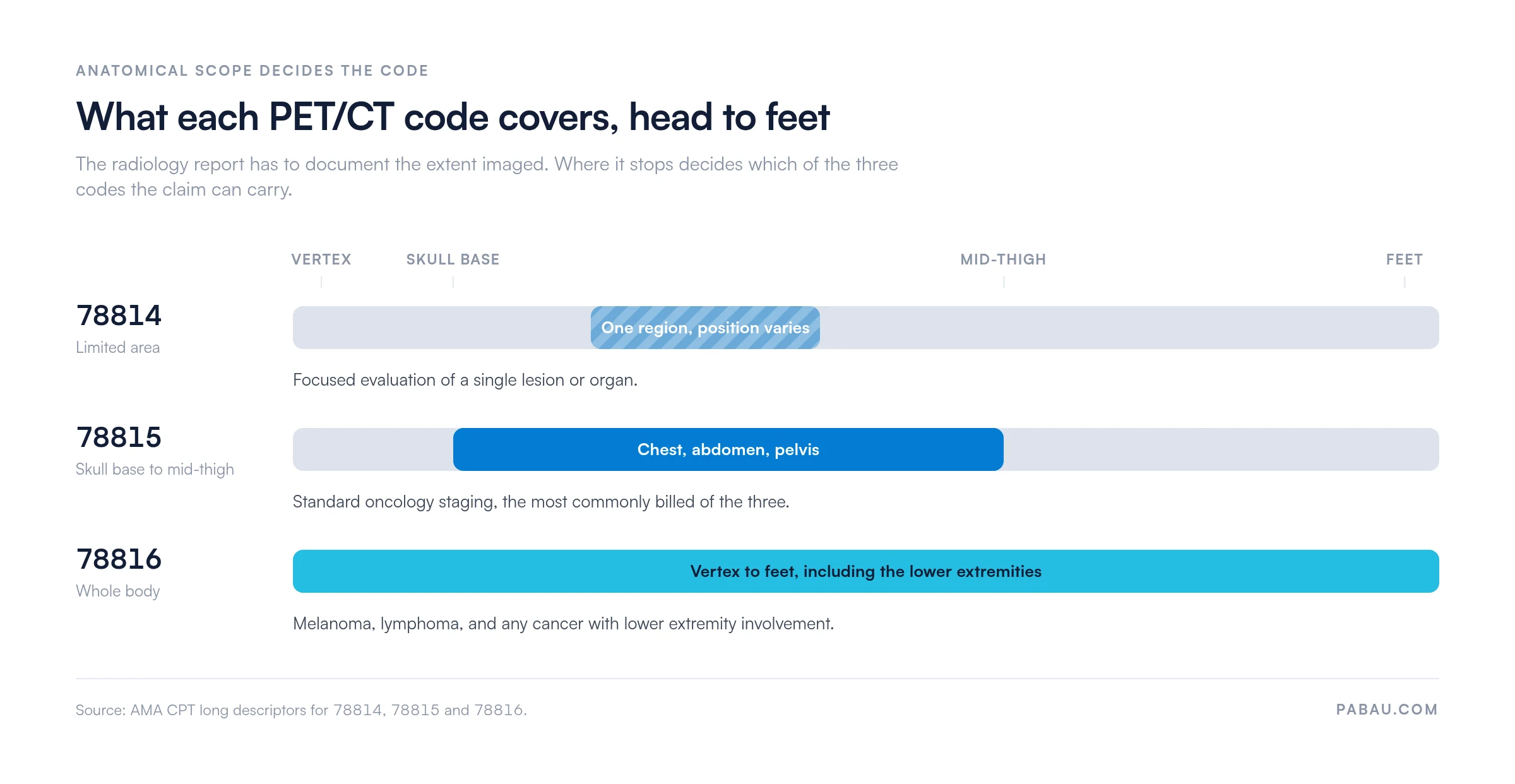
The most common mix-up is billing 78816 when the scan actually stopped at mid-thigh. Payers audit the documented scope against the radiology report, and a mismatch triggers a denial. Where the report describes imaging to the mid-thigh with no language extending past it, 78815 is the correct code.
The professional and technical components of the scan itself sit inside 78816, but the radiopharmaceutical is always billed separately on an HCPCS Level II code. Omitting the tracer code is a routine documentation error, and it costs the practice money it has already earned.
Coverage for newer non-FDG tracers is still moving. Whether A9597 is payable for a given oncology indication turns on the applicable MAC Local Coverage Determination, so read it before the claim goes out. Payers may also ask for clinical documentation supporting the choice of a non-FDG agent. The CMS HCPCS overview sets out the authoritative structure for Level II code rules.
Modifier selection for 78816 depends on the billing setting. In hospital outpatient departments, the technical and professional components are usually split between the facility and the interpreting physician. In freestanding imaging centers, one global bill covers both.
Medicare requires PI or PS on every FDG PET oncology claim. That pair replaced the old Q0 and Q1 coverage-with-evidence-development indicators, which stopped being required for routine oncologic FDG PET in June 2013. When a freestanding practice bills 78816 globally, the claim already covers both the interpretation and the technical work. Appending modifier 26 where you also own the equipment underbills the service, so confirm which components your practice controls before filing.
Run a quarterly modifier audit on your 78816 claims. Pull every claim that carried modifier 26 and confirm the facility separately billed TC for the same date of service. Then check that each Medicare FDG PET claim carries either PI or PS. A mismatch between the professional and technical filings is one of the fastest ways to trigger a payer audit.
Medicare covers 78816 under National Coverage Determination 220.6.17, which names the approved oncologic indications for FDG PET. CMS retired the umbrella NCD 220.6 on January 1, 2022, so 220.6.17 is the determination to cite today. Billing 78816 with an unsupported diagnosis code is the most common reason a Medicare PET claim is denied.
NCD 220.6.17 covers whole-body FDG PET for the uses below, where the diagnosis supports medical necessity. The table lists the supporting codes billed most often.
MAC Local Coverage Determinations sit on top of NCD 220.6.17 and add payer-specific requirements. Before billing 78816 on any non-standard oncology diagnosis, read the LCD for the patient’s jurisdiction. The supporting diagnosis itself comes from the ICD-10-CM code set, and the code you bill has to match the one the payer authorized.
Most commercial payers and many Medicare Advantage plans require prior authorization before a whole-body PET scan. Traditional Medicare fee-for-service does not, provided the NCD 220.6.17 criteria are met. The rules still differ plan by plan, so verify rather than assume.
Verifying eligibility before the day of service catches coverage problems while they can still be fixed. Practices with heavy prior authorization volume need that tracking step inside the scheduling workflow, not running alongside it in a separate spreadsheet.
CMS updates the Medicare Physician Fee Schedule annually, and geographic practice cost indices adjust every figure by location. The rates below are unadjusted national benchmarks drawn from published CMS data. Verify the current value with the CMS Physician Fee Schedule search tool before you rely on any published rate.
For the hospital outpatient setting, the Outpatient Prospective Payment System pays an Ambulatory Payment Classification rate rather than the fee schedule amount. Confirm the current APC grouping for 78816 with the facility’s revenue cycle team, since it moves with each annual rule.
Practices that post remittances electronically can match each 78816 payment against the benchmark they expected. Any line paying below that figure is then flagged for audit follow-up instead of being written off quietly at month end.
Most 78816 denials are preventable. The patterns below account for the bulk of rejected nuclear medicine PET claims.
The remittance advice tells you which pattern you hit. On 78816 claims, CARC 50 for a non-covered service and CARC 197 for an absent precertification come back most often. Each one points at a different fix upstream, so read the code before rewriting the claim.
Every 78816 claim needs these elements in the medical record before submission.
Build a 78816 charge capture template that auto-populates A9552 alongside the PET code. Have it block submission when a Medicare claim carries neither PI nor PS, and prompt staff for the prior authorization number. Practices that hardcode the checklist into the workflow see far fewer tracer-omission denials.
Nuclear medicine and radiology billing teams running high 78816 volume juggle four jobs at once. They track prior authorization across payers, attach the right tracer code to every claim, watch frequency limits by indication, and catch modifier errors before submission. Spreadsheet workflows miss denials that a connected billing platform catches on its own.
Pabau, practice management software built for clinical practices, centralizes that work in its claims management software. Eligibility checks, electronic submission, and remittance posting all sit in the same record as the appointment and the clinical note. Billing staff see CARC-level detail on returned remittances, so a coverage denial never gets confused with a missing companion code.
The practical result is that no 78816 claim leaves the practice before someone has confirmed the authorization status. Payments post against the expected rate automatically, and underpayments surface while the appeal window is still open.


Pabau tracks prior authorization, attaches companion tracer codes, and submits clean electronic claims. See how radiology and nuclear medicine billing teams use it to bring PET scan denial rates down.

78816 is a high-value code with a narrow margin for error. The anatomical extent has to be documented, the tracer code attached, the modifier matched to the setting, and the diagnosis aligned with NCD 220.6.17. Miss one of those and the appeal costs more than the claim is worth.
Pick the single step your practice keeps losing claims on and fix that one first. For most nuclear medicine teams it is prior authorization tracking, because the failure happens weeks before anyone looks at the claim. Book a demo to see how Pabau handles PET scan billing from authorization through remittance.

Not sure whether your scan should bill as limited-area instead of whole-body? CPT Code 78814 covers PET imaging of a single anatomical region and explains when the narrower code applies instead of 78816.
Wondering how the FDG tracer gets billed alongside the scan? HCPCS Code A9552 covers the radiopharmaceutical billing, coverage, and modifier rules that run on their own line from 78816.
CPT code 78816 covers a whole-body PET scan running from the vertex to the feet, with concurrently acquired CT for attenuation correction and anatomical localization. The tracer is always billed separately on its own HCPCS code, usually A9552 for FDG.
78814 covers a limited area, 78815 runs from the skull base to mid-thigh, and 78816 covers the whole body from vertex to feet. The distinction between 78815 and 78816 is whether the lower extremities were imaged, and the radiology report has to document it.
Yes. Medicare covers 78816 for approved oncologic indications under NCD 220.6.17, which replaced the retired umbrella NCD 220.6 in 2022. Covered uses include lung, colorectal, lymphoma, melanoma, and head and neck cancers. Scans on non-covered diagnoses, or beyond the MAC LCD frequency limit, are denied.
A9552 covers fluorodeoxyglucose F-18 and is the usual companion on oncology PET claims. A9597 covers a PET radiopharmaceutical for tumor identification that has no code of its own. Coverage for A9597 varies by payer and MAC LCD, so check the policy before billing.
Modifier 26 applies where the interpreting physician bills separately from the facility, and TC where the facility bills the technical component alone. Medicare also requires PI or PS on every FDG PET oncology claim, reporting initial or subsequent treatment strategy. A freestanding center billing globally appends neither 26 nor TC.
The leading cause is a diagnosis outside NCD 220.6.17 or the applicable MAC LCD. Missing prior authorization, scope documentation that only supports 78815, an omitted tracer code, and a frequency limit breach follow. A pre-submission checklist prevents each one.



