CCSD Code B2710: Radical mastectomy including block dissection
CCSD Code B2710: Definition and clinical scope CCSD Code B2710 is the UK private...

Last Updated: Nov 13, 2026
36468 is the CPT code for injection(s) of sclerosant for spider veins (telangiectasia), limb or trunk. It covers sclerotherapy of these tiny surface veins, which are under 1 mm across, whatever the number of injections.
Incompetent veins other than telangiectasia belong to 36470 and 36471, and foam in truncal veins to 36465 and 36466. Medicare contractors usually treat spider vein sclerotherapy as cosmetic unless the veins have bled.
Let Pabau's smart automation suggest the right codes, reduce claim denials, and keep your practice compliant—effortlessly.
Automate repetitive tasks and focus on what matters most—your patients.
Reduce coding errors and ensure compliance with the latest regulations.
Clean claims, fewer denials, and faster reimbursements.
Powerful insights and reporting to help your practice thrive.
HIPAA compliant SOC 2 certified GDPR-compliant Trusted by 4,000+ clinics worldwide

CPT code 36468 covers injection of sclerosant for spider veins (telangiectasia) of a limb or the trunk, whatever the number of injections.
Incompetent veins other than telangiectasia go to 36470 (single vein) or 36471 (multiple veins, same leg), and truncal-vein foam goes to 36465 or 36466.
Medicare contractors such as First Coast treat telangiectasia sclerotherapy as cosmetic, except when the veins have bled spontaneously or after trauma.
Under CMS billing article A58250, only D69.8, I78.0 and R58 support 36468, so venous insufficiency codes alone will not carry the claim.
Pabau pre-fills claims from the patient record and checks required claim fields before submission, which helps 36468 claims go out complete.
CPT code 36468 reports injection(s) of sclerosant for spider veins (telangiectasia), limb or trunk.
First Coast’s Medicare billing article A58250 directs coders to report it for spider veins once per extremity per session, however many injections are given. The code was formerly worded “Single or multiple injections of sclerosing solutions, spider veins (telangiectasia); limb or trunk.”
The AAPC summary of CPT 36468 describes single or multiple injections of a sclerosing solution to treat spider veins of the arms, legs or trunk. Telangiectasias are small, flat, thin-walled veins under 1 mm across, seen near the skin surface.
The code sits in the Surgery section, under the Cardiovascular System and its vascular injection procedures (36000-36598). The facial telangiectasia code, 36469, was deleted on January 1, 2015, so it has no place on a current claim.
Note what separates 36470 from 36471. It’s one vein against several veins in the same leg, not one leg against both legs. Neither code is a bilateral code.
Coding errors start when 36468 is treated as a catch-all for any vein injection. The code is limited to spider veins, and each neighboring code owns a different vessel or method.
The classic selection error is billing 36468 when the vein treated is an incompetent vein rather than a spider vein. The choice turns on the vessel and, for 36470 and 36471, on how many veins were injected in one leg.
The diagram traces that path from the procedure note to the code and its coverage question.
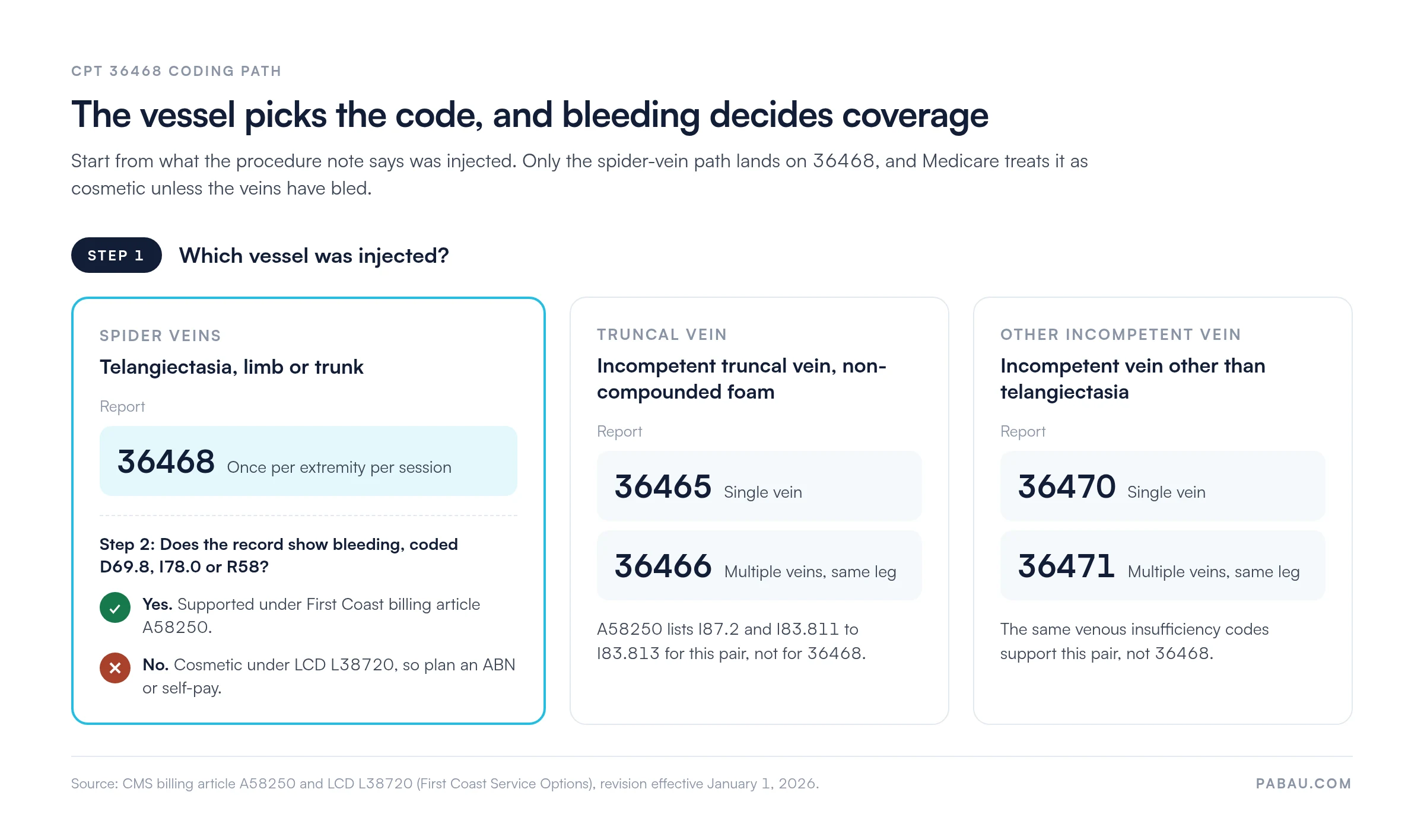
A patient may have spider veins and an incompetent vein treated at one visit. Code each vessel type with its own code and its own supporting diagnosis.
Check the current NCCI procedure-to-procedure edits before adding a distinct-service modifier such as 59 or XS. Document the vessel type, location and size for each site in the procedure note.
Before billing 36468, read the procedure note against the claim. If the note says ‘incompetent vein’ or ‘varicosity’ and the claim says 36468, a reviewer will catch the mismatch. Align the note language and the CPT code with the vessel treated.
Whether a 36468 claim pays usually depends on one question. Does the record show a medical reason for treating the spider veins, or does it read as a cosmetic request?
Medicare answers that through each contractor’s Local Coverage Determination (LCD). First Coast’s LCD L38720 on chronic venous insufficiency treats telangiectasias and reticular veins (CEAP class C1) as cosmetic.
The one exception is a patient with spontaneous or traumatic venous hemorrhage. Other contractors publish their own LCDs, so check the one that covers your practice.
One visit can straddle the coverage line. If symptomatic incompetent veins and cosmetic spider veins are both treated, only the medically necessary part is billable to insurance. Billing both without separate diagnoses invites an audit.
Our guide to billing compliance requirements covers medical necessity standards in more depth.
For commercial plans that require prior authorization, send the clinical notes with the request. Prior authorization rules change often, so confirm them with each payer before each treatment course.
The diagnosis on a 36468 claim decides most outcomes. In CMS billing article A58250, First Coast lists only three ICD-10-CM codes that support 36468. Venous insufficiency codes support 36465, 36466, 36470 and 36471 in that article, not 36468.
When the note documents a bleed with no more specific diagnosis, R58 is the not-elsewhere-classified option on that list. Other contractors and commercial plans keep their own lists, so check the policy that applies.
Use the most specific code the record supports. Never move to a covered diagnosis to get around a cosmetic exclusion, because payers compare diagnosis codes with the notes during audits.
Few modifiers come up on 36468, and most relate to Medicare non-coverage or a same-day second procedure. The table covers the ones coders meet most often.
Which of GA, GZ or GY fits a cosmetic sclerotherapy claim depends on your contractor’s guidance, so check it first. Laterality modifiers and modifier 50 are payer-specific on this code, so follow the payer’s written policy.
CMS billing article A58250 quotes the CPT Professional edition on units. It says 36468 may only be reported once per extremity per session, regardless of the number of injections. It is not a per-injection or per-site code.
Most problems with a spider vein claim are set up long before it reaches the payer. Here’s the route it takes, and what each step has to get right.
Medicare payment for 36468 depends on location (through the Geographic Practice Cost Index), the facility or non-facility setting and the year’s conversion factor.
Rates change each year when CMS publishes the updated fee schedule. Check current rates in the CMS fee schedule lookup tool, not in third-party guides.
Because Medicare contractors usually treat spider vein sclerotherapy as cosmetic, many practices run it as a self-pay service. For commercial claims, check the contracted rate before quoting the patient their share.
Each denial below traces back to one of the coding or coverage rules above. A set denial management workflow handles each one with the same fix every time, rather than case by case.
For Medicare patients, give an Advance Beneficiary Notice (ABN) before treatment where your contractor’s guidance calls for one. Review denial codes in medical billing for the common CARC codes on sclerotherapy remittances.
Audits of sclerotherapy claims ask two questions. Was the treatment medically necessary, and does the note support the code billed? The record must answer both before the claim goes out.
A reviewer should see why treatment was needed without having to infer it. Our guide to submitting a clean claim lists the data elements payers check at adjudication.
Vein and aesthetic practices treating spider veins often run covered and self-pay sclerotherapy side by side. Each claim has to carry the right code, a supported diagnosis and complete payer details. Re-keying that from paper notes is where errors creep in.
Pabau, the practice management platform we build, links the clinical record to billing. Its claims software for practices pre-fills the claim from the record, with the CPT code from the service and diagnoses from the problem list. Built-in ICD-10-CM and CPT lookup libraries help coders confirm each code. Pabau also checks that required claim fields are complete before the claim can be sent.
US claims go out through Claim.MD, with eligibility checks, claim-status tracking and ERA posting. Our Claim.MD clearinghouse guide walks through that route. Cash-pay sessions and insured claims share one patient record, so you can see both sides of a patient’s vein care in one place.

Pabau pre-fills claims from the clinical record, gives coders built-in code lookups and checks required claim fields before submission. See how it works for vein and aesthetic practices.

CPT code 36468 is a narrow code with a narrow coverage window. Get the vessel right and the coding is simple. The harder call is coverage, and the record settles it before the first injection.
So make that call up front. If the note can’t show bleeding, treat the session as cosmetic and plan the ABN or the self-pay quote. If it can, code the bleed from your contractor’s list and document it as carefully as the injections.
Book a demo to see how Pabau keeps insured and self-pay sclerotherapy claims on one patient record.

Need a denial prevention framework? Denial management in healthcare covers the workflows that reduce recurring denial patterns across procedure types.
Treating incompetent truncal veins with foam? CPT code 36465 explains non-compounded foam sclerotherapy of a single truncal vein.
Ablating more than one vein in a session? CPT code 36476 reports each subsequent vein treated with radiofrequency ablation in the same extremity.
Looking for clearinghouse submission guidance? Our Claim.MD clearinghouse guide explains how electronic claim routing, ERA receipt, and eligibility verification connect in a single submission workflow.
Want the full RCM picture for your practice? Revenue cycle management explained outlines the end-to-end process from patient intake through payment posting.
CEAP is the clinical scale for venous disease, running from C0 (no visible signs) to C6 (an active venous leg ulcer). C1 means telangiectasias or reticular veins. LCD L38720 treats C1 treatment as cosmetic unless the veins have bled.
No. 36468 describes injection of a sclerosant, so a laser or other non-injection treatment needs a different code. Check the CPT manual and the payer’s policy before you bill it.
The descriptor covers a limb or the trunk only. The old facial code, 36469, was deleted on January 1, 2015. Confirm the payer’s guidance before you bill any facial vein treatment.
No. First Coast Service Options publishes A58250 for Florida, Puerto Rico and the US Virgin Islands. Practices elsewhere follow their own contractor’s LCD and billing article, which may list different codes.
Not necessarily. Each plan sets its own medical policy, and some require prior authorization. Read the plan’s vein treatment policy before the first session.
No. A58250 states the sclerosant is included in the procedure code. In the office setting, required supplies and equipment are included too.