

CPT Code 30801: Superficial turbinate ablation billing guide
CPT Code 30801: Official descriptor and procedure overview The American Medical ...

Last Updated: Nov 27, 2026
W0660 is the CCSD code for coccygectomy (multiple levels), the surgical removal of part or all of the coccyx. It is the only coccygectomy code in the CCSD schedule, so partial and total excision are both billed under it.
The code sits in sub-chapter 3.1.3 Lumbar Region of the CCSD schedule used by UK private medical insurers, under reference Fc.031. Insurers expect pre-authorization, and the usual diagnosis on the claim is M53.3, which covers coccygodynia.
Let Pabau's smart automation suggest the right codes, reduce claim denials, and keep your practice compliant—effortlessly.
Automate repetitive tasks and focus on what matters most—your patients.
Reduce coding errors and ensure compliance with the latest regulations.
Clean claims, fewer denials, and faster reimbursements.
Powerful insights and reporting to help your practice thrive.
HIPAA compliant SOC 2 certified GDPR-compliant Trusted by 4,000+ clinics worldwide

CCSD code W0660 covers coccygectomy (multiple levels), under CCSD reference Fc.031 in sub-chapter 3.1.3 Lumbar Region.
W0660 is the only coccygectomy code in the CCSD schedule, so partial and total removal of the coccyx are both billed under it.
M53.3 Sacrococcygeal disorders, which includes coccygodynia, is the usual diagnosis on a W0660 claim. S32.2 Fracture of coccyx applies after trauma.
UK private medical insurers expect pre-authorization, backed by a record of failed conservative care, imaging and a consultant letter.
Practice software such as Pabau keeps the authorization number, operative note and diagnosis on one record, so the W0660 claim matches the note.
CCSD code W0660 is the UK private medical insurance code for coccygectomy, the surgical removal of part or all of the coccyx. Insurer schedules such as National Friendly’s CCSD-based schedule of fees list it in the Inter complexity band, with a £468 procedure fee.
The official descriptor reads Coccygectomy (multiple levels). It is published by the Clinical Coding & Schedule Development (CCSD) Group. UK insurers such as Bupa and AXA Health use that schedule to identify procedures on a claim.
Each insurer sets its own band and fee, so check the schedule of the insurer that is paying before you invoice. For the other procedure codes in the schedule, browse our CCSD code library. Bupa’s own list and claim rules are covered in our guide to Bupa CCSD procedure codes.
A coccygectomy removes part or all of the coccyx, the small triangular bone at the base of the spine. It is usually performed under general anesthesia, with the patient prone or in the jack-knife position. Most surgeons use a posterior midline incision over the sacrococcygeal junction, and some prefer a paramedian approach.
The main steps of the operation are:
The operative note should say which joint the excision started from and how much of the coccyx was removed. If the claim is queried, the insurer checks that description against the authorized procedure.
CCSD has one coccygectomy code, and it is W0660. The public CCSD schedule lists no separate code for single-level, partial or total coccygectomy. Removing the distal segments and removing the whole coccyx are billed the same way.
The descriptor reads (multiple levels), which can send coders looking for a single-level code. The schedule doesn’t have one. A claim that carries a code number missing from the schedule is rejected, because the insurer cannot match it to a procedure.
The clinical detail behind the claim still varies from case to case. Two checks keep a W0660 claim consistent:
Ask the operating surgeon to state the extent of the excision in the operative note, for example “coccyx excised from the sacrococcygeal joint”. That one line confirms the procedure behind the W0660 claim and lets the coder match it to the authorization.
Coccygectomy is reserved for patients whose coccyx pain has not settled with non-surgical care. Insurers review the indication closely before they authorize it. The diagnosis on the claim must match the one on the authorization.
The WHO ICD-10 browser holds the codes that most often describe a W0660 patient:
List M53.3 as the primary diagnosis when chronic pain is the reason for surgery. When a fracture or dislocation started the problem, put S32.2 or S33.2 first and add M53.3 as a secondary diagnosis.
Conservative care usually includes physical therapy, manipulation and steroid injection. Each insurer sets how long it must run before surgery is approved, so check the current Bupa, AXA Health or Aviva provider guidance.
UK private medical insurers expect pre-authorization before an elective coccygectomy. Without a valid authorization number, a W0660 claim is likely to be rejected or held until one is supplied.
A pre-authorization request usually includes the documents below. Requirements vary by insurer and policy year, so check the current provider guidance before you submit.
Keep the authorization number on the patient’s episode from the day it is issued. A claim that leaves without it is the easiest denial to prevent.
The operative note is the main audit document for a W0660 claim. Insurers ask for it when a claim is queried. An incomplete note is a common reason a valid claim is denied on review.
The operative note should contain these elements:
Storing operative notes in digital clinical documentation linked to the patient episode makes them quick to retrieve when an insurer asks.
The anesthetist bills separately from the operating surgeon, on their own invoice. Several other charges also stay off the surgeon’s W0660 claim:
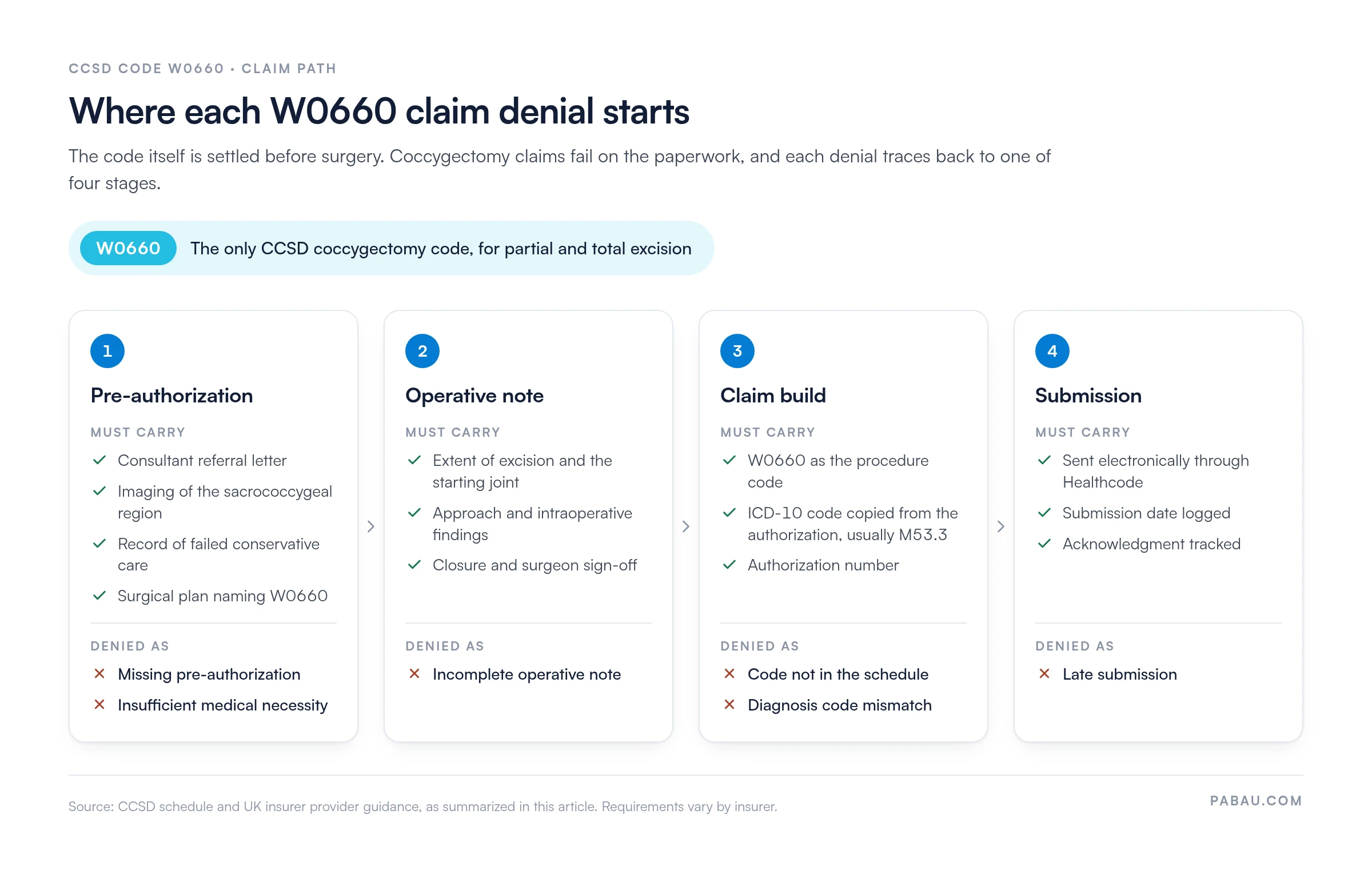
W0660 claims tend to fail for the same handful of reasons, and each one starts at a known stage of the claim. The diagram maps each denial to its stage, and the table below pairs it with the fix.
A structured patient record links the authorization, operative note, diagnosis and submission date in one place. That prevents most of these denials before the claim is sent.
Healthcode runs the electronic claims service that most UK private medical insurers accept. Sending W0660 claims through it speeds processing and leaves a clear submission record.
Reconcile your submitted W0660 claims against Healthcode acknowledgments every month. A claim marked as submitted but never acknowledged has usually failed before it reached the insurer. Catching it within days protects your filing window.
In many spinal and orthopedic practices, the authorization sits in an email and the operative note in another system. Someone then keys the claim in by hand. Each handoff is a chance to lose the authorization number or send a code the schedule doesn’t hold.
Pabau keeps those steps together on the patient record. Its paperless claims management sends claims electronically through Healthcode and to Bupa. The authorization code, dates and sessions sit on the patient’s case, with a warning when one is missing.
The result is fewer W0660 claims queried for a missing number or a mismatched note. Your team spends less time on rework and more time with patients.

Pabau tracks authorization codes on the patient’s case and sends claims electronically through Healthcode and to Bupa. Your W0660 claims leave complete, with less time spent chasing paperwork.

W0660 is the only coccygectomy code in the CCSD schedule, so code selection is settled before the operation starts. Whether the surgeon removes part or all of the coccyx, the claim carries W0660.
A W0660 claim fails on the paperwork around the code. The usual causes are a missing authorization number, thin evidence of failed conservative care, or a vague operative note. Capture all three at the source and the claim reaches the insurer complete. Book a demo to see how Pabau tracks authorizations and sends Healthcode claims from one patient record.

Looking for another CCSD procedure code? CCSD codes lists the procedure codes Pabau covers, chapter by chapter.
Need a broader CCSD code reference for Bupa claims? Bupa CCSD procedure codes covers Bupa’s procedure list and how its claims work.
Coding the diagnosis on a coccygectomy claim? ICD-10 code M53.3 covers sacrococcygeal disorders, including coccygodynia, and how to code them.
Looking to streamline surgical claim preparation? Private healthcare claims management explains how Pabau supports CCSD-coded billing from referral through payment.
CCSD code W0660 covers coccygectomy, the surgical removal of part or all of the coccyx. Its official descriptor is Coccygectomy (multiple levels), under CCSD reference Fc.031 in sub-chapter 3.1.3 Lumbar Region. UK private medical insurers such as Bupa and AXA Health use it to identify the procedure on a claim.
No. W0660 is the only coccygectomy code in the CCSD schedule, so partial and total excision of the coccyx are both billed under it. A claim that carries any other coccygectomy code number will not match the schedule. The operative note should still describe how much of the coccyx was removed.
M53.3 Sacrococcygeal disorders, not elsewhere classified, which includes coccygodynia, is the usual diagnosis on a W0660 claim. S32.2 Fracture of coccyx applies when trauma is the driving event. S33.2 covers a traumatic dislocation of the sacrococcygeal joint. The diagnosis on the claim must match the one on the insurer’s authorization.
Yes. UK private medical insurers such as Bupa, AXA Health, Aviva and Vitality expect pre-authorization before an elective coccygectomy. A claim without a valid authorization number is likely to be rejected or held. Requirements vary by insurer, so check the current provider guidance before surgery.
The operative note should state how much of the coccyx was removed and the joint the excision started from. It should also record the surgical approach, intraoperative findings, the structures protected, the closure, and the surgeon’s sign-off. Insurers check this note against the authorized procedure when they query a claim.
The most common reasons are a missing pre-authorization number and thin evidence of failed conservative care. Others are an incomplete operative note, a diagnosis that doesn’t match the authorization, and late submission. A code number that isn’t in the CCSD schedule is rejected too.
Each insurer sets its own fee for W0660. National Friendly’s October 2025 schedule of fees lists it in the Inter complexity band, with a £468 procedure fee. Check the schedule of the insurer that is paying before you invoice, because bands and fees differ.




