CCSD Code B2710: Radical mastectomy including block dissection
CCSD Code B2710: Definition and clinical scope CCSD Code B2710 is the UK private...

Last Updated: Nov 13, 2026
D0110 is the CCSD code for total excision of pinna, the complete removal of the outer ear. UK private medical insurers use it when a consultant removes the whole auricle, most often to treat skin cancer.
Excision of a lesion that leaves the ear in place is billed as D0210 instead. Most UK insurers expect pre-authorization before planned surgery goes ahead.
Let Pabau's smart automation suggest the right codes, reduce claim denials, and keep your practice compliant—effortlessly.
Automate repetitive tasks and focus on what matters most—your patients.
Reduce coding errors and ensure compliance with the latest regulations.
Clean claims, fewer denials, and faster reimbursements.
Powerful insights and reporting to help your practice thrive.
HIPAA compliant SOC 2 certified GDPR-compliant Trusted by 4,000+ clinics worldwide

CCSD code D0110 is total excision of pinna, the removal of the whole external ear, billed by UK consultants to private medical insurers.
Excision of a lesion that leaves the auricle in place is billed as D0210, so the operative note must confirm that no pinna remains.
C44.2, malignant neoplasm of skin of ear and external auricular canal, fits the most common reason for D0110: skin cancer of the ear.
Bupa, AXA Health, Aviva and Vitality expect pre-authorization before planned surgery, so record the authorization number before the operation.
Pabau’s practice management software keeps authorization numbers, operative notes and histology together for ENT and plastic surgery practices, and submits insurer claims through Healthcode.
CCSD code D0110 is the procedure code for total excision of pinna, the complete surgical removal of the external ear.
UK private medical insurers use the Clinical Coding and Schedule Development (CCSD) schedule for consultant billing. The CCSD Group of Aviva, AXA Health, Bupa and Vitality maintains it and publishes the code list on the CCSD website.
The full schedule on that site sits behind a login.
The pinna, also called the auricle, is the skin-covered cartilage framework of the outer ear. Total excision removes the whole structure, so no auricle remains after surgery.
Two groups of consultants bill D0110 most often. ENT and head and neck surgeons use it to treat cancer or severe trauma of the ear. Plastic and reconstructive surgeons use it when the ear is removed ahead of a reconstruction or a prosthesis.
UK insurers generally recognize consultants who hold full GMC registration and sit on the GMC Specialist Register. Each insurer also issues its own provider number, which goes on every bill.
In a total excision, the surgeon removes the entire external ear, including the cartilage framework and the skin that covers it. The procedure usually takes place in a hospital operating room under general anesthesia. For cancer, the incision keeps a margin of healthy tissue around the tumor.
Completeness is what separates D0110 from other ear codes. A lesion excision or a partial resection leaves part of the auricle in place, while a total excision leaves none. If the operative note describes removing most of the ear, the insurer may query the code or ask for the full note.
Ask the surgeon to state in the operative note: ‘Total excision of the pinna was performed; no auricular structure remains.’ That one line supports D0110 if the insurer checks the claim against the notes.
Total excision of the pinna is indicated when disease or injury goes beyond what a partial resection can safely treat. Most cases are cancers of the ear skin. Squamous cell carcinoma (SCC) is the usual driver, followed by basal cell carcinoma (BCC) and, less often, melanoma.
A biopsy of the ear lesion, billed separately under D0610, usually confirms the diagnosis first. When tumor size, depth or margin involvement makes ear-sparing surgery unsafe, complete removal of the auricle is the appropriate treatment. That decision is usually made by the skin cancer multidisciplinary team (MDT), and its outcome belongs in the patient record.
Non-cancer indications are rarer but still billable under D0110 when the notes support total excision. They include severe traumatic injuries where the ear cannot be saved, and some congenital deformities removed ahead of a prosthesis. For skin cancer practices, the notes should name the indication and record why a partial excision was not enough.
UK insurers check the diagnosis on a claim against the procedure billed, and many ask for it as an ICD-10 code. A diagnosis that does not justify total removal of the ear invites a query or a rejection. Use the most specific code the histology supports, following the WHO ICD-10 classification.
The CCSD schedule lists several other procedures on the external ear. The two below have their own guides, and our index of CCSD codes covers more of the schedule. For any other ear procedure, check the descriptor in the current CCSD schedule before you bill.
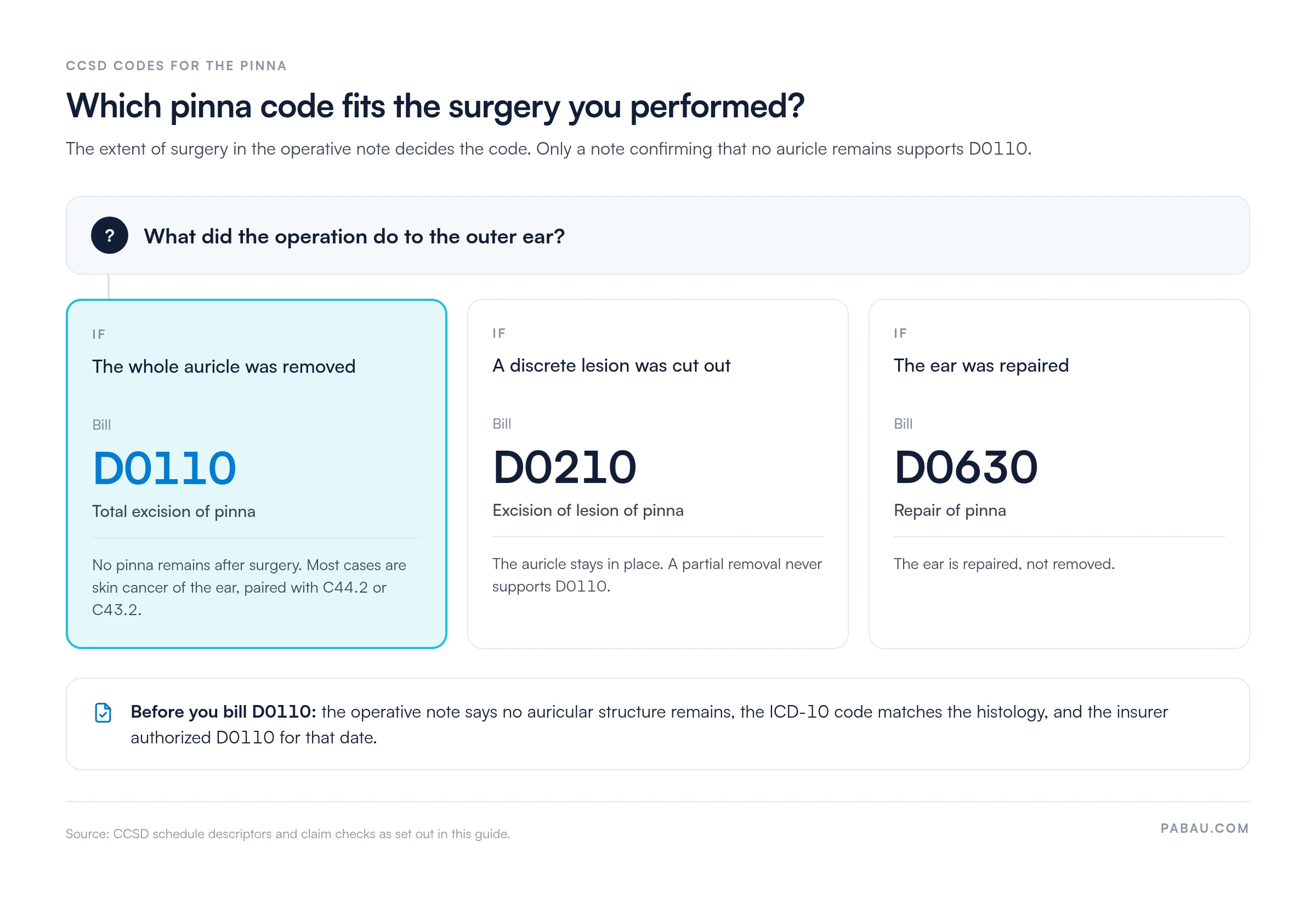
The CCSD procedure code framework expects the code that matches the documented extent of surgery. Billing D0110 for a partial removal is upcoding and creates audit risk for the practice. Billing a lesser code when the notes confirm total excision undercharges for the work done. The diagram below maps each extent of surgery to its code.
Reconstruction is often planned with the excision or soon after it. Whether a reconstruction code can go on the same bill depends on the CCSD schedule and the insurer. The schedule flags some code combinations as unacceptable, and insurers can apply their own rules on top.
Three reconstruction scenarios come up most often with D0110:
Check every planned combination in the current CCSD schedule before surgery. Then ask the insurer to authorize each code you plan to bill.
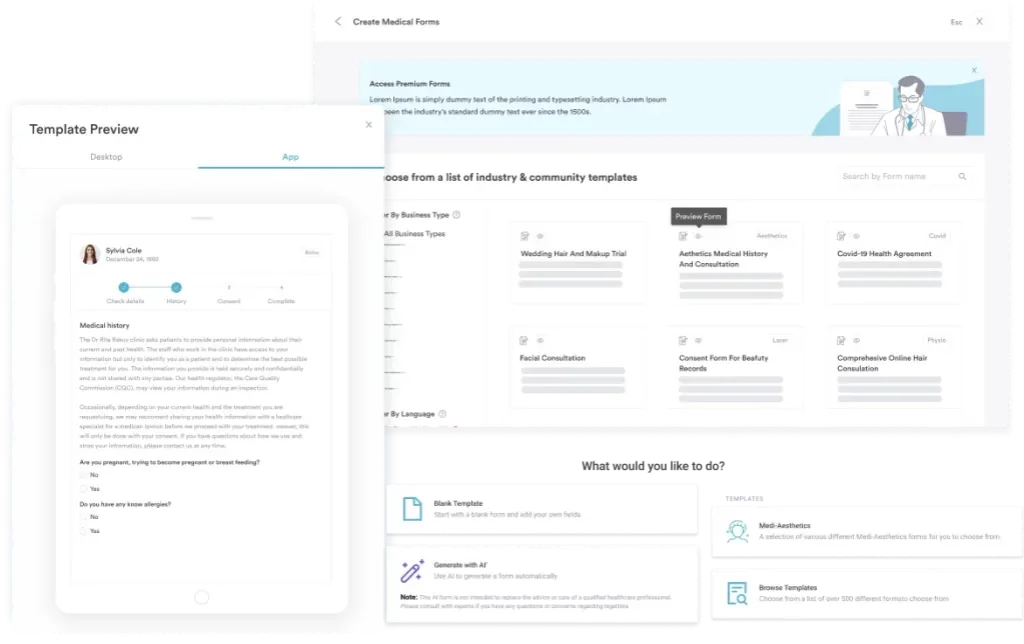
A D0110 claim rests on three sets of records. If one is missing, the insurer can hold the claim while it asks for more information. Digital clinical forms that capture all three at the point of care save billing staff from chasing them later.
Bupa, AXA Health, Aviva and Vitality all expect pre-authorization before planned surgery. In most cases, the patient contacts the insurer with the diagnosis and the CCSD code from the consultant. The insurer then issues an authorization number. The usual sequence runs like this:
Authorization shows the insurer expects to cover the procedure, but payment still depends on the policy terms. Tell the patient about any excess, shortfall or policy limit before surgery goes ahead.
D0110 claims fail for a predictable set of reasons. Most rejections can be prevented before the bill goes out, rather than fixed on appeal. The table below maps each common trigger to its fix.
Several other fees surround a D0110 procedure, and each one has its own route to the insurer. Check the current CCSD schedule and the insurer’s rules, since both change over time.
Practices billing D0110 repeat the same admin on every case. Staff track authorization numbers across several insurers, match ICD-10 codes to the procedure and chase histology reports before the bill goes out.
Pabau, the practice management platform we build, keeps those steps in one place. Its claims management software lets your team build insurer claims, spot missing documents and track every bill. Claims go out through Healthcode, the UK clearing house for private medical billing.
For ENT and plastic surgery practices with several consultants, that means fewer queried bills and a clear audit trail for each D0110 case.
Once a month, review the D0110 claims sent in the previous month. Flag any where the histology report arrived after the bill went out. Those cases show where your pre-submission checklist needs tightening.

Pabau helps UK ENT and plastic surgery practices keep authorization numbers, operative notes and histology together, and submit and track insurer claims through Healthcode.

A D0110 claim is usually decided before it leaves the practice. The operative note must confirm that no auricle remains, and the ICD-10 code must match the histology. The insurer must also have authorized D0110 for that date. When all three hold, the insurer has little reason to query the bill.
Billing staff can run all three checks from the records before every claim, so they belong in a repeatable workflow. To see how Pabau helps UK surgical practices bill CCSD codes through Healthcode, book a demo with the team.

Need a broader view of CCSD billing? Bupa CCSD codes guide explains how CCSD procedure codes work in UK private healthcare billing.
Billing a smaller ear procedure? CCSD code D0210 covers excision of a lesion of the pinna.
Repairing the ear rather than removing it? CCSD code D0630 covers repair of the pinna.
Billing the diagnostic biopsy? CCSD code D0610 covers biopsy of a lesion of the pinna.
Want fewer rejected claims across your billing? Claims management software from Pabau covers authorization tracking, claim submission and rejection follow-up in one place.
CCSD code D0110 covers total excision of the pinna, the complete surgical removal of the external ear. It applies only when no auricle remains after surgery. Excision of a discrete lesion that leaves the ear in place is billed under a different code, such as D0210.
CCSD codes are the procedure codes UK private medical insurers use for consultant billing. The CCSD Group of Aviva, AXA Health, Bupa and Vitality maintains the schedule. Consultants quote the codes on bills to those insurers and to many others in the UK.
C44.2, malignant neoplasm of skin of ear and external auricular canal, fits squamous cell carcinoma or basal cell carcinoma of the ear. Melanoma cases use C43.2. Traumatic cases may use S01.3, and congenital deformity cases may use Q17.3. The ICD-10 code must match the histology or clinical findings in the patient record.
No. The anesthetist bills the insurer separately under their own provider number. The hospital bills directly for the operating room, the stay and consumables. D0110 covers only the surgeon’s professional fee for the excision.
A total auriculectomy is the same operation as total excision of the pinna, so it maps to D0110 for UK private insurer billing. A partial auriculectomy does not. Check the current CCSD schedule for the code that matches the extent of surgery.
Yes, UK private medical insurers expect pre-authorization before planned surgery. Without an authorization number, the insurer can decline the bill and the patient may have to pay. Check that the authorization lists D0110 and any reconstruction codes.
The most common reasons are missing pre-authorization and a diagnosis code that does not support total excision. Operative notes that describe a partial removal also cause queries. Unauthorized reconstruction codes and a missing histology report are the next most frequent triggers.