

CCSD code G5100: Bypass of duodenum billing guide
CCSD code G5100 bills a bypass that leaves the duodenum in place CCSD code G5100...

Last Updated: Oct 16, 2026
D0210 is the CCSD code for excision of a lesion of the pinna, the visible outer part of the ear. UK private medical insurers use it when a consultant formally excises a discrete benign or malignant lesion from the auricle.
Biopsy of a pinna lesion as the sole procedure is billed as D0610, and total excision of the pinna as D0110. Repair of the pinna (D0630) cannot be claimed alongside D0210. Most UK insurers expect pre-authorisation before an elective excision goes ahead.
Let Pabau's smart automation suggest the right codes, reduce claim denials, and keep your practice compliant—effortlessly.
Automate repetitive tasks and focus on what matters most—your patients.
Reduce coding errors and ensure compliance with the latest regulations.
Clean claims, fewer denials, and faster reimbursements.
Powerful insights and reporting to help your practice thrive.
HIPAA compliant SOC 2 certified GDPR-compliant Trusted by 4,000+ clinics worldwide

CCSD code D0210 covers excision of a lesion of the pinna, billed to UK private medical insurers such as Bupa, AXA Health and Aviva.
The final histology report decides the ICD-10 diagnosis code that pairs with D0210, so code the diagnosis from pathology, not clinical suspicion.
The CCSD schedule lists D0110, D0410, D0610, D0630, S0632 and S0633 as unacceptable combinations with D0210.
Most UK insurers expect pre-authorisation before an elective pinna excision, and the claim then goes to the insurer electronically through Healthcode.
Pabau, the practice management platform we build, helps you capture complete operative notes and submit and track insurer claims through Healthcode.
CCSD code D0210 is the UK Clinical Coding & Schedule Development (CCSD) code for excision of lesion of pinna. The pinna, also called the auricle, is the visible skin-covered cartilage on the side of the head. D0210 applies when a consultant formally excises a discrete lesion from this structure, whether the lesion is benign or malignant.
D0210 sits in Chapter 5 (Ear, nose and throat) of the CCSD schedule, in the External Ear section, with an Intermediate complexity rating. It is specific to the pinna, so it does not cover a lesion in the external auditory canal or middle ear. It also does not cover a biopsy without full removal.
The CCSD schedule is the shared procedure code set that UK private medical insurers use. They include Bupa, AXA Health, Aviva, Vitality, Allianz Care, Freedom Health and National Friendly. Each insurer sets its own fee for D0210 for recognised consultants and prices it in pounds sterling. Those fee schedules sit behind insurer logins and change over time, so check the current figure with the patient’s insurer before treatment.
Pinna lesions that need excision include benign growths such as epidermoid cysts, fibromas, chondromas and keloids. They also include malignant cancers such as basal cell carcinoma, squamous cell carcinoma and melanoma. Local anaesthetic injection is standard for small, superficial lesions. However, surgeons keep general anaesthesia for larger or complex excisions and for many children.
A typical D0210 procedure runs in this order:
Malignant lesions need wider margins, often 3 to 5 mm for a well-defined basal cell carcinoma and more for squamous cell carcinoma or melanoma. In addition, a wide excision can leave a defect that needs a more complex repair. However, the CCSD schedule lists repair of the pinna (D0630) as an unacceptable combination with D0210, so you cannot add it to the same excision claim.
D0210 describes the procedure, not the pathology. The lesion type, however, changes the ICD-10 diagnosis code that goes on the claim alongside it. The table below maps common pinna lesions to their ICD-10 codes.
Code the diagnosis from the final histology report, not the pre-operative impression. For example, a lesion booked as a benign cyst that returns as basal cell carcinoma needs C44.2 on the claim. Also, where malignancy changes the operation itself, check the CCSD schedule for a code that matches what was done.
UK insurers can query or reject a D0210 claim when the clinical record does not support the code. The operative note should record each of the following:
Practices using digital clinical forms can build a D0210 operative note template. The template then prompts the surgeon for each field before they finalise the note.
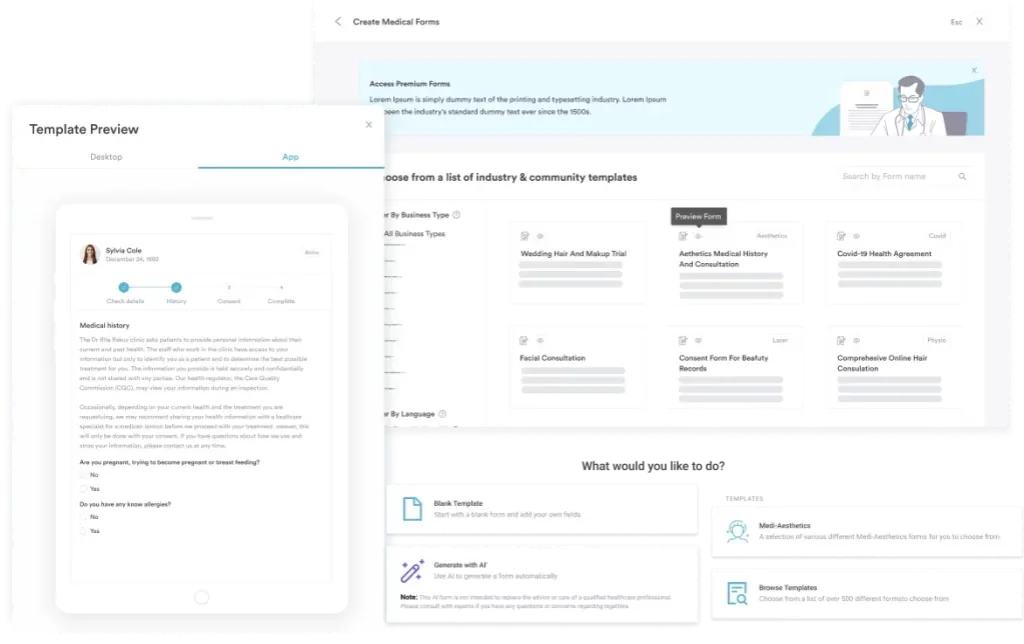
In addition, a pre-operative photograph with a scale reference is good practice, especially where the excision could look cosmetic. It also confirms the lesion’s presence and size if the insurer audits the claim later.
Most UK private medical insurers expect the patient to obtain pre-authorisation before an elective procedure such as D0210. The patient usually calls the insurer after a specialist consultation, quoting the CCSD code the consultant intends to perform. The insurer then issues an authorisation number for the episode.
Before the patient calls, the consultant’s team should be ready to give:
Policy terms differ by insurer and by plan, including outpatient limits and excess. Insurers usually approve a suspected malignancy quickly, but it still needs pre-authorisation. If the operation changes on the day, contact the insurer before claiming, because the authorisation covers only the code the insurer approved.
D0210 covers the excision itself. However, the laboratory or hospital normally bills histopathology, not the surgeon’s D0210 claim. Keep the laboratory reference in the record, so you can match the episode if the insurer asks.
Direct closure is part of the excision, and the CCSD schedule lists repair of the pinna (D0630) as an unacceptable combination with D0210. As a result, the insurer will not pay a separate repair line alongside it. Check the CCSD code narrative before claiming any further repair code for the same episode.
When the team uses general anaesthesia, the anaesthetist invoices the insurer separately against the same CCSD procedure code. In contrast, local anaesthetic that the operating surgeon gives is part of the D0210 procedure.
These CCSD codes sit close to D0210 in the External Ear section. Each one describes a different procedure, so you cannot claim any of them alongside D0210.
The CCSD schedule lists D0110, D0410, D0610, D0630, S0632 and S0633 as unacceptable combinations with D0210. S0632 and S0633 are general skin lesion excision codes. So a lesion on the pinna takes D0210 rather than a general skin code.
However, an excision biopsy, where the surgeon removes the whole lesion for diagnosis, codes as D0210 rather than D0610. The note must confirm the surgeon fully excised the lesion. Likewise, a later re-excision for involved margins is a new episode with its own pre-authorisation.
Rules for multiple procedures and laterality sit in the CCSD code narrative and schedule rules, not in separate modifier codes. The insurer applies them when it assesses the claim, so check the code narrative and the insurer’s guidance before claiming D0210 more than once in one session.
Billing teams for ENT, plastic surgery and dermatology practices can check D0210 rejections against these patterns before resubmitting.
Three checks catch most of these rejections before submission. First, confirm the ICD-10 code matches the final histology. Second, confirm the authorisation covers D0210 on the date of service. Third, confirm the note records site, size, margins and the specimen reference. The claim path below then shows where each check falls, from consultation to Healthcode.
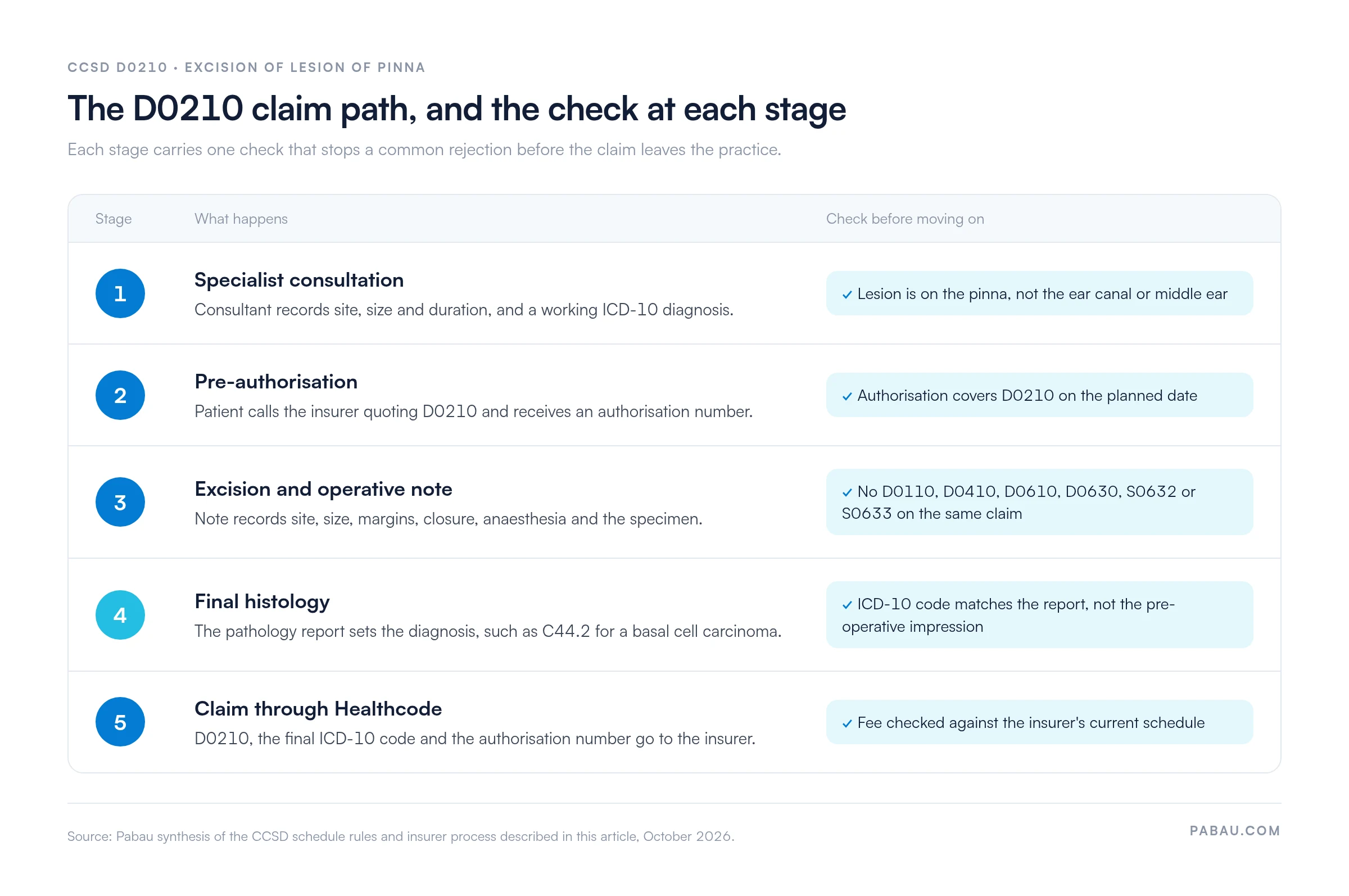
ENT surgeons, plastic surgeons and dermatologists face the same pressures on every pinna excision. The note must be complete, the diagnosis code must match pathology, and the claim must reach the right insurer. So practice software such as Pabau keeps the clinical record and the claim in one system.
The consultant still selects the CCSD and ICD-10 codes, and Pabau carries them through to the claim. For more codes in this schedule, see the CCSD codes reference.
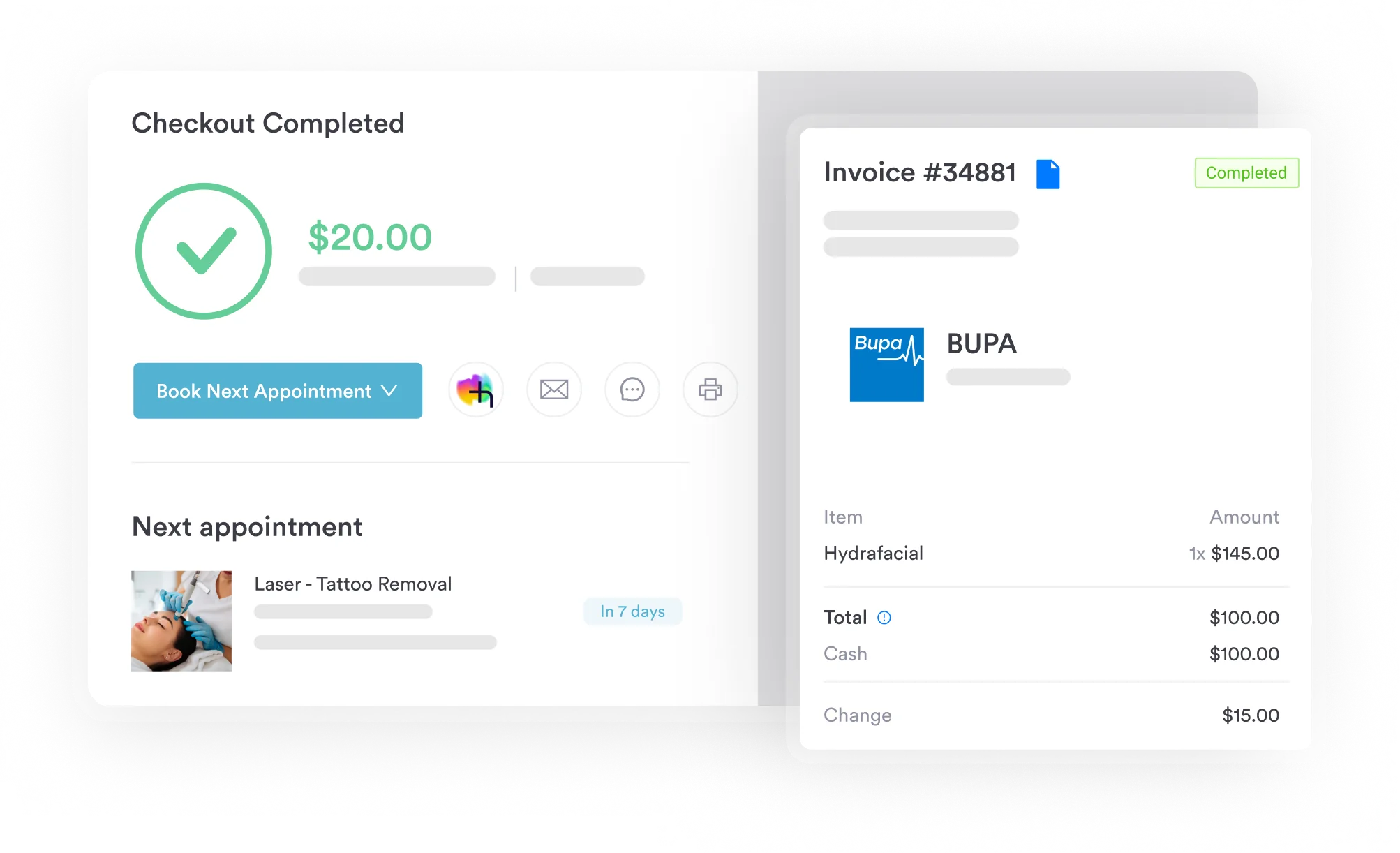

Pabau helps UK ENT, plastic surgery and dermatology practices build templated operative notes and submit and track insurer claims through Healthcode.

The practice usually decides a D0210 claim before it leaves. The diagnosis code must match the final histology, the note must support the code, and the insurer must have authorised D0210 for that date. When all three hold, the insurer has little to query.
The cost of getting this right is a few extra minutes per note. In contrast, the cost of getting it wrong is a rejected claim, a resubmission and sometimes a patient shortfall conversation. To see how Pabau handles pinna excision notes and Healthcode claims, book a demo.

Billing other UK private procedures? Pabau’s CCSD codes reference explains how the schedule is structured and lists codes across every chapter.
Taking a biopsy rather than excising the lesion? CCSD code D0610 covers biopsy of a lesion of the pinna as the sole procedure.
Draining a collection rather than removing a lesion? CCSD code D0410 covers drainage of a haematoma or abscess of the pinna.
Billing Bupa for surgical procedures? Pabau’s guide to Bupa CCSD codes covers how Bupa uses the schedule for claims.
CCSD code D0210 covers excision of a lesion of the pinna, the visible outer ear, in UK private healthcare. It applies to discrete benign or malignant lesions on the auricle. It does not cover lesions in the external auditory canal or middle ear, or a biopsy alone.
Yes. D0210 describes the procedure, and the ICD-10 code describes the lesion. Benign lesions use codes such as D17.0, D21.0, D22.2 or D23.2. Malignant lesions use C44.2 for skin cancers or C43.2 for melanoma, taken from the final histology report.
The CCSD schedule lists D0110, D0410, D0610, D0630, S0632 and S0633 as unacceptable combinations with D0210. These cover total excision of the pinna, drainage, biopsy as sole procedure, repair of the pinna and general skin lesion excision.
There is no direct equivalent, because CPT is a separate US system owned by the American Medical Association. The closest CPT ranges cover lesion excision of the face, ears, eyelids, nose and lips. These are 11440 to 11446 for benign lesions and 11640 to 11646 for malignant ones. Use these for orientation only, never for UK claims.
No. The CCSD schedule lists repair of pinna (D0630) as an unacceptable combination with D0210, and direct closure is part of the excision. Check the CCSD code narrative and the insurer before claiming any further reconstructive code for the same episode.



