CPT Code 69610: Tympanic membrane patch repair (myringoplasty)
CPT code 69610: official descriptor and procedure overview CPT code 69610 descri...

Last Updated: Oct 19, 2026
22000 is the CCSD code for routine electroencephalography (EEG) in an adult or a child aged over 5, including reporting. The fee covers the recording session, the standard activation procedures, and the signed report from the interpreting neurophysiologist.
CCSD codes apply only to UK privately funded care, not to NHS billing. A patient aged 5 or under takes a different code, and so does any study that runs beyond a standard waking session.
Let Pabau's smart automation suggest the right codes, reduce claim denials, and keep your practice compliant—effortlessly.
Automate repetitive tasks and focus on what matters most—your patients.
Reduce coding errors and ensure compliance with the latest regulations.
Clean claims, fewer denials, and faster reimbursements.
Powerful insights and reporting to help your practice thrive.
HIPAA compliant SOC 2 certified GDPR-compliant Trusted by 4,000+ clinics worldwide

CCSD code 22000 covers routine EEG in adults and children over 5, with reporting bundled into the procedure fee.
Reporting cannot be billed separately, and unbundling the interpretation charge is a known claim audit trigger.
Children under 5 must be billed under a different CCSD code, so applying 22000 to that age group is a coding error.
Ambulatory EEG is 22004 and 24-hour video telemetry EEG is 22005, so neither belongs on a 22000 invoice.
Most UK private insurers require pre-authorization for neurophysiology procedures before the claim is processed.
CCSD code 22000 is the Classification of Clinical Services and Diagnoses billing code for routine electroencephalography in adults or children aged over 5. The written report from the interpreting neurophysiologist is bundled into the code and cannot be invoiced on its own.
The official CCSD schedule is maintained by The CCSD Group, whose members are Bupa, Vitality, AXA Health, and Aviva. A CCSD Board and a Working Group handle its upkeep. The schedule states the descriptor verbatim: “Routine electroencephalography (EEG) in adult or child aged over 5 (Including reporting).”
Three elements of that descriptor decide whether the code fits. The procedure must be routine in scope, which means a standard multi-channel recording rather than an extended ambulatory study or video-EEG. The patient must be aged over 5 on the recording date. The report is covered by the fee, so it never appears as a separate line item.
CCSD codes are used exclusively in the UK private healthcare sector. They do not apply to NHS billing, which uses HRG tariff codes. Practitioners working across both sectors should apply CCSD 22000 only to privately funded episodes.
A routine EEG records the electrical activity of the brain through scalp electrodes, typically over 20 to 40 minutes of data acquisition. Knowing the steps helps billing staff verify that what was delivered matches what is being coded.
The procedure is performed by a trained EEG technician under the governance of a clinical neurophysiologist, who is responsible for the interpretation report. The British Society for Clinical Neurophysiology (BSCN) sets the standards for recording quality and report content that private insurers expect to see behind a claim.
Insurers assess medical necessity when processing CCSD code 22000 claims, so the referral must document a clinically supported reason for the EEG. Accepted indications align with BSCN and neurological clinical guidelines. A referral filed against the procedure record makes that link easy to demonstrate during a claim audit.
The referral letter or clinic correspondence included with the claim should state the specific clinical question the EEG is meant to answer. A vague indication such as “query neurological” is a common cause of medical necessity disputes with insurers.
The fee covers the recording, the standard activation procedures, the electrode work, and the written interpretation. Sedation, video-EEG, and prolonged monitoring sit outside it and carry their own codes. A recording made while the patient sleeps is also excluded, and belongs under 22003 instead. An inpatient sleep study recorded overnight bills under 22028.
Bundling is the single most important billing rule on this code. Practices used to the NHS model often track recording and reporting separately in-house. Invoicing the interpretation as its own line under CCSD is a billing error.
Code 22000 is correct only for a standard waking session in a patient aged over 5. Picking the wrong code from the CCSD neurophysiology family is the most common source of EEG claim rejections. Two checks settle it. Start with the patient’s age, then match the type of recording you performed.
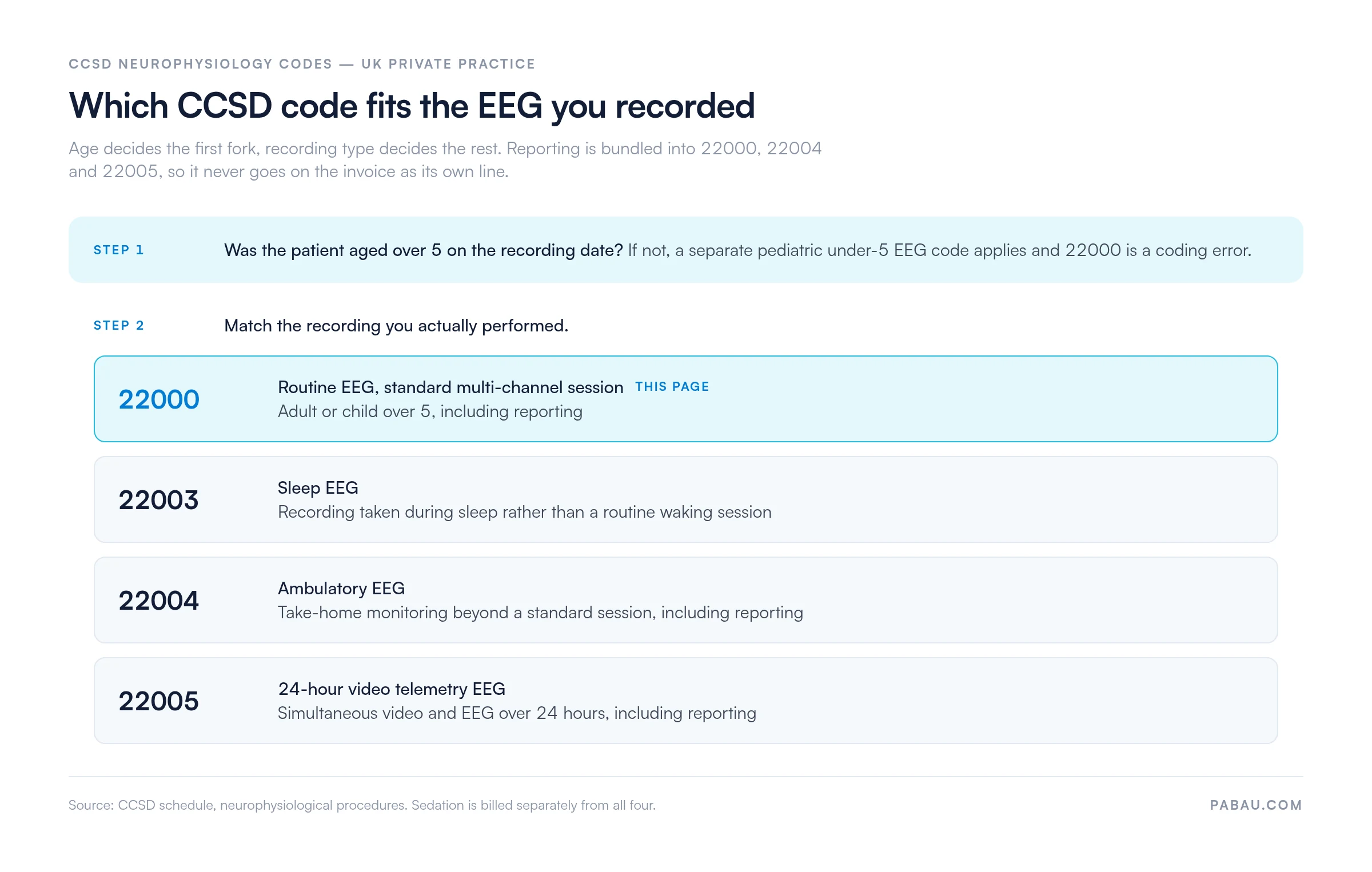
The table below carries the detail behind that routing. The Bupa CCSD codes reference covers how the wider code families are structured.
The over-5 boundary is explicit in the CCSD 22000 descriptor, and insurers enforce it at the claims processing stage. A child aged 4 years and 11 months does not qualify.
Applying the over-5 code to that patient usually results in a rejected claim, or a repayment request if it surfaces during an audit. Children under 5 have their own CCSD code, so confirm the current number against the live schedule before billing.
A clean CCSD code 22000 claim relies on a complete and contemporaneous clinical record. Insurers have the right to request supporting documentation, and an incomplete record is grounds for rejection or a repayment demand. Digital clinical forms that make the required fields mandatory before a record is saved keep that risk low.
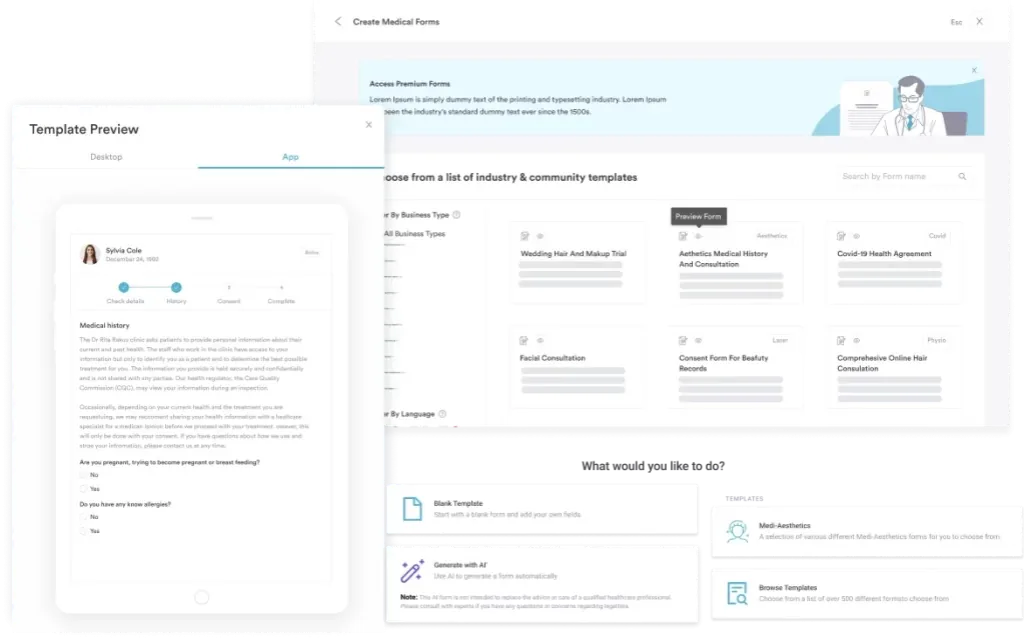
The following must be present in the patient record before the claim is submitted:
Practices in England are also subject to CQC registration requirements that govern record keeping for regulated activities. The documentation standard CQC expects lines up with what insurers want to see behind a claim.
Most major UK private health insurers require pre-authorization for neurophysiology procedures before a claim will be accepted. Pre-authorization is not a guarantee of payment, but it is a prerequisite. A claim submitted without it is typically rejected regardless of clinical appropriateness.
Insurer requirements vary by policy and are updated periodically, so verify them with each insurer before booking the procedure. The general position across major UK insurers as of 2026 is:
Billing staff should obtain the authorization reference number before the appointment is confirmed, then record it in the patient’s file. If a procedure goes ahead without pre-auth, the insurer has grounds to decline the claim in full. Some policies allow a retrospective appeal, but that is not a routine fix.
EEG claims are rejected more often than billing staff expect, usually for procedural reasons a pre-submission check would catch. The seven below cover most CCSD 22000 rejections, and they follow the patterns seen across the wider set of denial codes in medical billing.
The CCSD schedule published by The CCSD Group carries a suggested fee for each code, 22000 included. Those are guide prices rather than fixed rates. Insurers negotiate their own reimbursement rates with recognized providers, and those rates may sit above or below the CCSD figure.
For self-pay patients the practice sets its own rate, often using the CCSD guide fee as a benchmark. Before invoicing for CCSD code 22000, billing staff should check three things:
Audit your CCSD 22000 claims quarterly. Pull every EEG invoice submitted, then check each one against its pre-authorization reference and its signed report status. Flag any claim where the pre-auth was obtained after the procedure date. This 15-minute check catches the most common audit risk in neurophysiology billing before an insurer does.
Billing CCSD code 22000 correctly means tying the code to the right patient record and the correct procedure date. The signed report has to be in place before the invoice goes out.
Practice management software like Pabau holds all three in one place. Our claims management software handles insurer invoicing, authorization tracking, and claim submission for UK private practices.
Practices with high EEG volumes benefit from a pre-submission checklist built into the workflow, covering the age check, report sign-off status, and pre-auth reference. Pabau prompts staff to complete those checks before an invoice status changes to submitted. The error gets caught inside the practice rather than by the insurer.

Pabau supports UK private practices with CCSD code billing, insurer invoice generation, digital forms, and report attachment. See how it fits your neurophysiology workflow.

CCSD code 22000 is narrow in scope and still billed incorrectly more often than it should be. The bundled report, the over-5 age restriction, and insurer pre-authorization drive most rejections. All three are settled before the procedure, not after the claim comes back.
The practical move is to put the checks where the work already happens. Record the authorization reference at booking, keep the signed report in the same patient record as the invoice, and the quarterly audit becomes a formality. Book a demo to see how Pabau handles CCSD billing and insurer invoicing for UK private practices.

Need to check what an insurer will pay? Bupa procedure codes fee schedule explains how Bupa sets reimbursement rates and where to look up a code.
Want to cut claim admin across your private practice? Claims management software shows how Pabau handles insurer invoicing, authorization tracking, and claim submission.
CCSD code 22000 is the UK private-sector billing code for routine electroencephalography in adults or children aged over 5. The written report and interpretation are bundled into the single procedure fee. The code covers the recording session, activation procedures (hyperventilation and photic stimulation), electrode application, and a signed report by a qualified clinical neurophysiologist.
Yes. The official CCSD descriptor states “(Including reporting)” explicitly. The interpretation report is bundled and cannot be billed as a separate line item. Billing the report separately alongside code 22000 is a known unbundling error and a trigger for claim rejection or audit.
No. CCSD code 22000 applies to adults and children aged over 5 at the time of the recording. Children under 5 must be billed under a separate CCSD code specific to that age group. Applying 22000 to a patient under 5 is a coding error and will typically result in claim rejection.
CCSD 22000 covers a standard routine EEG session with bundled reporting. CCSD 22004 covers ambulatory EEG, which is take-home monitoring that runs beyond a standard session, also including reporting. The distinction is the recording setup. If the patient wore the equipment away from the department, 22004 applies rather than 22000.
Most major UK private health insurers, including Bupa, AXA Health, Vitality, and Aviva, require pre-authorization for neurophysiology procedures before a claim will be accepted. The authorization reference number should be obtained before the appointment and recorded on the invoice. Claims submitted without a required pre-auth are typically rejected regardless of clinical appropriateness, and retrospective appeal options are limited.
A claim needs a referral letter documenting the clinical indication, plus confirmation that the patient was aged over 5. It also needs the electrode count and montage used, the recording duration, and the activation procedures performed. Finally, it needs a signed report from a qualified clinical neurophysiologist and a procedure date matching the invoice. Missing any element is grounds for rejection or a retrospective audit finding.
CCSD 22004 covers ambulatory EEG, including reporting. CCSD 22005 covers 24-hour video telemetry EEG, also including reporting. If the study involves take-home equipment, overnight or 24-hour recording, or any monitoring period beyond a standard routine session, 22000 is not the correct code. Verify the code against the live CCSD schedule before billing.