Emotion Regulation Questionnaire Form
What is the Emotion Regulation Questionnaire Form? The emotion regulation questi...

May 8, 2026


Buy now, pay later is now available in Pabau

The biopsychosocial assessment examines biological, psychological, and social factors as an integrated whole, not in isolation.
Introduced by psychiatrist George Engel in 1977, the biopsychosocial model is now standard practice across mental health, physiotherapy, social work, and nursing.
A structured biopsychosocial assessment improves care planning by capturing the full picture of what is driving a patient’s presentation.
Clear documentation protocols and EHR integration help clinics meet CQC, GDPR, and HIPAA record-keeping standards.
Digital forms and AI-assisted note tools can reduce the administrative burden of biopsychosocial documentation without compromising clinical accuracy.
A patient presents with chronic lower back pain. Scans are normal, the physical exam is unremarkable, and they have missed six appointments in two months.
NIMH data show 23.1% of U.S. adults experienced any mental illness in 2022, often interacting with chronic physical conditions in ways a single-system lens misses. The biopsychosocial assessment is the framework clinicians use to make those biological, psychological, and social drivers visible across mental health clinics, physiotherapy practices, social work, and general medicine.
The biopsychosocial assessment organises clinical information into three interconnected domains. Each domain captures a different layer of a patient’s experience, and the power of the framework comes from examining how they interact. A diagnosis of anxiety, for example, cannot be understood only through neurobiology. The patient’s relationship history, current housing situation, and access to social support shape both the severity and the treatment response.
This domain covers physical and physiological factors: genetics, medical history, current medications, physical symptoms, and any relevant family history of illness. For a patient presenting with depression, the biological domain would include thyroid function, medication side effects, sleep disturbance, and any chronic conditions that overlap with depressive symptoms. Clinicians working across specialties – from GP practices to physiotherapy clinics – use this section to establish baseline physical context before moving to the psychological and social layers.
The psychological domain captures mental health history, emotional state, cognitive patterns, coping behaviours, and any prior or current psychiatric diagnoses. This is where the clinician explores the patient’s relationship with their own illness: do they catastrophise pain, or minimise symptoms? Are there past traumas that colour the current presentation? Structured psychiatric evaluation frameworks often align closely with this domain, providing a consistent format for capturing psychological risk factors and protective factors side by side.
Social determinants of health – housing, employment, income, relationships, cultural background, and community support – sit within the social domain. The World Health Organization describes social determinants as the conditions in which people are born, grow, live, work, and age, and their influence on health outcomes is well-established in the research literature. A patient with chronic pain living alone in precarious housing faces a very different set of barriers to recovery than a patient with identical physical findings who has strong family support and stable employment. The social domain makes those differences clinically legible. Digital intake forms that capture social history at the point of patient registration reduce the risk of this domain being skipped under time pressure.
There is no single universally mandated format for a biopsychosocial assessment, but most clinical guidelines and professional bodies recommend a structured interview approach that covers all three domains systematically. The Health and Care Professions Council (HCPC) standards of proficiency require allied health professionals to demonstrate the ability to gather, interpret, and record comprehensive patient information – a standard the biopsychosocial model directly supports.
In practice, a thorough biopsychosocial assessment typically unfolds over 45 to 90 minutes for a first presentation, depending on the complexity of the case and the clinical setting. The assessment may be completed in a single session or gathered iteratively across initial appointments. What matters is that all three domains are covered before a formulation or treatment plan is finalised.
The patient record should reflect structured inquiry across all three domains. Below are representative question categories used in biopsychosocial assessment interviews:
These categories are starting points, not a rigid checklist. Clinicians using motivational interviewing techniques will typically embed these questions within open, exploratory dialogue rather than delivering them as a structured questionnaire. The goal is a formulation, not just a dataset. Good clinical note frameworks for social work and therapy settings are designed to capture this nuance within structured documentation.

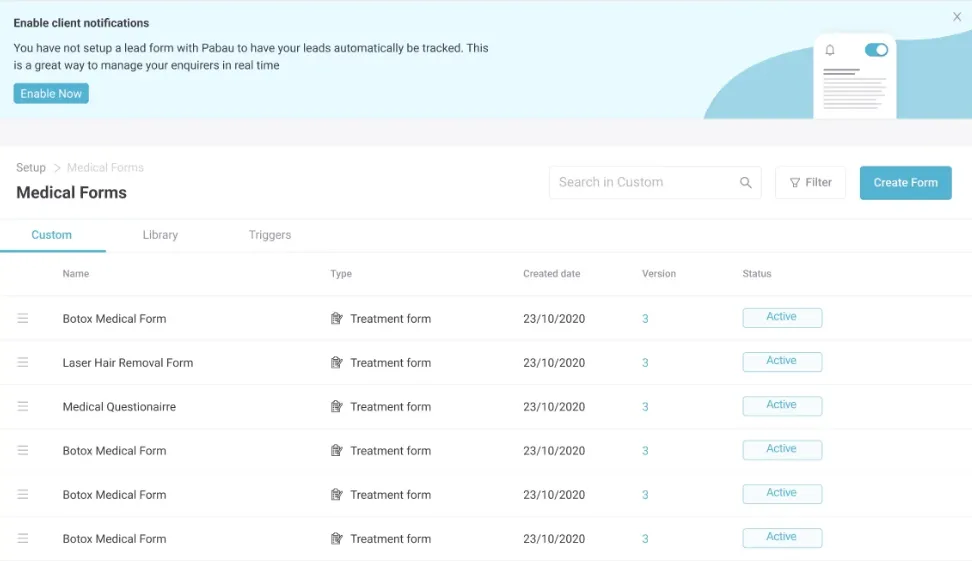
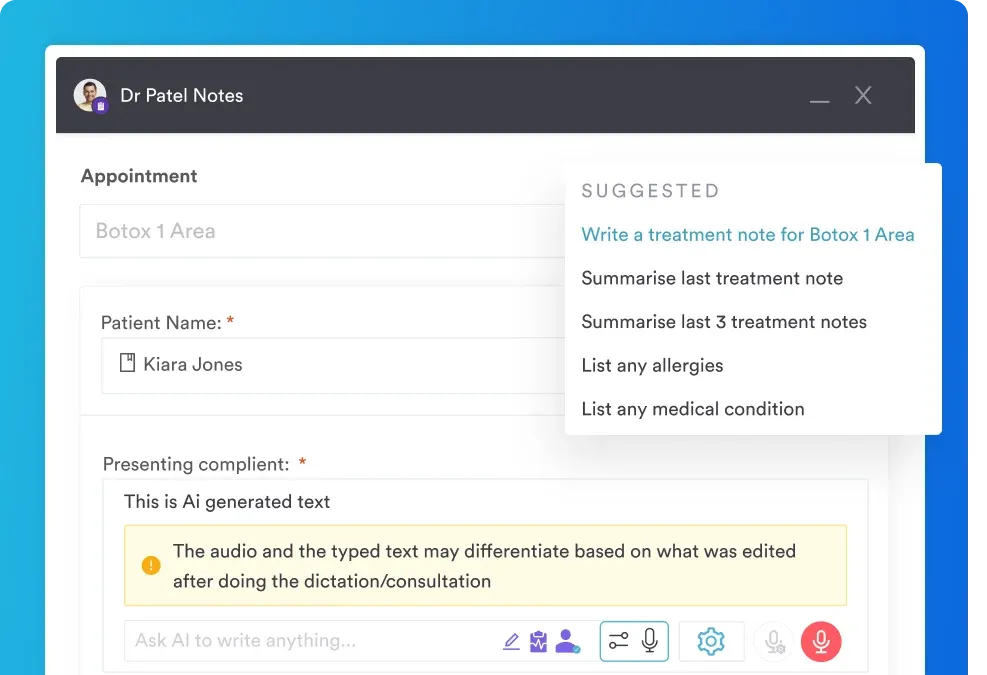
Pabau's digital forms, client records, and AI-assisted note tools help clinicians capture comprehensive patient information without the administrative burden. See how it works for your practice.

The biopsychosocial assessment is not confined to psychiatric or therapy settings. It is a cross-disciplinary tool used wherever a patient’s presentation cannot be explained by biological factors alone – which, in clinical reality, is the majority of complex cases.
In psychology and counselling practices, the biopsychosocial assessment is typically the foundation of the initial clinical formulation. Practitioners use it to distinguish between symptoms driven primarily by neurobiological factors (warranting pharmacological input) and those where psychological or social interventions are likely to have greater effect. The DSM-5 and ICD-11 diagnostic criteria both sit more comfortably within a biopsychosocial framework than a purely biomedical one, because both systems acknowledge that context shapes symptom presentation and severity. A clinician conducting a biopsychosocial assessment in a mental health setting will often screen simultaneously for risk, safeguarding concerns, and protective factors – making it one of the most information-dense assessments in clinical practice.
The evidence base for biopsychosocial approaches in chronic pain management is substantial. Research published in peer-reviewed literature, including a widely cited review in the Annals of Family Medicine examining twenty-five years of biopsychosocial practice, confirms that pain chronicity is strongly predicted by psychological and social factors – sometimes more than by tissue pathology. Physiotherapy EMR systems that support biopsychosocial intake processes allow clinicians to flag patients with high psychological risk early, enabling timely onward referral or multidisciplinary involvement before pain behaviours become entrenched.
Social workers conducting biopsychosocial assessments operate in a distinct but related context. Their focus is weighted toward the social domain – housing, safeguarding, family dynamics, and community resources – while still incorporating psychological and biological factors to build a complete picture. Across all of these professional contexts, the biopsychosocial assessment functions as a shared language that supports interdisciplinary collaboration.
Before your first appointment with a complex patient, send a structured digital intake form covering all three biopsychosocial domains. Reviewing the completed form before the session lets you allocate consultation time more effectively – spending less time on data collection and more time on clinical formulation and therapeutic rapport.
Documentation standards for the biopsychosocial assessment vary by profession and jurisdiction, but the underlying principle is consistent: the record must be sufficiently detailed to allow another clinician to understand the formulation and continue the patient’s care without losing critical context. The Care Quality Commission (CQC) in the UK and equivalent bodies in other jurisdictions inspect clinical records for completeness and accuracy – and a biopsychosocial assessment that is conducted thoroughly but documented poorly creates both a clinical risk and a compliance gap.
Electronic health records have substantially changed how biopsychosocial data is captured and reviewed. A well-configured EHR allows clinicians to structure assessment notes across the three domains, flag risk items for review, and make the record accessible to other members of a multidisciplinary team without requiring physical file transfer. AI-assisted clinical documentation tools can support the note-writing process by helping clinicians structure their observations quickly after a session, reducing the risk that important details are lost to memory or time pressure. These tools assist documentation – they do not replace clinical reasoning or the clinician’s own formulation.

From a compliance perspective, biopsychosocial assessment records containing sensitive mental health, social history, or safeguarding information are subject to heightened data protection requirements under GDPR in the UK and EU, and HIPAA in the United States. Clinics should ensure their record-keeping systems support the appropriate access controls, audit trails, and retention schedules for this category of data. Compliance management features within practice management platforms can support these requirements – though clinical leads retain responsibility for ensuring their documentation practices meet professional standards.
Schedule a periodic peer audit of biopsychosocial notes – for example, a rolling sample of records reviewed monthly by a clinical lead or peer reviewer. Audits surface documentation drift early, expose patterns of under-recorded social or psychological data, and give clinicians targeted feedback before small gaps become a clinical risk.
A practical documentation structure for a biopsychosocial assessment note typically includes: a presenting problem summary, findings across each of the three domains, a formulation linking the domains to the presenting problem, agreed goals, and a plan for review. Using a consistent format across a clinical team – whether through structured patient care management workflows or standardised note templates – reduces variability and makes peer review more straightforward.
Below is a short illustrative note for the chronic lower back pain presentation referenced at the top of this guide. It is intended to show structure rather than serve as a verbatim template.
Most biopsychosocial documentation errors are predictable, and most can be corrected with small workflow changes. The patterns below appear regularly in peer audits and clinical supervision across mental health, physiotherapy, and social work settings.
The most common error is collecting biological, psychological, and social information in parallel without ever integrating it into a formulation. A list of findings is not an assessment; the value of the model is in showing how the domains interact to produce the presenting problem.
When a patient presents with prominent physical symptoms, clinicians often default to a heavily biological write-up and reduce the psychological and social sections to brief footnotes. The result is an assessment that mirrors the biomedical view the framework was designed to expand on, and it tends to miss the factors most predictive of chronicity.
Social entries that stop at “lives with partner, works full time” leave safeguarding and risk gaps unaddressed. Domestic abuse screening, financial precarity, and caregiver strain belong in the social section of every initial assessment, with explicit fields in the record rather than free-text afterthoughts.
Digital intake forms speed up data collection but they do not write the assessment. Pasting raw intake responses into the record without clinician synthesis produces a note that satisfies a tick-box review but offers no clinical reasoning, no weighting of risk, and no formulation.
The social domain changes most often between visits and is the most likely to be left untouched in the record. Job loss, bereavement, housing instability, or a new caregiving role can reshape a patient’s presentation; if the social section is never revisited, the treatment plan drifts out of step with the patient’s actual circumstances.
The biopsychosocial assessment remains one of the most clinically rigorous frameworks in healthcare today because it refuses to reduce a patient’s presentation to a single cause. The friction in day-to-day practice is rarely the framework itself; it is whether your tools support consistent documentation across all three domains, integrated records that travel with the patient, and risk flagging that catches safeguarding concerns before they escalate.
Book a demo with Pabau to see how digital intake forms, structured EHR templates, and AI-assisted notes simplify biopsychosocial documentation across your clinical team, so a thorough assessment translates into a complete, compliant record every time.

Need a structured starting point for mental health assessments? Psychiatric Evaluation Template provides a step-by-step guide for conducting comprehensive mental health assessments in clinical practice.
Looking for clinical note frameworks used in therapy and social work? SOAP Notes for Social Work covers structured documentation approaches that complement biopsychosocial assessment records.
Want to digitise your patient intake process? Digital Forms lets clinics build customisable intake forms covering biological, psychological, and social history – completed by patients before their first appointment.
Managing a psychology or therapy practice? Psychology Practice Software outlines how Pabau supports clinical documentation, scheduling, and compliance workflows for psychology practices.
A biopsychosocial assessment is used to build a comprehensive picture of a patient’s health by examining biological, psychological, and social factors together. It supports clinical formulation, treatment planning, and care coordination – particularly in complex cases where a purely physical examination would leave important drivers of the presentation unaddressed. It is used across mental health, physiotherapy, social work, and nursing settings.
The three components are the biological domain (physical health, genetics, medications, medical history), the psychological domain (mental health, cognition, coping, emotional patterns), and the social domain (relationships, housing, employment, culture, and social determinants of health). The model, introduced by George Engel in 1977, treats these three domains as interconnected rather than separate.
A biopsychosocial assessment note should include a presenting problem summary, structured findings across all three domains, a formulation that links the domains to the patient’s current presentation, agreed goals, and a review plan. Using a consistent note template across your clinical team reduces variability and makes peer review more straightforward. Digital forms and EHR templates help standardise this process.
A psychosocial assessment focuses on psychological and social factors – mental health history, relationships, social circumstances, and coping behaviours. A biopsychosocial assessment adds a biological layer, explicitly incorporating medical history, physical symptoms, genetics, and medication into the clinical picture. The biopsychosocial model is therefore broader in scope and more commonly used in settings where physical and mental health overlap.
Biopsychosocial assessments are conducted by a range of healthcare professionals, including psychologists, psychiatrists, social workers, physiotherapists, occupational therapists, and nurses. The specific scope and emphasis of the assessment varies by profession and jurisdiction. In the UK, the HCPC sets standards of proficiency that require allied health professionals to gather and record comprehensive patient information consistent with the biopsychosocial framework.
Questions span all three domains. Biological questions cover medical history, medications, physical symptoms, and family health history. Psychological questions explore mood, anxiety, past diagnoses, trauma history, and coping strategies. Social questions address housing, employment, relationships, cultural background, and support networks. The assessment is typically conducted as a structured interview rather than a written questionnaire, with follow-up questions guided by the patient’s responses.