Thinking of opening a physical therapy clinic in Arizona? 🤔
You’ll need more than a treatment table and a stack of intake forms. The state wants proof that your clinic is properly registered, your licenses are in order, and your record-keeping can stand up to inspection.
Arizona’s requirements aren’t here to trip you up.
They exist to make sure patients get safe, consistent care. For physical therapists, assistants, and health care entrepreneurs, that means tackling paperwork before patient care.
In this guide, we’ll break down what the Arizona State Board of Physical Therapy expects, from business registration and licensure to supervision and continuing education, so you can stay compliant and focus on building a clinic people trust.
Understanding Arizona's PT clinic registration process
The registration application isn’t complicated, but it does require detail. You’ll need to provide the information set out in the state’s official checklist, including:
Name, primary address, and e-mail address of the business entity
Contact details for the manager responsible for the registered location
Names and addresses of the officers or directors of the business entity
Names and license numbers for each physical therapist providing services
Names and certificate numbers for each physical therapy assistant working at the location
A description of the physical therapy services offered
Beyond the basics, the Board requires clinics to:
✔️ Establish a written protocol for storing, transferring, and securing patient medical records.
✔️ Pay a $50 registration fee per site, renewed every two years (August 31 of odd-numbered years). Late renewals incur a $25 penalty, and registrations that lapse for more than three years are permanently expired.
✔️ Confirm whether your entity has ever faced disciplinary action, such as a suspension, revocation, or refusal to renew in another state or country.
✔️ Notify the Board within 30 days of any changes to business details, managers, or officers, and disclose procedures for patients to access their records if the entity closes.
Certificates must be displayed on-site, alongside staff licenses, so patients can see your physiotherapy clinic is properly registered.
💡 Pro tip: An all-in-one practice management system like Pabau makes this part easier. Staff licenses, certificates, and renewal dates can all be stored in their staff profiles, so you’re never scrambling to track paperwork when the Board comes calling.
Finally, keep in mind this process isn’t just for your main clinic. Under the Arizona Revised Statutes (A.R.S.) §32-2030, each location offering physical therapy services must be registered separately to stay compliant.
Licensure requirements for physical therapists in Arizona
Once your clinic registration is sorted, the next box to tick is making sure the therapists themselves are cleared to practice.
Arizona is particular about who qualifies. The Board wants every PT to show they’ve got the education, the exam scores, and the professional standards to back up the role.
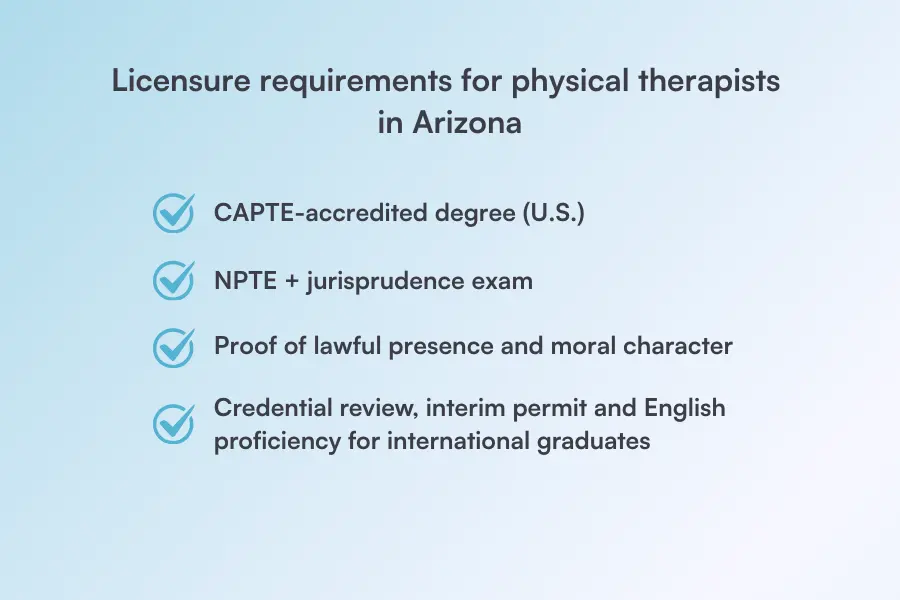
Licensure in Arizona rests on four core requirements:
Educational requirements. U.S. graduates need a Doctor of Physical Therapy (DPT) degree from a program with CAPTE accreditation. International applicants go through a credentialing review that measures their coursework against U.S. standards.
Exams. Every applicant must pass the National Physical Therapy Exam (NPTE), a 250-question test covering systems, interventions, and professional responsibilities, with FSBPT practice exams often used for prep. Arizona also requires the AZLAW jurisprudence exam on state statutes, with study materials provided by the Board, and a passing score on both is mandatory for licensure.
Residency and character. You’ll need to show proof of lawful U.S. presence and meet the Board’s requirement of good moral character. Any past disciplinary history is reviewed individually, so honesty on the application is key.
International pathway. Applicants trained abroad must complete a credential review, prove English proficiency (often through a TOEFL exam), and may also go through a supervised interim practice period before full licensure.
Arizona’s setup may sound strict, but it’s really just about ensuring therapists are prepared.
Whether your degree comes from Phoenix or abroad, the path is clear as long as you can back it up with the right credentials and exams.
What to know about interim permits and temporary practice
Some applicants, especially international graduates or new PT school grads waiting on exam results, can apply for an interim permit. It functions like a temporary license that allows you to practice, but always with supervision.
The permit is valid for 90 to 180 days. During that time, you have to work under the guidance of an unrestricted Arizona-licensed physical therapist. The goal is simple: Prove you can apply your training safely in a U.S. clinic before full licensure is granted.
It’s not a free pass, though. The Board can pull the permit at any point if you fail to follow supervision rules, show poor performance, or put patient safety at risk.
That said, for many people, it’s a lifeline. New graduates use it to gain clinical experience while paperwork is still moving through the system. Internationally trained therapists rely on it to complete U.S. requirements without putting their careers on hold.
Handled the right way, an interim permit is a useful bridge within the application process, keeping PTs-in-waiting active while paperwork moves forward.
Supervision rules and responsibilities in Arizona
In Arizona, a PT license comes with more than the right to treat patients.
It also carries responsibility for anyone working under your watch, whether that’s a PTA, an aide, or a student gaining experience. The rules are clear, but how they play out depends on the role.
PTAs (Physical Therapist Assistants): These clinicians work under general supervision. The PT doesn’t need to keep an eye on every move, but they must be available and directly involved in shaping the plan of care.
Aides and students: Here the expectation is different. Arizona requires on-site supervision, so a licensed PT has to be physically present and ready to step in at any moment.
Documentation and billing: Even when a PTA provides part of the treatment, the PT signs off on the records and takes responsibility for billing. Accuracy here always lands back on the licensed therapist.
Credential checks: Verifying that staff qualifications are current isn’t optional. If an aide or assistant is out of compliance, the PT supervising them is the one the Board will hold accountable.
Strong supervision protects both patients and clinics.
The hard part is keeping documentation, billing, staff oversight, and credentials aligned. Pabau makes it easier by linking treatment notes, sign-offs, staff activity, and credential checks in one system, so PTs can stay in control of care and ready for any compliance review.
Continuing competence and license renewal requirements
Arizona doesn’t hand out a PT license and then wave goodbye forever.
Ongoing education is built into the practice of physical therapy, with clear rules for keeping skills and knowledge up to date.
The Board lays it out in its Continuing Competence (CE) guidelines, and here are the essentials every PT should keep in mind:
20 contact hours every two years. At least 10 must come from Category A activities, which include approved coursework, formal education programs, or accredited continuing education.
Cycle timing. The CE window runs from September 1 to August 31 of even-numbered years. Miss the deadline and you risk disciplinary action, not just late fees.
Audits. Random checks are part of the process, and any licensee may be chosen during renewals. If it’s you, have certificates, transcripts, or other proof ready within 60 days.
Exceptions. In cases of hardship or disability, you can apply for a waiver, but the Board decides case by case.
💡 Pro tip: The best approach is to track CE hours as you go and file certificates right away. Having everything organized throughout the cycle makes renewals smooth and protects you from stress if your number comes up in an audit.
Other operational considerations for PT clinics
Regulations cover more than licenses and permits. The everyday operations of how a clinic runs are just as important, and that’s where a lot of new owners get caught off guard.
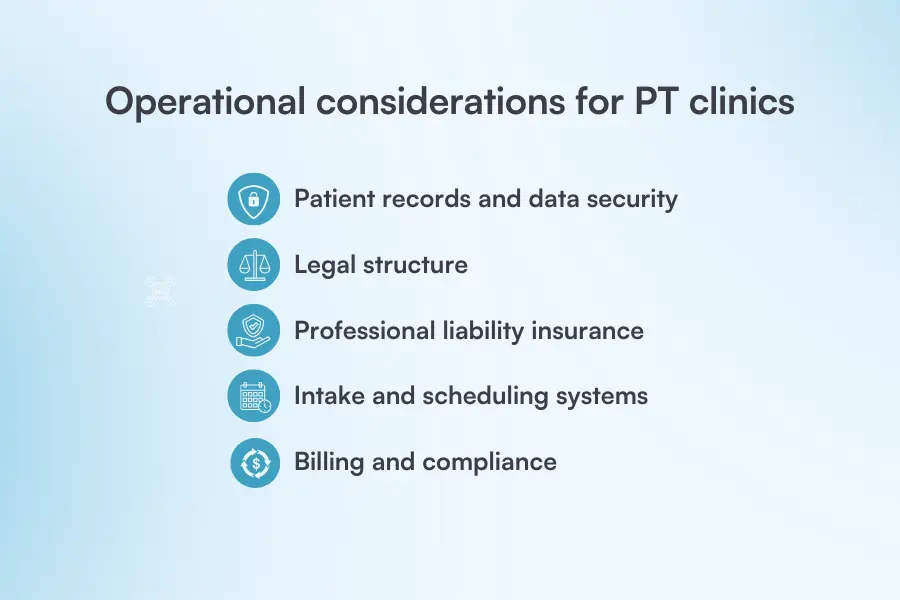
Patient records and data security. Arizona law requires secure, on-site storage of medical records. Whether digital or paper, they must be protected, retrievable, and HIPAA-compliant.
Legal structure. Deciding between a Limited Liability Company (LLC), a Professional Limited Liability Company (PLLC), or a Corporation shapes your liability and tax obligations. Many new clinics skip legal advice here, only to backtrack later.
Insurance. Every licensed physical therapist is expected to carry liability insurance. It protects you, your staff, and your patients.
Intake and scheduling systems. Smooth onboarding makes care more consistent. Digital intake forms, reliable scheduling, and automated reminders cut errors and reduce missed appointments.
Billing and compliance. Accurate documentation and clean claims are the backbone of financial stability. Errors slow payments, create extra admin, and can draw unwanted attention from regulators. These are all areas where physiotherapy clinic management software like Pabau can offer strong support.
Plenty of clinics pour energy into treatments and neglect the backend until it catches up with them. Keep these basics tight, and you’ll be spending your time with patients, not paperwork.
There’s business registration to handle, licenses to maintain, supervision rules to follow, and continuing education to keep up with. Layer on the daily work of records, scheduling, billing, and insurance, and it becomes clear why many clinics find the operational side tougher than the patient care itself.
That’s where the right system changes everything.
Pabau helps physical therapy clinics manage the admin load without pulling focus from the treatment table. Licenses, CE tracking, patient records, intake, scheduling, and billing all live in one place, so you can run smoothly and stay confident that compliance is covered.
Ready to launch with confidence? Book a demo and see how Pabau can help you build a clinic that works seamlessly from day one.