Aesthetics & Beauty Cosmetic Surgery
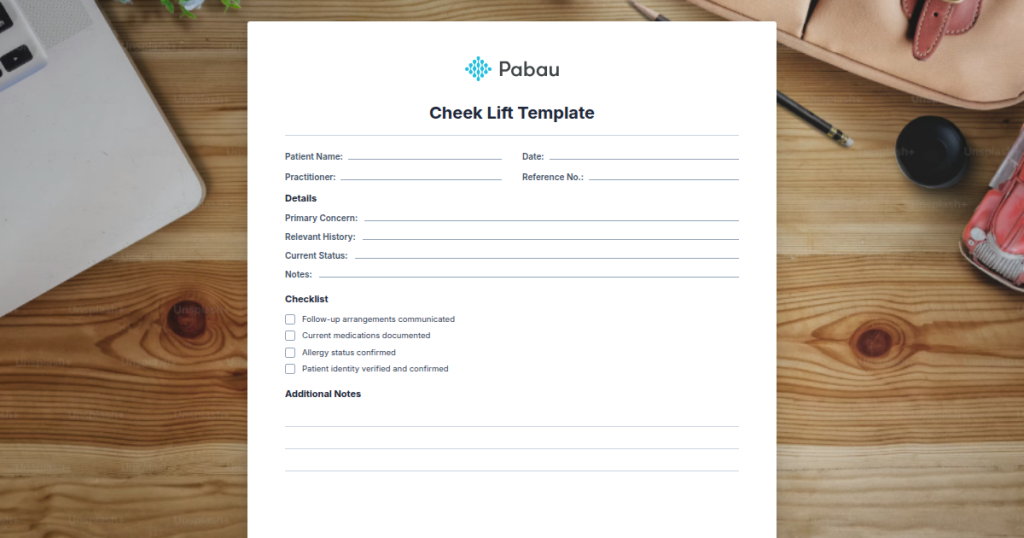
Cheek Lift Template
Download Your Free Cheek Lift Treatment Template Cheek Lift A comprehensive chee...

April 28, 2026


Buy now, pay later is now available in Pabau

A cheek lift template documents mid-face repositioning, malar fat pad elevation, and skin tightening procedures.
Pre-treatment consent must cover endoscopic and deep plane techniques, recovery timelines, and documented risks like nerve injury and asymmetry.
Contraindication screening identifies absolute risks (active infection, unrealistic expectations) and relative concerns (bleeding disorders, medications).
Pabau’s digital forms and AI-assisted documentation streamline consent workflows and ensure compliance with CQC, GMC, RCS, and BAAPS standards for cosmetic surgery.
A comprehensive cheek lift template covering pre-treatment consultation, informed consent with risk disclosure, contraindication screening, clinical documentation fields, and post-operative aftercare instructions for mid-face lift procedures.
Download templateA cheek lift template is a structured clinical documentation form designed for aesthetic practitioners performing mid-face rejuvenation procedures. The cheek lift procedure repositions the malar fat pads and tightens overlying skin to restore youthful contours and address age-related volume loss in the cheek region. This template is intended for surgical mid-face procedures (endoscopic mid-face lift and deep plane lift) performed by qualified plastic or cosmetic surgeons under appropriate anaesthetic, and is distinct from non-surgical “cheek lift” treatments using injectable dermal fillers, which fall under separate regulatory and consent frameworks.
This template serves multiple critical functions. It captures pre-operative patient details, documents informed consent conversations, screens for contraindications, records procedural decisions (endoscopic versus deep plane approach), and provides structured aftercare instruction protocols. In the UK, surgical cheek lifts are governed by the General Medical Council (GMC), the Royal College of Surgeons (RCS) Professional Standards for Cosmetic Surgery, the British Association of Aesthetic Plastic Surgeons (BAAPS), and the Care Quality Commission (CQC) for clinic registration and record-keeping. A comprehensive cheek lift template ensures your clinic meets these regulatory expectations.
The template also functions as a risk management document. By systematically capturing contraindications, patient expectations, and documented risks, you create a defensive clinical record that protects both patient safety and your practice’s compliance profile. Therapeutic disclosure of risks like temporary nerve paresthesia, asymmetry, or prolonged swelling demonstrates informed decision-making and reduces liability exposure.
Using a cheek lift template workflow ensures consistent documentation and streamlined patient communication. Follow these five operational steps to integrate the template into your clinic procedures.
This five-step workflow converts a static form into an active risk-mitigation and communication tool. Pabau’s digital forms platform allows you to customize this template structure and send pre-filled forms to patients via patient portal, reducing appointment time and improving compliance with initial paperwork collection.
The cheek lift template is essential for any aesthetic practice offering mid-face procedures. Specific clinical settings include:
Across all these settings, the template supports the shared goal of documented informed consent and transparent communication about procedural risks and realistic outcomes. Medical spa management software must support these multi-procedure workflows, ensuring that consent forms stay with the patient record regardless of which provider conducts the procedure.
A structured cheek lift template delivers operational and compliance benefits that extend beyond the individual patient encounter.
Compliance and regulatory protection: CQC guidance requires documented evidence of informed consent, contraindication screening, and patient understanding of procedural risks. A comprehensive cheek lift template demonstrates that your clinic follows consensus standards. Templates aligned with RCS and BAAPS Professional Standards for Cosmetic Surgery include tiered risk disclosure (severity and likelihood documented) and explicit consent statements that satisfy regulatory reviewers during inspections.
Workflow efficiency: Standardized templates reduce time spent generating new consent documents for each patient. Staff can quickly customize demographic and clinical observation sections while ensuring core risk disclosures and consent statements remain consistent. Pabau’s Echo AI clinical documentation assistant can pre-fill observation fields and auto-generate aftercare instruction sets based on the procedure technique selected, saving 10-15 minutes per patient.
Patient safety and realistic expectations: Written risk disclosure combats recall bias. Patients who read and initial specific risks are statistically less likely to claim they weren’t informed if a complication occurs. A cheek lift template that explains technique differences (endoscopic recovery is faster but results are subtler; deep plane yields more dramatic results but requires longer recovery) helps patients align expectations with their anatomy and goals.
Documentation consistency: When multiple practitioners in your clinic perform cheek lifts, a unified template ensures that contraindication screening, risk disclosure, and aftercare instructions are applied uniformly. This consistency reduces clinical variability and strengthens your defense if an adverse event is disputed.
Audit-ready records: During CQC or GDPR compliance audits, inspectors review consent documentation as a marker of clinical governance. A cheek lift template with dated signatures, tiered risk initials, and detailed contraindication screening demonstrates that your clinic operates under documented protocols. Safer clinical notes practices, including structured templates and audit trails, strengthen your governance posture.
A comprehensive cheek lift template includes these core documentation areas. Understanding each section ensures you tailor the template to your clinic’s specific procedures.
Facial consent forms covering multiple procedures (injectables, lasers, chemical peels) share similar core structures, so customizing a master template library is more efficient than rebuilding consent forms from scratch for each procedure.
In the UK, aesthetic practitioners performing surgical cheek lifts operate under multiple regulatory frameworks that directly inform what your template must cover. Understanding these requirements ensures your documentation meets regulatory expectations and protects your clinic.
CQC and NHS England standards: The Care Quality Commission requires registered providers to demonstrate informed consent processes for all invasive procedures. Cosmetic surgery clinics must show evidence that patients understand risks, benefits, and realistic outcomes. A detailed cheek lift template with tiered risk documentation and patient initials on each risk satisfies this requirement.
RCS and BAAPS Professional Standards for Cosmetic Surgery: The Royal College of Surgeons (RCS) Professional Standards for Cosmetic Surgery and the British Association of Aesthetic Plastic Surgeons (BAAPS) set the consent expectations for surgical cheek lifts. Both bodies, alongside GMC consent guidance, recommend a two-stage consent process: an initial consultation where risks, benefits, alternatives, and realistic outcomes are discussed and documented, followed by a separate consent confirmation on the day of (or shortly before) surgery. RCS, BAAPS, and the GMC also recommend a minimum 2-week cooling-off period between the initial consultation and the procedure, allowing patients adequate reflection time before non-urgent cosmetic surgery. A cheek lift template structured around these principles – with separate consultation and confirmation signatures, dated risk acknowledgements, and a cooling-off attestation – demonstrates adherence to RCS, BAAPS, and GMC standards.
JCCP (non-surgical procedures only): The Joint Council for Cosmetic Practitioners (JCCP) regulates non-surgical aesthetic cosmetic procedures and hair restoration; it does not set consent standards for surgical cheek lifts. Clinics that also offer non-surgical mid-face treatments (such as a dermal-filler-based “liquid cheek lift”) may reference JCCP standards for those specific services, but surgical cheek lift consent should follow RCS, BAAPS, and GMC guidance.
GMC guidance on informed consent: General Medical Council (GMC) registered doctors performing cheek lifts must follow GMC consent guidance, which emphasizes patient autonomy, disclosure of material risks, and documentation of discussions. Surgeons using a cheek lift template that includes both general risks and procedure-specific details (endoscopic versus deep plane differences, recovery timeline variation by approach) satisfy GMC expectations.
GDPR and patient data handling: Your cheek lift template will contain sensitive health data (medical history, medications, contraindications). Under GDPR, you must demonstrate legitimate interest for collecting and processing this data, secure storage, retention limits, and patient rights to access and correction. Skin clinic software with GDPR-compliant data management ensures patient records stay secure while remaining audit-ready.
Beyond consent, the template should reference your clinic’s cooling-off period policy (typically 14 days for cosmetic procedures in the UK) and any mandatory reflection period before non-urgent surgery, demonstrating that you give patients adequate time for informed decision-making.
While a standard cheek lift template provides the structural foundation, your clinic should adapt it to match your specific procedures and patient population.
Technique specialization: If your clinic primarily performs endoscopic cheek lifts (favored for younger patients and subtle enhancement), emphasize the minimally invasive advantages and realistic timeline in your template (results appear over 3-6 months as swelling resolves). If you perform deep plane lifts (suited to advanced ptosis and comprehensive mid-face correction), document the extended recovery and more dramatic potential outcomes.
Combined procedures: Many cheek lifts are performed alongside facelifts, brow lifts, or dermal fillers. Your template should reference which procedures are being combined, how they interact clinically (a deep plane facelift and cheek lift often address similar anatomy), and whether additional risks apply to the combination.
Patient communication style: Customize the risk disclosure language to match your clinic’s educational approach. Some clinics use visual diagrams showing malar fat pad repositioning; others rely on verbal explanation supported by the template’s text. Either approach is valid; consistency matters more than a particular style.
Importance of consultations for aesthetic practitioners emphasizes that documentation supports consultations, not replaces them. Use the template as a scaffold for conversation, not a checkbox exercise.
Modern aesthetic clinics benefit from integrating the cheek lift template into a digital workflow that connects intake, consent, and clinical notes. This approach reduces paperwork, improves patient experience, and creates an audit trail that strengthens compliance.
When a patient books a cheek lift consultation, send them the demographic and medical history sections via patient portal one week prior to their appointment. They complete it before arrival, giving your team time to flag any contraindication concerns and streamlining the consultation itself. During the consultation, your practitioner completes the clinical assessment, risk discussion, and consent signature sections (using a digital signature pad or printed form). After the procedure, the aftercare section is reviewed and printed as a take-home instruction sheet.
Best aesthetic clinic software features integrated digital forms, patient portals, and e-signature capabilities that automate this workflow. Rather than managing separate documents for each patient, your clinic maintains a single cheek lift template that routes through intake, consultation, procedure, and aftercare stages, creating a complete clinical record in one place.
A cheek lift template transforms a routine consent conversation into a documented, defensible clinical process. By systematically capturing patient history, documenting procedural decisions, disclosing risks, and recording aftercare instructions, you demonstrate that your clinic operates under rigorous governance standards. UK regulatory bodies (CQC, GMC, RCS, BAAPS) expect this evidence when they audit your clinic or when complications are disputed. The template protects patient safety, clarifies realistic expectations, and protects your practice’s legal standing.
The downloadable cheek lift template above provides the structural foundation for your clinic’s mid-face lift documentation. Customize it for your specific techniques, have it reviewed by a healthcare lawyer, and integrate it into your digital workflow using software that tracks consent, stores records securely, and remains audit-ready. Book a demo with Pabau to see how digital forms and integrated clinical notes can streamline your cheek lift workflows while ensuring full regulatory compliance.
Generic forms may cover baseline consent principles, but procedure-specific templates (like a cheek lift template) document risks unique to mid-face lifting. Endoscopic versus deep plane approaches carry different risk profiles; a generic form cannot address these nuances. Regulatory bodies (CQC, GMC, RCS, BAAPS) expect documentation that shows you addressed the specific procedure the patient is undergoing. A cheek lift template customized to your technique is stronger defensively than a generic form.
Review your template annually or whenever your procedural protocols change. If you adopt a new endoscopic instrument or change your aftercare antibiotic recommendations, update the template to reflect current practice. If CQC, RCS, BAAPS, or GMC guidance is updated, align your template with the new standards. A template that hasn’t been reviewed in 3+ years may not reflect your current practice and could weaken your compliance defense.
Do not proceed with the procedure. Document in the clinical record that the patient was offered the cheek lift template and all risks were discussed, but the patient declined to sign. This written documentation (even if the patient refuses the template itself) protects your clinic. Some patients may be uncomfortable with formal paperwork; offer the template verbally, answer all questions, and document your discussion in a progress note. The goal is informed consent; the form is the evidence mechanism, not a prerequisite.
Yes. UK templates reference CQC, GMC, RCS, and BAAPS standards, emphasize GDPR compliance, and include the recommended 2-week cooling-off period for cosmetic surgery. US templates reference state medical board regulations and FDA guidance (if implants are involved). Pabau offers region-specific templates; choose the one matching your licensing jurisdiction and regulatory framework. Never use a US template in a UK clinic or vice versa without legal review.
You can customize a template for your clinic’s specific procedures, but have a healthcare lawyer review your final version before using it clinically. A lawyer ensures your risk disclosures are aligned with regulatory requirements, your consent language is legally sound, and your documentation structure supports your liability defense. Template customization is reasonable; legal review is essential before deployment.