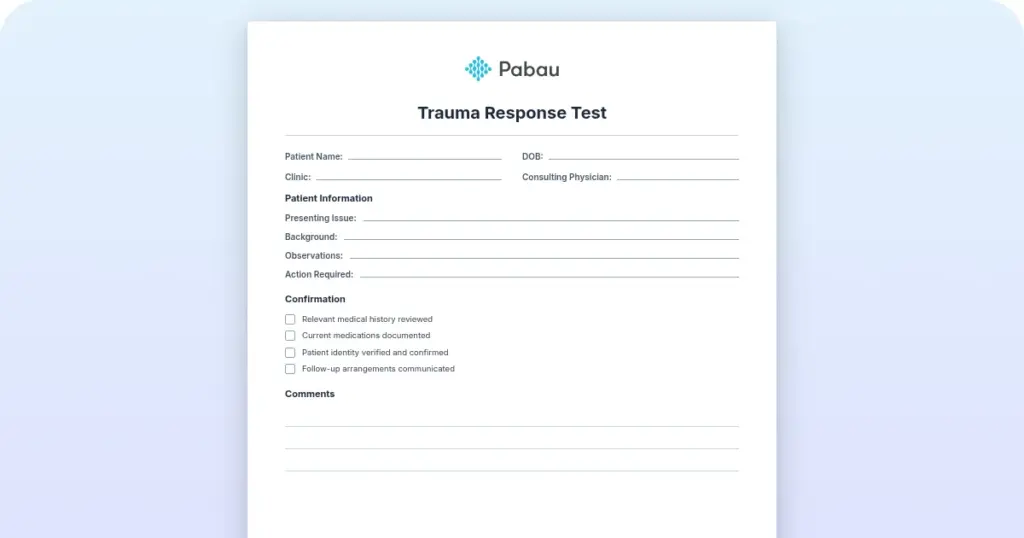
Trauma response test: Free template for clinicians
A trauma response test is a structured screening questionnaire that helps clinic...

7
Last Updated: Oct 15, 2026

An impulse control disorder test template is a standardised clinical screening tool that helps mental health professionals systematically assess impulsive behaviour patterns and symptoms indicative of conditions like intermittent explosive disorder, kleptomania, or pathological gambling.
The most validated measurement framework for impulsivity assessment is the Barratt Impulsiveness Scale (BIS-11), which evaluates attention, motor control, and non-planning dimensions across multiple items scored on a four-point scale.
DSM-5 criteria classify impulse control disorders under ‘Disruptive, Impulse-Control, and Conduct Disorders’ and require documentation of recurrent failure to resist impulses, repeated behaviour escalation, and functional impairment or distress.
Pabau’s digital forms and Pabau Scribe documentation tools enable clinicians to embed impulse control disorder assessments directly into patient workflows, streamlining screening documentation and creating a permanent clinical record for follow-up treatment planning.
A standardised clinical assessment tool designed to evaluate patterns of impulsive behaviour and help identify potential impulse control disorders. This comprehensive screening instrument includes symptom assessment, functional impact evaluation, and DSM-5 diagnostic criteria reference points.
Download templateAn impulse control disorder test template is a clinician-facing assessment instrument that systematically documents impulsive behaviour patterns, functional consequences, and diagnostic indicators within a structured format. Unlike consumer-facing self-assessments found online, this template is designed for clinical environments where mental health professionals need validated measurement data to inform diagnosis and treatment planning.
Impulse control disorders are classified in the DSM-5 under ‘Disruptive, Impulse-Control, and Conduct Disorders’ and include conditions such as intermittent explosive disorder, kleptomania, pyromania, trichotillomania, and pathological gambling. Each disorder shares a common feature: recurrent failure to resist an impulse or drive that results in harmful behaviour. The assessment template anchors clinical documentation to these diagnostic criteria while capturing the severity and functional impact that determine whether treatment is warranted.
Legal and regulatory frameworks require comprehensive clinical documentation for any diagnostic assessment. By using a standardised impulse control disorder test template, practices demonstrate compliance with clinical documentation standards and create a defendable record of the assessment process. This is particularly important in mental health settings where diagnostic accuracy and documentation clarity directly impact treatment outcomes and legal protection.
Implementing an impulse control disorder test template into your clinical workflow requires clear protocols and staff training. These five operational steps ensure the assessment is administered consistently and results are documented accurately.
Mental health clinicians across multiple specialties encounter patients with impulsive behaviour patterns that warrant formal assessment. Psychiatrists and psychologists use the impulse control disorder test template to differentiate between impulsivity traits and diagnosable disorders. Therapists working with trauma, anxiety, or substance use populations often screen for comorbid impulse control issues that complicate treatment response. Because dramatic, attention-seeking behavior can be mistaken for impulsivity, clinicians sometimes run a parallel Cluster B screen such as the histrionic personality disorder test to separate a personality-pattern presentation from a primary impulse control disorder. Psychological assessment is only as useful as the record that keeps it comparable over time.
Primary care providers and physician assistants benefit from the template when evaluating aggressive outbursts, self-harm urges, or financial/legal consequences that suggest underlying impulse control dysfunction. Occupational therapists assess impulsivity as part of functional capacity evaluation, particularly in adolescent populations where impulse control is still developing. Group therapy facilitators and case managers use the assessment to identify patients needing individual psychiatric evaluation before or during group work.
Turning this scale into a digital form with form capture software removes double entry and keeps every score legible.
Standardised assessment templates reduce diagnostic inconsistency by ensuring every clinician follows the same measurement protocol. Rather than relying on unstructured clinical interviews that vary by provider experience, a validated template applies consistent scoring logic across all patients, strengthening diagnostic reliability.
This eliminates manual transcription errors and creates searchable clinical records that support both treatment planning and quality improvement initiatives.
The impulse control disorder test template is grounded in validated psychometric instruments that have undergone peer-reviewed reliability and validity testing. The Barratt Impulsiveness Scale (BIS-11) is the most widely used self-report measure of impulsivity in clinical research, evaluating three dimensions: attentional impulsiveness (difficulty focusing), motor impulsiveness (acting without thinking), and non-planning impulsiveness (lack of future orientation). According to NCBI peer-reviewed research, the BIS-11 has demonstrated strong psychometric properties across diverse populations.
The Minnesota Impulse Disorders Interview (MIDI) is a structured diagnostic interview that shows excellent test-retest reliability and discriminant validity against primarily non-impulsive psychiatric symptoms. Research published in ScienceDirect confirms the MIDI’s ability to differentiate impulse control disorders from anxiety, depression, and obsessive-compulsive conditions. Templates incorporating MIDI-informed item selection enhance diagnostic specificity when ruling out alternative explanations for apparent impulsivity.
Mental health clinics often struggle to balance comprehensive assessment with time constraints. Embedding an impulse control disorder test template into your intake process ensures no patient with impulsivity concerns falls through the diagnostic gap.
Deploy the template as a digital form completed during the intake appointment or sent via patient portal before the first clinical visit. This hybrid approach reduces administrative burden while ensuring clinician review and clinical judgment remain central to the diagnostic process.
Store completed assessments in your electronic health record system with date stamps and clinician signatures. This creates a longitudinal record that tracks whether impulsivity patterns persist, improve, or change in response to treatment intervention. Over time, your clinic develops outcome data demonstrating the effectiveness of your impulse control disorder screening and treatment protocols.
A standardised impulse control disorder test template transforms diagnostic clarity and treatment precision in mental health practice. Rather than relying on unstructured clinical impression, clinicians who use a validated assessment instrument ground their diagnoses in documented, measurable data aligned with DSM-5 criteria. The template serves as both a screening tool for initial identification and a diagnostic instrument for definitive assessment.
Pabau’s clinical documentation and digital forms capabilities enable your team to deploy this assessment seamlessly within your existing workflow. Book a demo to see how Pabau’s integrated assessment and documentation tools support your mental health practice.
No. A self-assessment screening tool can identify patterns suggestive of impulse control disorder, but only a qualified mental health professional can provide a clinical diagnosis. The impulse control disorder test template is designed for clinician administration and interpretation, with results integrated into comprehensive clinical interviews and diagnostic decision-making.
DSM-5 impulse control disorders include intermittent explosive disorder (recurrent aggressive outbursts), kleptomania (recurrent theft urges), pyromania (fire-setting), trichotillomania (hair-pulling), and pathological gambling. The template evaluates common features across these subtypes while directing clinicians to assess subtype-specific criteria.
The template embeds DSM-5 diagnostic thresholds directly into the assessment structure. Items assess core criteria including recurrent failure to resist impulses, tension before the behaviour, pleasure or relief during the behaviour, and resulting distress or functional impairment. Clinicians cross-reference scored responses against DSM-5 checkboxes for diagnostic confirmation.
Administer the full assessment at diagnostic intake and whenever treatment response requires evaluation. Some clinics use briefer screening versions during follow-up visits to track symptom trajectory without full reassessment. Repeat full assessment typically occurs at 3-month, 6-month, and 12-month treatment intervals depending on clinical complexity.
Escalate immediately to safety assessment and crisis protocols. Document risk indicators clearly in the patient record. Impulse control disorders co-occur with elevated self-harm and aggression risk, requiring supplemental suicide and violence risk screening. Do not use the assessment as a stand-alone safety evaluation tool.