CPT code 36468: Injection sclerotherapy of telangiectasia billing guide
CPT code 36468: Official descriptor and code family CPT code 36468 is defined by...

Last Updated: Nov 13, 2026
J7325 is the HCPCS Level II code for hyaluronan or derivative, Synvisc or Synvisc-One, for intra-articular injection, 1 mg. It covers both hylan G-F 20 products, and one unit equals 1 mg.
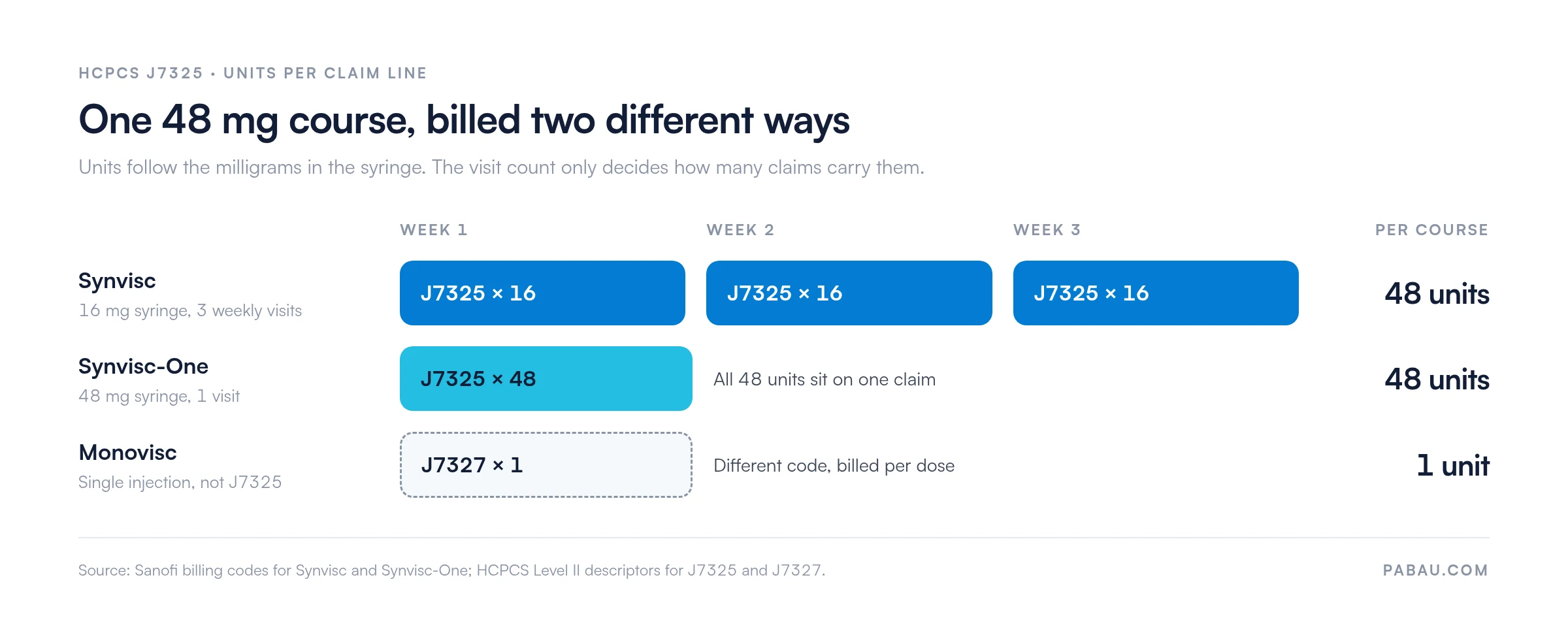
A Synvisc visit uses one 16 mg syringe, so you bill 16 units at each of three visits. A Synvisc-One visit uses one 48 mg syringe, so you bill 48 units once. Monovisc is a different product and bills J7327.
Let Pabau's smart automation suggest the right codes, reduce claim denials, and keep your practice compliant—effortlessly.
Automate repetitive tasks and focus on what matters most—your patients.
Reduce coding errors and ensure compliance with the latest regulations.
Clean claims, fewer denials, and faster reimbursements.
Powerful insights and reporting to help your practice thrive.
HIPAA compliant SOC 2 certified GDPR-compliant Trusted by 4,000+ clinics worldwide

HCPCS code J7325 bills both Synvisc and Synvisc-One, the two hylan G-F 20 products, at one unit per 1 mg.
A Synvisc visit uses one 16 mg syringe and bills 16 units, while a single Synvisc-One visit bills 48 units.
Monovisc bills J7327 per dose, so swapping J7325 and J7327 between the two one-shot products is a wrong-code error.
Pair J7325 with CPT 20610 and a specific M17 code, such as M17.11 for one knee or M17.0 for both.
Medicare Part B pays J7325 at ASP plus a 6% add-on, and CMS updates that rate every quarter.
HCPCS code J7325 is the Level II code for Synvisc and Synvisc-One, both hylan G-F 20 injections for knee osteoarthritis. One unit equals 1 mg. Sanofi’s Synvisc-One billing codes page lists J7325 for both products, with 48 units for Synvisc-One and 16 for Synvisc.
That one rule settles most billing questions. You count milligrams in the syringe, not injections or visits. Keep the reference table below close when you build the claim.
J7325 covers one active ingredient, hylan G-F 20, in either of its two Sanofi products. Synvisc comes as a 2 mL prefilled syringe holding 16 mg. It’s given once a week for three weeks.
Synvisc-One comes as a 6 mL prefilled syringe holding 48 mg, given as a single injection. Both are FDA-approved for knee osteoarthritis pain after conservative care and simple painkillers haven’t worked. Most Medicare coverage policies for hyaluronans are written for the knee alone.
Units on a J7325 line equal the milligrams injected. Each product comes in one fixed syringe size, so the math stays short.
Both courses land on 48 mg, which is why the two products blur together on paper. The difference is timing. Synvisc spreads 48 units over three claims, while Synvisc-One puts all 48 on one, as the chart below shows.
The classic error is billing 1 or 3 units, the syringe or injection count. That leaves most of the payment on the table and costs staff time on a corrected claim. Bill each Synvisc injection on its own date of service.
Here’s how a single Synvisc-One injection moves through billing. The patient is illustrative: a traditional Medicare patient with primary osteoarthritis of the right knee.
Change one detail and the claim changes with it. With Synvisc, the same patient generates three claims of 16 units each, a week apart. If both knees get Synvisc-One on one day, the units double to 96 and the diagnosis becomes M17.0.
J7325 pays for the product only. The injection itself is billed with CPT 20610, arthrocentesis, aspiration and/or injection of a major joint or bursa, without ultrasound guidance.
A J7325 line sent without an administration code usually comes back denied. Add the RT, LT or 50 modifier your payer expects on the 20610 line.
The diagnosis needs the same precision. Pick the code that matches the type of osteoarthritis and the knee you injected.
Avoid M17.9, osteoarthritis of knee, unspecified, when the chart supports more. Some payer policies won’t accept it, and it never says which knee was treated.
Hyaluronan products have their own codes in the J7318-J7329 block. Some bill per milligram and some per dose, and that split drives most wrong-code errors.
The trap is the single-injection products. Synvisc-One and Monovisc are both one-shot treatments, so staff sometimes assume they share a code. They don’t. Synvisc-One bills J7325 at 48 units, and Monovisc bills J7327 at 1 unit per dose.
When in doubt, read the syringe label. Synvisc’s NDC is 58468-0090-01 and Synvisc-One’s is 58468-0090-03, and both map to J7325.
Medicare Part B pays J7325 under the average sales price (ASP) method. The allowed amount per milligram is the ASP plus a 6% add-on, and CMS resets it every quarter.
Don’t quote a rate from memory. Download the current quarter from the CMS ASP pricing files, find J7325 and match the quarter to your date of service. Then multiply by the units on the line.
Medicare Advantage and commercial payers set their own contracted rates. Check each payer’s fee schedule before you quote a patient’s out-of-pocket cost.
Put the quarterly ASP release on the billing calendar. CMS posts each file before it takes effect, so update your J7325 charge before January 1, April 1, July 1 and October 1.
Traditional Medicare doesn’t require prior authorization for J7325. Instead, the record must meet your MAC’s coverage criteria before the first injection.
How long conservative care must run varies by policy, so check the active coverage rule rather than assuming a set number of months. A dated record of each failed treatment makes every request faster to assemble.
A thin note rarely triggers a front-end rejection. The problem surfaces later, on a records request or a post-payment review, when the note can no longer be amended. Build the chart entry first and the claim lines from it.
Hyaluronan denials cluster around a few repeat errors. Most are fixed with a corrected claim, while a few need a formal appeal. Start by spotting which pattern your practice repeats.
Each quarter, group your J7325 denials by claim adjustment reason code. A handful of codes tend to recur, and fixing their root cause beats appealing claims one at a time.
Many practices bill viscosupplementation from two places. The injection note lives in the chart, and the claim gets keyed into a separate billing tool. Units and lot numbers drift apart.
Pabau, the practice management and billing platform we build, keeps both on one patient record. You record each syringe’s lot number and expiry against the patient and the appointment. Orthopedic and sports medicine practices then have the audit trail beside the treatment note.
For US insurance billing, Pabau’s specialty practice claims software works through the Claim.MD clearinghouse. Your team can check eligibility before the visit, send CMS-1500 claims as 837P files and post electronic remittance (ERA) against each claim.
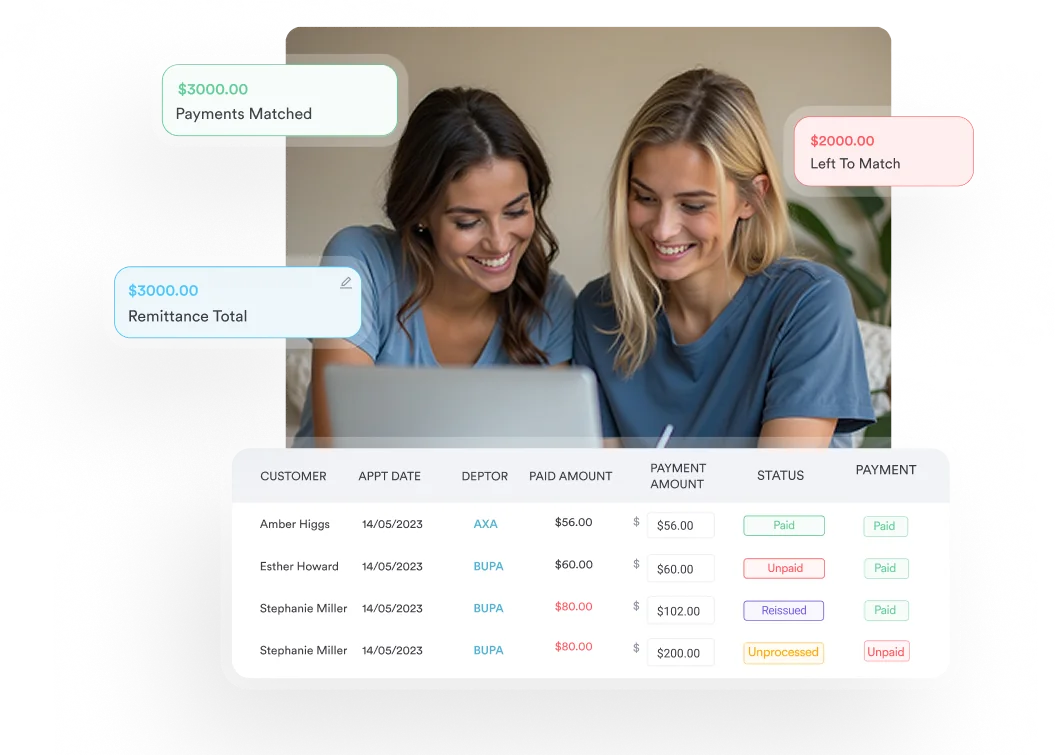

Pabau records syringe lot numbers against each appointment and sends US insurance claims through Claim.MD, with eligibility checks and ERA posting. See how it fits an orthopedic or sports medicine practice.

J7325 rewards practices that bill from the syringe label. Read the product, count the milligrams, and the code and units follow: 16 units per Synvisc visit, 48 for Synvisc-One.
The costly mistakes come from assumptions. A one-shot product isn’t automatically J7327, and a three-visit course isn’t billed as three units. Build those two checks into charge entry, and the rework drops sharply.
Book a demo to see how Pabau keeps lot numbers, claims and remittance for each injection on one patient record.

Billing Monovisc instead? HCPCS code J7327 covers the per-dose code for the other single-injection hyaluronan.
Coding the injection itself? CPT code 20610 explains the major joint administration code that rides with J7325.
Switching patients to Orthovisc? HCPCS code J7324 walks through per-dose billing for a three- to four-injection series.
Sending claims electronically? Understanding the Claim.MD clearinghouse explains how claims and remittance move between your practice and payers.
Struggling with repeat denials? Denial management in healthcare shows how to build a prevention and appeals workflow.
Medicaid programs require it, and many commercial payers do too. Report Synvisc as 58468-0090-01 or Synvisc-One as 58468-0090-03, in the format your payer specifies.
It depends on the coverage policy. Many Medicare policies allow a repeat course no sooner than six months after the last, with documented improvement. Check your payer’s rule before booking.
The FDA regulates hyaluronan knee injections as medical devices, approved through premarket approval. Payers still bill them with J codes, and Medicare pays them through the ASP method.
Only when a significant, separately identifiable E/M service takes place, reported with modifier 25. A visit booked just for the injection doesn’t support a separate E/M code.