CCSD Code B2710: Radical mastectomy including block dissection
CCSD Code B2710: Definition and clinical scope CCSD Code B2710 is the UK private...

Last Updated: Nov 13, 2026
C8650 is the CCSD code for fluorescein angiography of eye (including ocular photography). UK private medical insurers and private hospitals use it to bill the test. One code covers the dye injection and the full fundus image series, so the photography is not billed as a separate line.
CCSD (Clinical Coding and Schedule Development) is the procedure schedule maintained by Aviva, AXA Health, Bupa and VitalityHealth with major private hospital groups. C8650 sits in chapter 4, Eye and orbital contents, and each insurer sets its own fee for it.
Let Pabau's smart automation suggest the right codes, reduce claim denials, and keep your practice compliant—effortlessly.
Automate repetitive tasks and focus on what matters most—your patients.
Reduce coding errors and ensure compliance with the latest regulations.
Clean claims, fewer denials, and faster reimbursements.
Powerful insights and reporting to help your practice thrive.
HIPAA compliant SOC 2 certified GDPR-compliant Trusted by 4,000+ clinics worldwide

CCSD code C8650 bills fluorescein angiography of the eye with its ocular photography as one item, so a separate photography line is unbundling.
CCSD is the UK private insurance schedule, maintained by Aviva, AXA Health, Bupa and VitalityHealth with major private hospital groups.
UK insurers generally expect pre-authorization for the exact code, and the diagnosis must support the test.
Each insurer sets its own C8650 fee: AXA Health lists £100 and Allianz Care £110, so check the current schedule before you price it.
CCSD code C8650 is the UK private insurance code for fluorescein angiography of the eye, with the ocular photography billed inside the same code.
The narrative reads Fluorescein angiography of eye (including ocular photography) in AXA Health’s specialist code schedule. AXA files it under chapter 4, Eye and orbital contents. That parenthetical sets the bundling rule for every C8650 claim.
CCSD stands for Clinical Coding and Schedule Development. The full set of CCSD codes is maintained by UK insurers and private hospital groups. Aviva, AXA Health, Bupa and VitalityHealth sit on its board alongside groups such as Spire Healthcare, Nuffield Health and HCA Healthcare. Consultants put the code on pre-authorization requests and invoices to UK private medical insurers.
The CCSD group writes the codes and narratives but does not set fees. Each insurer decides whether it covers C8650 and how much it pays. C8650 is also separate from fundus photography billed on its own, which has its own code, C8652.
Fluorescein angiography uses an intravenous injection of sodium fluorescein dye, followed by rapid serial fundus photography of the retinal and choroidal vessels. Each clinical step leaves something in the record that supports the claim.
The fundus image series cannot be separated from the angiography. That is why the CCSD narrative includes the photography in C8650, and why a second photography line on the same invoice counts as unbundling.
Insurers expect the diagnosis on the pre-authorization request and invoice to support fluorescein angiography. UK insurers work with WHO ICD-10 rather than the US ICD-10-CM, so codes stop at four characters.
Code the diagnosis that prompted the test, not the test itself. A routine examination code next to C8650 invites a query when the notes show active AMD. Check the clinical record against the code before the pre-authorization request goes in.
The narrative names ocular photography as part of C8650. Insurers also treat the component parts of a procedure as included in its fee. Allianz Care’s UK fee schedule, for example, states that its fee covers associated drug costs and pre- and post-procedure attendance.
Read the table as an invoice check. Every component marked included belongs on the single C8650 line, and a component billed separately takes its own line under the insurer’s rules.
Before you send a C8650 invoice, check the line items. If ocular photography or C8652 appears on the same invoice, remove it. That one check prevents the most common unbundling rejection for this test.
C8650 sits in section 4.12, General, of chapter 4 in the insurer schedules. Its closest neighbor is the photography-only code, which is easy to add by mistake.
When the angiogram leads to laser treatment of a retinal lesion, that treatment takes its own code, C8200. For any other eye test performed in the same visit, take the code from the current CCSD schedule rather than from memory. The schedule is updated regularly, and the CCSD website requires a login to search it.
A correctly coded C8650 claim can still be queried if the clinical record does not support it. Insurers can ask for the notes, and a missing record counts against the claim.
A structured angiography note standardizes what is captured at the point of care. The minimum documentation for a C8650 claim includes:
Complete the documentation on the day of the test. Later entries are acceptable for clinical purposes, but they can draw extra scrutiny if an insurer audits the claim.
UK private insurers generally expect the patient to get pre-authorization before a planned test, and the authorization is tied to the CCSD code requested. Cover depends on the patient’s policy. Allianz Care, for example, notes that a listed fee does not guarantee cover and that some treatments need pre-authorization.
Performing C8650 without a required authorization usually means the insurer will not pay. The patient then owes the fee themselves. Confirm the authorization number when the appointment is booked, not after the test.
Rejected C8650 claims follow predictable patterns. Each one has a prevention step you can build into the billing workflow. The path below shows where each check sits between booking and payment.
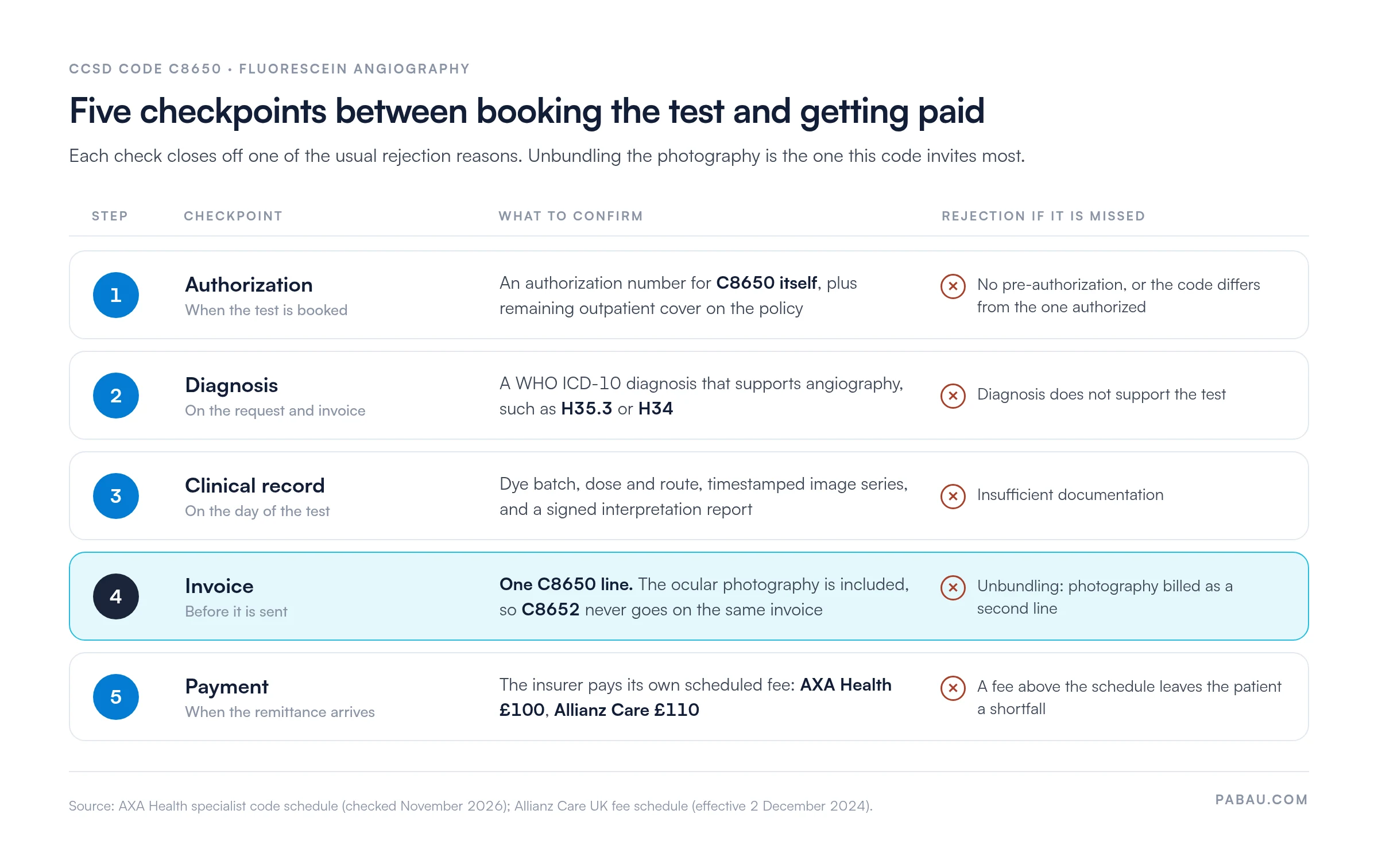
Unbundling is the most frequent billing error for C8650. It happens when ocular photography, or C8652, goes on the same invoice as C8650. The narrative already includes the photography, so the insurer will refuse the second line.
Bill one C8650 line for the angiography and its photography. Repeated unbundling carries a further risk. Allianz Care warns that it may withdraw a consultant’s recognition status over it.
Raise a disputed C8650 claim with the insurer’s provider or medical services team, and include the interpretation report. When an insurer declines a patient’s own claim, the patient can use the insurer’s complaints process. After that, the Financial Ombudsman Service can review it.
Each insurer sets its own fee for C8650, because the CCSD group does not discuss or determine fees. Two published schedules show how the amounts differ.
Bupa, Aviva and VitalityHealth publish their own schedules to recognized consultants. Bupa’s code search is at codes.bupa.co.uk, and our guide to Bupa CCSD codes explains how to use it. Check each insurer’s current figure before you set your price, because schedules change.
If your fee is above an insurer’s scheduled amount, the patient usually pays the difference. Some insurers go further. Allianz Care states it may decline to authorize treatment when the consultant’s fee exceeds its published fee.
Store a separate C8650 price for each insurer you bill. AXA Health and Allianz Care pay different amounts for the same code, so a single flat fee leaves some patients with an unexpected shortfall.
Usually not. The dye is injected once and circulates to both eyes, so imaging both eyes in one session is one test. The C8650 narrative names no laterality, and neither the AXA Health nor the Allianz Care schedule lists a bilateral C8650 variant.
Insurers handle bilateral work differently, so confirm the rule before you bill a second unit. Allianz Care, for example, applies a bilateral code where one exists. Where none exists, its multiple-procedure rule pays 50% of the fee for a second procedure.
When in doubt, call the insurer’s provider helpline before invoicing. A pre-submission call takes far less time than reworking a rejected claim.
Many ophthalmology practices still key each insurer claim into a separate portal. Authorization numbers sit in emails, and nobody sees a rejected C8650 line until the remittance arrives.
Pabau, the practice management platform we build, turns the invoice you already raise into an electronic claim. It sends claims to UK insurers through Healthcode and Bupa, and checks them against Healthcode’s validation rules before they go.
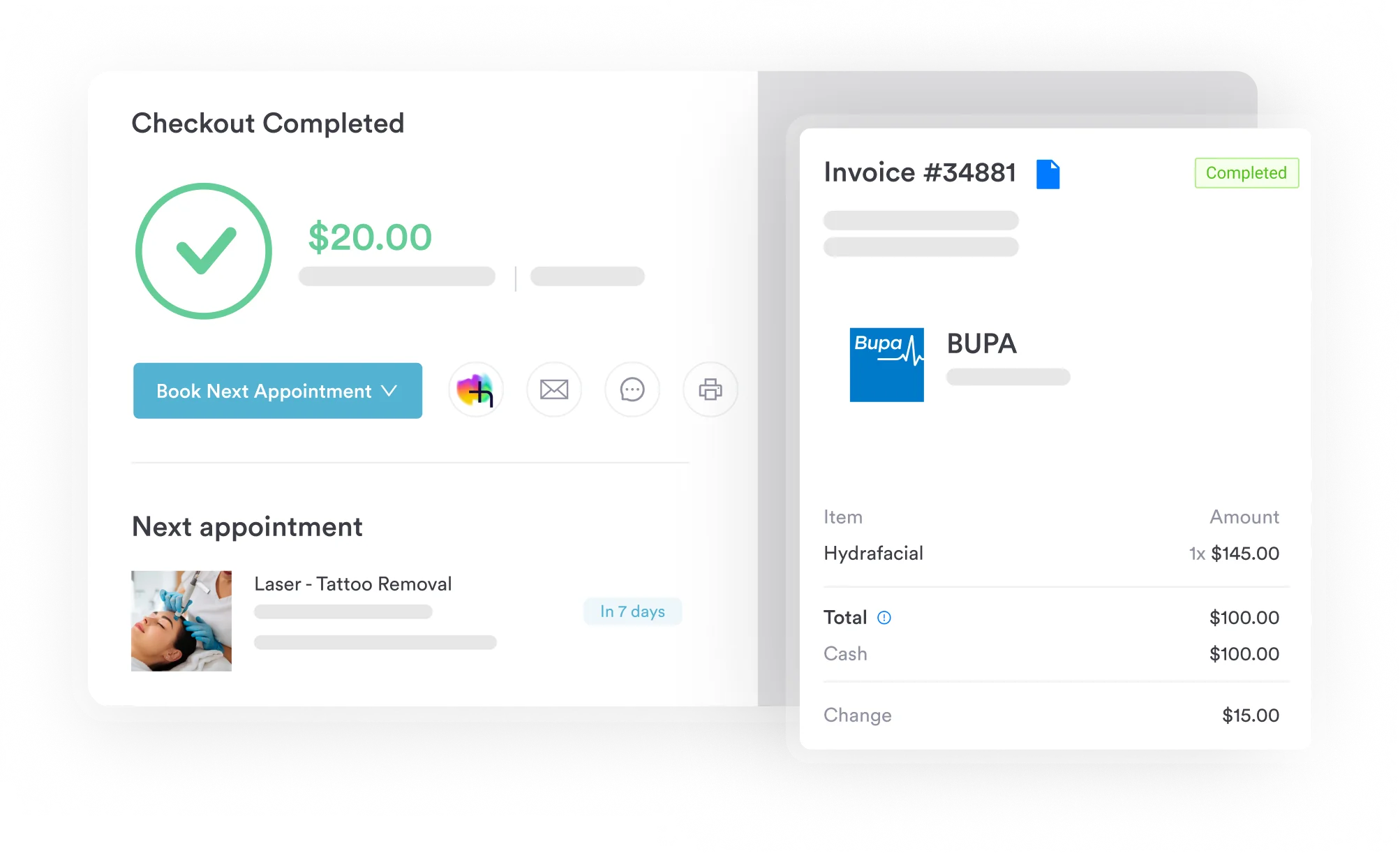
The practice records the insurance policy and authorization code against the patient’s case. Claims management software in Pabau then tracks each claim’s status on one dashboard. The result is fewer rejected lines and faster payment from insurers.

Pabau turns your invoices into electronic claims for UK private insurers through Healthcode, validates them before submission and tracks every claim on one dashboard.

C8650 pays only when three pieces line up. You need an authorization for that exact code, a diagnosis that supports angiography, and one invoice line covering the photography. The fee then depends on the insurer, not on the CCSD schedule. Load each insurer’s figure into your price list and check it when schedules change.
Pabau keeps the clinical record, the authorization number and the claim on the same patient case. To see how Pabau sends C8650 claims to UK insurers through Healthcode, book a demo.

Need the full CCSD picture? Bupa CCSD codes explains how the schedule is structured, how to find codes and how pre-authorization works with UK insurers.
Treating the lesion the angiogram found? CCSD code C8200 covers laser photocoagulation or cryotherapy of a retinal lesion and what its claim needs.
Billing retinal surgery? CCSD code C7920 explains how to bill pars plana vitrectomy with tamponade, buckling and retinopexy.
Want to understand how Pabau supports practice billing? Claims management software for private practices explains how Pabau handles claim submission, tracking and rejected claims.
CCSD code C8650 covers fluorescein angiography of the eye, including ocular photography, as one procedure. It includes the dye injection and the full fundus image series. UK private insurers expect it on a single invoice line.
Usually, yes. UK private insurers generally ask the patient to get pre-authorization before a planned test, and the authorization is tied to the CCSD code. Requirements and cover differ by insurer and policy, so check before the appointment.
Common pairings are H35.3 for macular degeneration, E11.3 with H36.0 for diabetic retinopathy, and H34 for retinal vascular occlusion. H30 covers chorioretinal inflammation and H35.5 hereditary retinal dystrophy. Code the diagnosis that prompted the test. You can confirm a code in the WHO ICD-10 browser.
C8650 is fluorescein angiography with its ocular photography included. C8652 is fundus or anterior segment ocular photography as the sole procedure, with no dye injection. The two are never billed together for the same test.
The usual reasons are a missing pre-authorization, a diagnosis that does not support the test, and photography billed as a separate line. Thin documentation and an exhausted outpatient limit also cause rejections. A pre-submission check catches most of them.
Often, yes, when the consultation is a separate face-to-face assessment. Insurers pay consultations outside the procedure fee under their own rules. Allianz Care, for example, pays one consultation per patient per day. Check the insurer’s rules first.
There is no single fee, because each UK insurer sets its own and the CCSD group does not set fees. AXA Health lists £100 for the procedure. Allianz Care’s UK schedule lists £110, plus £105 for an anesthetist. Check the insurer’s current schedule.