CCSD code XR390: AVM embolization billing guide
CCSD code XR390 is the UK private healthcare code for embolization of an arterio...

Last Updated: Nov 24, 2026
CCSD code XR320 is the UK private insurance code for dilatation or stenting of the nasolacrimal duct under imaging control. In plain terms, a clinician widens a blocked tear duct, or props it open with a stent, while watching live imaging. The code sits in Chapter 17 of the CCSD schedule, Interventional radiology.
The “XR” prefix is where most coding errors start, because it reads like X-ray. A radiograph billed as XR320 comes straight back. Get the scope, the code pairings and the procedure note right, and an insurer has little left to query.

CCSD code XR320 covers dilatation or stenting of the nasolacrimal duct under imaging control, in Chapter 17, Interventional radiology.
The XR prefix doesn’t mean plain X-ray, so never use XR320 for a radiograph.
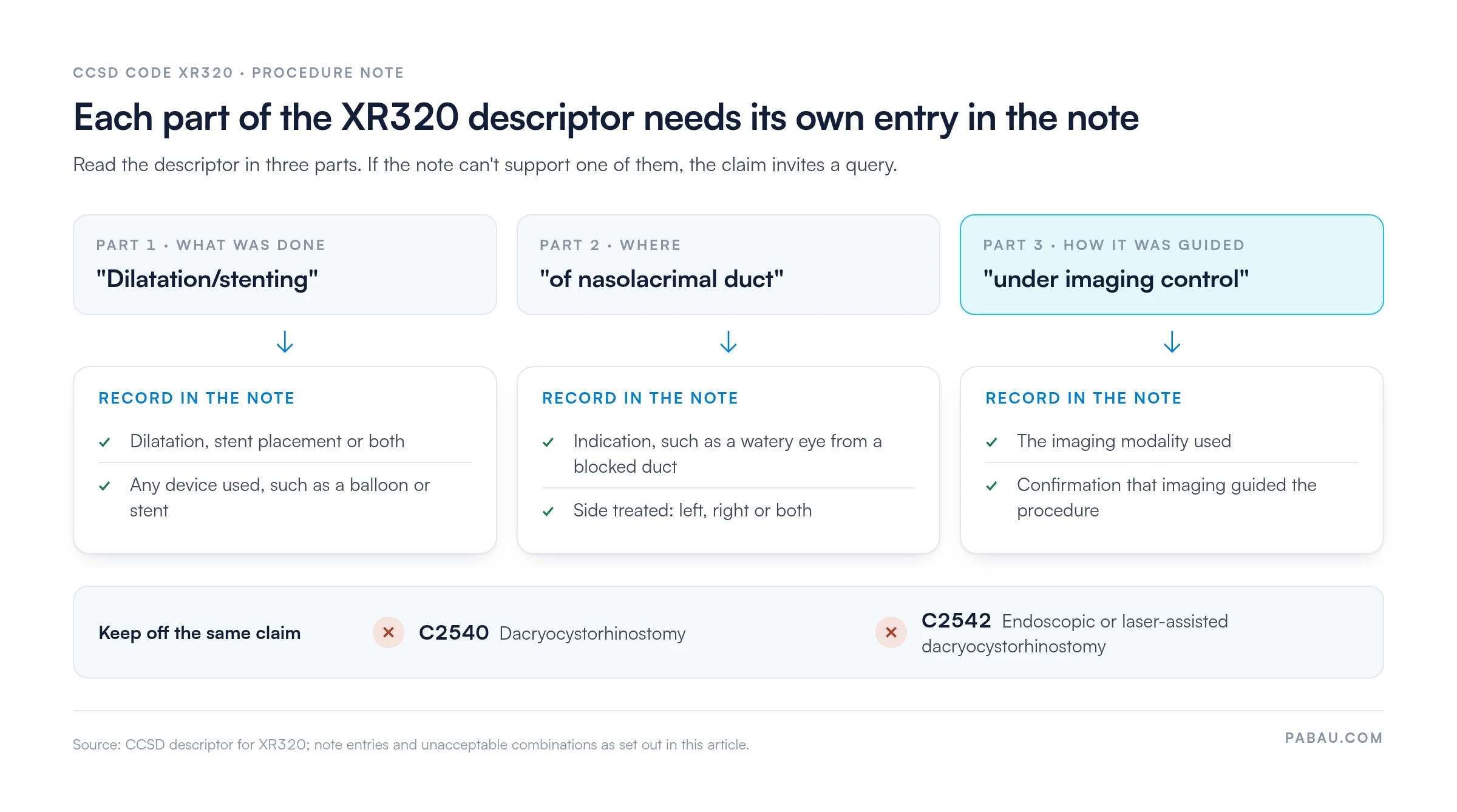
CCSD lists XR320 as an unacceptable combination with the dacryocystorhinostomy codes C2540 and C2542, so keep them off the same claim.
The procedure note should show the side treated, whether the duct was dilated or stented, and the imaging that guided it.
Each insurer sets its own fee and pre-authorization rules for XR320, so check them before the procedure date.
The Clinical Coding & Schedule Development Group (CCSD) gives XR320 this descriptor: “Dilatation/stenting of nasolacrimal duct under imaging control.” It sits in sub-chapter 17.7, Head and neck, within Chapter 17, Interventional radiology. The same chapter holds the embolization codes, including XR360 for uterine fibroids.
The nasolacrimal duct drains tears from the eye into the nose. When it blocks, the patient gets a persistently watery eye. XR320 describes widening that duct, or holding it open with a stent, while the operator watches on imaging.
Some guides describe XR320 as a plain-film X-ray code. The CCSD schedule doesn’t support that reading, and it has no plain-film XR series. Here’s the code at a glance, and our CCSD code library covers the rest of the schedule.
Use XR320 when a nasolacrimal duct is dilated, stented or both, with imaging guiding the work. In practice, that covers:
These belong somewhere else:
For an unusual case, read the code’s own guidance on the CCSD site before you code it. CCSD publishes codes for any insurer to use, but each insurer decides whether to adopt them.
One example comes from a Bupa proposal on imaging and radiology codes. It describes XR320 as a procedure of around 30 minutes, normally performed by an ophthalmologist. In some hospitals, an interventional radiologist does the work instead.
That means the claim can come from an ophthalmic or oculoplastic surgeon, or from radiology. Agree who bills XR320 before the patient arrives. Two specialists claiming one procedure is a quick way to trigger a query.
Insurers check claims against the clinical record. For XR320, the record should support each part of the descriptor. Capture these details in the procedure note:
Read the descriptor in three parts, and the map below shows which note entry backs each one.
Pre-authorization rules for XR320 vary by insurer and by policy. Check with the patient’s insurer before the procedure date, not after it. These tools are a good starting point:
When the insurer issues an authorization code, record it on the patient’s case with its dates. A claim that arrives without it is likely to be queried.
CCSD doesn’t set fees. Its site says each insurer takes its own view on classification, reimbursement and fees.
As one example, Freedom Health’s Chapter 17 interventional radiology schedule, dated 1 October 2024, lists XR320 as Major complexity at £550. Your rate with another insurer may differ. Confirm it in that insurer’s fee tool before you invoice.
For a wider view of how one large insurer handles the schedule, see our guide to Bupa CCSD codes.
Many XR320 claims stall on admin rather than coding. An authorization code goes missing, or a claim sits in a spreadsheet waiting to be sent.
Pabau, a practice management platform with built-in claims management, keeps those details on the patient’s case. It tracks the pre-authorization code, its dates and the sessions it covers, and warns you when one is missing. Its digital forms hold the structured procedure note too.

Once the note and authorization are in place, claims go to UK insurers via Healthcode from the same case.


Pabau tracks pre-authorization codes, dates and sessions on each case, warns you when one is missing, and submits claims via Healthcode.

XR320 is a tear duct procedure, and the claim should read like one. Code it from the descriptor and keep C2540 and C2542 off the same claim. Make the imaging guidance visible in the note, and settle who bills it before the patient arrives.
Get those four right, then check the insurer’s authorization and fee rules. That gives the claim its best chance of paying without a query. Book a demo to see how Pabau tracks authorization details on each case and submits claims via Healthcode.

Need the wider Bupa picture? Bupa CCSD codes explains how Bupa uses the CCSD schedule and where to check its coding rules.
Treating the lacrimal sac itself? CCSD code C2640 covers incision of the lacrimal sac and how to bill it.
Looking up another CCSD code? CCSD codes gathers our CCSD code guides by chapter and procedure.
Want fewer claims stuck on missing authorizations? Claims management software shows how Pabau tracks pre-authorization codes on each case and submits claims via Healthcode.
It’s the tear duct that drains tears from the eye into the nose. When it blocks, tears can’t drain away, so the eye waters persistently.
The operator passes a fine catheter into the blocked duct and inflates a small balloon to widen it. Imaging, often fluoroscopy, shows the position throughout. A stent may be left in place to keep the duct open.
XR320 works inside the existing duct, widening or stenting it through a catheter under imaging. A dacryocystorhinostomy (DCR) is surgery that creates a new drainage route from the tear sac into the nose.
No. NHS hospitals record procedures with OPCS-4 codes. CCSD codes such as XR320 are used to bill UK private medical insurers.