CCSD Code V1730: Extraoral fixation of mandible
What is CCSD code V1730? CCSD code V1730 is the UK private medical insurance cod...

Last Updated: Nov 24, 2026
C6990 is the CCSD code for insertion of valve into anterior chamber of eye. It covers glaucoma drainage devices, valved or non-valved, whose tube drains aqueous humor from the anterior chamber to a plate under the conjunctiva.
Surgeons use it when medication or earlier glaucoma surgery has not controlled eye pressure. Trabeculectomy, minimally invasive glaucoma surgery (MIGS) devices and cyclodestructive procedures are typically coded separately.
Let Pabau's smart automation suggest the right codes, reduce claim denials, and keep your practice compliant—effortlessly.
Automate repetitive tasks and focus on what matters most—your patients.
Reduce coding errors and ensure compliance with the latest regulations.
Clean claims, fewer denials, and faster reimbursements.
Powerful insights and reporting to help your practice thrive.
HIPAA compliant SOC 2 certified GDPR-compliant Trusted by 4,000+ clinics worldwide

CCSD Code C6990 covers insertion of a valve or tube shunt into the eye’s anterior chamber to lower IOP in refractory or secondary glaucoma.
Ahmed, Baerveldt and Molteno drainage devices are usually coded under C6990, while MIGS devices such as the iStent and Preserflo are typically coded separately.
All major UK private insurers require pre-authorization before anterior chamber valve surgery, and a missing pre-auth is a common reason for denial.
Device implant costs may be bundled into the C6990 fee or invoiced separately, depending on insurer policy, so confirm before submission.
Pabau, a practice management platform, supports UK insurance billing through Healthcode and BUPA, with claims management and prior-authorization tracking.
CCSD Code C6990 covers surgical insertion of a valved or non-valved drainage device into the eye’s anterior chamber to lower intraocular pressure (IOP).
The CCSD schedule of procedures, the major UK private insurers’ shared coding standard, gives the descriptor as “insertion of valve into anterior chamber of eye.” The code applies to glaucoma drainage implants that divert aqueous humor from the anterior chamber to a plate under the conjunctiva or Tenon’s capsule.
Surgeons use it for aqueous shunt implantation when medication or earlier surgery has not controlled IOP, in these clinical contexts:
Cyclodestructive procedures, minimally invasive glaucoma surgery (MIGS) devices such as the iStent or Preserflo MicroShunt, and trabeculectomy are typically coded separately. Cyclodiode laser, for example, is a form of ciliary body ablation, which has its own code, C6610. Check the current CCSD schedule edition when coding, because descriptors and classifications are updated periodically.
Anterior chamber valve insertion places a glaucoma drainage device with one end in the anterior chamber. The other end connects to a plate beneath the conjunctiva. Aqueous humor drains through the tube, and IOP falls passively once a filtering bleb forms around the plate.
The operative note needs these patient selection details to support C6990 billing:
The operative report should also describe each key surgical step:
Payers audit these steps when they review a C6990 claim against the operative note.
The table maps the main glaucoma drainage devices to their manufacturer, mechanism and usual coding status in UK private practice.
Check device classification against the current CCSD schedule edition before you submit a claim. Royal College of Ophthalmologists (RCOphth) guidance sets the clinical framework for patient selection. The code follows the procedure performed, so a device’s brand name alone does not decide it.
A frequent miscoding error with CCSD Code C6990 is billing a tube shunt implant under the trabeculectomy code, or the reverse. The two operations differ in anatomical target, revision risk and payer funding pathway. Each alternative below has its own entry in the CCSD code library.
When a trabeculectomy bleb fails and the surgeon implants a tube shunt in a later episode, that episode uses C6990. If both procedures happen in the same sitting, which is unusual, ask the insurer’s medical reviewer before you submit a combined claim. When the surgeon revises an earlier glaucoma operation without a new implant, check C6150 instead.
UK private medical insurers (PMIs) audit C6990 claims against the operative note, discharge summary and consent documentation. Missing or vague operative details are a frequent reason for denial, alongside an absent pre-authorization.
The operative note for a C6990 claim must include:
Before submitting a C6990 claim, check the operative note against a short list. Confirm the device name and lot number, the operated eye, the preoperative IOP, the pre-auth reference on the invoice and a signed discharge summary. A single missing field can hold up payment while the insurer raises a query.
Every major UK PMI requires pre-authorization before anterior chamber valve surgery. A C6990 claim without a valid pre-auth reference is likely to be denied outright. Get pre-auth before the procedure date, because retrospective approval is not guaranteed.
Our Bupa CCSD billing guide breaks down Bupa-specific requirements. For the wider insurer landscape, the table below summarizes what each major PMI typically needs:
These requirements reflect standard PMI practice for major ophthalmic surgery. Insurer policies change, so confirm current requirements with each insurer before you submit. NICE NG81 (Glaucoma: diagnosis and management) provides the clinical evidence base for pre-auth justification letters.
A clean C6990 claim follows six steps, and skipping one raises the risk of a query or a denial. The checklist below shows which checks belong before, during and after surgery.
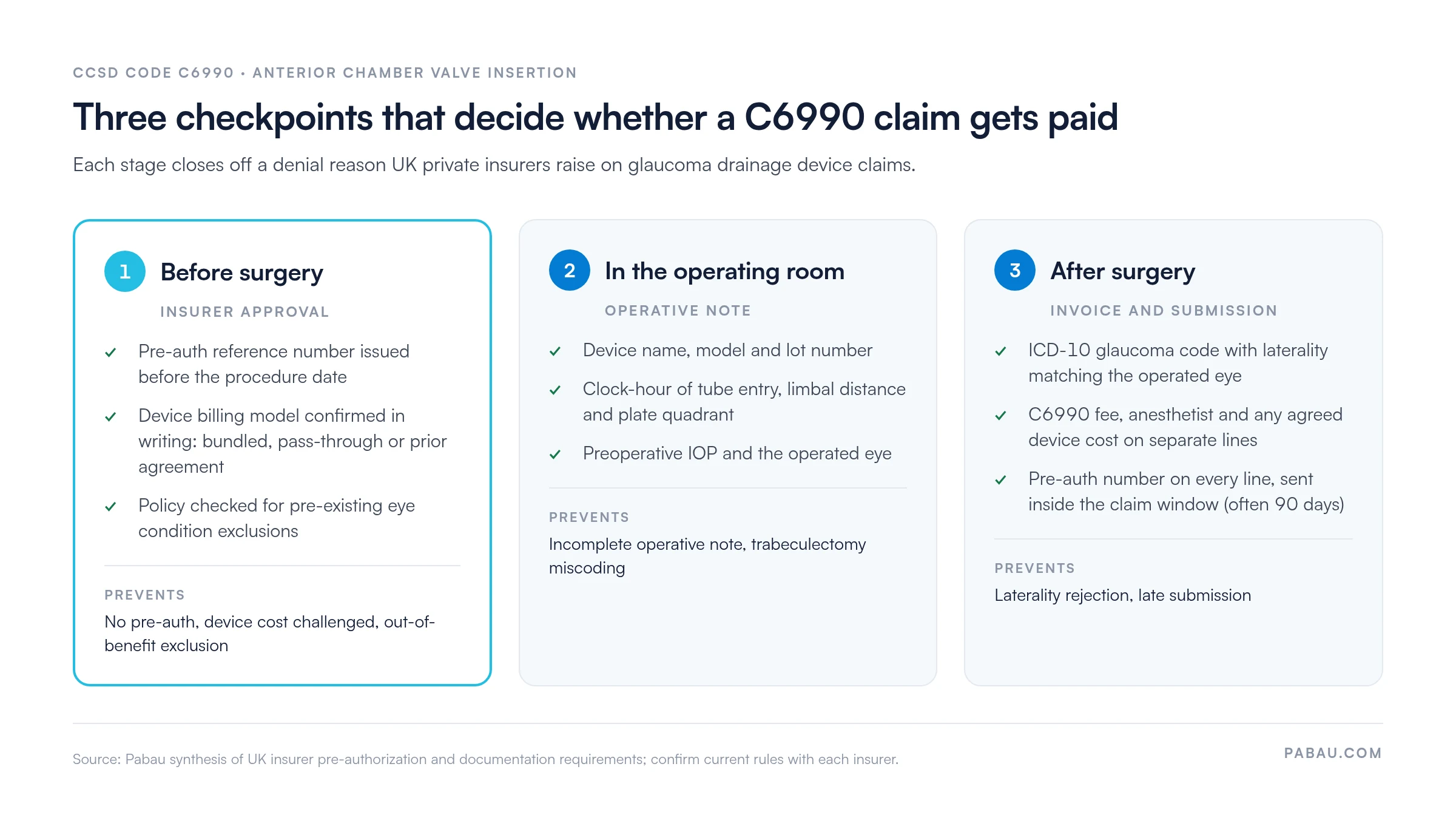
Denial patterns for CCSD Code C6990 are consistent across UK PMIs. The table below maps the most frequent root causes to the corrective action for each.
The Ahmed, Baerveldt or Molteno device cost may be bundled into the C6990 surgical fee or invoiced as a separate line. Individual insurer policy decides which, not a universal CCSD rule.
UK PMIs use three models:
Confirm the device billing model with each insurer at the pre-authorization stage. Ask directly: “Is the [device name] cost included in the C6990 fee under this patient’s policy, or may it be invoiced separately?” Then get the answer in writing.
The Bupa procedure fee schedule shows how Bupa structures surgical reimbursement. Device policy still needs confirming for each episode.
A C6990 claim needs a valid ICD-10 diagnosis code alongside the CCSD procedure code. Insurers check that the diagnosis matches the operated eye, so use the most specific code available.
The codes above follow ICD-10-CM. UK insurers often work from the UK ICD-10 5th edition, which has no laterality character. State the operated eye in the operative note and on the invoice. Use the NHS Classifications Browser to confirm the UK code for each diagnosis.
When the notes name no glaucoma type, H40.9 is the fallback, but insurers tend to query an unspecified diagnosis on a surgical claim. Billing managers new to this work can start with our guide to how medical billing works.
Without a shared system, a billing manager chases the pre-auth reference by email and checks the operative note by hand. Each insurer invoice is then built from scratch. Each of those handoffs is where a lot number or an authorization date goes missing.
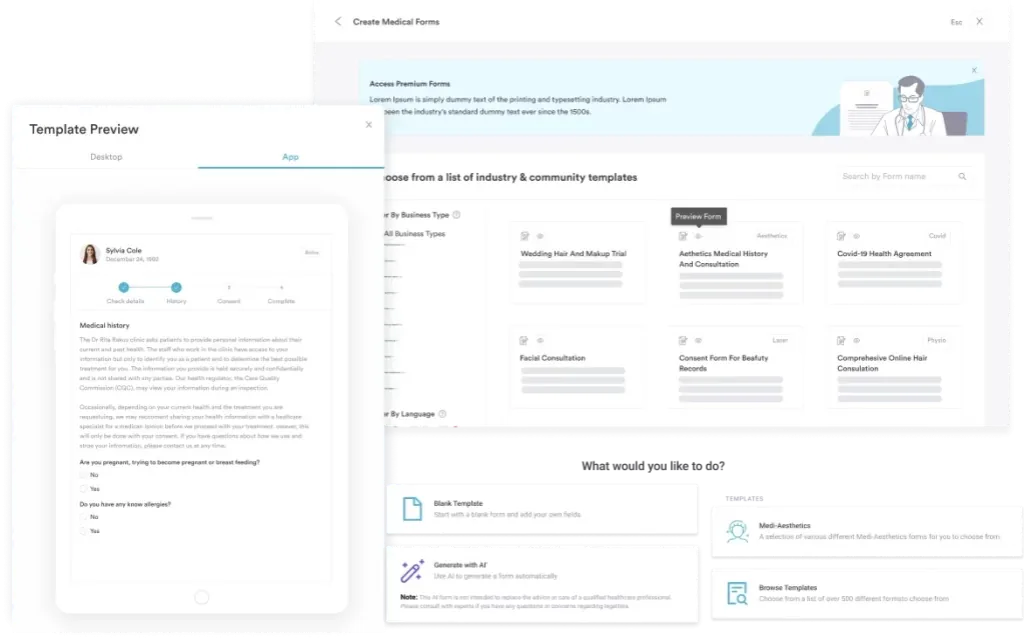
In Pabau, the prior-authorization code and its dates sit on the patient’s case, and Pabau flags a missing pre-auth before anyone raises the invoice. Custom surgical note forms let ophthalmic practices capture the device, lot number and placement fields that insurers check.
Claims then go to UK insurers through Healthcode and BUPA, and claims management tracks each one until it is paid. That leaves the billing team free to spend its time on insurer queries that need a person’s judgment.

Pabau supports UK insurance billing through Healthcode and BUPA, with claims management. It tracks prior-authorization codes and dates and flags a missing pre-auth before you invoice.

C6990 is a narrow code, which makes it straightforward to apply. If the operative note shows a tube and plate implanted into the anterior chamber, the code fits. If it shows a scleral flap, a laser or a micro-stent, look elsewhere in the schedule.
The revenue is usually lost before the coding step. A claim without a pre-auth reference, or a device invoice nobody agreed in advance, is hard to recover after the fact. Settle both with the insurer before the patient reaches the operating room.
Pabau tracks prior-authorization codes and dates on each case and flags a missing pre-auth before the invoice goes out. Book a demo to see how it handles UK insurance billing through Healthcode and BUPA for ophthalmic practices.

Need a broader CCSD billing reference? Bupa CCSD codes covers how Bupa maps CCSD procedure codes to its reimbursement schedule, with submission requirements across code categories.
Looking for a complete UK private billing workflow? Bupa procedure codes fee schedule explains how Bupa structures surgical fees and what practices submit alongside each invoice.
Billing a more complex glaucoma operation? CCSD Code C6160 covers complex glaucoma surgery and the codes it cannot be billed with.
Coding laser treatment for angle-closure glaucoma? CCSD Code C6230 walks through billing for unilateral laser iridotomy.
CCSD Code C6990 covers insertion of a valve or tube shunt into the eye’s anterior chamber to lower intraocular pressure in refractory or secondary glaucoma. It applies to glaucoma drainage devices such as the Ahmed valve and Baerveldt or Molteno implants. Trabeculectomy, MIGS devices and cyclodestructive procedures are typically coded separately.
The principal devices coded under C6990 are the Ahmed glaucoma valve (New World Medical), the Baerveldt implant (Johnson & Johnson) and the Molteno implant. MIGS devices such as the iStent, Hydrus and Preserflo MicroShunt are typically coded separately. Check device classification against the current CCSD schedule edition before submitting.
Trabeculectomy creates a scleral flap drainage pathway without implanting a device, and it is typically coded separately. C6990 covers implanting a physical drainage device, a tube and plate, into the anterior chamber. Billing a trabeculectomy code for a tube shunt insertion is a miscoding error that leads to denial and a resubmission with an explanation letter.
Yes. Bupa requires pre-authorization before anterior chamber valve surgery, as do AXA Health, Aviva Health and Vitality Health. Get pre-auth before the procedure date, because retrospective approval is not guaranteed. Bupa typically asks for evidence of failed prior treatment, the IOP history and a specialist referral letter.
Combining C6990 with other ophthalmic surgical codes on the same episode needs individual insurer agreement. If cataract extraction and valve insertion happen in the same sitting, list each procedure as a separate line with its own CCSD code. The insurer may apply a secondary procedure discount, so get written guidance from its medical reviewer first.
The most common denial reasons are a missing pre-authorization and a trabeculectomy code submitted in place of C6990. Others are an incomplete operative note, a device invoiced without insurer agreement, an exclusion for pre-existing eye conditions and a late submission. The denial table above gives the corrective action for each.
Neighboring CCSD codes cover trabeculectomy, cyclodestructive procedures such as cyclodiode laser, MIGS devices such as the iStent and Preserflo, and bleb revision. Check the specific code numbers against the current CCSD schedule at ccsd.org.uk, because the schedule is updated periodically.