Figuring out commission structures in a medical spa can feel like trying to solve a Rubik’s cube blindfolded.
Pay too little, and your team isn’t motivated. Pay too much, and suddenly, your profit margins are gasping for air.
Somewhere in between is the sweet spot, but how do you find it?
A good commission structure can keep your team motivated, help you retain top talent, and boost your bottom line. But med spas aren’t like regular salons—there are legal rules to follow before you start paying commissions.
This guide will break it all down – how commission works, what to consider, and how to stay compliant. No confusing jargon, just clear and practical advice to help you get it right.
⚠️ Disclaimer
This article is for informational purposes only and should not be considered legal advice. Always check with a qualified attorney or compliance expert before making changes to your compensation structure.
Can med spas legally offer commission-based compensation?
Short answer: It depends on where you’re located.
Unlike traditional spas, which operate more like retail businesses, med spas are classified as medical practices. That means they have to follow stricter regulations when it comes to paying employees – especially when commissions are involved.
Many states have laws that limit or outright prohibit commission-based pay for medical services. If your med spa is structured incorrectly, offering commissions could put you at risk of legal issues.
The key takeaway? Before rolling out a commission structure, you need to understand your state’s specific compensation rules.
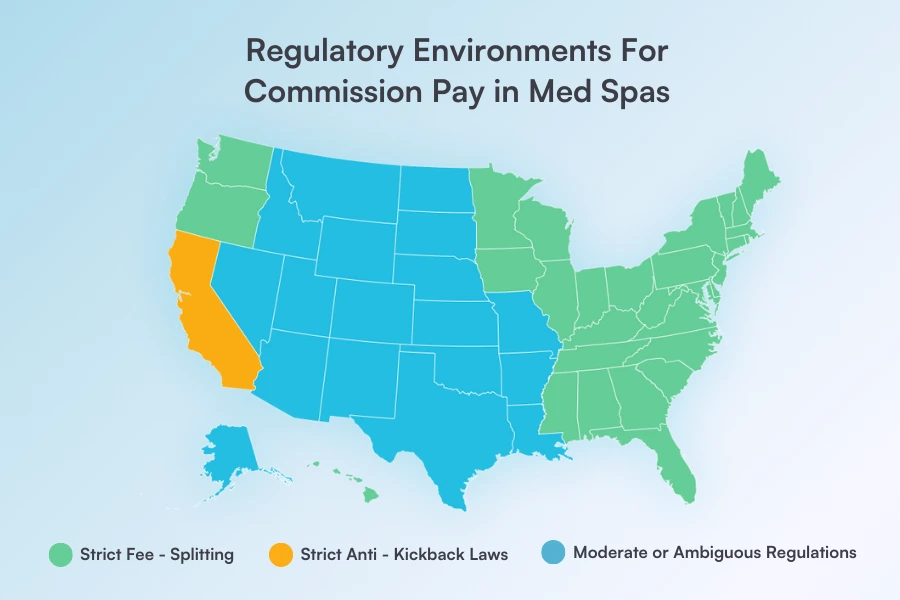
States with fee-splitting statutes
One of the biggest legal hurdles for commission-based pay in med spas is fee-splitting laws. These laws prohibit medical professionals from sharing fees with non-licensed individuals or entities in exchange for referralsor services.
The idea is to prevent financial incentives from influencing medical decisions – but they also impact how med spa employees can be paid.
Several states, including California, New York, and Illinois, have strict fee-splitting rules that could make commission-based pay risky.
Even if a state doesn’t explicitly prohibit fee-splitting, its medical board may still view commissions as unethical or unprofessional conduct. This means med spa owners must be extra careful when structuring employee compensation.
States with anti-kickback laws
Anti-kickback laws are designed to prevent healthcare providers from receiving or offering any compensation for patient referrals or for the purchase of services or goods.
Some states interpret commission-based pay as a form of kickback – especially if it’s tied to treatments performed by licensed medical professionals.
Federal Anti-Kickback Statute (AKS) is a federal law that applies to all states and prohibits offering or receiving any form of payment or commission for referrals of healthcare services or the purchase of items that are reimbursed by government health programs (like Medicare or Medicaid).
Med spas, especially those that accept government health insurance, need to ensure they comply with this law.
So what’s the safest approach? Consult a healthcare attorney before implementing any commission-based pay to ensure you’re in the clear.
Types of commission structures in med spas
Once you’ve navigated the legal side of things, the next step is choosing a commission structure that works for your med spa.
There’s no one-size-fits-all approach – some models are simple and predictable, while others are designed to push performance.
Flat rate commission
A flat-rate commission means employees earn a fixed dollar amount per service or product sold—no percentages, just a set payout. For example:
$20 per laser hair removal session sold
$10 per skincare product sold
This method keeps things simple, making payroll predictable and easy to manage.
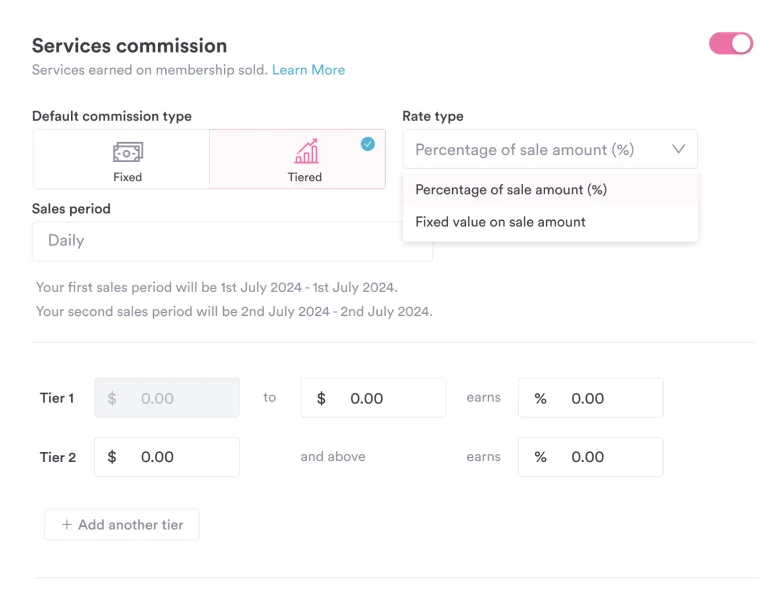
With an all-in-one practice management software like Pabau, you can easily manage booking and scheduling, record keeping, payment processing, as well as commission tracking.
With this feature commission you can set up and automate flat-rate payouts seamlessly – no spreadsheets or manual calculations needed.
Pros:
Easy to calculate and track
Predictable costs for business owners
Encourages employees to sell specific services or products
Cons:
May not incentivize high-value sales
Employees might prioritize quantity over quality
Percentage-based commission
With a percentage-based model, employees earn a cut of the revenue from each service or product they sell. For example:
15% commission on Botox services
10% commission on skincare product sales
This structure is great for incentivizing employees to sell higher-value treatments since their earnings increase with the price of the service. Most med spas set commission rates between 10-20%, depending on the service type and profit margins.
Pros:
Aligns employee earnings with revenue growth
Encourages higher-value sales and upselling
Cons:
Can lead to unpredictable payroll costs
Needs careful planning to maintain profit margins
Tiered commission systems
Tiered commission structures reward employees for hitting sales or service milestones. Instead of a fixed percentage, commission rates increase as sales go up. Here’s an example:
10% commission on sales up to $5,000
15% commission on sales between $5,001–$10,000
20% commission on sales above $10,000
This system creates a built-in incentive for employees to go the extra mile—the more they sell, the more they earn. It’s especially effective in med spas with strong retail products offerings or premium service packages.
Pros:
Motivates employees to sell more
Helps drive higher revenue
Cons:
Can be complex to manage without the right software
Employees may focus too much on hitting targets rather than client care
Hybrid models
A hybrid commission model combines hourly rate or salary with performance-based commissions. This setup provides financial stability while still rewarding employees for bringing in sales.
For example, a provider might earn:
$25 per hour + 10% commission on all treatments performed
$3,000 base salary + 5% commission on sales
This approach works well for med spas that want to attract top talent while ensuring team members stay motivated to generate revenue.
Pros:
Offers financial security for employees
Encourages performance while reducing turnover
Cons:
Can be costly if not structured correctly
Requires a balance between guaranteed pay and commissions
Key considerations for designing a commission structure for your med spa
A well-designed system should motivate your team, boost revenue, and keep your med spa financially healthy. But to get there, you need to think beyond just the numbers.
Labor laws
First things first – your commission structure has to be legal. Med spas operate under a different set of rules than traditional salons, so you’ll need to make sure your pay structure follows both state and federal labor laws.
Some key areas to keep in mind:
Minimum wage compliance: If employees earn commissions, their total pay (including commissions) must still meet minimum wage requirements.
Overtime regulations: If your employees are non-exempt, they’re entitled to overtime pay, which can complicate commission calculations.
Employee classification: Independent contractors and employees have different compensation rules – misclassifying staff can lead to hefty fines.
Before rolling out a new commission plan, it’s always a good idea to check with a legal or HR expert to make sure you’re staying compliant.
Fairness and transparency
Nothing kills motivation faster than confusion over pay. If employees don’t understand how their commissions are calculated – or worse, if payouts seem inconsistent—morale will take a hit.
To avoid misunderstandings, keep your commission structure crystal clear. That means:
Putting everything in writing – lay out exactly how commissions are earned, calculated, and paid.
Setting expectations upfront – discuss the structure during onboarding and provide ongoing training as needed.
Keeping communication open – encourage employees to ask questions and provide feedback to ensure fairness.
When everyone knows what to expect, there’s less room for disputes—and more room for growth.
Profit margins
A commission system should reward employees without hurting your bottom line. If commissions are too high, your spa’s profitability could suffer. If they’re too low, your team won’t be motivated to sell. The trick is finding the right balance.
A few ways to protect your margins:
Adjust commission rates based on service profitability – higher commissions for high-margin treatments, lower for those with tighter margins.
Incorporate retail sales incentives – product sales can be a great way to boost revenue without affecting service profits.
Use tiered commissions strategically – reward top performers without overpaying across the board.
By carefully structuring commissions, you can incentivize sales while keeping your med spa financially stable.
Tracking performance
The best commission plan in the world won’t work if you can’t track it accurately. Manually calculating commissions can lead to errors, disputes, and wasted time. Instead, invest in a reliable tracking system to automate payouts and keep things running smoothly.
With software like Pabau, you can:
Track employee sales in real-time
Automate commission calculations to ensure accuracy
Generate reports to monitor performance and adjust incentives as needed
When commissions are transparent, automated, and easy to track, your team can focus on what really matters, that being delivering great client experiences and growing your business.
Streamline your med spa staff management with Pabau
Designing the right commission structure for your med spa takes careful planning – you need to balance motivation, compliance, and profitability while keeping things fair and transparent for your team.
The good news? You don’t have to do it alone. That’s where Pabau comes in.
It’s an all-in-one practice management software that provides everything a med spa needs, in this case:
Automation of commission tracking
Simplifying payroll
Keeping your staff motivated without the headache of manual calculations
Plus, our all-in-one system helps you manage scheduling, client records, and performance insights – so you can focus on growing your business instead of crunching numbers.
Ready to take the stress out of staff management? Book a demo today!