EHR ROI: How to calculate and maximize your return
EHR ROI is the financial return a practice earns on its electronic health record...

Last Updated: Oct 15, 2026
The med spa compensation strategies that hold up best pair base pay with commission or tiered commission. Size the mix so provider pay stays in the low-to-mid 30% range of service revenue. How a platform handles staff commissions and reporting is among the areas covered in our ranking of software for med spas.
Base pay keeps good people through a slow January. Commission rewards the injectors and estheticians who fill the book. Get the balance wrong and you either lose your best provider to the practice down the road, or watch payroll swallow the margin.
This guide uses the payroll-first method. You set the labor budget first, fit each role’s pay model inside it, then test the plan against one month of numbers. It covers every pay model, pay by role, a worked commission example and the legal limits.

Most med spas do best with base pay plus commission or tiered commission, not straight commission or flat salary alone.
The payroll-first method sets the labor budget before the pay models: provider pay in the low-to-mid 30% of service revenue, total labor under about 55%.
Match each role’s model to the revenue it controls, so providers earn a production share and support staff earn base pay plus team bonuses.
Paying commission on net revenue after product cost, rather than gross, can move an injector’s pay by thousands of dollars a month.
Commission on medical treatments can breach state fee-splitting rules, so check your state before paying nurses a share of treatment revenue.
The three main types of compensation strategies are base pay, commission and hybrid pay, which combines a fixed base with commission.
Most med spas then stack two layers on top. Bonuses reward hitting a target, and tiered commission raises a provider’s rate as their monthly revenue grows. Each model below trades payroll predictability against motivation in a different way.
Base pay is the fixed amount a team member earns before any commission or bonus, paid as either an hourly wage or an annual salary.
Hourly staff are non-exempt under the Fair Labor Standards Act (FLSA), so hours over 40 in a workweek earn time and a half. Commission earned by an hourly employee also counts toward the regular rate used to calculate that overtime. Plenty of owners only find that out at their first payroll audit.
Commission-based pay gives a provider a percentage of the revenue from the treatments they perform or the products they sell.
Service commission is the big number, because treatments carry most of a med spa’s revenue. Retail commission on skincare is usually a much smaller rate on a much smaller base. Rates also vary by region. Mindbody puts West Coast service commission in the 30s, while pockets of the Northeast reach 50% and higher.
Straight commission gives the practice the most predictable payroll ratio, because pay only rises when revenue does. The trade-off is income volatility for the provider, which makes it a hard sell to an experienced injector with a mortgage.
Hybrid pay combines a guaranteed hourly rate or salary with commission or a bonus once a provider passes a production target.
Diamond Accelerator calls hourly-plus-bonus the most popular model for injectors. Its suggested trigger is revenue of five times the provider’s hourly rate before the bonus starts. At $45 an hour, that means the bonus starts once the injector bills more than $225 for each hour worked.
The base protects the provider in slow weeks. The trigger protects the practice, because no bonus is paid on revenue that barely covers the base.
Tiered commission raises a provider’s rate once monthly revenue passes a threshold, while profit sharing pays leaders a slice of the practice’s profit.
Here is an illustrative tiered plan. The injector earns 20% on the first $25,000 of monthly service revenue and 25% on everything above it. In a $35,000 month, that pays $5,000 plus $2,500, or $7,500 in total. The effective rate is about 21%, while the top-tier rate still gives a strong producer a reason to push.
Profit sharing fits managers and lead injectors, whose decisions shape the whole practice rather than one column of the schedule. Diamond Accelerator’s warning is blunt. An injector responsible for $80,000 to $100,000 or more a month may start thinking about going solo. A profit share gives them a reason to stay.
The table below sets the six models side by side, with the role each one fits best and the risk it carries.
The right med spa compensation models match pay to how much revenue each role directly controls. Providers earn a production-linked share, and support roles earn base pay plus team bonuses.
Nurse injectors and nurse practitioners carry the highest revenue per hour, so their pay is where the payroll-first method matters most. Our guide to what aesthetic nurses earn breaks the range down by experience. Diamond Accelerator puts injector compensation at about 20% of the revenue they generate, within an 18% to 25% band.
Estheticians vary most by setting. The BLS reports a median of $21.79 an hour for skincare specialists in May 2025, rising to $24.81 in physician offices. Medical settings pay more, so a med spa esthetician salary usually beats a day spa rate before any commission is added.
Front desk staff earn close to the receptionist median of $18.27 an hour, or $19.00 in healthcare settings. The front desk books, confirms and sells memberships, so a small team bonus tied to those numbers costs little and changes behavior.
Spa managers have no reliable national benchmark, so the med spa manager salary you offer should come from local postings. The BLS median for medical and health services managers, $59.55 an hour, mostly reflects hospital administrators. Treat it as a ceiling.
A salary plus a bonus tied to the labor ratio keeps your manager guarding the same budget you are.
Medical directors are paid for oversight, not production. Our guide on how to hire a medical director reports $500 to $4,000+ a month for an off-site retainer. A full-time, on-site physician runs $120,000 to $250,000+ a year, based on commonly reported salary data such as Glassdoor.
Any med spa salary figure is a national midpoint. Rates in Los Angeles, Miami or New York run well above those in smaller markets, so check local job postings before you publish a range.
Build a med spa compensation plan payroll-first. Set the labor budget as a share of revenue, fit each role’s pay model inside it, then test it on one month of numbers.
The six steps below are the payroll-first method in order. Together with the two tables above, they work as a copyable compensation plan template.
Choose the model by how predictable your demand is. Unpredictable demand calls for base pay, steady demand for hybrid pay, and proven high producers for tiered commission.
Revisit the stage at each review. The same injector can move from hourly to hybrid to tiered as their book grows, without the practice ever rewriting its budget.
Commission on net revenue deducts product cost before the rate applies, and on injectables that one definition can shift thousands of dollars a month.
Take one injector’s month, using illustrative figures. They bill $40,000 in treatments, and toxin and filler cost the practice $12,000. Their commission rate is 30%.
The chart below shows where the rest of the $40,000 goes in each version.
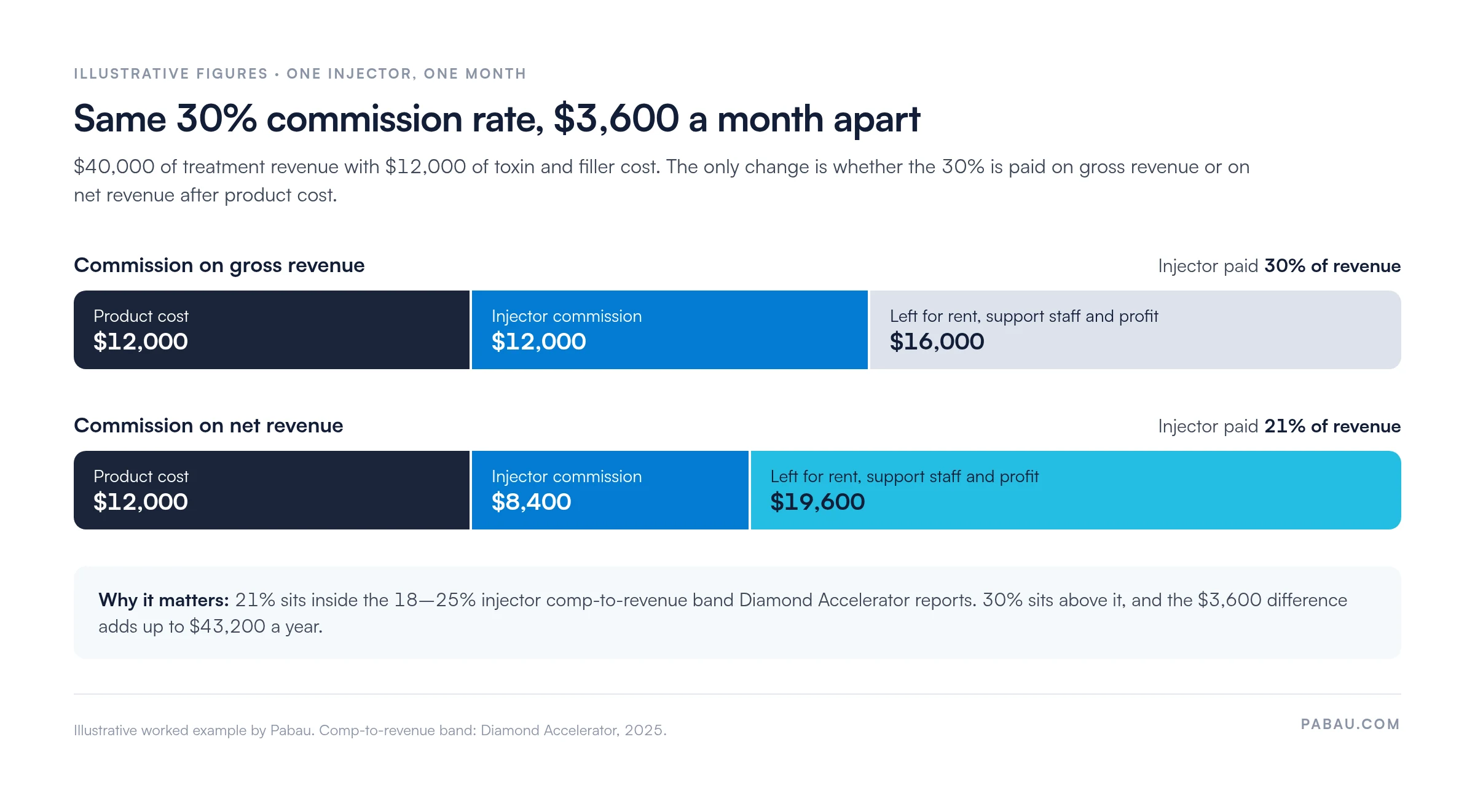
When we set up commission rules with practices during onboarding, gross or net is usually the first decision to settle. Neither answer is wrong. A net plan simply needs a higher headline rate to feel competitive, so say which one you use when you recruit.
Pay structure is only half of retention. Staff stay longest when a fair pay model comes with visible progression and benefits they value. Those three levers also win new hires, because candidates compare offers on all of them.
A base that sits below local postings is the fastest way to lose staff, whatever the commission rate. Check local listings for each role every review cycle, and set your base at or slightly above the local midpoint. Hiring cheaper, less experienced staff tends to cost more in turnover and retraining than it saves.
Individual commission can pit providers against each other over walk-ins and rebookings. A team bonus tied to a monthly revenue or rebooking target gives the front desk and the treatment rooms the same goal. A 2024 CaptivateIQ survey polled 1,000 commissionable US workers in sales roles. Of those, 57% said commissions or bonuses motivate them to do a better job.
Top providers leave when they cannot see what comes next. A simple ladder, such as associate injector, senior injector and lead injector, gives each step a higher base or commission tier. Tie each step to training completed and results sustained, so promotion is earned rather than negotiated.
Retail commission works when it rewards recommendations that match the treatment plan. Keep the rate modest, pay it on products tied to the patient’s aftercare, and track returns. Patients notice a hard sell, and a pushy retail culture costs more in trust than it earns in product sales.
Benefits often decide between two similar offers. The ones med spa staff value most are practical:
Paying non-physicians a percentage of medical-service revenue can breach state fee-splitting and corporate practice of medicine rules. Check your state before paying commission on medical treatments.
Fee-splitting statutes stop physicians from sharing fees for medical services with non-physicians. Anti-kickback rules add a second limit. According to the American Med Spa Association, paying commission for steering a patient to another provider can count as a kickback.
California is the strictest common example. Commission on medical treatments is generally not allowed there, while commission on retail and non-medical services typically is. AmSpa notes that paying for patient referrals in California risks up to a year in prison and a fine of up to $50,000. Our guide to med spa commission laws covers the state-by-state detail.
The compliant alternatives are the models above: hourly or salary pay, bonuses on non-medical metrics, and commission on retail. Confirm your plan with a healthcare attorney in your state.
A payroll-first plan only works if you can see each provider’s revenue and commission without rebuilding a spreadsheet every month. Practice management software like Pabau keeps appointments, invoices and staff records in one system, built as medical spa software.
Pabau’s commission feature lets you set fixed or tiered commission as a percentage or a fixed value. You can set separate rules for services, products, memberships and gift cards. Pabau calculates each team member’s commission from the invoices they are attached to, so payday stops depending on manual tallies.
Pabau’s staff scheduling and reporting sit alongside the commission rules. You can check revenue by practitioner against your labor budget before the next review.


Pabau works out fixed and tiered commission from every invoice and reports revenue by practitioner, so your compensation plan stays inside its labor budget.

Med spa compensation strategies that last start with the budget, not the rate. Once provider pay has a ceiling in the low-to-mid 30% of service revenue, every model choice becomes a question of fit rather than guesswork.
Give new providers security, give steady ones a share of production, and give your top producers a tier worth reaching. Then decide gross or net in writing before anyone signs, because that single line moves more money than most rate negotiations.
Book a demo to see how Pabau tracks tiered commission and practitioner revenue, so your compensation plan pays out correctly every month.

Planning your own pay as well as your team’s? Med spa owner salary shows what owners take home at each stage of the business.
Hiring your next esthetician? How to find and hire skilled estheticians covers where to find candidates and how to assess them.
Adding nursing support to the team? How to hire LPNs at your med spa explains what LPNs can do and how to bring them on.
Running a practice in California? Can a nurse open a med spa in California? walks through the ownership and supervision rules.
Operating in Texas? Medical director for med spa Texas sets out the 2026 rules and typical costs.
The core pay models are base pay, commission and hybrid pay. Base pay is a salary or hourly wage, commission is a share of revenue, and hybrid pay combines both. Most med spas add bonuses or tiered commission on top.
A part-time, off-site medical director retainer typically runs $500 to $4,000 or more a month. A full-time, on-site physician earns about $120,000 to $250,000 or more a year, depending on state and service mix.
Provider pay should sit in the low-to-mid 30% range of service revenue, according to Mindbody. Add support staff, payroll taxes and benefits, and total labor should stay under about 55% of revenue.
Yes, usually as hourly pay plus commission on services and retail. The hourly base covers quieter weeks, while commission rewards rebooking and aftercare sales. In strict states, keep commission to non-medical services and products.
Commission for nurses on medical treatments is restricted in many states, including California, under fee-splitting and corporate practice of medicine rules. Hourly pay with bonuses on non-medical metrics is the safer structure.