Professional development record
A professional development record is a structured log of a healthcare practition...

7
Last Updated: Oct 8, 2026

In Texas, only a licensed physician can own the medical side of a med spa, through a professional entity like a PLLC or PA.
Non-physicians can’t own the medical practice, but they can own and run the business through a Management Services Organization (MSO).
Physician assistants can hold a minority stake in the medical entity, but nurses, estheticians, and investors can’t own it directly.
A licensed physician must serve as medical director and control every clinical decision, whoever owns the business.
Texas splits regulatory oversight in two. The Texas Medical Board licenses the medical practice, and the Texas Department of Licensing and Regulation licenses the cosmetic side.
Texas isn’t just the second largest state in the US. It’s also one of the country’s busiest markets for aesthetics, home to thousands of med spas. Nationally, providers perform 28.2 million minimally invasive cosmetic treatments a year across more than 11,000 med spas.
But before you sign a lease and stock up on Botox, one question decides how you structure the rest. Who can legally own a med spa in Texas?
The short answer is that a licensed physician has to own the medical side of the business. That single rule shapes your ownership structure, who makes clinical decisions, and how a non-physician can still profit from the business.
This guide breaks down what the law requires and how the ownership structure works in practice. That way, you can set the business up right the first time. Next comes choosing a platform to run it on, the subject of our medical spa software guide.
Under Texas law, only a licensed physician can own the medical side of a med spa.
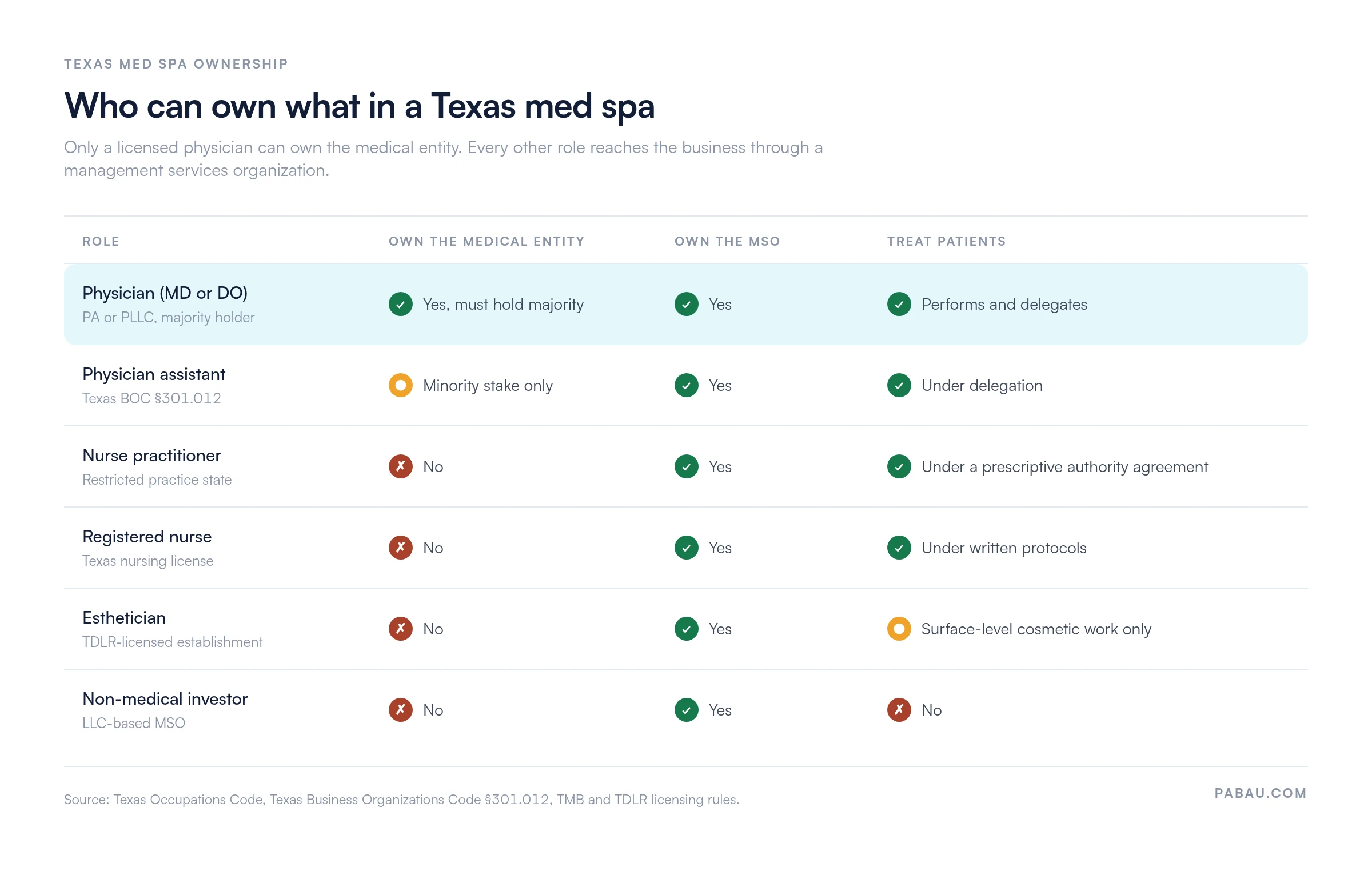
Physician assistants can hold a minority stake in the medical practice, but a licensed physician must keep majority ownership and control. Nurses, estheticians, and non-medical investors can’t own the medical practice directly. They take part through a Management Services Organization (MSO) instead.
The table below sets out what each role can own, and who is allowed to treat patients.
Regulations for med spa ownership vary from state to state. But the general rule is the same almost everywhere. Only licensed physicians can own a med spa or supervise the medical services it provides.
The point of that rule is patient safety. A physician may not personally perform every treatment, but someone with medical training has to decide who does.
That leaves a licensed physician with several responsibilities to juggle daily.
A Management Services Organization, or MSO, is a separate business that handles the operational and administrative side of a med spa. The work covers scheduling, marketing, billing, hiring non-clinical staff, equipment, and premises.
The MSO is how non-physicians legally take part in a Texas med spa. The structure uses two entities. A physician-owned professional entity owns the medical practice, and a non-physician-owned MSO runs the business side under Texas med spa licensing laws.
A management services agreement (MSA) ties them together, setting out the services the MSO provides and how it’s paid. The physician keeps full control of clinical decisions, and the MSO holds no ownership in the medical practice.
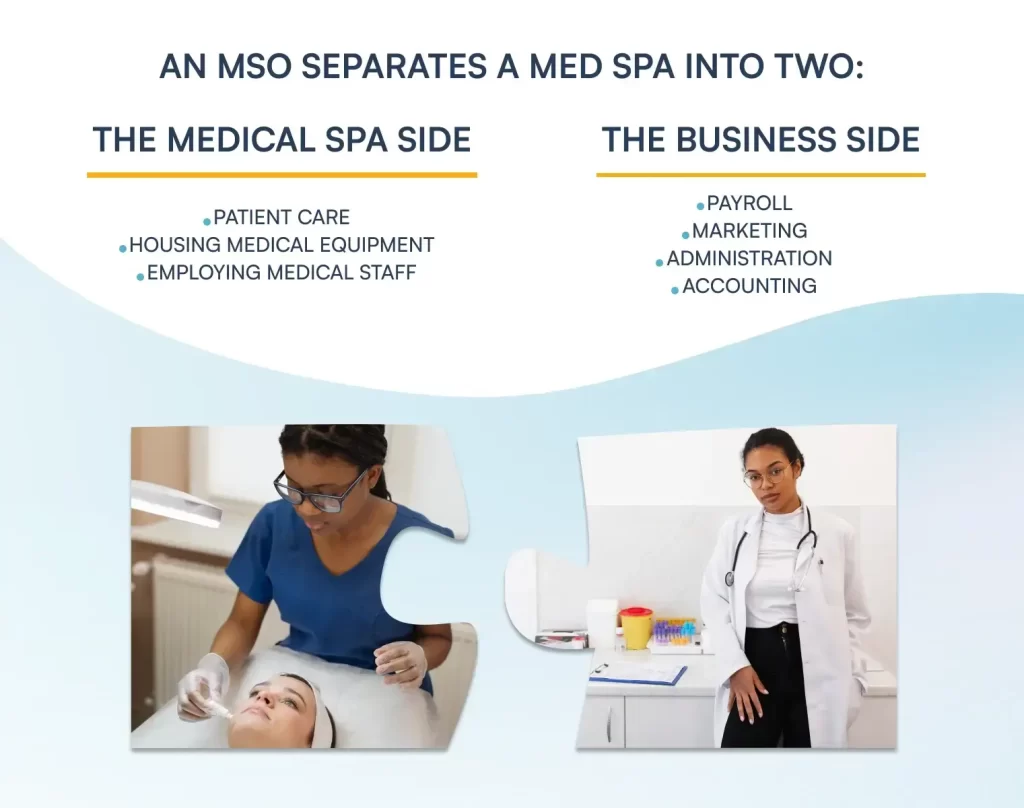
💡The only way non-physicians can share in a Texas med spa is through an MSO. That MSO is usually set up as an LLC to protect personal assets. They can profit from the business side, but the medical practice itself stays physician-owned.
No, a nurse practitioner cannot own the medical practice inside a Texas med spa, because Texas reserves that ownership for licensed physicians.
The reason sits in scope of practice rather than company law. The American Association of Nurse Practitioners classifies Texas as a restricted practice state for nurse practitioners (NPs). A Texas NP works alongside a physician for their whole career, however senior or experienced that NP becomes.
That physician relationship is formal and written. Texas Occupations Code §157.0512 requires an NP who prescribes to hold a prescriptive authority agreement, signed and dated by both parties. Botox, dermal fillers, and prescription-strength peels all sit inside that delegation.
The prescriptive authority agreement is not a one-time filing. Texas requires the agreement to describe a quality assurance and improvement plan, and to document how that plan runs. In practice that means chart review, plus a meeting between the NP and the delegating physician at least once a month.
So the delegating physician is a standing operating cost and a monthly calendar commitment. Budget for that review time the same way you budget for rent or laser servicing.
None of that blocks a nurse practitioner from owning the business. An NP counts as a non-physician like anyone else, so the MSO structure described above applies in full. The NP owns the management company, a physician owns the medical entity, and a management services agreement links the two.
Texas company law draws the same line. Texas Business Organizations Code §301.012 lets physicians and physician assistants jointly own the professional entity. Advanced practice registered nurses are absent from that provision, so an NP’s stake belongs in the MSO rather than in the medical practice.
In the Texas med spas we onboard, the NP is often the one running the floor day to day. The delegating physician appears in the protocols and the chart reviews.
So a nurse practitioner can open a med spa in Texas, own the company, and take the profit. What that NP cannot own is the medicine. Registered nurses and licensed vocational nurses follow the same MSO route. Our guide to nurses opening med spas sets out what each license allows in Texas.
A Texas med spa has to satisfy medical rules and business rules at the same time. In practice that means a physician-owned medical entity, a designated medical director, and licenses from two separate state agencies.
If you are still planning the business itself, our guide to starting a med spa covers the steps that come before ownership structure.
In Texas, med spas must be owned, or at least co-owned, by a licensed physician. Many of the services a med spa provides are classified as medical procedures. Someone licensed to perform or oversee them has to hold the practice.
Texas law lets non-physicians own the business side of a med spa. A licensed physician must still manage and oversee the medical work performed each day.
Non-physician owners cannot make medical decisions. The licensed physician who serves as medical director oversees the medical treatments and ensures compliance with state standards.
No single license covers a med spa. You need a stack of them, spanning local business permits, state medical oversight, and federal privacy rules. A med spa compliance checklist helps keep every permit current so you can operate legally and avoid fines.
The key licensing requirements and permits for opening a med spa include:
Which licenses your med spa needs comes down to the services you offer, and two Texas agencies split the oversight.
A full-service med spa in Texas usually needs both. The setup needs a physician-led medical practice registered with the TMB, plus a TDLR establishment license for the cosmetology side.
The Medical Practice Act (MPA) is a state-specific law designed to protect the public from the unprofessional or unsafe practice of medicine.
It outlines what physicians and healthcare professionals can and cannot do within their scope of practice.
Many med spa treatments, including injectables, laser therapy, microneedling, and IV therapy, are considered medical procedures and fall under the practice of medicine.
Each US state has its own version of the MPA. In Texas, it’s mandated under the Texas Occupations Code. Here’s how the MPA regulates med spas:
Most med spas employ several kinds of healthcare professionals. Alongside licensed physicians, there are nurse practitioners, physician assistants (PAs), registered nurses, and estheticians.
Take nurses as an example. They must be licensed to perform medical treatments such as injecting Botox, microneedling, or chemical peels. Their nursing license confirms they have the skills to practice safely.
To become licensed, nurses must:
Yes, but only at the surface. A TDLR-licensed esthetician in Texas can perform cosmetic microneedling on the outer layer of the skin. That is where the scope of practice stops.
Once the treatment goes deeper, or uses prescription serums or platelet-rich plasma (PRP), it becomes a medical procedure. Then it has to be delegated and supervised by the medical director. The same line applies to Botox, dermal fillers, and laser treatments. Estheticians can’t perform or own these medical services.
Informed consent can feel repetitive to collect, but it is what proves the patient understood the treatment. A signed form records that they knew the benefits, the risks, and the likely outcome.
It also confirms their personal and medical information is handled securely, in compliance with HIPAA regulations. To meet HIPAA standards, med spas should:
Running a med spa means collecting and storing protected health information (PHI). That data has to stay secure at every point, from the intake form to the treatment note.
Where you store it decides how much of that protection you get by default. Purpose-built medical spa EMR software handles access controls, audit logs, and encryption without a separate project to set them up.
Poor record-keeping can have serious consequences for both the patient and the med spa. Some of the biggest risks are:
Med spas are treated as medical practices, so med spa owners have to satisfy both general business rules and Texas’s medical regulations.
Here’s how the ownership usually gets structured:
Texas med spas answer to three state bodies and two federal ones. The Texas Medical Board and the TDLR handle most of the day-to-day licensing work between them.
💡To stay off the regulatory radar, med spas must comply with Texas’s Corporate Practice of Medicine doctrine, known as CPOM. CPOM keeps medical decision-making in the hands of licensed physicians, free from corporate or financial influence.
An MSO structure splits a med spa into two entities whose records still have to agree with each other. The medical director signs off on treatments, and the management company runs the books.
Practice management software like Pabau keeps both sides working from the same patient file. Purpose-built medical spa software holds consent forms, treatment notes, delegation protocols, and license records in one system.
Your medical director and your MSO can then both do their jobs without the paperwork piling up:
Multi-location med spas face the same documentation load as a single practice, just multiplied. Ageless Enhancements Med Spa used Pabau to bring pen-and-paper patient records into one system across two locations. The switch cut roughly 10 minutes of admin per patient, time a medical director can put toward patient oversight instead of chasing paperwork.

Pabau’s digital records, intake forms, and HIPAA-compliant storage give your medical director full visibility into every treatment, consent, and license on file. Your ownership structure then holds up if TMB or TDLR ever come asking.

Texas doesn’t leave room for a workaround on med spa ownership. If you’re not a licensed physician, you don’t get to own the medical practice. Structure the business correctly with an MSO and a management services agreement. You can still build, run, and profit from a med spa without ever holding a scalpel or a syringe.
Skipping this step draws Texas Medical Board scrutiny. So does structuring around it with an informal fee arrangement instead of a proper MSA, which can also void liability coverage. Get the entity structure right before you sign a lease, not after a complaint lands on the TMB’s desk.
Once ownership is settled, the compliance work doesn’t stop. HIPAA, TDLR licensing, and record keeping all need a system that holds up as the practice grows. Book a demo to see how Pabau helps med spa owners in Texas keep documentation audit-ready from day one.

Want the national picture before you dig into Texas specifics? Medical spa ownership rules breaks down how they shift from state to state.
Curious how Texas rules compare with other state licensing regimes? Med spa licensing laws covers scope of practice and compliance in more depth.
Ready to map out every permit before you open your doors? Medical spa requirements checklist walks through the licenses and inspections most owners forget.
Still deciding whether a med spa is the right business to build? How to start a med spa covers the business planning steps that come before ownership structure.
Looking to keep clients engaged after they book? Patient engagement strategies outlines eight tactics for improving engagement and six criteria for choosing a platform.
Start by locking in the ownership structure. The medical practice must be physician-owned, with non-physicians taking part through an MSO. From there, work through TMB and TDLR licensing, a medical director, HIPAA-compliant systems, and the right business entity. Handle those before you hire, fit out a space, and launch.
Not the medical side. A non-physician can’t own the medical practice. The business side is still open to them through a Management Services Organization (MSO) that partners with a physician-owned practice.
A nurse can help run and profit from a med spa through an MSO, but they can’t own the medical practice itself. Only a licensed physician can own that, with physician assistants able to hold a minority stake.