HIPAA compliant texting: What you can send patients & how to communicate securely
HIPAA compliant texting is possible when a text holds no protected health inform...

Last Updated: Oct 16, 2026
Commission laws for med spas allow commission pay in general, but many states ban paying licensed staff a percentage of medical procedure fees. Three bodies of law drive that ban: fee-splitting rules, the corporate practice of medicine (CPOM) doctrine, and anti-kickback statutes. Each state mixes them differently. Staff commissions and reporting are two of the areas compared in our ranking of the top med spa software.
Retail product sales and flat bonuses agreed in advance are the usual safe ground. A 10% cut of an injector’s filler revenue is where med spas most often get into trouble.
This guide maps the rules in six states: New York, California, Arizona, Texas, South Carolina and Florida. It also works through the dollar difference between a commission and a flat bonus. Then it shows how software for med spas keeps every payout documented.

Commission pay is legal at med spas in general, but many states ban paying licensed staff a percentage of medical procedure fees.
Fee-splitting rules, the corporate practice of medicine (CPOM) doctrine and anti-kickback laws are the three legal bases behind those bans.
The med spa commission compliance map compares six states, from strict New York, California and Texas to more permissive Florida.
Flat per-treatment bonuses, non-revenue targets and retail product commissions carry less fee-splitting risk than a percentage of procedure revenue.
Practice management software like Pabau records every commission rule and payout, so you can show an auditor or attorney how staff were paid.
Commission laws matter because med spas sell medical procedures, and medical spa laws treat a share of a medical fee differently from a sales commission. A salon can pay a stylist a percentage of every haircut. A med spa paying a nurse a percentage of every filler syringe can break three separate rules:
The penalties land on both sides of the paycheck. Licensed staff risk board discipline, up to suspension or revocation of their license. Owners face fines, and in California, possible criminal charges.
Most commission problems start with a pay plan borrowed from a salon or retail business. In med spas we onboard, the pattern we see most is one percentage applied to every service, from skincare sales to filler appointments. That single rule mixes low-risk retail commission and high-risk procedure commission in the same payroll line.
These three setups cause the most trouble:
Med spa commission pay is regulated by state labor boards, state medical and nursing boards, and HIPAA, which covers the records behind each payout. Labor boards decide how much you must pay. Medical and nursing boards decide what you may pay a licensed person for.
Because those rules overlap, have a healthcare attorney review any new commission plan before you roll it out.
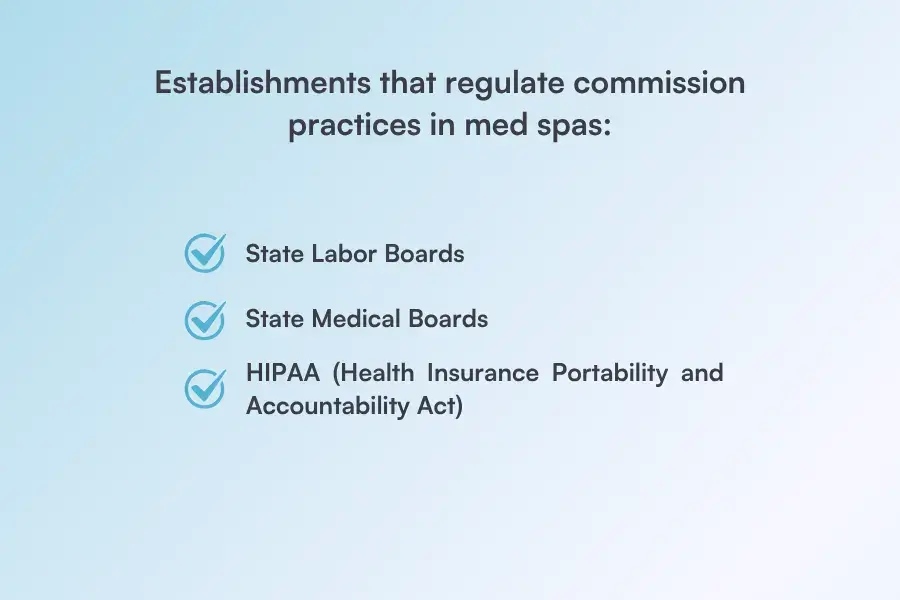
State labor boards
State medical and nursing boards
HIPAA (Health Insurance Portability and Accountability Act)
Fee-splitting and commission rules vary more between states than almost any other area of medical spa laws. Here is how six states handle commission on medical procedures.
New York treats sharing professional fees with anyone outside the licensed profession as misconduct, so commission on medical procedures is generally off-limits. Education Law section 6530(19) lets physicians share fees only with partners, employees or associates licensed in the same profession.
Regents Rule 8 NYCRR 29.1(b)(4) applies the same limit to nurses and every other licensed profession. New York also enforces corporate practice restrictions strictly, so a lay-owned spa can’t take a cut of a nurse practitioner’s procedure fees. The state labor department polices wages, but it can’t override those professional limits.
A California medical spa can’t pay licensed staff a percentage of medical treatment revenue, because the state’s CPOM doctrine and fee-splitting laws both forbid it. Business and Professions Code section 2400 bars corporations from practicing medicine.
Paying or accepting a commission for patient referrals also breaches section 650. Under subdivision (i), a first conviction can bring up to one year in county jail, a fine of up to $50,000, or both.
Commission on retail products and non-medical spa services is generally allowed. Total pay must still meet California’s minimum wage and overtime rules.
Arizona allows commission on medical procedures only for licensed professionals who personally provide or take part in the treatment. Anyone can own an Arizona med spa, but a licensed physician must oversee clinical services as medical director.
A.R.S. section 32-1401(27)(v) makes it unprofessional conduct for a physician to divide a professional fee for patient referrals. So paying an unlicensed marketer or front desk employee a percentage for booking procedures remains risky.
Texas treats paying anyone to secure patients as a crime, and generally only physicians can own a medical practice. Texas Occupations Code section 165.155 makes it a Class A misdemeanor for a physician to pay or reward anyone for soliciting patients.
The broader Patient Solicitation Act, section 102.001, covers every state-licensed health professional and names commissions outright. Section 164.052 lets the Texas Medical Board discipline a physician who helps an unlicensed person or corporation practice medicine.
That is why lay-owned Texas med spas usually run through a management services organization (MSO). Ownership also decides who a commission can legally flow to. Our guide to Texas med spa ownership walks through that setup.
Delegated cosmetic procedures must also follow the Medical Board’s Chapter 169 rules, including written protocols the supervising physician reviews every year. For Texas nurses and PAs, a salary plus a bonus that doesn’t track procedure fees is the lower-risk setup.
South Carolina has no statute written specifically for med spa commission or fee-splitting. Percentage pay on procedures can still breach CPOM case law and board ethics rules. The misconduct grounds in S.C. Code section 40-47-110 never mention fee-splitting by name.
Two of those grounds still reach physician fee splitting: obtaining fees under dishonorable circumstances, and violating the board’s code of medical ethics. South Carolina’s corporate practice rule comes from case law, starting with Ezell v. Ritholz (1938).
Corporations and lay owners can own a South Carolina med spa. They can’t direct or influence a clinician’s medical judgment, and that line matters most for nurse injectors.
Nurse practitioners perform medical acts under a practice agreement with a physician, as set out in section 40-33-34. A commission that rewards an NP for adding syringes per patient invites the question of who is steering treatment.
Because no statute draws the line, talk to a South Carolina healthcare attorney before paying any nurse injector or nurse practitioner a percentage. Bring the pay plan and the practice agreement to the same meeting.
Florida has the most permissive rules, with no CPOM statute for aesthetic practices. The fee-splitting ban targets referrals: Section 458.331(1)(i) bars commission or split fees for them, and Section 456.054 bars kickbacks, with no cash-pay carve-out. A practice not wholly owned by licensed practitioners may need a Health Care Clinic License. The Board of Medicine accepts pay tied to a provider’s own services but rejects shares of total revenue — a nurse paid for their own treatments is safer than a marketer paid per referral.
This map compares all six states — general information, not legal advice, as a starting point with your attorney; sources checked September 2026.
| State | Can licensed staff earn commission on medical procedures? | Key legal basis | Safer alternative |
|---|---|---|---|
| New York | Generally no. Only same-profession partners, employees or associates may share fees. | Fee-splitting (Education Law §6530(19), 8 NYCRR 29.1(b)(4)) and strict CPOM | Salary plus flat bonuses, and commission on retail only |
| California | No, not on medical treatments. | CPOM (B&P §2400) and referral payments (B&P §650, fines up to $50,000) | Flat or tiered bonuses, and commission on retail and non-medical services |
| Arizona | Yes, but only for licensed professionals who personally provide the treatment. | Fee-splitting for referrals (A.R.S. §32-1401(27)(v)) | Flat bonuses for unlicensed staff, never pay per referral |
| Texas | High risk, so avoid percentages of procedure fees. | Strict CPOM (Occ. Code §164.052) and patient solicitation (§165.155, §102.001) | Salary plus flat bonuses inside a compliant MSO structure |
| South Carolina | Gray area, because no statute addresses it directly. | CPOM case law (Ezell v. Ritholz) and misconduct grounds (§40-47-110) | Flat bonuses, reviewed by counsel against the NP practice agreement |
| Florida | Often yes, when tied to the provider’s own services rather than referrals. | Referral fee-splitting (§458.331(1)(i)) and kickbacks (§456.054) | A share of own services or flat bonuses, never pay per referral |
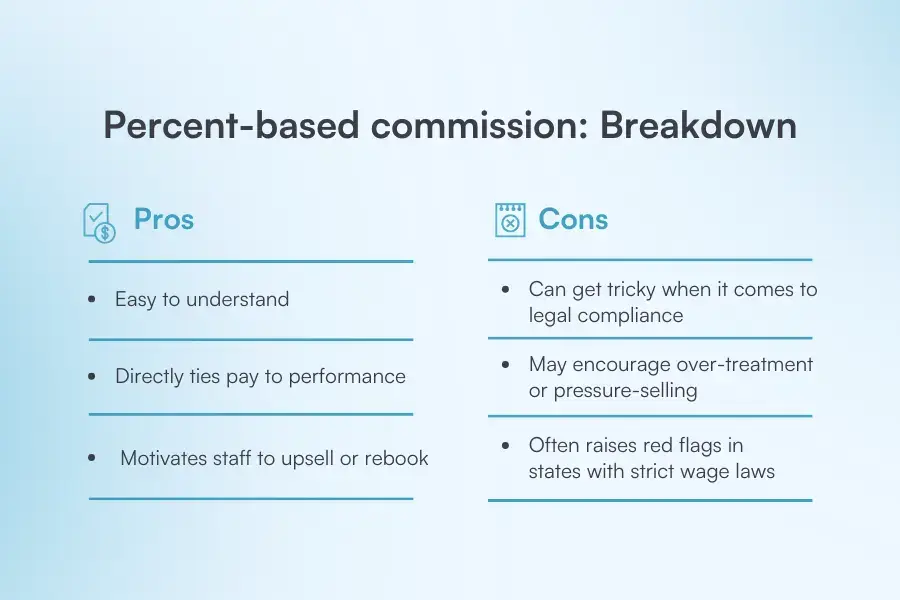
Most spa commission structures fall into three models: a percentage of revenue, flat or tiered bonuses, and revenue or profit sharing. In a med spa, the model you pick also sets how much fee-splitting risk you carry.
A percent-based commission pays staff a fixed share of the revenue they bring in, and it’s the model that most often collides with fee-splitting law. If an injector performs a $500 treatment on a 10% commission, they take home $50.
Now pay the same injector a flat $50 bonus per treatment instead, and watch what happens when the price moves:
| Treatment price | 10% commission | Flat $50 per-treatment bonus |
|---|---|---|
| $400 (discounted) | $40 | $50 |
| $500 (list price) | $50 | $50 |
| $650 (upgraded) | $65 | $50 |
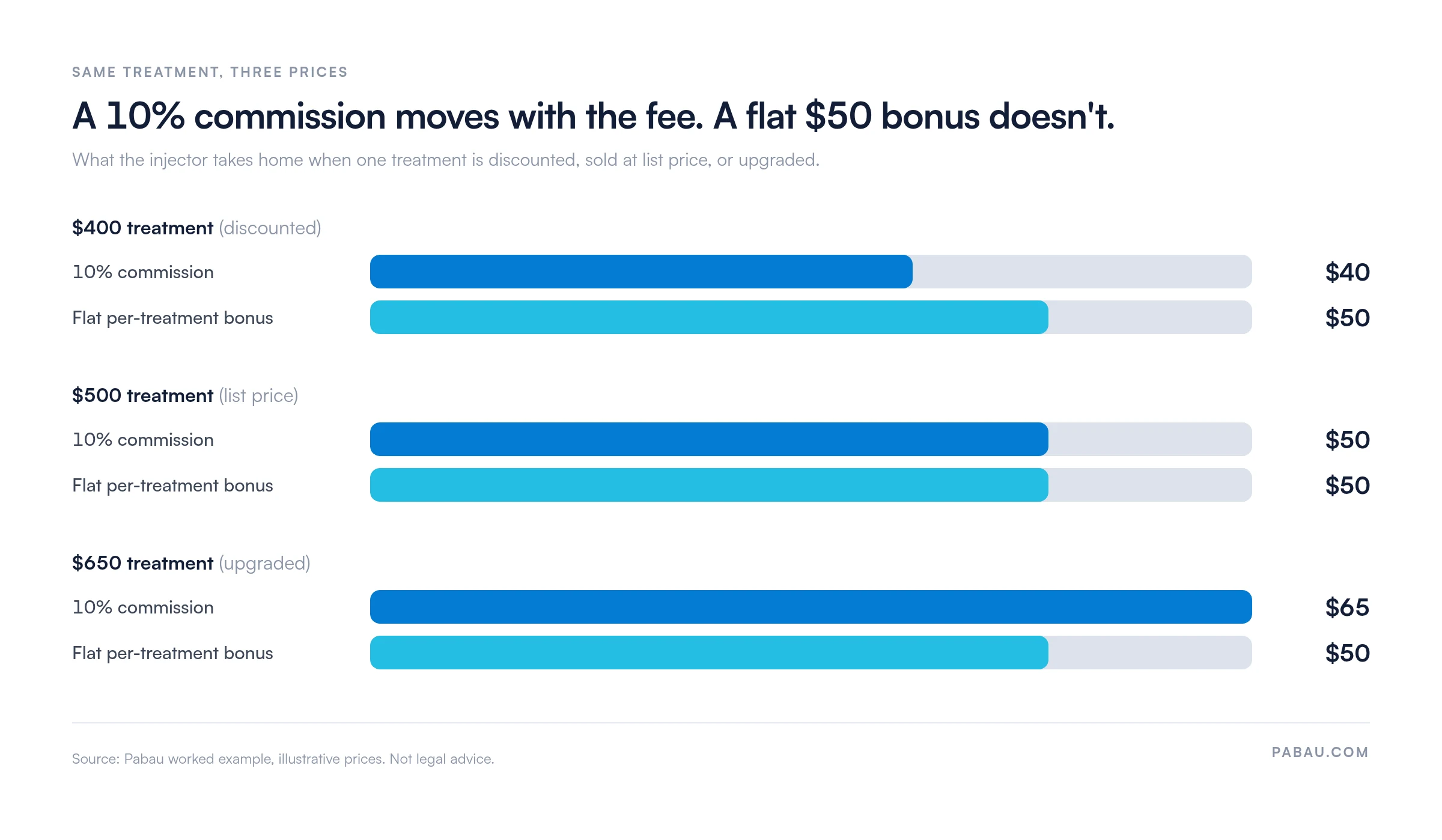
The commission is a share of the professional fee, which is exactly what fee-splitting laws prohibit. The flat bonus is a fixed amount agreed in advance, so the injector earns nothing extra by upselling a bigger treatment.
That’s why the bonus structure carries less fee-splitting risk. It isn’t risk-free, though. A per-treatment bonus still rewards volume, so strict states like New York and Texas may still question it.
In practices we onboard, switching a service from a percentage to a fixed dollar amount is usually a settings change rather than a payroll rebuild.
Flat-rate bonuses pay a set dollar amount per milestone instead of a percentage, such as $50 for each treatment package sold. A tiered plan steps the reward up: hit $10,000 in monthly revenue and earn $200, or hit $15,000 and earn $400.
Tiers based on revenue still track fees. In a strict state, tie the tiers to targets like rebooking rate, retail sales or patient review scores instead.
Why flat bonuses work:
Revenue sharing gives employees a cut of overall income, while profit sharing distributes part of the earnings left after expenses. A practice-wide profit pool sits further from any single procedure fee, which is why the American Med Spa Association lists profit sharing among lawful alternatives.
When it makes sense:
The trade-off is motivation. Profit sharing is harder to calculate and explain, and a quarterly pool rewards effort less directly than an individual bonus.
Room rental arrangements raise two legal questions: how the rent is calculated, and whether the provider passes the test for an independent contractor. In a room rental or booth rent setup, a licensed provider rents a treatment room, sets their own schedule and bills their own patients.
Flat rent agreed in advance is the safer version. Rent calculated as a percentage of the provider’s treatment revenue is a fee split under another name.
The federal space rental safe harbor applies the same test where federal programs are involved. Rent must be set in advance, match fair market value, and ignore the volume or value of referrals.
The second risk is 1099 misclassification. The IRS weighs behavioral control, financial control and the relationship between the parties. A provider who works your hours, uses your products and books through your front desk looks like an employee, whatever the lease says.
If the IRS would class that provider as an employee, you face back payroll taxes and possibly unpaid overtime. The classification section below covers the test in more detail.
Three checks catch most compliance problems before a commission plan goes live.
Fee-splitting happens when a licensed professional shares a procedure fee with someone else, such as a lay owner, a marketer or unlicensed staff. Many states prohibit it outright, and others reach it through CPOM or kickback rules covered above.
Why it matters:
Tip: Check your state’s medical practice act and CPOM rules before you set rates. The American Med Spa Association (AmSpa) also publishes med spa-specific legal guidance.
Med spa staff are either W2 employees on payroll or independent contractors who run their own business. The label on the contract doesn’t decide which.
What’s the difference?
Why classification matters:
Tip: Misclassification can mean back taxes, back wages and penalties. If in doubt, ask an employment attorney.
Commissioned employees must still earn at least minimum wage for every hour worked, and non-exempt staff get overtime after 40 hours a week. A slow month doesn’t lower that floor.
What to know:
Tip: Keep detailed time records, and check total pay against federal and state wage rules every pay period. If payroll and bookkeeping live in separate tools, compare options in our roundup of med spa accounting software.
A compliant pay plan comes down to three habits: reward results without sharing fees, write the rules down, and adjust for each state.
You can reward high performers without touching procedure fees. Build bonuses around rebooking rates, patient review scores, retail sales, or treatments completed against a flat amount.
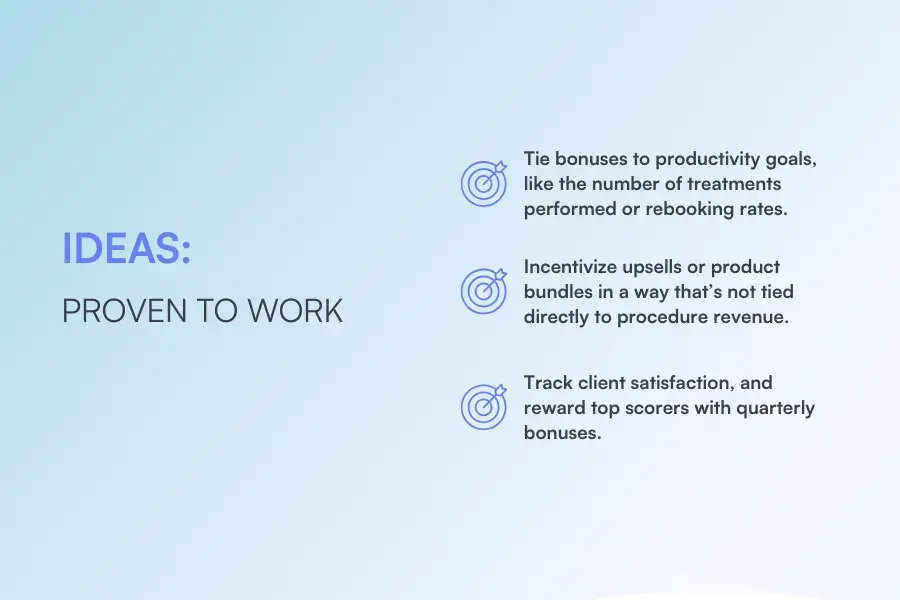
Staff still see their effort recognized, and you stay out of fee-splitting territory. Rewarding quality and retention also grows the practice more steadily than rewarding upsells.
Tip: Keep performance metrics transparent and easy to track. Staff stay more motivated when they understand how they’re being measured.
If your pay structure lives in your head or on a sticky note, it won’t survive an audit or a dispute.
What to do:
Written policies make audits easier and reduce payout disputes. For more models to build from, see our med spa compensation strategies.
Check each location against the med spa commission compliance map above before copying a pay plan across state lines. A plan that works in Florida can breach New York law.
If you run several locations, keep a separate written policy for each state. Review it whenever that state’s medical or nursing board issues new guidance.
Practice management software like Pabau turns your commission rules into settings instead of spreadsheet formulas. You decide who earns what, on which services, and Pabau applies those rules to every sale.
Pabau calculates commission from the rules you set per team member and category. Each rule can be fixed or tiered, with a percentage or a dollar rate.
Discounts and taxes can be deducted before commission is calculated, so payouts match what the patient paid.

The benefits:
Your injectors, estheticians and front desk team play very different roles, so their pay rules can differ too. With Pabau, you can:
That means retail commission for the front desk and a flat bonus for injectors can run side by side. That split is where most of the compliance map points.
Clear records protect the business if a board, labor department or attorney ever asks how staff were paid.
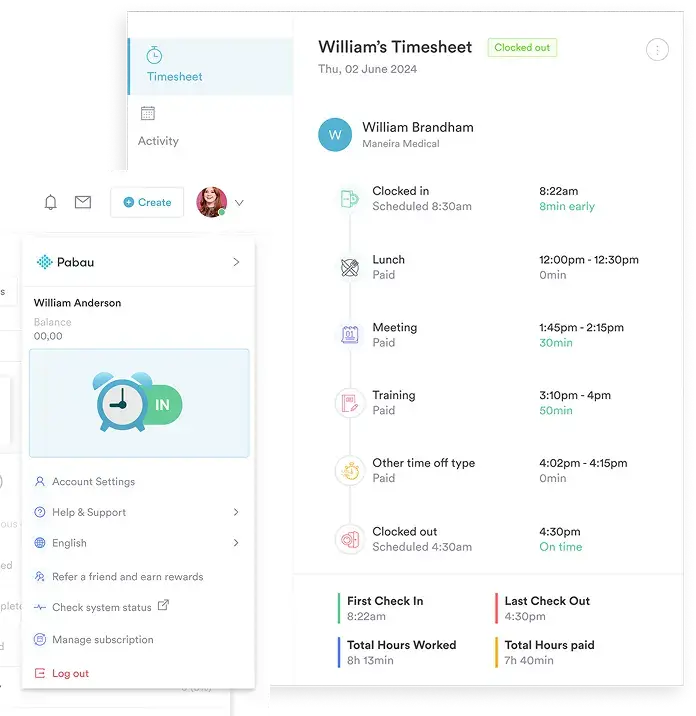
Pabau gives you:

Pabau records the commission rule, rate and payout behind every sale at every location. When an auditor or attorney asks how staff were paid, the answer is one report away.

Commission pay and compliance can coexist at a med spa, as long as you separate retail from procedures. Pay commission on products and non-medical services. For injectables and other medical treatments, a flat or target-based bonus keeps staff motivated without handing anyone a share of a professional fee.
The trade-off is that a flat bonus won’t reward the upsell the way a percentage does, and that’s exactly what regulators care about. Before you change a pay plan, take the written version and your state’s row of the compliance map to a healthcare attorney.
Book a demo to see how Pabau tracks commissions, bonuses and hours so every payout holds up to review.

Running locations in more than one state? Med spa laws by state compares ownership, licensing and compliance rules across the US.
Opening or restructuring in Texas? Texas med spa regulations explains delegation, supervision and ownership rules for Texas owners.
Need a medical director who can sign off on your pay plan? How to hire a medical director for your med spa covers what to look for and how to structure the agreement.
Want to audit the rest of your practice? The medical spa requirements checklist lists the licenses, policies and records a med spa needs.
Looking for the bigger compliance picture? Med spa compliance for owners walks through the regulations that affect day-to-day operations.
Many physicians earn productivity pay based on the services they personally perform, which most states allow for employed doctors. What fee-splitting laws forbid is a physician paying or accepting money for patient referrals, or sharing professional fees with unlicensed owners.
Commission makes income unpredictable for staff and can push them toward upselling treatments a patient doesn’t need. At a med spa, a percentage of procedure fees can also count as illegal fee-splitting. It makes minimum wage and overtime calculations harder, too.
Commission-only pay is legal for employees only if total earnings meet minimum wage for every hour worked, plus overtime where it applies. Many states also bar commission on medical procedures, so commission-only plans usually work only for retail or non-medical roles.
Yes, in most states. Skincare and other retail sales aren’t professional medical fees, so commission on them is the common exception to fee-splitting rules. Keep retail commission in its own written rule, separate from any treatment bonus.
The federal Anti-Kickback Statute covers services paid for by federal programs such as Medicare and Medicaid, so most cash-pay cosmetic treatments fall outside it. State kickback laws, such as Florida’s section 456.054, have no such payer limit.