The age-old dilemma of the service world: Should you play it safe with a fixed salary or spice things up with commissions?
Fixed salaries are great for keeping your books tidy and your revenue strong, steady, and predictable. But if you add compensation structures to the equation, you’ll notice how much a little incentive goes.
Paying commission is doable, but without a clear understanding of commission laws, med spas risk stepping onto shaky legal ground and opening the door to violations.
In this guide, we’ll discuss commission laws, their importance, and regulations to avoid legal issues, and a few best practices for structuring your medical spa’s compensation. So, let’s get into it!
Why commission laws matter in the med spa industry
Before making the final ruling on where you stand with commissions, there are a few things you need to understand first, legally.
Working in the medical aesthetics and healthcare industry, there are severe medical practice state regulations that must be followed and obeyed, which is why med spas often operate in a legal grey area.
Non-compliance with commission laws can lead to lawsuits, audits, hefty fines, and serious reputational damage that’s often hard to recover from.
This is why it’s crucial to have the best possible understanding of how commissions work and how they’re regulated, so both you, your business, and your employees can be protected at any given moment.
Common scenarios that trigger compliance risks
Many med spas unintentionally cross legal lines when it comes to commission structures, often due to a lack of clarity around healthcare-specific labor laws. Here are a few common scenarios that could put your business at risk:
Rewarding injectors per treatment: While this might seem like a logical way to incentivize performance, tying compensation directly to medical procedures can violate fee-splitting laws in many states (especially for non-physicians).
Paying front desk staff per retail sale: This can be legal in some contexts, but it blurs the line between hourly wages and commission-based sales, especially if it’s not properly documented or calculated.
Misclassifying employees as independent contractors: Treating staff (either aestheticians, nurses, or injectors) as contractors when they meet the employee criteria can result in hefty fines and backpay liabilities.
These mistakes happen often, especially in growing aesthetic practices, trying to reward top performers, or streamline their operations and workflows.
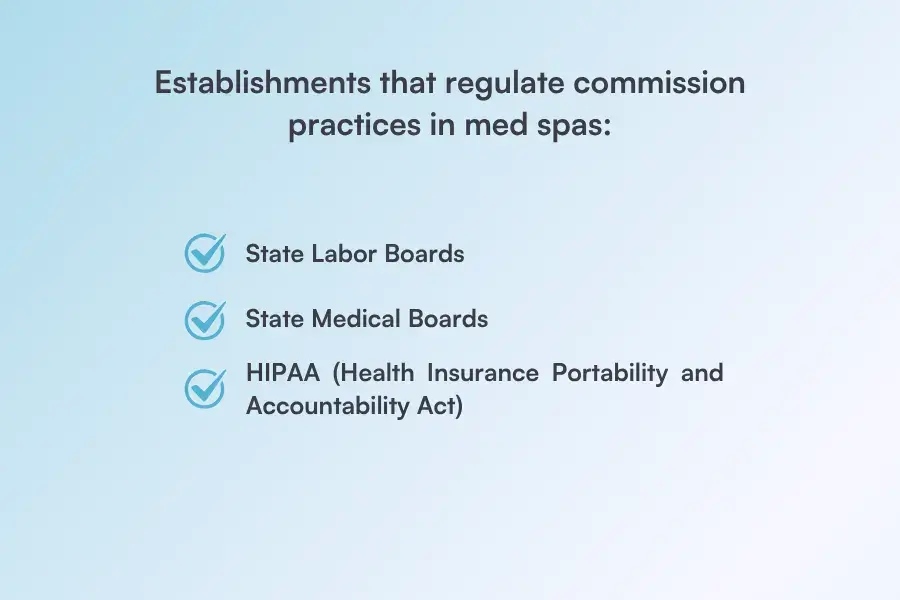
Who regulates commission practices in med spas?
State and federal regulations shape commission practices for med spas. Below is a general explanation of how commission practices work.
However, to make sure you’re on the safe side with the law, it’s best to consult with a lawyer before implementing any commission changes in your business!
Responsible for wage and hour laws, overtime, and basic employee rights.
Oversee how workers are paid, including commission structures and whether commission-only pay is legal under state law.
Ensure fair labor practices, so before rolling out a new commission plan, check your state’s labor board website or contact a representative for updated guidance.
Define which services must be performed by licensed professionals and specify what kinds of compensation are permitted for medical staff.
Many states, including New York, California, and Texas, have strict rules against paying commissions on medical procedures, especially for non-licensed staff or where it could influence clinical decision-making.
HIPAA (Health Insurance Portability and Accountability Act)
While HIPAA does not directly regulate commission pay, it requires med spas to protect staff and patient information. Commission records must be kept confidential and HIPAA-compliant if they include treatment data or patient information.
Examples of regulations and how they vary state-by-state
New York:
The New York State Education Department is strict on “fee-splitting.” Commission-based compensation for medical procedures performed by licensed professionals, such as RNs, NPs, or physicians, is generally prohibited due to the state’s strict fee-splitting laws. Commissions tied directly to medical services can be considered illegal fee-splitting and are not permitted. The labor board oversees wage and hourly compliance, but cannot override medical board restrictions.
California:
In California, the Medical Board requires med spas to have a licensed physician as a medical director. Fee-splitting laws prohibit commission-based pay for medical treatments. While staff may earn commissions on retail sales or non-medical spa services, paying a cut of medical service revenue is typically not allowed. The California Labor Board also requires all commission structures to meet basic wage standards.
Arizona:
Arizona law permits licensed and unlicensed individuals to own a med spa. Still, all clinical services must be overseen by a licensed physician acting as the medical director, in compliance with Arizona Medical Board regulations. The Arizona State Board of Nursing enforces licensing for medical professionals, and commission pay on medical procedures is only allowed for licensed professionals who personally provide and participate in the medical treatments.
Understanding commission structures in a med spa setting
Commission-based compensation is one of the most popular ways to motivate performance. But to stay compliant and pay your staff fairly, it’s important to understand how different commission models work in a medical setting.
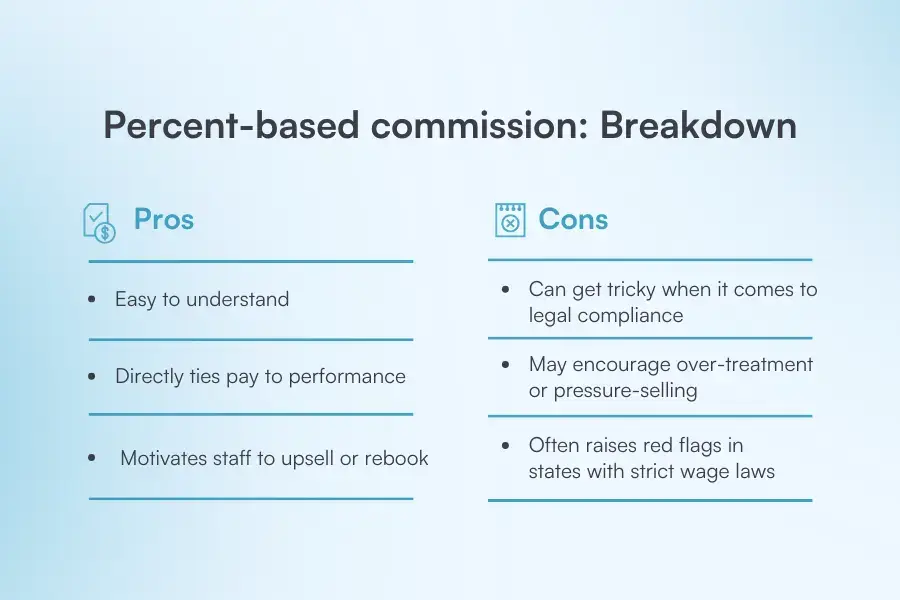
Percent-based commission
This is probably the first thing that comes to mind when you hear “commission.” A percent-based structure means your team earns a set percentage of the revenue they bring in.
For example, if an injector performs a $500 treatment and gets a 10% commission, they take home $50.
This model is common for injectors, laser technicians, and estheticians. Basically, anyone performing billable services.
Percent-based commission can be a strong motivator, but it walks a fine legal line, especially in med spas with hourly staff or in states with stricter wage laws. Make sure you know the rules before you roll it out.
Flat-rate bonuses or tiers
Some med spa businesses use flat-rate bonuses instead of a percentage. For example, they offer a $50 bonus for each package sold. Or they set up a tiered system: Hit $10k in monthly revenue, get $200; hit $15k, get $400, and so on.
✅Why it works:
Gives med spa employees clear goals to work toward
Can be easier to manage from a compliance perspective
Keeps pay consistent regardless of treatment pricing
💡When it’s safer: If you’re worried about commissions causing legal grey areas, this kind of incentive structure can be a safer bet.
It’s still performance-based but doesn’t directly tie earnings to a percentage of sales, reducing the risk of classification or wage violations.
Revenue-sharing or profit-sharing models
These are less common in med spa practices, but you might hear about them in practices where employees are deeply involved in the business’s success.
Revenue-sharing means employees get a cut of overall income, while profit-sharing distributes earnings after expenses.
📝When it makes sense:
In smaller or boutique clinics where staff take on multiple roles
For leadership or long-term employees as a retention tool
As part of an ownership or equity model
‼️Disclaimer: While it can feel more collaborative and fair, this structure is complex to calculate and explain. It also doesn’t provide the same immediate motivation as more direct, individual-based incentives.
Legal considerations and compliance guidelines
If you’re offering commission-based pay, even with the best intentions, it’s easy to accidentally cross into non-compliant territory.
Here are some legal considerations to check off your list if you’re paying commissions:
Fee-splitting laws and medical oversight
What is fee-splitting? It’s when a medical professional shares a portion of their procedure fee with someone else, like an employer or non-medical staff member. Many states strictly prohibit this.
Why it matters:
In some states, licensed professionals (like registered nurses, nurse practitioners, or physician assistants) cannot be paid based on a percentage of a procedure’s cost, especially if the owner isn’t a licensed medical provider.
Violating fee‑splitting laws can lead to serious consequences, including disciplinary action such as suspension or revocation of a medical license, and in some cases, allegations of unlawful business practices or violations of corporate practice of medicine regulations.
Tip: Always check your state’s rules around Medical Practice Acts and Corporate Practice of Medicine laws. The American Med Spa Association (AmSpa) can also provide some useful med spa-specific legal information!
Employee classification: Contractor vs. W2 employee
Generally, there are two types of employee classification: contractual and W2 payroll employees.
What’s the difference?
W2 employees are on payroll, and you’re responsible for their taxes, benefits, and overtime pay.
Independent contractors are self-employed and handle their taxes, but you lose some control over how and when they work.
Why classification matters:
Misclassifying healthcare professionals (injectors or estheticians) to avoid payroll obligations is a common compliance mistake.
If someone works set hours, uses your equipment, and is under your direction, they’re likely a W2 employee, even if you call them a contractor.
Tip: Misclassification can lead to hefty penalties. If in doubt, consult a legal or HR professional.
Minimum wage and overtime considerations
Something you hear often in the service industry is that if an employee is earning commission, the wage can be near the minimum. This is a common misconception.
What to know:
Even if someone is paid commission, their total earnings must meet or exceed minimum wage for all hours worked.
Unless an employee is properly classified as exempt (which is rare in med spas), they’re considered non-exempt under labor laws. This means they’re entitled to overtime pay for any hours worked beyond 40 hours per week.
Tip: Keep detailed time records, and always calculate whether their total pay complies with federal and state wage laws, every pay period.
Best practices for structuring med spa compensation
We went into what can go wrong, but now, let’s focus on what works. Our best advice: keep your team motivated and your business compliant.
Here’s how to build a compensation strategy that’s fair, legal, and good for business.
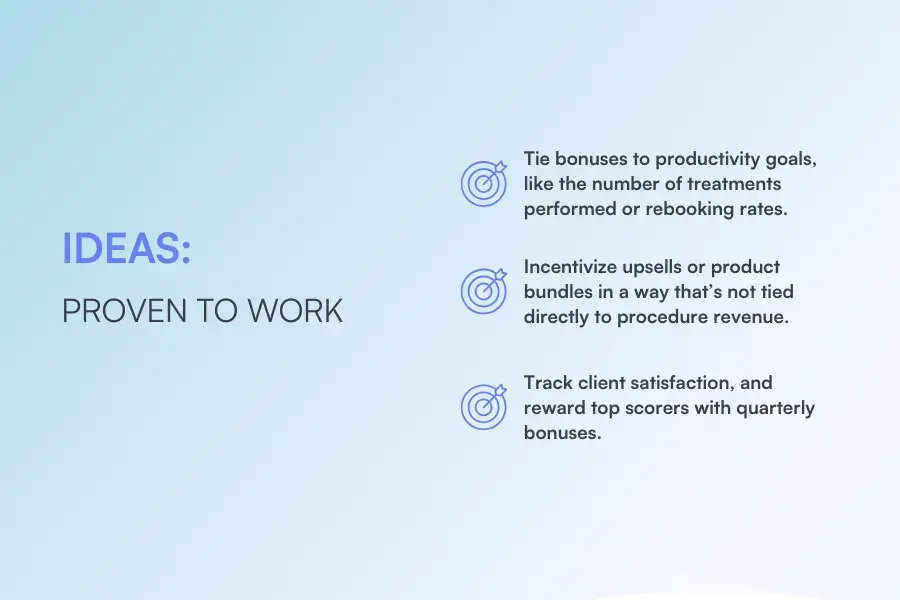
Align pay with performance without violating laws
You can reward high performers, you just need to be smart about how you do it.
Rewarding performance without risking compliance isn’t impossible, it just takes the right structure. Focus on clear goals, fair metrics, and bonuses that don’t hinge on procedure revenue.
Why it’s better: You’re still recognizing your team’s effort, but without crossing into risky fee-splitting territory. Plus, focusing on quality and retention helps grow your clinic sustainably.
Tip: Keep performance metrics transparent and easy to track. Your staff will feel more motivated when they understand how they’re being evaluated.
Set clear, documented compensation policies
If your pay structure lives in your head, or on a sticky note, it’s time to level up.
What to do:
Put your commission and bonus policies in writing
Review them with your staff during onboarding and performance reviews
Include specifics: who qualifies, how payouts are calculated, and when they’re paid
Why it matters: Clarity builds trust. When everyone’s on the same page, there’s less confusion, fewer disputes, and more accountability.
Bonus: Clear policies make audits easier and help you avoid accidental non-compliance. They’re also great for improving employee satisfaction and long-term retention.
In California, the Corporate Practice of Medicine doctrine is strict. Medical professionals cannot be paid based on procedure revenue.
In Texas, things are slightly more flexible, but you still need to avoid direct fee-splitting and ensure licensed professionals are supervised appropriately.
What to do:
Research your state’s labor laws, wage rules, and any medical board opinions around compensation.
If you operate in multiple states, consider having different policies for each location.
How Pabau helps you stay compliant and reward your team
Balancing fair compensation with legal compliance isn’t easy for medical spa owners. That’s why Pabau, your all-in-one software, is built to help you stop guessing and ease the compliance part of the business.
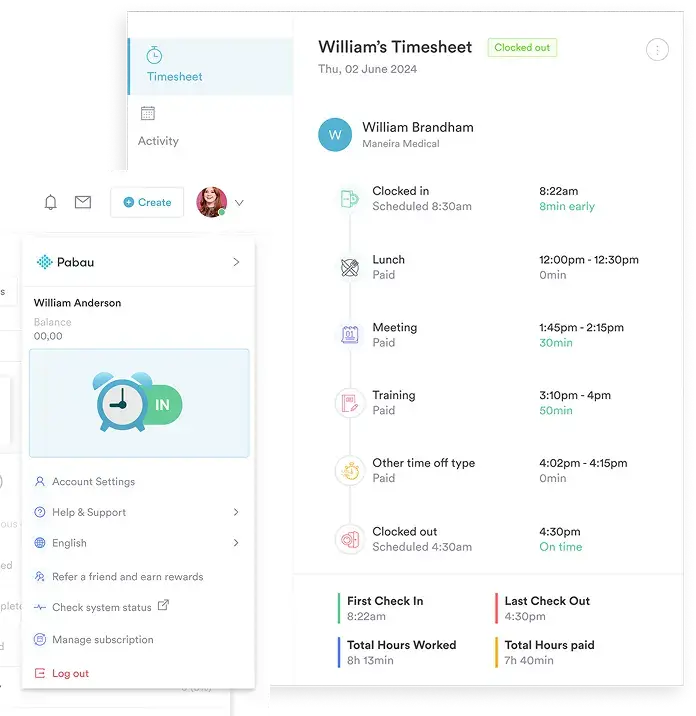
Tracking performance, automating payouts, and much more – we simplify the tricky stuff so you can focus on running your med spa and patient care.
Automated commission tracking and payouts
Forget Excel sheets and manual calculations. Pabau automatically tracks commissions based on the rules you set, so every payout is accurate, timely, and hassle-free.
A crystal-clear record of how and why each payout was made
It’s the perfect support system for the compliance best practices we covered earlier, and it helps build trust with your team. The bottom line: It also saves your well-being!
Build a team culture that’s compliant and motivated
At the end of the day, you want to reward your team, not risk lawsuits or lose sleep over payroll mistakes. With Pabau, you don’t have to choose between compliance and motivation. You get both.
We’ve helped med spas across the globe simplify their operations, stay compliant, and keep staff happy with transparent, fair compensation.