








Mood Words for Clinical Documentation: Complete Guide
The US averages 362.6 mental health providers per 100,000 people, according to America’s Health Rankings – a national figure that hides steep state-by-state gaps in who can actually get an appointment. Wherever access is tightest, every word a clinician writes about a client’s mood carries operational weight. Payers scrutinize terminology for medical necessity. Quality assurance […]
Types of Moods: Clinical Spectrum & Assessment Guide
A patient says they feel “fine,” but their flat affect and three weeks of poor sleep tell a different story. Reading that gap accurately is what separates a thorough mental health assessment from a missed diagnosis. An estimated 21 million U.S. adults had at least one major depressive episode in the past year, about 8.3% […]
MoCA score interpretation: A guide for clinicians
A MoCA score of 26 or above out of 30 falls in the normal range. Scores of 18 to 25 point to mild cognitive impairment, 10 to 17 to moderate, and anything below 10 to severe. Those bands are only the starting point. What a total warrants depends on the patient’s education and age, and […]
Emotional Support Animal Letter Sample: ESA Template for Therapists
What Is an Emotional Support Animal Letter Sample – and Why Does It Matter for Your Practice? Many licensed therapists receive ESA requests with little guidance on what a legally defensible letter actually requires. With more than one in five U.S. adults (59.3 million in 2022) living with a mental illness, per the National Institute […]
Unspecified Anxiety Disorder: F41.9 Diagnosis, Coding & Treatment
Unspecified anxiety disorder sits at a diagnostic crossroads that most clinicians encounter frequently. A patient presents with persistent worry, physical tension, and sleep disruption. The symptoms are real and impairing. Yet the clinical picture does not map cleanly onto generalised anxiety disorder, panic disorder, or any other specific DSM-5 category. This is precisely where unspecified […]
ESA Letter Example: What Every Valid Letter Must Include
Mental health professionals are increasingly asked by patients to provide an ESA letter example as part of a housing accommodation request. With more than one in five U.S. adults (59.3 million in 2022) living with a mental illness, per the National Institute of Mental Health, those requests are reaching licensed clinicians more often than ever. […]
Coping skills for depression: Evidence-based strategies for clinicians
Coping skills for depression work best when the skill is matched to the severity of the episode, rather than picked off a list. Behavioral activation suits less severe presentations, CBT-based cognitive restructuring suits more severe ones, and MBCT holds the relapse-prevention slot. Depression affects approximately 332 million people globally, according to the World Health Organization. […]
Zung Self Rating Anxiety Scale Worksheet
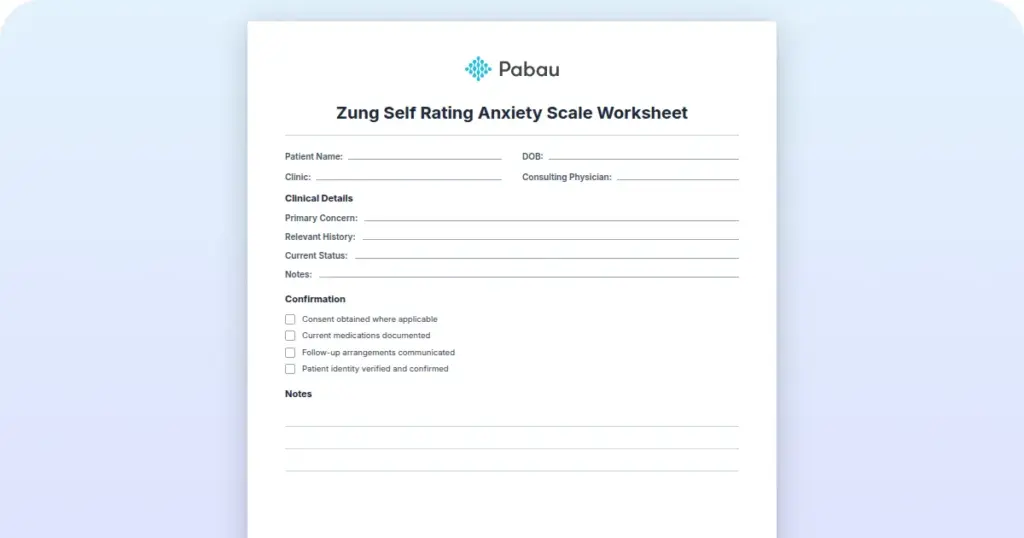
Download Your Free Zung Self-Rating Anxiety Scale Worksheet Zung Self-Rating Anxiety Scale A ready-to-use anxiety assessment worksheet covering 20 items on a 1-4 scale, symptom domain breakdowns, raw-to-Anxiety-Index conversion table, and clinical interpretation guidance for anxiety severity classification. Download template What is a Zung Self-Rating Anxiety Scale Worksheet? The Zung Self-Rating Anxiety Scale (SAS) is […]
Pittsburgh Sleep Quality Index – PSQI Template
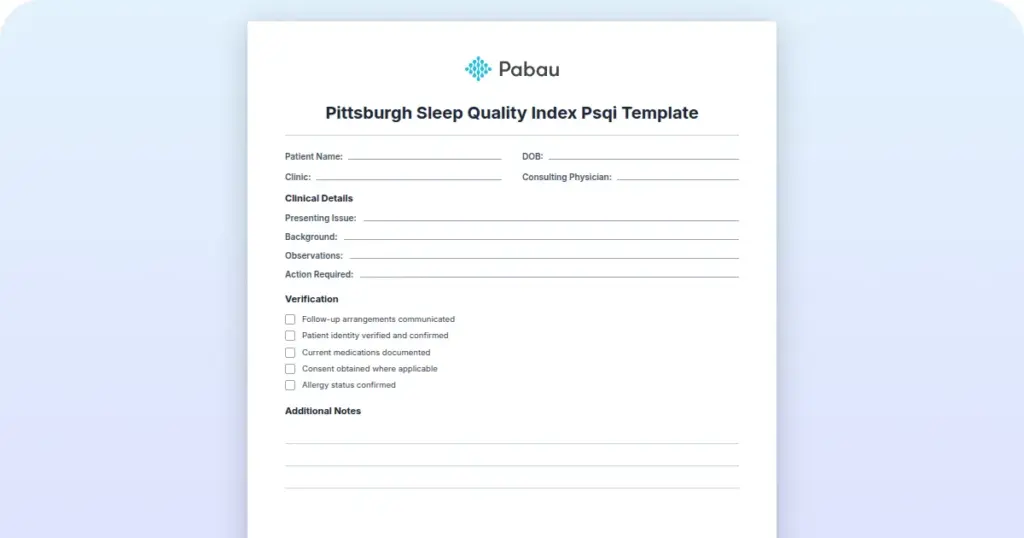
Download Your Free Pittsburgh Sleep Quality Index (PSQI) Template Pittsburgh Sleep Quality Index (PSQI) A comprehensive 19-item self-report questionnaire assessing sleep quality over a one-month interval with 7 component scores and structured interpretation guidelines. Download template What is a Pittsburgh Sleep Quality Index (PSQI) Template? The Pittsburgh Sleep Quality Index (PSQI) is a standardised clinical […]
HEADSS Assessments Form
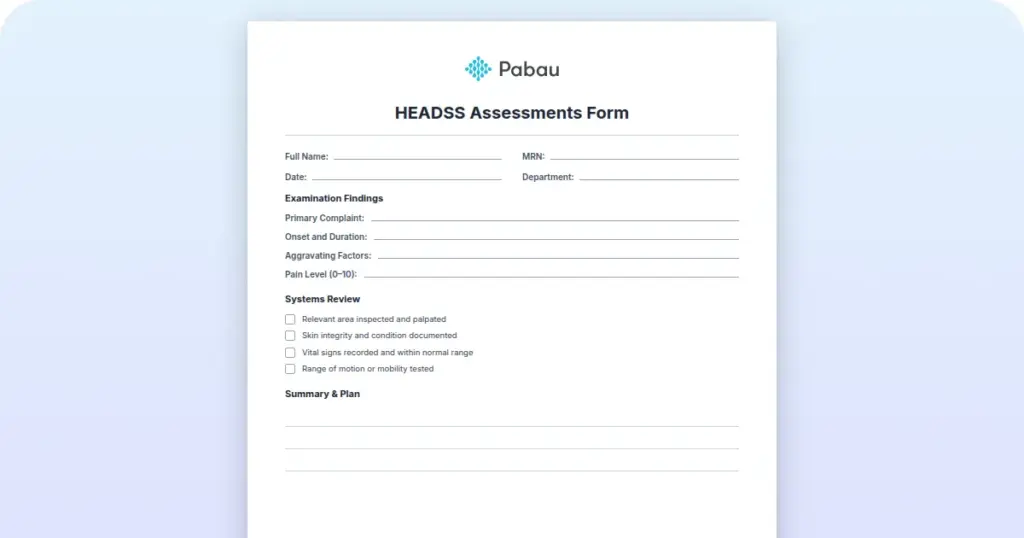
What Is a HEADSS Assessment Form? The HEADSS assessment form is a systematised screening tool that structures clinical conversations with adolescents across six domains of psychosocial functioning. Originally developed by Berman in 1972 and formally published by Goldenring and Cohen in Contemporary Pediatrics (1988), HEADSS has become standard practice in paediatric, mental health, and primary […]